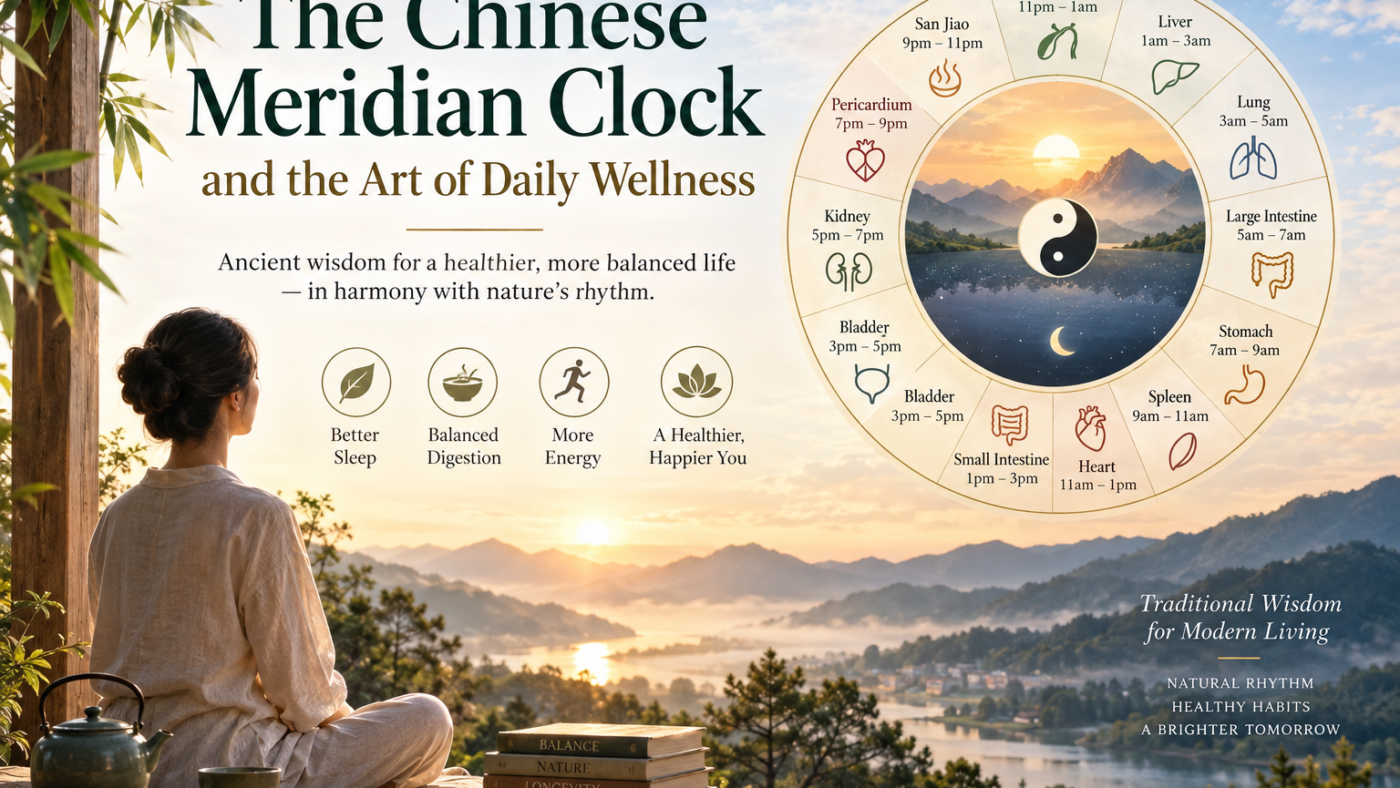
The Chinese Meridian Clock, traditionally known as Zi Wu Liu Zhu, is an ancient concept in Traditional Chinese Medicine that describes the body as moving through a repeating 24-hour rhythm.
Rooted in classical Chinese medical thought, including ideas associated with the Huangdi Neijing, the system divides the day into twelve two-hour periods. Each period is traditionally associated with one of the twelve primary meridians and its corresponding organ system.
Rather than viewing the body as a collection of isolated organs, Traditional Chinese Medicine sees health as a dynamic relationship among circulation, digestion, rest, emotional balance, movement, and the natural rhythm of day and night.
The Meridian Clock should therefore be understood primarily as a traditional wellness framework rather than as a scientifically established timetable of organ activity. Many of its practical recommendations, however—such as maintaining regular sleep, eating breakfast, staying hydrated, exercising during the day, and allowing the body to wind down in the evening—are consistent with the broader principle of living according to a stable daily rhythm.
11:00 p.m.–1:00 a.m.: Gallbladder Meridian
In the traditional Meridian Clock, the gallbladder meridian is associated with the period from 11:00 p.m. to 1:00 a.m.
Traditional Chinese Medicine describes the gallbladder as closely connected with the liver and associates it not only with digestion but also with decisiveness, courage, and the smooth circulation of Qi.
From a traditional wellness perspective, this is considered an important period for deep rest. Going to bed before midnight is therefore commonly encouraged in Chinese health-preservation traditions.
Regardless of meridian theory, maintaining a consistent bedtime and obtaining sufficient nighttime sleep are important for overall health, cognitive performance, mood, and metabolic regulation.
1:00 a.m.–3:00 a.m.: Liver Meridian
The period from 1:00 a.m. to 3:00 a.m. is traditionally associated with the liver meridian.
Classical Chinese medicine states that “the liver stores the blood” and regards the liver system as important for the smooth movement of Qi, emotional balance, tendons, and vitality.
Traditional theory places particular emphasis on being asleep during this period, allowing the body to settle into a state of deep rest.
Modern physiology does not support the idea that the liver performs its metabolic functions exclusively during these two hours. The liver works continuously. Nevertheless, regular sleep supports metabolic health, hormonal regulation, immune function, and many other restorative processes.
3:00 a.m.–5:00 a.m.: Lung Meridian
From 3:00 a.m. to 5:00 a.m., the lung meridian is traditionally considered most prominent.
In Chinese medicine, the lungs are said to “govern Qi” and to influence respiration, circulation, the skin, and the distribution of defensive energy throughout the body.
This period traditionally emphasizes quiet breathing and continued sleep.
People with respiratory illnesses may notice that certain breathing symptoms vary during the night or early morning, but these patterns can have many medical explanations and should not automatically be attributed to meridian activity.
5:00 a.m.–7:00 a.m.: Large Intestine Meridian
The early morning period from 5:00 a.m. to 7:00 a.m. is associated with the large intestine meridian.
Traditional Chinese Medicine considers the lung and large intestine to be paired systems. The early morning is therefore often regarded as a favorable time for elimination and beginning the body’s transition from rest to daytime activity.
A regular morning bowel habit may be supported by sufficient fiber, hydration, physical activity, and a consistent daily routine.
Rather than forcing a bowel movement at a particular hour, the more important goal is to maintain comfortable and regular digestive function.
7:00 a.m.–9:00 a.m.: Stomach Meridian
The period from 7:00 a.m. to 9:00 a.m. is traditionally associated with the stomach meridian.
Chinese health-preservation traditions often encourage eating a nourishing breakfast during this time, reflecting the idea that digestive activity is strong in the morning.
A balanced breakfast can be useful for many people, particularly when it contains protein, fiber-rich carbohydrates, healthy fats, fruits, vegetables, or other minimally processed foods.
Individual needs vary, however, and there is no universal requirement that everyone must eat within this exact two-hour window.
9:00 a.m.–11:00 a.m.: Spleen Meridian
From 9:00 a.m. to 11:00 a.m., the spleen meridian traditionally takes prominence.
The Chinese medical concept of the spleen differs considerably from the anatomical spleen recognized in modern medicine. In Traditional Chinese Medicine, the spleen system is strongly associated with transforming food into usable nourishment, transporting nutrients, supporting Qi and blood, and maintaining digestive strength.
This makes the late morning a symbolic period of nourishment, concentration, and productive activity.
Traditional teachings also connect the condition of the lips and mouth with the spleen system. Changes in lip color, however, can have many causes and should not be used alone to diagnose a health condition.
11:00 a.m.–1:00 p.m.: Heart Meridian
Midday is traditionally associated with the heart meridian.
In Chinese medicine, the heart is said to “govern the blood vessels” and to house the Shen, a concept that includes aspects of consciousness, emotional stability, and mental presence.
A brief period of relaxation after lunch has long been valued in Chinese health culture. A short nap may help some people restore alertness and energy, especially when nighttime sleep has been insufficient.
Long or late naps, however, may interfere with nighttime sleep in some individuals. Rest should therefore be adapted to personal needs.
1:00 p.m.–3:00 p.m.: Small Intestine Meridian
The small intestine meridian is traditionally associated with the period from 1:00 p.m. to 3:00 p.m.
Traditional Chinese Medicine describes the small intestine as separating the “clear” from the “turbid,” symbolically distinguishing useful nourishment from waste.
From a modern physiological perspective, digestion and nutrient absorption continue for many hours after eating.
This period can serve as a practical reminder to remain hydrated, avoid excessive overeating, and allow the digestive system time to process the midday meal.
3:00 p.m.–5:00 p.m.: Bladder Meridian
From 3:00 p.m. to 5:00 p.m., the bladder meridian is traditionally considered most active.
The bladder system in Chinese medicine is associated with fluid regulation and is also connected with one of the longest meridian pathways in the body.
Traditional wellness practices often regard the afternoon as a suitable time for physical movement.
Walking, mobility exercises, Tai Chi, Qigong, strength training, or other appropriate forms of exercise can help reduce prolonged sitting and support cardiovascular, metabolic, musculoskeletal, and mental health.
Hydration should be maintained according to thirst, activity level, climate, and individual health needs rather than according to a fixed meridian schedule.
5:00 p.m.–7:00 p.m.: Kidney Meridian
The period from 5:00 p.m. to 7:00 p.m. is associated with the kidney meridian.
In Traditional Chinese Medicine, the kidney system has a much broader meaning than the anatomical kidneys. It is associated with Jing, or essence, as well as growth, reproduction, development, aging, bones, hearing, and long-term vitality.
The early evening can therefore be viewed as a time to begin shifting from intense daytime activity toward restoration.
Gentle exercise, a balanced evening meal, and reduced psychological stimulation may help prepare the body for the quieter hours ahead.
7:00 p.m.–9:00 p.m.: Pericardium Meridian
From 7:00 p.m. to 9:00 p.m., the pericardium meridian is traditionally emphasized.
Chinese medicine regards the pericardium as a protective system surrounding the heart and connects it with emotional balance, circulation, and interpersonal connection.
This period is well suited to calming evening activities such as spending time with family, reading, stretching, meditation, gentle breathing, or quiet conversation.
Reducing intense work and excessive digital stimulation during the late evening can also make the transition to sleep easier.
9:00 p.m.–11:00 p.m.: San Jiao Meridian
The final period in the traditional twelve-part cycle is associated with the San Jiao, or Triple Burner.
San Jiao is a functional concept unique to Traditional Chinese Medicine rather than a single anatomical organ. It is traditionally associated with the movement of Qi and fluids through the upper, middle, and lower regions of the body.
From a health-preservation perspective, 9:00 p.m. to 11:00 p.m. is considered a time for settling down and preparing for sleep.
Dimming lights, reducing stimulating activities, limiting late-night meals, and establishing a predictable bedtime routine may support healthy sleep.
Nighttime, Rest, and the Traditional Rhythm of Yin and Yang
Traditional Chinese philosophy describes daytime as increasingly Yang—active, bright, warm, and outward-moving—while nighttime becomes increasingly Yin—quiet, dark, cool, and restorative.
Within this framework, health depends partly on balancing activity with rest.
Ancient health-preservation teachings therefore encouraged people to rise with daylight, remain appropriately active during the day, and gradually become quieter as night approached.
Modern lifestyles are very different from those of ancient China, but the underlying principle remains relevant: the human body benefits from regular patterns of sleep, activity, meals, and light exposure.
Circadian biology has demonstrated that the human body contains internal biological clocks influenced strongly by the light-dark cycle. Sleep-wake timing, hormone secretion, body temperature, digestion, and many other processes change throughout the day.
These scientific findings should not be considered proof of the traditional Meridian Clock, but both perspectives emphasize an important practical message: time and rhythm matter to human health.
Should the Meridian Clock Be Adjusted for Location?
Traditional discussions of Zi Wu Liu Zhu sometimes emphasize the position of the sun and suggest adjusting the clock according to local solar time rather than relying mechanically on a country’s official time zone.
This idea reflects the historical relationship between Chinese timekeeping and the movement of the sun.
For everyday wellness, however, there is usually no need to calculate exact longitude-based meridian times. Modern circadian health is influenced more practically by consistent sleep schedules, natural daylight exposure, meal timing, physical activity, and the local light-dark environment.
For most people, living according to the actual daytime and nighttime pattern of their location is more useful than trying to calculate highly precise meridian activation periods.
A Holistic View of the Body
One of the most important distinctions between Traditional Chinese Medicine and modern biomedicine is the way each system defines an “organ.”
Modern medicine describes organs anatomically and physiologically. The heart, liver, kidneys, lungs, digestive tract, nervous system, endocrine system, and other structures are studied according to measurable biological functions.
Traditional Chinese Medicine uses organ names within broader functional networks.
The TCM concept of the “Heart,” for example, includes more than the anatomical heart. It also includes traditional relationships with circulation, consciousness, emotional state, the tongue, and specific meridian pathways.
The same principle applies to the Liver, Spleen, Lung, Kidney, and other systems.
Understanding this difference prevents a common mistake: interpreting classical Chinese descriptions as if they were literal statements of modern anatomy.
Living With Rhythm Rather Than Watching the Clock
The deepest lesson of the Meridian Clock is not that every organ suddenly switches on or off at a particular hour.
Its greater value lies in its emphasis on rhythm.
Eat with reasonable regularity.
Stay active during the day.
Allow digestion time between meals.
Stay adequately hydrated.
Use the afternoon for appropriate movement.
Reduce stimulation as evening approaches.
Sleep consistently.
Respect the need for recovery.
When viewed in this way, Zi Wu Liu Zhu becomes less about rigidly following twelve time slots and more about building a daily rhythm that supports long-term physical and mental well-being.
Traditional Chinese wellness has always emphasized harmony between the individual and the surrounding environment. The Meridian Clock represents one expression of that philosophy—a reminder that health is shaped not only by what we do, but also by when we rest, move, eat, and recover.
Used thoughtfully, it can serve as a cultural and wellness framework for becoming more aware of daily rhythms while remaining compatible with modern medical knowledge.
FAQ
What is the Chinese Meridian Clock?
The Chinese Meridian Clock is a traditional concept in Chinese medicine that divides a 24-hour day into twelve two-hour periods. Each period is associated with one of the twelve primary meridians and its traditional organ system.
What does Zi Wu Liu Zhu mean?
Zi Wu Liu Zhu is a traditional Chinese medical concept describing the rhythmic circulation of Qi through the meridian system over the course of the day. It is commonly discussed today as the Chinese Meridian Clock or TCM body clock.
Are organs really more active at certain two-hour periods?
Traditional Chinese Medicine associates particular meridian systems with specific two-hour periods. Modern physiology does not establish that individual organs switch into peak activity according to this exact schedule. The Meridian Clock is therefore best understood as a traditional wellness framework rather than a modern physiological timetable.
What time is associated with the Liver Meridian?
In the traditional Meridian Clock, the Liver Meridian is associated with approximately 1:00 a.m. to 3:00 a.m.
What time is associated with the Heart Meridian?
The Heart Meridian is traditionally associated with the period from approximately 11:00 a.m. to 1:00 p.m.
What time is associated with the Kidney Meridian?
The Kidney Meridian is traditionally associated with approximately 5:00 p.m. to 7:00 p.m.
Is the Chinese Meridian Clock scientifically proven?
The specific two-hour meridian and organ associations of Zi Wu Liu Zhu have not been established by modern medical science. However, modern circadian research does show that sleep, hormone secretion, metabolism, body temperature, digestion, and alertness vary throughout the 24-hour day.
Can the Meridian Clock be used to diagnose disease?
No. Meridian timing should not be used on its own to diagnose symptoms or disease. Persistent, severe, or unexplained symptoms should be assessed by an appropriate healthcare professional.
Medical Disclaimer: This article discusses traditional Chinese health concepts for educational purposes. The Meridian Clock and meridian-based organ timing are concepts from Traditional Chinese Medicine and have not been established as equivalent to modern anatomical or physiological systems. They should not be used to diagnose, prevent, or treat disease. Persistent or concerning symptoms should be evaluated by a qualified healthcare professional.
This article is for general education and does not replace individualized care from a qualified health professional. Seek appropriate advice for persistent, severe, or concerning symptoms.
Read the full medical disclaimer