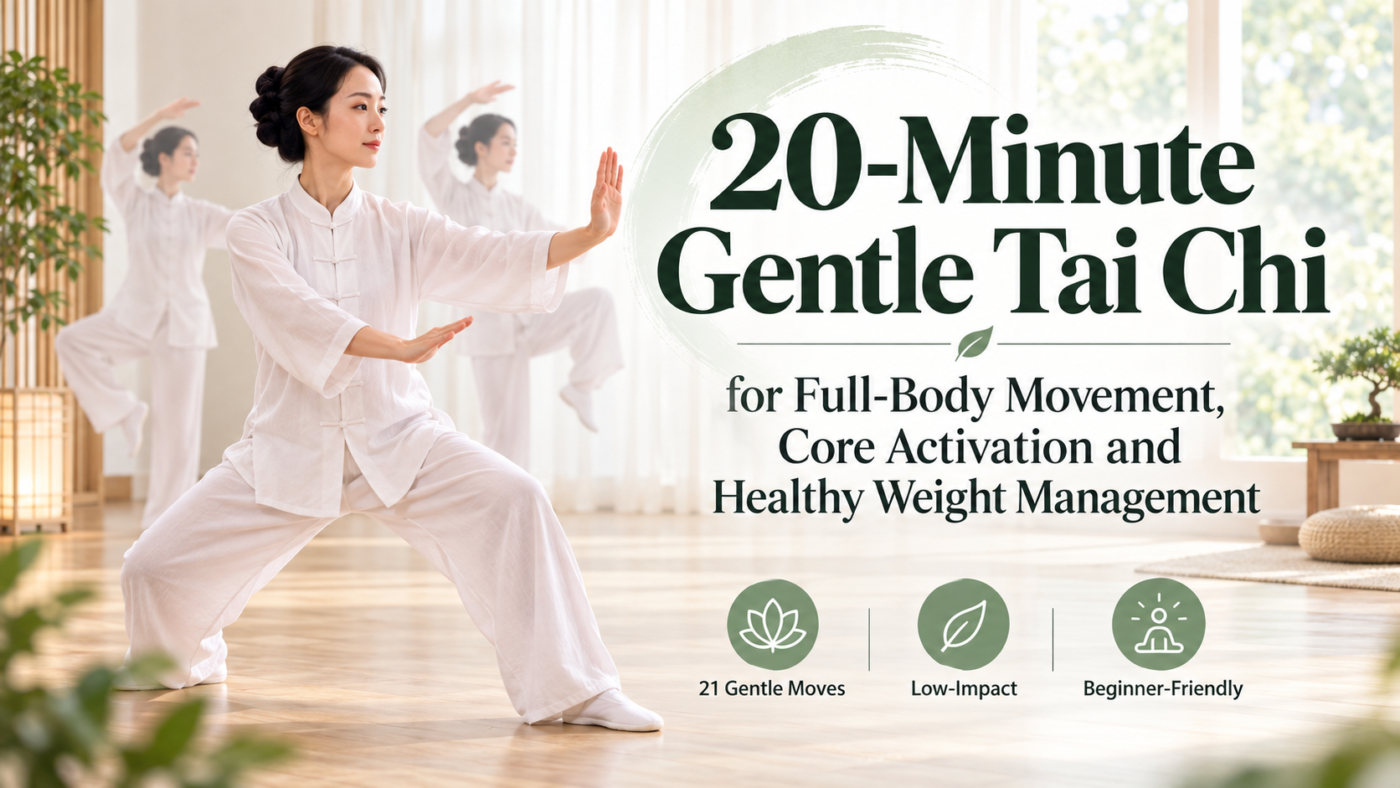
A 20-minute gentle Tai Chi routine can be a practical way to keep the whole body moving without jumping, running, or high-impact exercise. This Day 1 sequence combines heel raises, stepping, trunk rotation, controlled squats, knee lifts, arm patterns, balance work, mobility exercises, and a gradual cool-down.
The original routine describes the session as a “fat-burning challenge” and suggests that it can reduce visceral fat. That needs a more accurate explanation.
Tai Chi can contribute to daily physical activity and energy expenditure, but no single exercise session can specifically burn visceral fat or target fat from one part of the body. Reductions in body fat depend on total energy balance over time, regular physical activity, nutrition, sleep, age, genetics, and other individual factors.
What this routine can realistically do is help you move more, challenge the legs and core, improve coordination and balance, and support a more active lifestyle. Those benefits can contribute to long-term weight management when combined with other healthy habits.
Why a 20-Minute Gentle Tai Chi Routine Can Be Useful
Twenty minutes is long enough to accumulate meaningful movement while still being manageable for many beginners.
This routine repeatedly uses:
Weight shifting
Knee bending
Heel raising
Arm reaching
Trunk rotation
Single-leg balance
Side bending
Low-impact stepping
These patterns activate multiple muscle groups while keeping the intensity relatively gentle.
That makes the routine particularly useful for people who want a full-body session without the joint stress associated with jumping or running.
Can Tai Chi Help With Visceral Fat?
Visceral fat is stored deeper inside the abdominal cavity around internal organs.
Excess visceral fat is associated with increased cardiometabolic risk.
Regular physical activity can help reduce visceral fat over time, especially when combined with appropriate nutrition and an overall reduction in excess body fat.
However, Tai Chi does not selectively “melt” visceral fat.
A more accurate way to describe its role is that Tai Chi can contribute to total physical activity and energy expenditure. If practiced consistently as part of a broader lifestyle that includes walking, aerobic exercise, resistance training, and balanced nutrition, it may support gradual improvements in body composition.
Does Core Activation Burn Belly Fat?
Core exercises strengthen and coordinate the muscles of the trunk.
They do not selectively remove fat from the abdomen.
Movements such as knee lifts, trunk rotations, side bends, and cross-body patterns can challenge the abdominal muscles, but fat loss occurs systemically rather than locally.
This distinction is important because strong abdominal muscles can improve function and posture even when changes in body fat occur more slowly.
The 21-Move 20-Minute Gentle Tai Chi Routine
Move at a controlled pace and breathe naturally.
You should not feel rushed.
If balance is difficult, perform the standing movements near a sturdy chair, wall, or countertop.
Exercise 1: Heel Raise With Arm Lift
Stand with your feet comfortably apart.
Bend your knees slightly.
Sweep both arms upward as you gradually straighten your legs.
Rise onto your toes as the arms reach overhead.
Lower your heels and open both arms outward.
This movement activates the calves, thighs, shoulders, and trunk while gradually increasing whole-body activity.
Move smoothly rather than bouncing.
Exercise 2: Step and Push
Step one foot forward.
Push one hand forward while drawing the opposite hand back toward your waist.
Alternate the hands several times.
Then change legs and repeat on the other side.
This pattern combines stepping with trunk rotation and arm coordination.
Keep the forward step comfortable and avoid forcing the knee too far ahead if that feels unstable.
Exercise 3: Twist and Reach
Bring both hands together in front of your chest.
Rotate your torso gently toward one side.
Reach one arm backward and slightly upward while extending the opposite arm forward.
Return to the center and repeat on the other side.
This movement encourages controlled rotation through the trunk and shoulders.
Keep the pelvis stable enough that the twist remains comfortable.
Exercise 4: Step and Open
Step one foot forward.
Open both arms outward to the sides.
Return to the starting position.
Repeat with the opposite foot.
The coordinated pattern combines leg movement with chest and shoulder opening.
It also keeps several muscle groups active at once.
Exercise 5: Squat Cross Push
Bend your knees slightly.
Keep both hands close to the waist.
Push one hand diagonally across the body.
Return it and switch sides.
The lower-body position challenges the thighs and hips, while the cross-body push adds trunk involvement.
A shallow squat is enough.
Exercise 6: Rolling Arm Pull
Circle both arms downward.
Extend one arm forward while the opposite arm rolls and pulls backward.
Continue alternating.
This flowing pattern keeps the shoulders, upper back, and torso active.
Avoid lifting the shoulders toward the ears.
Exercise 7: Knee Lift Taps
Lift one knee at a time.
At the same time, gently tap the sides of your abdomen.
Alternate knees in a steady rhythm.
The knee lifts increase lower-body activity and challenge balance.
The tapping itself does not burn abdominal fat, but the movement pattern increases overall activity.
Exercise 8: Palm Press Twist
Extend one arm forward with the palm facing outward.
Use the opposite hand to provide light contact against it.
Maintain the arm position while rotating the torso gently from side to side.
This movement can mobilize the wrists, shoulders, chest, and upper trunk.
Avoid pressing hard through the wrist.
Exercise 9: Bend and Punch
Bend your knees slightly.
Keep both hands in front of the chest.
Punch one hand forward at a time.
Continue alternating at a smooth pace.
Combining lower-body engagement with faster upper-body movement can increase total movement without requiring impact.
Keep the punches controlled rather than forceful.
Exercise 10: Bend and Uppercut
Maintain a small bend in the knees.
Bring both hands near the torso.
Lift one hand upward in an uppercut pattern.
Alternate sides.
This movement activates the arms, shoulders, upper back, and trunk while keeping the legs involved.
Exercise 11: Knee Lift Elbow Drop
Place both hands behind your head.
Lift one knee.
Bring the opposite elbow gently toward it.
Return to the starting position and switch sides.
This cross-body movement challenges coordination and trunk control.
You do not need to touch the elbow and knee.
Exercise 12: Side Lean Flow
Keep both hands behind your head.
Lean your torso gently toward one side.
Return to the center.
Repeat toward the other side.
This movement encourages mobility through the sides of the trunk.
Avoid collapsing forward.
Exercise 13: Knee Lift Hold
Lift one knee.
Place both hands gently on top of the raised knee.
Hold briefly.
Lower the leg and switch sides.
This controlled position challenges balance and trunk stability.
Use external support if needed.
Exercise 14: Step Back Twist
Clasp your hands in front of the body.
Step one leg backward.
Rotate gently toward the opposite side.
Return to the center and change legs.
Backward stepping adds a balance challenge while the rotation keeps the trunk mobile.
Exercise 15: Overhead Reach Twist
Raise both hands overhead.
Stand tall.
Rotate slowly from side to side while keeping the arms lifted.
This movement combines shoulder mobility, trunk rotation, and postural control.
Reduce the height of the arms if overhead movement causes shoulder discomfort.
Exercise 16: Hip Circles
Place both hands on your hips.
Stand with the feet comfortably apart.
Circle the hips slowly in one direction.
Then reverse.
Keep the movement smooth and controlled.
The goal is mobility, not a large range.
Exercise 17: Side Knee Crunch
Place both hands behind your head.
Lift one knee outward to the side.
Bring the same-side elbow gently toward it.
Lower and alternate.
This movement challenges lateral trunk control, balance, and hip mobility.
It does not specifically burn fat from the waist.
Exercise 18: Gentle Body Shake
Keep the knees soft.
Allow the body to bounce very lightly while the arms hang loose.
Let the shoulders and hands relax.
This movement helps transition from the more active portion of the routine into the cool-down.
If bouncing feels uncomfortable, simply shift weight gently from side to side.
Exercise 19: Belly Circle Rub
Place both hands on the abdomen.
Rub slowly in comfortable circles.
Keep the pressure light.
Breathe calmly.
This movement may feel relaxing, but it should not be presented as a way to burn abdominal or visceral fat.
Its primary role here is relaxation and body awareness.
Exercise 20: Overhead Reach
Let both arms rest in front of the body.
Raise them slowly overhead.
Lengthen upward without forcing the spine.
Lower the arms gradually.
This movement helps restore shoulder and upper-body mobility after the active portion of the routine.
Exercise 21: Full-Body Tapping
Cross the arms gently in front of the chest.
Tap lightly around the shoulders.
Continue down the arms.
Then tap across the abdomen and along the legs.
Keep the contact gentle.
This final movement can promote body awareness and help the body transition into a relaxed state.
Claims that tapping directly improves circulation or removes fat should be avoided.
Why This Routine Feels More Active Than Traditional Slow Tai Chi
Traditional Tai Chi can be extremely slow and meditative.
This routine borrows Tai Chi-style principles but includes more repetitive stepping, knee lifts, arm patterns, and squatting.
That makes it closer to a gentle Tai Chi-inspired conditioning routine.
The continuous movement can modestly increase energy expenditure while preserving a low-impact format.
How Much Energy Does 20 Minutes of Tai Chi Burn?
There is no single number that applies to everyone.
Energy expenditure depends on:
Body size
Movement intensity
Fitness level
Age
Muscle mass
Range of motion
Rest periods
A gentle Tai Chi session generally burns fewer calories than vigorous running or cycling.
That does not make it ineffective.
Low-impact activity can be easier to repeat consistently, and consistency has a major effect on long-term health outcomes.
Why Low-Impact Exercise Can Still Be Valuable
High-impact exercise is not required for every health goal.
Low-impact movement can still improve:
Balance
Mobility
Coordination
Muscular endurance
Movement confidence
Daily energy expenditure
Exercise consistency
For older adults, beginners, or people who dislike intense workouts, those benefits can be especially important.
What This Routine Can and Cannot Do for Fat Loss
This routine can:
Increase daily physical activity
Contribute to energy expenditure
Challenge major muscle groups
Improve movement confidence
Support exercise consistency
It cannot:
Target belly fat
Directly melt visceral fat
Guarantee weight loss
Replace dietary changes when energy intake remains too high
Produce major body-composition changes after one session
That distinction makes the routine more scientifically accurate and more trustworthy.
How Often Should You Practice?
This routine can be performed several times per week.
If it remains comfortable, daily practice may also be reasonable.
For broader health and body-composition goals, combine it with:
Brisk walking
Other aerobic exercise
Progressive resistance training
Adequate protein intake
Balanced nutrition
Consistent sleep
The total amount of activity across the week matters more than any individual 20-minute session.
A Better Way to Approach a 7-Day Challenge
A seven-day challenge can be useful for building momentum.
It should not be viewed as a promise of rapid fat loss.
A better goal is to use the seven days to establish a repeatable habit.
During the week, focus on:
Showing up each day
Learning the movements
Improving balance
Increasing movement confidence
Reducing sedentary time
Making exercise feel sustainable
If those habits continue beyond the challenge, the long-term benefits become much more meaningful.
Who Should Modify the Routine?
Reduce the range of motion if you have limited mobility.
Use a chair during balance exercises.
Make squats shallower if the knees are sensitive.
Avoid deep trunk rotation if it causes back discomfort.
People recovering from surgery or managing significant cardiovascular, neurological, or musculoskeletal conditions should seek individualized guidance before beginning a new exercise routine.
When to Stop
Stop exercising if you experience:
Chest pain
Severe shortness of breath
Dizziness
Sudden weakness
Sharp joint pain
Loss of balance
Unusual neurological symptoms
Exercise should feel challenging at times, but it should not feel dangerous.
Final Thoughts
This 20-minute gentle Tai Chi routine offers 21 low-impact movements that combine stepping, squatting, trunk rotation, knee lifting, arm coordination, balance work, mobility exercises, and a gradual cool-down.
It can help keep the whole body moving and contribute to daily energy expenditure.
It should not be described as a direct visceral-fat treatment or a way to target belly fat.
The real value is broader.
Regular Tai Chi-inspired movement can support balance, mobility, coordination, muscular endurance, and exercise consistency.
When combined with healthy nutrition, resistance training, aerobic activity, and adequate sleep, it can become a useful part of a long-term healthy-weight and healthy-aging strategy.
Frequently Asked Questions
Can 20 minutes of Tai Chi help with weight loss?
Yes, it can contribute to daily physical activity and energy expenditure. Significant weight loss, however, depends on total energy balance over time.
Can Tai Chi reduce visceral fat?
Regular physical activity can help reduce visceral fat as part of an overall lifestyle strategy. Tai Chi cannot selectively target visceral fat by itself.
Does Tai Chi burn belly fat?
No exercise can specifically burn fat from the abdomen. Tai Chi may support overall fat loss by contributing to physical activity and energy expenditure.
Is this routine suitable for beginners?
Yes. Most movements can be performed slowly and with a reduced range. People with balance concerns should use a chair or wall for support.
Is 20 minutes of Tai Chi enough exercise?
Twenty minutes is a meaningful amount of activity, but broader fitness goals usually require additional aerobic and strength exercise across the week.
Can I do this routine every day?
Daily practice may be reasonable if the movements remain comfortable and recovery is good.
Is Tai Chi good for people over 60?
Tai Chi can be especially useful for many older adults because it emphasizes balance, weight shifting, coordination, and controlled low-impact movement.
Medical Disclaimer
This article is for educational purposes only and is not medical advice. Exercise should be adjusted to your individual health, fitness level, balance, and mobility. Stop if you experience pain, dizziness, chest discomfort, unusual shortness of breath, or loss of balance, and consult a qualified healthcare professional when appropriate.
This article is for general education and does not replace individualized care from a qualified health professional. Seek appropriate advice for persistent, severe, or concerning symptoms.
Read the full medical disclaimer