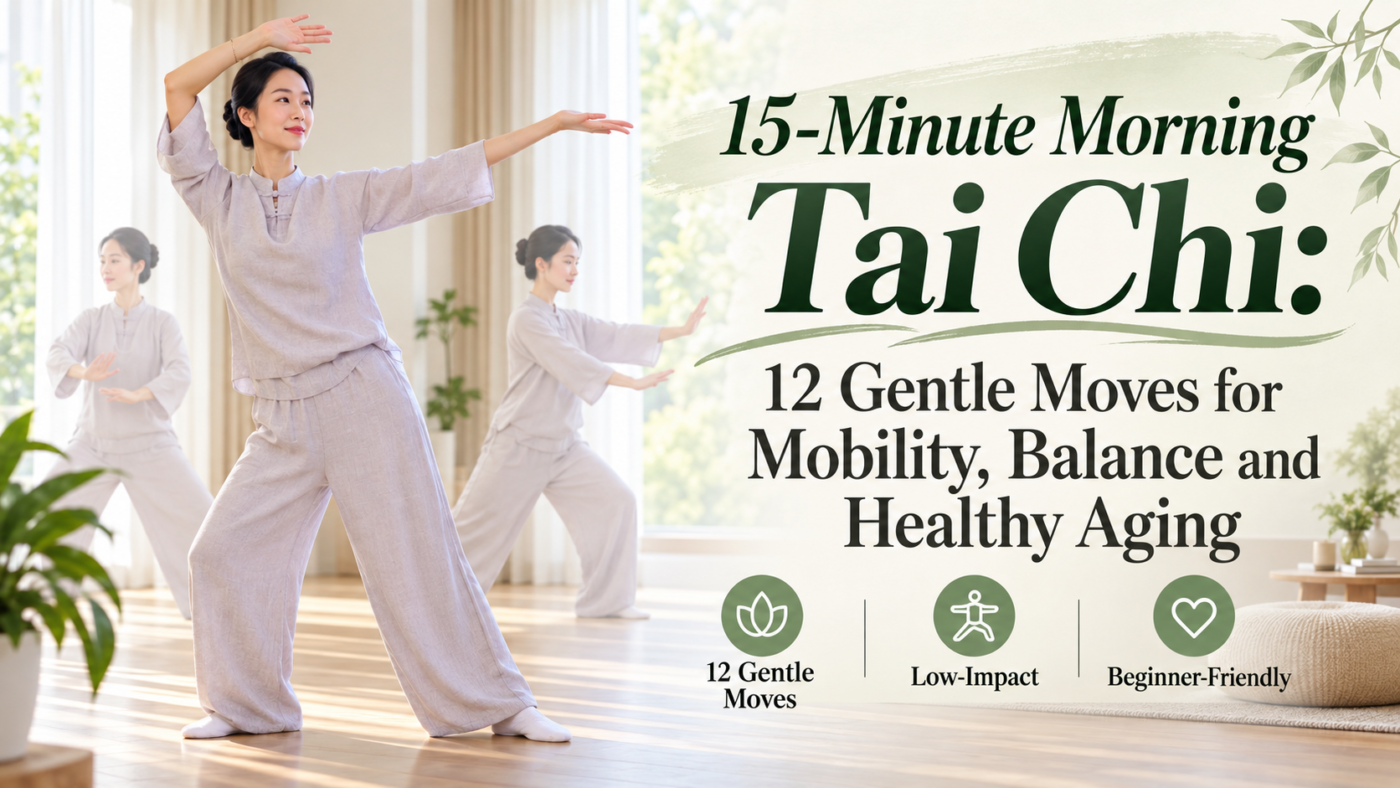
Starting the day with 15 minutes of morning Tai Chi can be a simple way to wake up the body without jumping, running, or exhausting exercise. This gentle routine combines heel raises, weight shifts, controlled squats, arm swings, stepping, balance work, and mobility-focused movements to help the body transition gradually from rest into activity.
The goal is not to “reverse aging” or guarantee fat loss in 15 minutes. No exercise can stop biological aging, and body-fat reduction depends on overall energy balance, nutrition, total physical activity, sleep, genetics, and long-term consistency.
What a regular Tai Chi practice can realistically support is just as valuable: better balance, lower-body control, mobility, coordination, muscular endurance, and a more active daily routine. Those benefits become increasingly important as we age.
Why Morning Tai Chi Can Be a Good Way to Start the Day
After several hours of sleep, many people wake up feeling stiff through the hips, ankles, shoulders, and lower back. Moving immediately into vigorous exercise may not feel comfortable, especially for older adults or people returning to activity.
A gentle Tai Chi sequence provides a gradual alternative.
Slow, controlled movements encourage the joints to move through comfortable ranges while progressively activating the legs, hips, trunk, and upper body. Weight shifting and single-leg movements also challenge balance without requiring high-impact exercise.
The result is a whole-body session that can help you feel more mobile and physically prepared for the rest of the day.
Can 15 Minutes of Tai Chi Support Healthy Aging?
Tai Chi cannot literally stop or reverse aging.
However, several physical abilities that often become more difficult with age can be trained.
These include:
Balance
Leg strength
Coordination
Joint mobility
Postural control
Movement confidence
Functional endurance
Maintaining these abilities can make everyday activities such as walking, climbing stairs, turning, reaching, and getting up from a chair easier and safer.
That is a much more meaningful definition of “staying youthful” than promising that exercise can change your biological age overnight.
Can Morning Tai Chi Help With Fat Loss?
Tai Chi is physical activity, so it contributes to daily energy expenditure.
However, a single 15-minute routine should not be presented as a stand-alone fat-burning solution.
Fat loss occurs when energy expenditure exceeds energy intake over time. Regular Tai Chi can contribute to that process by helping you move more consistently, particularly if you enjoy low-impact exercise and are more likely to maintain it.
For larger changes in body composition, Tai Chi works best alongside regular walking or other aerobic exercise, resistance training, adequate protein intake, balanced nutrition, and healthy sleep habits.
The 12-Move 15-Minute Morning Tai Chi Routine
Move at a comfortable pace and avoid forcing your range of motion.
You should be able to breathe normally throughout the routine.
If balance is uncertain, practice near a sturdy chair, countertop, or wall.
Exercise 1: Alternating Heel Raises
Stand tall with your feet approximately hip-width apart.
Place your hands comfortably on your waist.
Lift one heel slowly while keeping the front of the foot on the floor. Lower it and raise the opposite heel.
Continue alternating from side to side.
This simple movement gently activates the calf muscles and ankles after sleep while introducing rhythmic movement into the lower body.
Heel raises can also help train ankle control, which is important for walking and balance.
Keep your movements smooth rather than bouncing.
Exercise 2: Hip Sway With Arm Swing
Stand with your feet slightly wider than hip-width apart and keep your knees relaxed.
Shift your hips gently toward one side while allowing one arm to rise and the other to lower.
Move back through the center and repeat in the opposite direction.
This flowing side-to-side pattern mobilizes the hips, waist, shoulders, and trunk.
Avoid pushing the hips aggressively. The movement should remain comfortable and controlled.
Exercise 3: Step Back and Open
Stand tall with both hands positioned in front of your body.
Step one foot gently backward.
As you step, open the arm on the same side behind you while allowing your torso to rotate slightly.
Return to the starting position and repeat on the opposite side.
Backward stepping challenges balance differently from ordinary forward walking.
The opening movement also encourages mobility through the shoulders, chest, and upper back.
Keep the backward step short if you are still developing confidence.
Exercise 4: March and Press
Begin marching slowly in place.
Raise both hands in front of your chest and press them gently forward.
Return the hands toward your body.
On the next repetition, press your arms outward to the sides.
Continue alternating arm directions while maintaining an easy marching rhythm.
This movement combines upper- and lower-body activity and can gently increase heart rate without jumping.
Changing arm directions also challenges coordination.
Exercise 5: Turn and Open
Stand comfortably with your knees slightly relaxed.
Turn your torso gently toward one side while opening both arms.
Return to the center.
Repeat on the opposite side.
The rotation should come from the trunk and hips rather than forcing the lower back.
This movement can help maintain rotational mobility through the waist, chest, and shoulders.
Rotation is especially important because many everyday tasks require turning rather than moving only forward and backward.
Exercise 6: Gentle Dip With Arm Swing
Stand with your feet comfortably apart.
Bend your knees slightly and lower your body a small amount.
As you dip, swing one arm upward and the other downward.
Rise slightly and switch sides.
Keep the movement rhythmic and relaxed.
This exercise increases leg involvement while adding shoulder movement and whole-body coordination.
You do not need to squat deeply.
A shallow knee bend is enough to make the movement useful.
Exercise 7: Cross-Arm Weight Shift
Cross your arms gently in front of your body.
Keep your feet comfortably wide.
Shift your body weight toward one leg while allowing the opposite leg to become lighter.
Return through the center and shift toward the other side.
Weight shifting is a fundamental component of Tai Chi.
It trains the ability to control your center of mass over your base of support, which is closely related to balance during walking and changes of direction.
Keep both feet in contact with the floor until you feel confident.
Exercise 8: Squat and Arm Lift
Stand with your feet comfortably apart.
Bend your knees and hips slightly while lowering your body.
At the same time, allow both arms to swing upward.
Return to standing and lower the arms.
Repeat slowly.
This movement combines lower-body strengthening with shoulder mobility and coordinated whole-body movement.
The squat does not need to be deep.
People with sensitive knees can reduce the range or use a chair for additional support.
Exercise 9: Heel Raise Pull
Extend both arms forward.
Rise slowly onto the balls of your feet while pulling both hands backward toward your waist.
Lower your heels and extend the arms forward again.
Repeat at a controlled pace.
The heel raise activates the calves while the coordinated arm movement keeps the upper body involved.
Avoid rushing the lowering phase.
Controlling the descent is part of the exercise.
Exercise 10: Wide Squat Arm Press
Place your feet wider than shoulder-width apart.
Open both arms toward the sides.
Bend your knees slightly as you bring your hands forward.
Rise gradually and open the arms again.
Continue at a comfortable pace.
This controlled movement challenges the thighs, hips, glutes, and trunk while encouraging upper-body coordination.
Keep the knees tracking in approximately the same direction as the toes.
Do not force yourself into a low squat.
Exercise 11: Hip Sway With Two-Arm Swing
Relax your knees and begin shifting gently from one side to the other.
Allow both arms to swing naturally across the body in the same direction as the weight shift.
Continue with an easy rhythm.
This movement reduces the intensity after the squat sequence while keeping the hips, shoulders, and trunk active.
Let the arms remain relaxed rather than deliberately forcing them.
Exercise 12: Knee Lift With High Reach
Finish the routine by standing tall.
Lift one knee while reaching the same-side arm overhead.
Use the opposite hand to move gently toward the raised knee.
Lower the leg and switch sides.
This final exercise brings together balance, coordination, hip mobility, shoulder movement, and trunk control.
Move slowly enough that you remain stable.
Holding a chair with one hand is completely acceptable if needed.
Why Balance Training Matters More With Age
Balance is not controlled by a single muscle.
It depends on the coordinated interaction of vision, the inner ear, sensory information from the feet and joints, muscle strength, reaction speed, and nervous-system control.
Because Tai Chi repeatedly asks the body to shift weight, step in different directions, slow down movements, and briefly reduce support from one leg, it provides repeated opportunities to train these systems together.
This is one reason Tai Chi is frequently used as a low-impact movement option for middle-aged and older adults.
Why Leg Strength Matters for Healthy Aging
The legs perform much of the work required for independent daily life.
They help us:
Stand up from chairs
Climb stairs
Walk safely
Recover balance after a misstep
Carry groceries
Get in and out of vehicles
Move across uneven surfaces
Movements such as shallow squats, heel raises, stepping, and controlled weight shifts provide gentle muscular loading.
For maximum strength benefits, Tai Chi can eventually be combined with progressive resistance training.
Tai Chi and Joint Mobility
Joint mobility naturally varies between individuals.
Age, previous injuries, arthritis, activity level, muscle stiffness, and lifestyle can all affect movement.
The slow pace of Tai Chi allows you to explore comfortable ranges without relying on momentum.
Rather than trying to force flexibility, focus on gradually improving movement quality.
Small improvements repeated consistently can be more useful than pushing aggressively through discomfort.
How Morning Movement Can Reduce Sedentary Time
One overlooked benefit of a morning exercise routine is behavioral.
When physical activity becomes the first intentional movement of the day, it creates a clear daily habit.
Even if the session lasts only 15 minutes, it may help prevent an entire morning from becoming sedentary.
A short practice can also make it psychologically easier to add walking or other activity later.
For many people, consistency matters more than creating the “perfect” exercise routine.
Is 15 Minutes Enough?
Fifteen minutes is enough to provide meaningful movement.
It is not necessarily enough to meet every fitness goal.
Think of this routine as one component of your weekly physical activity.
Depending on your health and fitness level, you can gradually add:
Brisk walking
Longer Tai Chi sessions
Cycling
Swimming
Resistance training
Mobility work
Recreational activities
The best program is one that combines cardiovascular fitness, muscular strength, balance, and mobility.
How Often Should You Practice Morning Tai Chi?
You can practice this routine several times per week or even daily if the movements remain comfortable.
Beginners may start with three or four sessions each week.
As the sequence becomes familiar, daily practice can be easier because the movements require little equipment, space, or preparation.
Consistency is more important than intensity.
What Results Can You Realistically Expect?
After several weeks of consistent practice, some people may notice that movements feel easier and more coordinated.
Potential improvements may include:
Better balance confidence
Greater ankle and hip mobility
Improved movement awareness
Less morning stiffness
Better coordination
Greater confidence with squatting and stepping
More daily physical activity
Changes in body weight or body composition typically require a longer period and depend on diet, total exercise, sleep, and many individual factors.
Morning Tai Chi for Adults Over 40
Adults in midlife often begin noticing that flexibility, recovery, balance, and muscle strength require more deliberate attention than they did earlier in life.
Gentle Tai Chi can be particularly useful because it combines several physical qualities within a single session.
It does not replace resistance training or cardiovascular exercise, but it can complement both.
The combination becomes increasingly valuable as maintaining physical function becomes a higher priority than simply exercising for appearance.
Morning Tai Chi for Adults Over 60
For older adults, the goal should generally be safe and sustainable movement rather than extreme intensity.
Use smaller steps if necessary.
Hold a chair during heel raises or knee lifts.
Reduce squat depth.
Perform turns slowly.
Take longer rest periods whenever needed.
Modification does not reduce the value of the exercise.
The goal is to practice movement safely and consistently.
When to Stop or Modify an Exercise
Gentle muscular effort is normal.
Sharp or increasing pain is not.
Stop the exercise if you experience:
Chest pain
Severe shortness of breath
Dizziness
Sudden weakness
Loss of balance
Sharp joint pain
Unusual neurological symptoms
People with recent surgery, significant cardiovascular disease, severe balance problems, advanced joint disease, or other medical limitations should receive individualized guidance before starting a new exercise program.
The Bigger Picture of Healthy Aging
There is no single exercise that keeps a person young.
Healthy aging is influenced by many factors, including physical activity, muscle strength, nutrition, sleep, cardiovascular health, metabolic health, social engagement, and medical care.
Tai Chi contributes to this bigger picture by encouraging controlled movement and making physical activity accessible.
The purpose is not to fight every sign of aging.
It is to preserve the ability to move well and remain physically capable for as long as possible.
Final Thoughts
A 15-minute morning Tai Chi routine can be an effective way to begin the day with intentional movement.
These 12 gentle exercises combine stepping, weight shifting, heel raises, squats, trunk rotation, arm movements, and balance challenges without requiring high-impact exercise or complicated equipment.
The routine cannot stop aging or guarantee fat loss. What it can do is support mobility, balance, coordination, lower-body strength, and daily physical activity.
Those benefits matter at every age.
You do not need an exhausting workout every morning to make exercise worthwhile.
Sometimes the most valuable routine is the one you can comfortably return to tomorrow.
Frequently Asked Questions
Is 15 minutes of Tai Chi every morning enough?
Fifteen minutes is a useful amount of daily movement, particularly for mobility and balance practice. For broader health and fitness benefits, combine it with additional aerobic activity and strength training throughout the week.
Can morning Tai Chi help with weight loss?
Tai Chi contributes to physical activity and energy expenditure, but fat loss depends primarily on total energy balance over time. It works best as part of a broader exercise and nutrition strategy.
Does Tai Chi slow aging?
Tai Chi cannot stop biological aging. Regular practice may help maintain abilities such as balance, mobility, coordination, and physical function that often become more challenging with age.
Is this morning Tai Chi routine suitable for beginners?
Yes. The movements are low impact and can be performed with smaller ranges. Anyone with balance concerns can use a chair or wall for support.
Is Tai Chi good for people over 60?
Tai Chi can be particularly useful for many older adults because it emphasizes controlled movement, weight shifting, balance, and mobility. Individual medical and physical limitations should still be considered.
Can I do morning Tai Chi every day?
Daily practice can be reasonable if the movements remain comfortable and you recover well. Reduce the intensity or take a rest day if you experience persistent soreness or joint discomfort.
Should I do Tai Chi before breakfast?
It can generally be practiced before or after breakfast depending on personal comfort. There is no requirement to exercise while fasting for Tai Chi to be beneficial.
Medical Disclaimer
This article is for educational purposes only and is not medical advice. Exercise should be modified according to your health, physical ability and mobility. Stop if you experience pain, dizziness, chest discomfort, unusual shortness of breath or loss of balance, and consult a qualified healthcare professional when appropriate.
This article is for general education and does not replace individualized care from a qualified health professional. Seek appropriate advice for persistent, severe, or concerning symptoms.
Read the full medical disclaimer