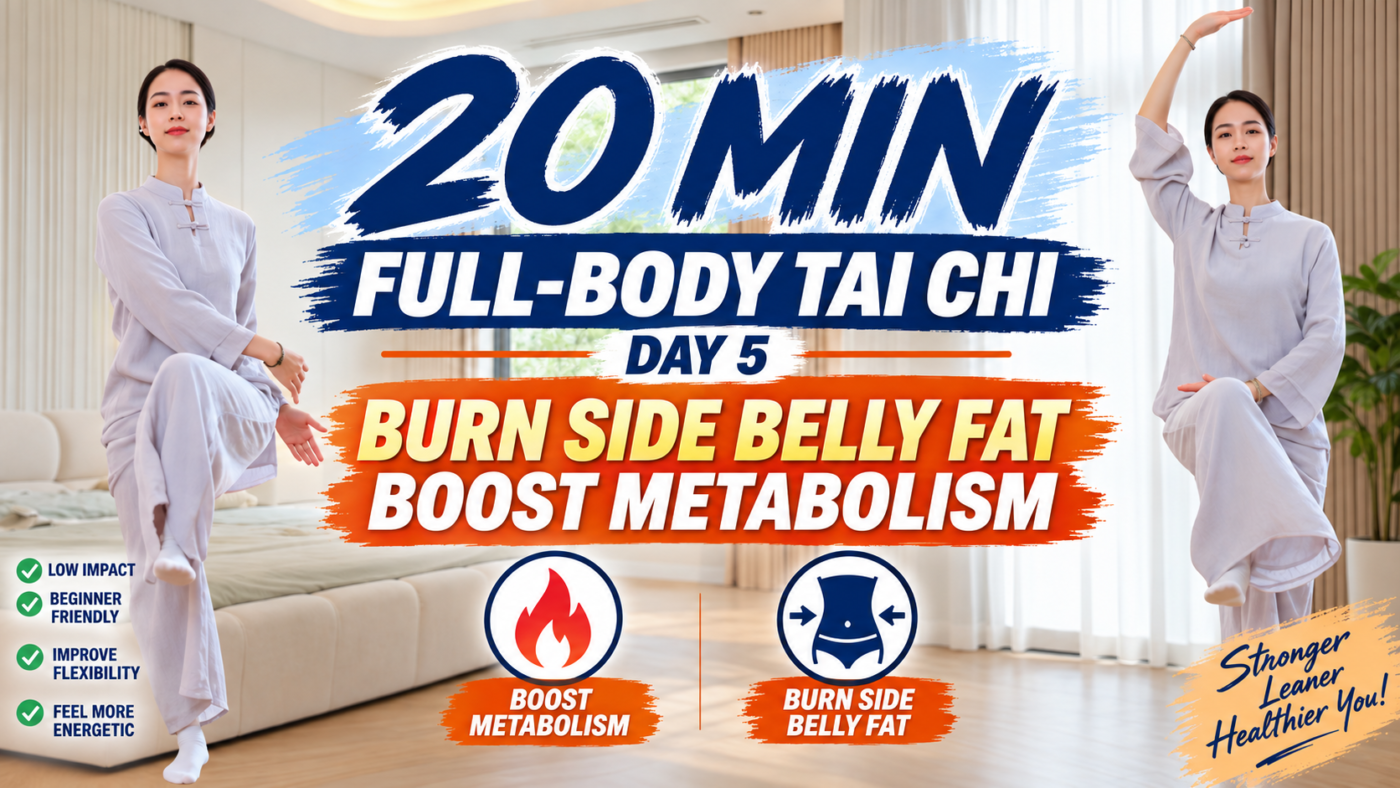
A 20-minute movement session can be long enough to challenge the whole body while still remaining approachable for beginners, older adults, and anyone who prefers low-impact exercise.
This routine combines flowing Tai Chi-inspired patterns with knee lifts, rotations, squats, reaches, toe raises, side steps, balance drills, and mobility work. Together, these movements can support coordination, flexibility, posture, lower-body strength, core control, and daily energy expenditure.
It is important to correct one common misconception at the outset: no single twisting, reaching, or abdominal movement can directly “burn belly fat” from the exact area being exercised. Fat loss happens systemically. Exercise can strengthen the muscles around the waist and increase overall energy use, but body-fat reduction depends on the broader combination of nutrition, total activity, sleep, stress, genetics, and metabolic health.
The real strength of this routine is that it keeps the entire body moving continuously and gently.
Why This 20-Minute Tai Chi-Inspired Routine Works Well
The sequence repeatedly moves the body through rotation, flexion, extension, side bending, weight shifting, balancing, squatting, and reaching.
That matters because good physical function is not based on one movement alone.
A well-rounded routine should challenge multiple abilities, including:
Balance.
Mobility.
Coordination.
Core stability.
Lower-body strength.
Shoulder movement.
Postural control.
Gentle cardiovascular endurance.
The movements are intentionally rhythmic. You do not need to rush. Smooth execution is more valuable than speed.
Exercise 1: High-Low Reach Rotation
Stand upright with your feet comfortably apart.
Rotate your torso toward one side while lifting one arm overhead and extending the other arm outward.
Return to the center and repeat on the opposite side.
Keep the movement controlled and allow your rib cage and shoulders to rotate naturally.
Why It Helps
This movement challenges the obliques and deeper trunk stabilizers while improving rotational mobility.
The alternating reach also promotes coordination between the upper and lower body.
It can strengthen the waist area, but it does not selectively remove fat from the waist.
Exercise 2: Knee Lift With Back Swing
Hold both arms slightly curved in front of your chest.
Lift one knee while swinging both arms gently backward.
Return to the center and repeat on the other side.
Why It Helps
Knee lifting challenges hip flexion, balance, and lower-abdominal stabilization.
The backward arm swing also opens the chest and shoulders.
When performed continuously, the movement can gently raise heart rate and contribute to total daily energy expenditure.
Exercise 3: Front-and-Back Hand Clap
Clap both hands together in front of your body.
Then move the arms behind you and bring the hands together again if your shoulder mobility allows.
Repeat continuously.
Why It Helps
This movement encourages shoulder extension, chest opening, and upper-back mobility.
Do not force the hands to meet behind your body. If your shoulders are tight, simply reach backward without clapping.
Large upper-body movements may increase activity slightly, but they should be performed comfortably rather than aggressively.
Exercise 4: Side-to-Side Arm Swing
Stand comfortably.
Rotate your body from side to side while allowing both arms to swing naturally.
Keep your knees relaxed and let the movement come from the whole trunk rather than forcing the lower back.
Why It Helps
Gentle rotational movement can improve thoracic mobility and reduce feelings of stiffness.
The oblique muscles help control the side-to-side motion.
Again, twisting can strengthen and mobilize the midsection, but it cannot directly flatten the abdomen by removing local fat.
Exercise 5: Open-Arm Chest Twist
Begin with both fists or hands together in front of the chest.
Rotate toward one side while opening both arms wide.
Return to center and repeat on the other side.
Why It Helps
This movement combines chest opening with trunk rotation.
It can be particularly useful for people who spend many hours sitting or working at a computer.
The upper back, shoulders, and trunk all participate.
Exercise 6: Heel-Tap Reach
Bend one leg behind your body while reaching the opposite hand toward the heel.
Raise the other arm overhead.
Return to standing and repeat on the other side.
Why It Helps
This movement challenges balance, quadriceps mobility, diagonal core control, and coordination.
Use a wall or chair for support if needed.
Do not force the heel too close to the body if the knee feels uncomfortable.
Exercise 7: Hip Swing With Arm Drive
Shift the hips toward one side while moving both arms outward in the same direction.
Return through the center and repeat on the other side.
Why It Helps
The movement encourages lateral mobility through the hips and trunk.
It also engages the side-body muscles involved in controlling movement.
The rhythmic pattern makes it useful as a gentle conditioning exercise.
Exercise 8: Cross Toe Reach
Stand with your feet wide apart.
Hinge forward from the hips and reach one hand toward the opposite foot while extending the other arm upward.
Return to center and switch sides.
Why It Helps
This pattern combines hamstring mobility, hip hinging, trunk rotation, and shoulder movement.
You do not need to reach all the way to your toes.
If your hamstrings or back feel tight, reach toward the shin instead.
Exercise 9: Knee Lift Reach
Lift one knee while reaching the opposite hand toward it.
Raise the other arm overhead.
Return to standing and switch sides.
Why It Helps
This cross-body movement challenges coordination and trunk control while activating the hip flexors and abdominal stabilizers.
When repeated continuously, it can also elevate heart rate modestly.
Exercise 10: Knee Bend With Overhead and Back Clap
Stand with your feet wide apart.
Clap your hands overhead.
Bend the knees slightly while moving your arms behind the body.
Return to standing and repeat.
Why It Helps
The movement combines lower-body strength with shoulder mobility.
The knee bend activates the thighs and glutes while the arm motion increases upper-body involvement.
A shallow knee bend is perfectly acceptable.
Exercise 11: Squat Prayer Raise
Stand with your feet wide and knees slightly bent.
Bring the hands together in front of the chest.
Raise the hands overhead, then open the arms outward while maintaining a comfortable squat-like position.
Repeat smoothly.
Why It Helps
Holding the lower body in a semi-squat increases muscular demand in the thighs and hips.
The overhead reach adds shoulder mobility and postural control.
This movement can increase overall exercise intensity, but it does not directly “flatten” the abdominal wall through stretching.
Exercise 12: Side Leg With Overhead Clap
Extend one leg out to the side while raising both arms overhead.
Bring the hands together if comfortable.
Return to center and repeat on the other side.
Why It Helps
The exercise challenges lateral hip strength, balance, inner-thigh mobility, and full-body coordination.
Keep the standing knee soft and avoid leaning excessively.
Exercise 13: Toe Raise With Back Swing
Reach both arms overhead.
Swing the arms behind you while rising onto your toes.
Return to the starting position and repeat.
Why It Helps
Rising onto the toes activates the calf muscles and challenges balance.
The calf muscles also contribute to circulation in the lower legs during movement.
The overhead reach encourages an elongated posture through the trunk.
Exercise 14: Squat and Toe Raise
Keep the arms overhead while bending into a light squat.
Stand back up, swing the arms downward, and rise onto your toes.
Repeat smoothly.
Why It Helps
This combines two useful lower-body patterns: squatting and calf raising.
The thighs, glutes, calves, and trunk all contribute.
Because more muscle groups are working together, this is one of the more demanding movements in the sequence.
Exercise 15: Side Toe Reach
Stand with the feet wide and raise both arms overhead.
Bend toward one side while reaching the same-side hand toward the toes.
Keep the opposite arm extended overhead.
Return to center and switch sides.
Why It Helps
This movement emphasizes lateral flexibility through the trunk and hips.
It can strengthen and stretch the side-body muscles, but it does not selectively reduce “love handles.”
Exercise 16: Back Step With Open Arms
Extend both arms forward.
Step one foot backward while rotating the torso and opening both arms wide.
Return to center and repeat on the other side.
Why It Helps
The step-back pattern challenges balance, coordination, hip control, and trunk rotation.
It also resembles functional movements used during walking, turning, and reaching in everyday life.
Exercise 17: Toe Raise With Alternating Arm Reach
Raise one arm overhead while allowing the other arm to move behind the body.
At the same time, rise onto your toes.
Return and switch sides.
Why It Helps
This asymmetrical movement challenges balance and deeper trunk stabilizers.
The combination of calf activation and reaching also promotes whole-body coordination.
Exercise 18: Side Leg Cross Reach
Extend one leg to the side while sweeping both arms upward and crossing them above your head.
Return to center and switch sides.
Why It Helps
This final movement combines lateral leg control, shoulder mobility, balance, and full-body coordination.
The broad sweeping motion makes it a useful way to finish the routine with relaxed, continuous movement.
Can This Routine Help With Belly Fat?
It can contribute to a broader fat-loss strategy, but not through spot reduction.
The most accurate way to think about it is this:
The exercises increase physical activity.
Some of them modestly increase heart rate.
Several engage large muscle groups.
Repeated practice can improve fitness and make daily movement easier.
Those factors can support energy balance and long-term weight management.
But abdominal fat is not removed simply because the abdominal muscles are contracting during an exercise.
Does Tai Chi Boost Metabolism?
The phrase “boost metabolism” is often exaggerated.
Any physical activity increases energy expenditure while you are doing it, and regular exercise can support better body composition and metabolic health over time.
However, a single short workout does not dramatically increase resting metabolism for the rest of the day.
The more useful goal is consistency.
Twenty minutes of movement practiced regularly can matter far more than an occasional intense session.
Why Rotation Is Valuable Even Without Spot Reduction
Many of the movements in this routine involve twisting and side bending.
These movements are still useful even though they do not burn local fat.
Rotation supports:
Spinal mobility.
Oblique strength.
Coordination.
Postural control.
Movement confidence.
Ability to turn and reach during daily life.
These are valuable physical qualities, especially as people age.
How Hard Should This Routine Feel?
For most people, the routine should feel light to moderate.
You should still be able to breathe comfortably.
You should not feel as though you are fighting for balance or forcing your joints into uncomfortable positions.
Use smaller movements when needed.
Pause if you become dizzy.
Hold onto a chair if balance is difficult.
Quality comes first.
Is 20 Minutes Enough?
Yes, especially if the alternative is doing nothing.
A 20-minute session can meaningfully contribute to weekly physical activity and help establish a sustainable habit.
For broader health benefits, combine it with walking, resistance training, and other forms of movement throughout the week.
You do not need every workout to be long or intense.
Can You Do It Every Day?
Many people can practice a gentle version of this routine daily.
However, individual recovery varies.
If repeated squats, toe raises, or knee lifts cause persistent soreness or joint discomfort, reduce frequency or intensity.
Daily movement is helpful.
Daily maximal effort is unnecessary.
A Smarter Way to Use This Routine for Fat Loss
If your goal includes reducing body fat, combine the routine with a broader lifestyle approach.
Prioritize balanced meals.
Eat adequate protein.
Control overall calorie intake.
Walk more during the day.
Include strength training when appropriate.
Sleep consistently.
Manage chronic stress.
Stay patient.
Fat loss is rarely determined by one exercise.
It is shaped by the total pattern of your lifestyle.
The Bottom Line
These 18 Tai Chi-inspired movements create a practical 20-minute routine that combines mobility, balance, coordination, core control, lower-body strengthening, rotational movement, and gentle cardiovascular activity.
They can support a more active lifestyle and contribute to long-term weight management.
But the real benefits come from consistency, not from claims that a particular twist or reach can directly melt fat from the waist.
Move smoothly.
Stay within a comfortable range.
Use support when needed.
And treat the routine as one part of a broader approach to health, mobility, and healthy aging.
FAQ
Can this 20-minute Tai Chi routine help with weight loss?
Yes, it can contribute to daily energy expenditure and physical activity, but meaningful fat loss depends on overall lifestyle factors such as nutrition, total calorie intake, sleep, and consistency.
Can these exercises directly burn belly fat?
No. Exercises can strengthen the abdominal and waist muscles, but they cannot selectively burn fat from those areas.
Can twisting exercises reduce love handles?
Twisting can improve trunk mobility and strengthen the obliques, but local fat reduction is not possible through one specific movement.
Is this routine suitable for beginners?
Yes. Beginners can reduce range of motion, move more slowly, use support for balance, and perform shallower squats.
Can older adults do these exercises?
Many can be adapted for older adults, especially when movements are slower and balance support is available.
Can I practice this routine daily?
Many people can practice a gentle version every day if they recover well and do not experience persistent pain or excessive fatigue.
Is this traditional Tai Chi?
Not exactly. It combines Tai Chi-inspired flowing movement with conventional fitness exercises such as squats, toe raises, knee lifts, and side reaches.
Medical Disclaimer
This article is for educational and informational purposes only and is not medical advice. Exercise needs vary according to age, health status, medications, injuries, balance ability, and fitness level. Stop exercising and seek appropriate medical care for chest pain, fainting, severe dizziness, unusual shortness of breath, sudden weakness, or significant pain. People with chronic medical conditions, recent injuries, or major physical limitations should consult a qualified healthcare professional before beginning a new exercise program.
This article is for general education and does not replace individualized care from a qualified health professional. Seek appropriate advice for persistent, severe, or concerning symptoms.
Read the full medical disclaimer