A few years ago, I met an older gentleman exercising in a local park.
He was already in his 80s, yet he still moved with remarkable confidence.
What caught my attention was not a complicated Tai Chi sequence or an expensive piece of exercise equipment.
He was simply squatting.
But it was not an ordinary squat.
He lowered himself close to the ground, opened his knees outward, kept his torso upright, placed both hands on his knees, and rhythmically shifted pressure from one side to the other.
He called the movement the Tiger Squat.
By the time I saw him again more recently, he was 85 and still practicing in the park.
He told me that he had performed the movement regularly for years because he believed it helped keep his lower body strong and his hips flexible.
Like many traditional exercises passed from person to person, his claims went beyond what modern evidence can prove. He associated the practice with prostate health and urinary function.
Those benefits should not be treated as established medical effects.
But the movement itself is still interesting.
A properly modified Tiger Squat challenges several physical qualities that become increasingly important with age:
hip mobility,
ankle mobility,
leg strength,
deep-squat tolerance,
balance,
pelvic control,
and the ability to comfortably move close to the ground.
For adults who can perform it safely, it can be a demanding but useful mobility exercise.
What Is the Tiger Squat?
The Tiger Squat is a deep, wide squat performed close to the floor.
Instead of simply holding a stationary squat, the practitioner gently shifts from side to side while using the hands to guide the knees.
The basic position looks like this:
Feet moderately apart.
Toes turned slightly outward.
Knees opening in the same general direction as the toes.
Hips lowered toward the heels.
Torso kept reasonably upright.
Hands resting lightly on the knees.
Weight shifting slowly from one side to the other.
The original practice sometimes attempts to lower one knee very close to the floor before returning to the center and changing sides.
That is an advanced range.
It is not necessary for beginners.
Your goal is not to force the knee onto the ground.
Your goal is to explore a comfortable range of hip and ankle motion while remaining in control.
Why Deep Squatting Becomes Harder With Age
Many adults discover that squatting becomes surprisingly difficult after years of chair-based living.
That does not necessarily mean the body has suddenly become incapable.
It often means that certain ranges of motion have not been used regularly.
Modern life usually involves:
sitting in chairs,
driving,
working at desks,
using sofas,
and rarely spending extended time near the floor.
As a result, deep hip flexion, ankle dorsiflexion, rotational hip movement, and comfortable low-level positions may gradually become unfamiliar.
Muscles can become less tolerant of these positions.
Balance may decline.
Leg strength may decrease.
The nervous system may simply become less confident near the ground.
A squat-based exercise therefore challenges much more than the thighs.
It asks the hips, knees, ankles, feet, pelvis, trunk, and nervous system to cooperate.
Start With a Hip-Opening Warm-Up
Do not immediately force yourself into the deepest Tiger Squat you can manage.
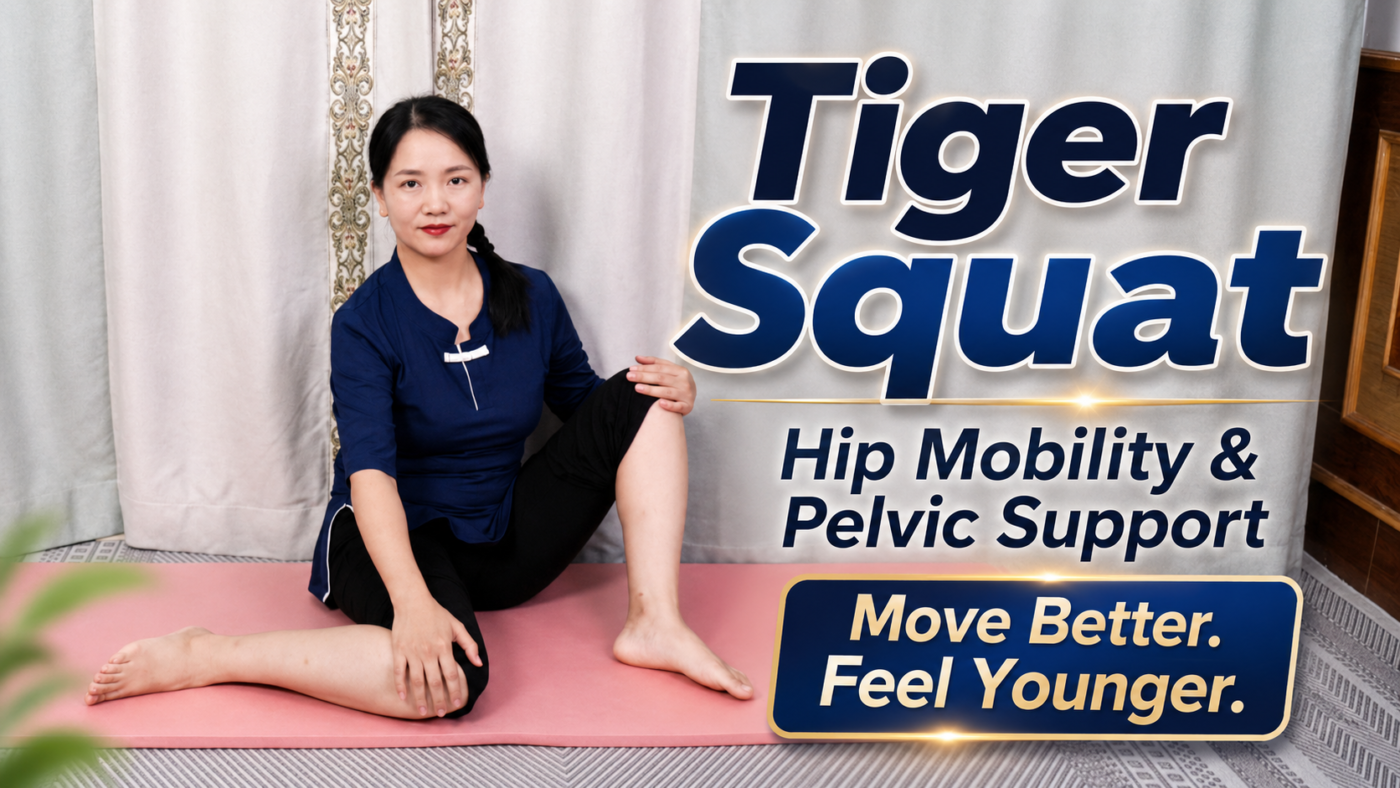
Begin on the floor.
Sit on a mat or folded blanket.
Open your knees comfortably toward the sides.
Keep the hips relaxed.
Now allow one knee to move gently toward the floor while the other side remains more upright.
Return to the center.
Change sides.
Move slowly from left to right.
You may place your hands on the thighs or knees and apply only a very gentle guiding pressure.
Do not push aggressively.
A stretching sensation around the inner thighs and hips can be normal.
Sharp pain is not.
Perform approximately:
10–20 gentle alternating repetitions.
If sitting directly on the floor is difficult, sit on one or two firm cushions.
Elevating the pelvis can make hip rotation much more comfortable.
This warm-up is designed to prepare the hips for the deeper squat that follows.
How to Perform the Tiger Squat
Step 1: Set Your Feet
Stand with your feet approximately shoulder-width apart or slightly wider.
The exact distance varies depending on body proportions and mobility.
Turn your toes outward slightly.
Do not force an extreme turnout.
Your knees should generally track in the same direction as your toes.
Step 2: Lower Slowly
Hold a sturdy support if necessary.
Bend your hips and knees.
Gradually lower your pelvis.
Only descend as far as you can remain stable.
If your heels lift or you lose balance, stop higher.
You can place a folded mat or a stable heel wedge under your heels if needed.
There is no requirement that your hips reach your heels.
Step 3: Open the Knees Comfortably
Allow the knees to move outward.
This creates a wider hip position.
Do not use your hands to violently push your knees apart.
Your hip anatomy determines how far you can comfortably open.
More is not automatically better.
Step 4: Keep the Torso Controlled
Try to keep your torso reasonably upright.
A small forward lean is normal during a squat.
What you want to avoid is collapsing completely forward or twisting aggressively from side to side.
Imagine that the top of your head continues reaching upward even as your hips descend.
Step 5: Rest Your Hands on the Knees
Place your palms lightly on the knees or lower thighs.
The hands are there for awareness and mild guidance.
They are not there to force your joints into the floor.
Step 6: Shift From Side to Side
Move your weight gently toward one side.
Allow that knee to lower slightly if your mobility permits.
Return to the middle.
Change sides.
Think:
left — center — right — center.
Move slowly.
Your torso should remain relatively steady while most of the motion occurs through the hips, legs, and pelvis.
How Many Repetitions Should You Do?
The original routine encourages repeated alternating presses.
Beginners should be much more conservative.
Start with:
5–10 alternating repetitions.
Then stand up carefully.
Walk around.
See how your knees, hips, ankles, and lower back feel.
If everything feels comfortable, perform another short set.
Over several weeks, you may gradually build toward:
10–20 repetitions per set
for
2–3 sets.
There is no special health benefit to forcing dozens of repetitions while your technique deteriorates.
Consistency matters more than volume.
What Does the Tiger Squat Actually Train?
The movement can challenge several important areas at once.
1. Hip Mobility
The hips move into substantial flexion during a deep squat.
The wide stance also introduces outward rotation and abduction.
For people accustomed almost entirely to chair sitting, this can feel dramatically different.
Regular, comfortable exposure may help the body become more familiar with deeper hip positions.
2. Inner-Thigh Mobility
The adductor muscles along the inner thighs are placed in a lengthened position when the knees open outward.
This is one reason beginners often feel significant tension around the groin and inner thighs.
Do not interpret strong stretching as something that must be “broken through.”
Increase the range gradually.
3. Ankle Mobility
A comfortable deep squat requires the ankles to move forward over the feet.
Limited ankle mobility is one common reason people:
lift their heels,
fall backward,
or cannot descend deeply.
If your heels rise, use support.
You can work on ankle mobility separately rather than forcing the squat.
4. Leg Strength
The quadriceps, gluteal muscles, adductors, calves, and other lower-body muscles contribute to controlling the squat.
Repeated practice can therefore provide a strength-endurance challenge, particularly for people who are not accustomed to low positions.
5. Balance and Ground Confidence
Being comfortable near the floor is an underrated physical skill.
As people age, some gradually avoid squatting, kneeling, or getting onto the floor.
Unfortunately, avoiding those positions can make them feel even more difficult.
Practicing controlled low positions may help preserve confidence in moving through different levels.
What About the Pelvic Floor?
The Tiger Squat places the pelvis and hips in a different position from ordinary chair sitting.
That can change how the muscles around the pelvis, hips, abdomen, and pelvic floor coordinate.
However, it is too strong to say that the Tiger Squat automatically “strengthens the pelvic floor.”
Pelvic-floor function is complex.
Some people need strengthening.
Others have pelvic-floor muscles that are already excessively tense and need better relaxation and coordination instead.
Therefore, do not repeatedly squeeze the pelvic floor during the squat unless you have a specific reason to do so.
Breathe normally.
Allow the abdomen and pelvic region to move naturally.
Can the Tiger Squat Improve Prostate Health?
This requires an important correction.
There is no reliable evidence showing that the Tiger Squat prevents:
prostatitis,
benign prostate enlargement,
prostate cancer,
or other prostate disorders.
It should therefore not be advertised as a “prostate cure.”
The story of an 85-year-old man who practiced the squat for years and also happened to have good urinary health is interesting—but it is an individual experience.
It does not prove that the squat caused his prostate health.
What the movement can reasonably do is promote:
general physical activity,
lower-body mobility,
hip movement,
muscular engagement,
and body awareness.
Those are worthwhile benefits on their own.
Men with persistent urinary symptoms should not rely on squatting exercises instead of medical evaluation.
Frequent Nighttime Urination Is Not Simply an Aging Problem
Waking repeatedly at night to urinate is called nocturia.
It becomes more common with age, but that does not mean everyone should simply accept it.
Possible contributors in men can include:
prostate enlargement,
bladder problems,
diabetes,
sleep disorders,
excessive evening fluids,
certain medications,
cardiovascular conditions,
and other medical factors.
If nighttime urination becomes frequent or disruptive, it is worth discussing with a healthcare professional.
Seek prompt medical attention if urinary symptoms include:
blood in the urine,
painful urination,
fever,
inability to urinate,
severe lower abdominal pain,
or rapidly worsening symptoms.
Exercise is valuable.
Diagnosis still matters.
What About Women’s Pelvic Health?
The same caution applies to claims about women.
There is no evidence that performing the Tiger Squat treats pelvic inflammatory disease or gynecological infections.
Those conditions can require medical diagnosis and treatment.
However, women who can squat comfortably may still benefit from the general movement qualities of the exercise:
hip mobility,
leg strength,
balance,
and lower-body coordination.
The movement can be valuable without being turned into a treatment for reproductive disease.
Why Your Legs May Feel Different Afterward
Beginners frequently report that their legs feel unusually heavy, warm, or tired after spending time in deep squat positions.
That makes sense.
The exercise demands ranges and muscle activity that may not occur frequently during ordinary walking.
The thighs work.
The calves work.
The hips move differently.
The feet adjust to the ground.
After standing up, some people describe feeling more firmly connected to the floor.
That subjective sensation may simply reflect increased awareness and temporary changes in muscle activation after an unfamiliar movement.
It does not need a mystical explanation to be meaningful.
Do Not Repeat My Beginner Mistake
When I first tried this movement, my hips felt as if they had rusted.
The inner thighs were extremely tight.
I could perform only a small number of repetitions before the legs became tired.
That is exactly why beginners should not begin by trying to match someone who has practiced for years.
Muscles and joints need time to adapt.
If you perform a new squat routine so aggressively that your legs are painfully sore for several days and stairs become difficult, you probably progressed too quickly.
Exercise soreness can happen.
But disabling soreness is not a badge of success.
Start smaller.
Adapt.
Then add more.
A Better Four-Week Tiger Squat Progression
Week 1: Learn the Position
Start with the seated hip warm-up.
Perform:
10–20 gentle hip movements.
Then try:
5 Tiger Squat shifts per side.
Use a wall, table, or sturdy chair for support.
Do not chase depth.
Week 2: Build Comfort
Continue the warm-up.
Perform:
8–10 alternating squat shifts.
Rest.
Repeat for 2 sets if comfortable.
Week 3: Increase Control
Try slightly longer sets.
Focus on keeping:
the heels supported,
the knees comfortable,
the torso controlled,
and the breathing relaxed.
Week 4: Build Endurance
If the body has adapted well, gradually work toward:
15–20 alternating repetitions.
Perform 2–3 sets.
There is no requirement to practice every day.
For many people, several sessions per week are sufficient.
Should Your Knee Touch the Floor?
No.
The original version sometimes lowers the knee almost to the mat.
That represents a large amount of combined hip, knee, ankle, and foot motion.
Many people will not comfortably reach that position.
That is fine.
Your successful Tiger Squat may be much higher.
Imagine three levels.
Beginner
Remain relatively high.
Shift only slightly from side to side.
Intermediate
Descend farther.
Allow greater hip rotation.
Advanced
Move deeply while keeping the position comfortable and controlled.
Depth should be earned.
Not forced.
What If Your Heels Lift?
That is extremely common.
Do not repeatedly force them down.
Instead, try:
a folded exercise mat,
a stable heel wedge,
or a small elevation under both heels.
You can also hold a solid support in front of you.
As ankle mobility improves, you may gradually reduce the amount of assistance.
What If Your Knees Hurt?
Stop.
The Tiger Squat is not an appropriate exercise for everyone.
A deep squat can place substantial demands on the knees.
People with:
acute knee injury,
significant knee pain,
recent knee surgery,
severe osteoarthritis symptoms,
unstable joints,
or major mobility restrictions
should not force this movement.
A physiotherapist or other qualified professional can help determine whether a modified squat is suitable.
Pain should not be interpreted as “the meridians opening.”
Who Should Be Especially Careful?
Use additional caution if you have:
hip replacement,
knee replacement,
recent surgery,
advanced arthritis,
osteoporosis with fracture risk,
significant balance problems,
neurological disorders,
severe ankle limitations,
or a history of falls.
You can often work toward similar benefits with higher, supported movements rather than a full deep squat.
A Supported Tiger Squat for Beginners
If the floor version feels intimidating, use a countertop or sturdy railing.
Stand facing the support.
Hold it with both hands.
Place your feet comfortably apart.
Lower only halfway.
Open the knees slightly.
Shift your weight gently left and right.
Return to standing.
This modified version preserves the basic movement idea while dramatically reducing the difficulty.
Once this becomes comfortable, you can gradually increase the squat depth.
Does This Exercise Help With Sleep?
There is no evidence that the Tiger Squat directly treats insomnia.
However, regular physical activity can contribute to better sleep in many people.
If an evening mobility routine helps you relax, reduces the feeling of stiffness, and gives your body an opportunity to move after a sedentary day, you may subjectively find it easier to settle down afterward.
That is very different from claiming the squat is a sleep treatment.
Persistent insomnia deserves its own evaluation.
Why the Exercise Can Feel Easier After Several Weeks
The first few sessions may feel awkward.
Then something changes.
You understand where to place your feet.
Your ankles tolerate more motion.
Your hips become more comfortable near the floor.
Your muscles fatigue less quickly.
Your balance improves.
The movement that initially seemed impossible may gradually become familiar.
This is one of the fundamental principles of training.
The body adapts to what you repeatedly ask it to do.
That does not mean every tissue has been “opened.”
It means your nervous system and musculoskeletal system are learning.
Deep Squatting Is Not a Test of Youth
It is tempting to look at an 85-year-old man who can squat comfortably and conclude:
“If he can do it, everyone should.”
That is not how bodies work.
Some people naturally have hip anatomy that favors deep squatting.
Others have different femoral, pelvic, ankle, and limb proportions.
Past injuries matter.
Training history matters.
Strength matters.
Therefore, never compare your squat depth directly with someone else’s.
The important question is:
Are you moving better than you did before?
That is enough.
The Real Lesson From an 85-Year-Old Man in the Park
The most valuable lesson was probably not that the Tiger Squat possesses a secret ability to protect the prostate.
It was that he kept moving.
At 85, he still went to the park.
He still squatted.
He still challenged his legs.
He still moved his hips through ranges many younger adults had stopped using years earlier.
That is worth paying attention to.
Healthy aging rarely comes from one magical movement.
It comes from maintaining the habit of movement itself.
Walk.
Squat if appropriate.
Strengthen your muscles.
Practice balance.
Move your ankles.
Use your hips.
Get down toward the floor when you safely can.
And keep giving your body reasons to remain capable.
The Tiger Squat can be one part of that practice.
Not because it cures everything.
But because it asks the lower body to do something modern life often forgets to ask:
move deeply, deliberately, and under control.
Frequently Asked Questions
What is the Tiger Squat?
The Tiger Squat is a deep, wide squat combined with gentle side-to-side weight shifting. The knees open outward while the torso remains relatively upright.
Is the Tiger Squat good for people over 60?
It can be appropriate for some healthy, mobile older adults, but it is relatively demanding. Beginners should use support and a reduced depth. People with significant knee, hip, ankle, balance, or bone-health problems may need another exercise.
Does the Tiger Squat protect the prostate?
There is no reliable evidence that this specific squat prevents prostate enlargement, prostatitis, or other prostate diseases.
Can it reduce nighttime urination?
It should not be promoted as a treatment for nocturia. Frequent nighttime urination can have many causes and may require medical evaluation.
Does it strengthen the pelvic floor?
The movement engages muscles around the hips, pelvis, and trunk, but it cannot be assumed to strengthen every person’s pelvic floor. Pelvic-floor problems may involve weakness, excessive tension, or poor coordination.
Should I force my knees toward the floor?
No. Use only a comfortable range. The knee does not need to touch the floor.
Should my heels stay down?
Ideally, the feet should feel stable, but heel elevation is common when ankle mobility is limited. A stable support underneath the heels can make the squat more accessible.
How many repetitions should beginners perform?
Begin with approximately 5–10 gentle alternating shifts and reassess how your body feels. Add repetitions gradually.
Can women practice it?
Yes, if the movement is appropriate for their joints, balance, and mobility. However, it should not be described as a treatment for pelvic or gynecological infections.
Is soreness normal?
Mild muscle soreness can occur after a new exercise. Severe pain, swelling, joint pain, or soreness that substantially interferes with walking should not be ignored.
Medical Disclaimer
This article is for educational purposes only and is not medical advice. The Tiger Squat is a demanding deep-squat movement and may not be suitable for everyone.
Stop if you experience sharp knee, hip, ankle, groin, or lower-back pain, dizziness, instability, numbness, or other concerning symptoms.
People with joint replacements, recent surgery, significant arthritis, osteoporosis-related concerns, neurological conditions, major balance problems, or persistent urinary or pelvic symptoms should seek individualized professional advice before attempting unfamiliar deep-squat exercises.
This article is for general education and does not replace individualized care from a qualified health professional. Seek appropriate advice for persistent, severe, or concerning symptoms.
Read the full medical disclaimer