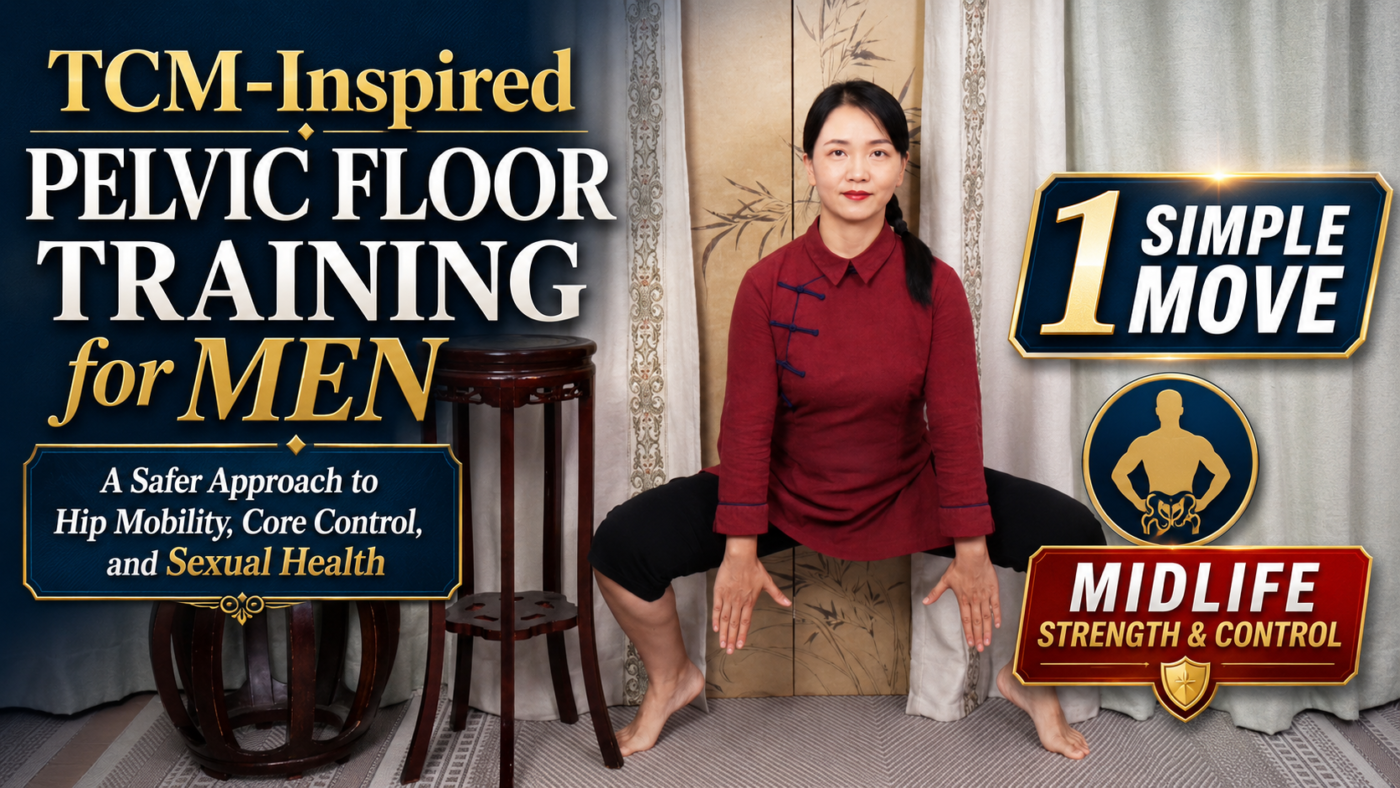
Pelvic floor exercises for men can be a practical way to build pelvic awareness, muscular control, coordination, and lower-body strength. Traditional Chinese wellness approaches describe this region through concepts such as Zongjin, Liver and Kidney meridians, while modern anatomy focuses on the pelvic-floor muscles, nerves, blood vessels, and surrounding structures.Traditional Chinese wellness practices often describe the lower abdomen, groin, pelvis, and reproductive region through the concept of Zongjin, sometimes translated as the “ancestral sinews” or “gathering of the sinews.”
Classical Chinese medicine associates this region with the Liver, Kidney, Stomach meridians and the Chong Mai, or Penetrating Vessel. In traditional theory, healthy movement of qi and blood through these pathways is considered important for lower-body vitality, reproductive function, and overall strength.
Modern anatomy describes the same region very differently.
Sexual function in men depends on a complex interaction among blood vessels, nerves, hormones, psychological factors, the pelvic floor, cardiovascular health, medications, metabolic health, and many other influences.
That means erectile difficulties cannot simply be explained as a “blocked tendon” or a blocked meridian.
However, behind the traditional language is an interesting practical idea: the pelvic floor, hips, lower abdomen, gluteal muscles, and breathing mechanics are all worth training.
This article explores two traditional-style exercises—the first involving gentle awareness around the lower pelvis, and the second involving controlled pelvic movement and pelvic-floor contraction—while separating useful movement principles from claims that go beyond current evidence.
What Is “Zongjin” in Traditional Chinese Medicine?
In traditional Chinese medical literature, Zongjin refers broadly to a gathering of sinews associated with the genital and lower pelvic region.
It should not be interpreted as one specific anatomical tendon.
Traditional theory connects this area with several meridians, particularly the Liver and Kidney systems, because those systems historically played important roles in discussions of reproduction, vitality, and sexual function.
The concept is culturally important, but it is not equivalent to a modern anatomical structure such as the pelvic floor, pudendal nerve, penile arteries, prostate, or erectile tissue.
For contemporary health education, the safest interpretation is to treat Zongjin as a traditional framework describing the functional region around the pelvis and groin.
Erectile Function Is More Complex Than a “Blocked Meridian”
An erection depends heavily on adequate blood flow and intact nerve signaling.
Cardiovascular health, blood pressure, diabetes, smoking, medications, sleep, testosterone levels, stress, depression, anxiety, relationship factors, and pelvic-floor function can all contribute.
Because of that, persistent erectile dysfunction deserves appropriate medical attention.
It can sometimes be an early indicator of cardiovascular or metabolic problems rather than simply a local sexual issue.
No massage, tapping technique, meridian exercise, or seven-day routine can guarantee stronger erections.
The useful goal is therefore not to promise a cure.
It is to improve the physical qualities that exercise can realistically influence: pelvic control, lower-body strength, breathing coordination, movement awareness, and general fitness.
Part 1: Gentle Pelvic Awareness Instead of Forceful Tapping
Some traditional routines recommend repeatedly striking the area around the pubic bone and groin with a hollow palm.
The stated traditional purpose is to “move qi and blood” and “clear stagnation.”
A safer modern interpretation is simply to develop awareness of the lower abdominal and pelvic region.
Repeated hard striking of the pubic area, groin, testicles, or perineum is unnecessary and may cause pain, bruising, tissue irritation, or injury.
If you want to incorporate touch into the routine, use gentle contact rather than force.
How to Locate the Area Safely
Stand comfortably.
The pubic bone lies below the lower abdomen.
Moving downward from the navel toward the pelvis, you can eventually feel the firm bony region at the front of the pelvis.
The groin lies to either side.
There is no need to press deeply.
Avoid pressing directly on the testicles or aggressively manipulating sensitive tissues.
If an area is unusually painful, swollen, firm, or tender, that is not evidence that a meridian is “blocked.”
Persistent pain or swelling should be medically evaluated.
A Gentler Breathing Version
Stand with the feet approximately shoulder-width apart.
Allow the knees to soften slightly.
Relax the abdomen and shoulders.
Place one or both hands gently over the lower abdomen or upper pelvic region.
Take a slow breath in through the nose.
As you exhale, allow the lower abdomen and pelvic floor to relax.
Continue for several breaths.
This may sound much less dramatic than pounding the pelvis, but relaxation is important.
Many people habitually tighten the abdominal wall and pelvic floor when concentrating, exercising, or feeling stressed.
Learning both contraction and relaxation can be valuable.
Part 2: Pelvic Rocking With Pelvic-Floor Engagement
The second exercise in the traditional routine is more interesting from a modern movement perspective.
It combines:
A partial squat.
Controlled pelvic movement.
Arm movement.
Breathing.
Pelvic-floor contraction.
In some versions, calf raises are added as a progression.
This is not a proven treatment for erectile dysfunction, but it can be adapted into a useful coordination exercise.
Starting Position
Stand with your feet approximately shoulder-width apart.
Keep the knees slightly bent.
Do not force the knees forward.
Let the hips soften as though you were beginning to sit into a very shallow squat.
Keep your torso upright.
Avoid exaggerating the movement by arching the lower back.
Your head and shoulders should remain relatively quiet.
Step 1: Find a Neutral Pelvis
Before moving, become aware of the pelvis.
Tilt the pelvis slightly backward.
Then slightly forward.
The movement should be small.
You are not thrusting forcefully.
You are learning controlled pelvic motion.
Once you understand the two directions, return to a comfortable middle position.
Step 2: Extend the Arms
Reach both arms forward with the palms facing downward.
Keep the shoulders relaxed.
The arms mainly serve as a coordination component.
Step 3: Draw the Hands Back
Rotate the wrists and gently form loose fists.
Draw the elbows backward toward the sides of the body.
At the same time, allow the pelvis to move slightly forward.
Do not aggressively thrust the hips.
Keep the movement smooth and controlled.
Step 4: Add a Gentle Pelvic-Floor Contraction
As the pelvis moves forward, gently contract the muscles of the pelvic floor.
For men, one way to identify these muscles is to imagine stopping the flow of urine or preventing the passing of gas.
This is only a visualization.
Repeatedly stopping urine during actual urination is not recommended as a training method.
Contract gently rather than maximally.
Then fully relax the pelvic floor as you return to the starting position.
That relaxation phase is important.
A constantly tight pelvic floor can also contribute to discomfort and dysfunction.
Step 5: Coordinate the Breath
Avoid holding your breath.
A simple pattern is:
Inhale as you return to the starting position.
Exhale during the gentle pelvic-floor contraction.
The breathing does not need to be rigidly timed.
The main objective is to avoid straining.
Do Not Turn This Into Aggressive Pelvic Thrusting
The original routine encourages strong, repeated forward thrusting.
That is unnecessary.
The pelvis should move through a small, controlled range.
The upper body should remain relatively steady.
The lower back should not repeatedly snap into extension.
Think of the movement as controlled pelvic rocking rather than forceful thrusting.
Progression: Add a Calf Raise
Once the basic movement feels easy and coordinated, you can increase the challenge slightly.
During the forward phase, rise gently onto the balls of the feet.
Lift the heels only as high as you can comfortably control.
Then lower the heels as you return.
This adds calf activation and creates a greater balance challenge.
The exercise now combines:
Pelvic control.
Pelvic-floor engagement.
Calf strength.
Ankle stability.
Postural control.
Breathing.
Whole-body coordination.
Traditional practice may describe this as stimulating the Kidney meridian through the feet and “raising yang.”
From a modern perspective, the heel raise simply recruits the calf muscles and increases postural demand.
The two explanations should not be treated as the same physiological mechanism.
How Many Repetitions?
Claims that men must perform 100, 200, or 300 repetitions every day are excessive for most beginners.
More is not automatically better.
Start with approximately 8 to 15 slow repetitions.
Rest.
If the movement remains comfortable and your technique stays controlled, perform another set.
Two or three sets may be enough initially.
Over time, the number can increase gradually.
If your groin, pelvic floor, lower back, knees, or calves become painful, reduce the workload.
Quality matters more than repetition count.
Can Pelvic-Floor Training Help Erectile Function?
There is a more credible idea underneath the original traditional claim.
The pelvic-floor muscles do participate in sexual function.
In men, pelvic-floor training has been studied for conditions including urinary control and erectile difficulties.
However, that does not mean every pelvic exercise will produce dramatic results or that a man will become “hard as steel in seven days.”
Training adaptations generally take time.
And erectile dysfunction can have causes that exercise alone cannot address.
The best interpretation is that appropriately performed pelvic-floor exercises may be one component of a broader men’s health program.
Pelvic-Floor Contraction Is Not the Whole Story
Many people hear “pelvic floor exercise” and immediately think about squeezing harder.
That can be a mistake.
Healthy pelvic-floor function involves both contraction and relaxation.
The muscles must be able to tighten when needed and release when needed.
Constantly clenching throughout the day may contribute to pelvic pain, urinary symptoms, or discomfort.
During this routine:
Contract gently.
Hold only briefly.
Then relax completely.
Do not perform every repetition at maximum intensity.
What the Exercise Cannot Promise
This routine should not be described as being able to:
Guarantee stronger erections in seven days.
Cure erectile dysfunction.
Treat prostate disease.
Resolve urinary disorders.
Correct infertility.
Treat female gynecological disease.
Clear lymphatic “waste” from the genitals.
Open blocked penile arteries.
Increase testosterone dramatically.
Reverse cardiovascular disease.
These are medical claims requiring much stronger evidence.
The value of the exercise lies primarily in movement and muscular training.
What About “Improved Blood Circulation”?
Muscular activity does influence local blood flow.
When muscles repeatedly contract and relax, their metabolic demands change and circulation responds accordingly.
But this does not mean a pelvic exercise mechanically “flushes out” waste products or removes vascular blockage.
If erectile problems are caused by atherosclerosis or another cardiovascular condition, exercise may be part of overall health management, but it is not a method for physically opening an obstructed artery.
Why General Cardiovascular Health Matters
Erectile health is closely connected with vascular health.
For many men, protecting sexual function means protecting overall cardiovascular health.
That includes regular physical activity, maintaining healthy blood pressure, managing diabetes when present, addressing abnormal cholesterol, avoiding smoking, limiting excessive alcohol intake, obtaining adequate sleep, and following appropriate medical treatment.
A short pelvic exercise can complement those habits.
It cannot replace them.
When Erectile Difficulties Should Be Evaluated
Occasional difficulties are common.
Persistent problems are different.
Consider speaking with a qualified healthcare professional if erectile difficulties repeatedly occur, especially if they represent a new change.
Seek appropriate evaluation particularly when sexual changes occur alongside:
Chest discomfort.
Shortness of breath.
Diabetes.
High blood pressure.
Known cardiovascular disease.
Major changes in libido.
Penile pain.
Significant curvature.
Pelvic pain.
Urinary symptoms.
Neurological symptoms.
Persistent erectile dysfunction is a health issue, not simply a matter of willpower or “insufficient yang.”
A Simple Beginner Routine
Try the following version instead of immediately attempting hundreds of repetitions.
Minute 1: Breathing and Relaxation
Stand comfortably and take slow breaths while relaxing the abdomen and pelvic floor.
Minutes 2–3: Pelvic Rocking
Perform 10 to 15 slow pelvic rocking repetitions.
Keep the range small and controlled.
Minutes 3–4: Add Gentle Pelvic-Floor Engagement
Contract gently during the forward phase.
Fully relax during the return.
Minute 5: Optional Heel Raise
If your balance is good, add a small heel raise during the forward phase.
Stop before fatigue causes your technique to deteriorate.
This creates a short routine that is easier to maintain and less likely to encourage excessive straining.
The Traditional Perspective
Traditional Chinese wellness would explain the exercise differently.
The lower pelvic area is often associated with the gathering of the sinews, or Zongjin.
The Liver is traditionally said to “govern the sinews,” while the Kidney system is associated with reproductive vitality and essence.
Exercises involving the pelvis, groin, feet, breathing, and whole-body coordination may therefore be described as supporting the Liver and Kidney meridians and strengthening the body’s yang.
Those concepts belong to a traditional medical framework.
They can be respected without presenting them as proven anatomical mechanisms.
The most responsible approach is to preserve the traditional philosophy while clearly distinguishing it from modern physiology.
Pelvic floor exercises for men should be performed with controlled breathing rather than excessive straining.
For beginners, pelvic floor exercises for men do not require hundreds of repetitions.
Some pelvic floor exercises for men combine contraction with controlled hip movement.
The effectiveness of pelvic floor exercises for men depends on consistency, technique, and the underlying cause of symptoms.
Pelvic floor exercises for men are best viewed as part of a broader healthy-aging and fitness program.
The Takeaway
The claim that one exercise can make a man’s sexual performance dramatically stronger in seven days is not medically reliable.
But the original practice contains several worthwhile movement principles.
Controlled pelvic movement can improve body awareness.
Pelvic-floor training can strengthen muscles involved in continence and sexual function.
Calf raises can strengthen the lower legs.
Slow breathing can reduce unnecessary tension.
And combining these elements creates a simple coordination exercise that can be practiced without equipment.
If you want to use this traditional routine, focus on those realistic benefits.
Do not hit sensitive areas aggressively.
Do not chase hundreds of repetitions immediately.
Do not hold your breath.
Do not treat pain as proof that something is “blocked.”
Train gradually, learn both pelvic-floor contraction and relaxation, and remember that sexual health is closely connected with overall cardiovascular, metabolic, neurological, hormonal, and psychological health.
That is a more useful—and safer—way to bring an old traditional concept into modern daily practice.
Frequently Asked Questions
Is Zongjin a real anatomical tendon?
Not in modern anatomy. Zongjin is a traditional Chinese medical concept describing the convergence of sinews and functional relationships around the pelvic and genital region.
Can pelvic-floor exercises improve erectile function?
Pelvic-floor training may help some men, particularly as part of a structured program, but results vary and it should not be presented as a guaranteed cure.
How quickly should results appear?
There is no reliable seven-day timeline. Muscular training usually requires consistent practice over weeks or longer, and erectile difficulties may have causes unrelated to pelvic-floor strength.
Should I strike or slap the pubic area?
Forceful striking is unnecessary. Gentle contact is safer. Avoid striking the testicles, perineum, or painful areas.
Should I perform 200 or 300 repetitions every day?
Beginners generally do not need anywhere near that number. Start with small sets of controlled repetitions and increase gradually.
Is stronger contraction always better?
No. Pelvic-floor muscles need both strength and the ability to relax. Excessive clenching may create tension and discomfort.
Can this exercise replace medical treatment for erectile dysfunction?
No. Persistent erectile dysfunction deserves appropriate medical evaluation because vascular, neurological, hormonal, medication-related, and psychological factors may all be involved.
Medical Disclaimer
This article is for educational and general wellness purposes only and is not medical advice. Traditional Chinese medicine concepts such as Zongjin, qi, meridians, Kidney yang, and Liver qi represent a traditional wellness framework and should not be interpreted as established anatomical structures or physiological mechanisms. The exercises described here are not treatments for erectile dysfunction, infertility, prostate disease, urinary disorders, cardiovascular disease, or other medical conditions. Seek appropriate professional evaluation for persistent sexual, urinary, pelvic, or cardiovascular symptoms.
This article is for general education and does not replace individualized care from a qualified health professional. Seek appropriate advice for persistent, severe, or concerning symptoms.
Read the full medical disclaimer