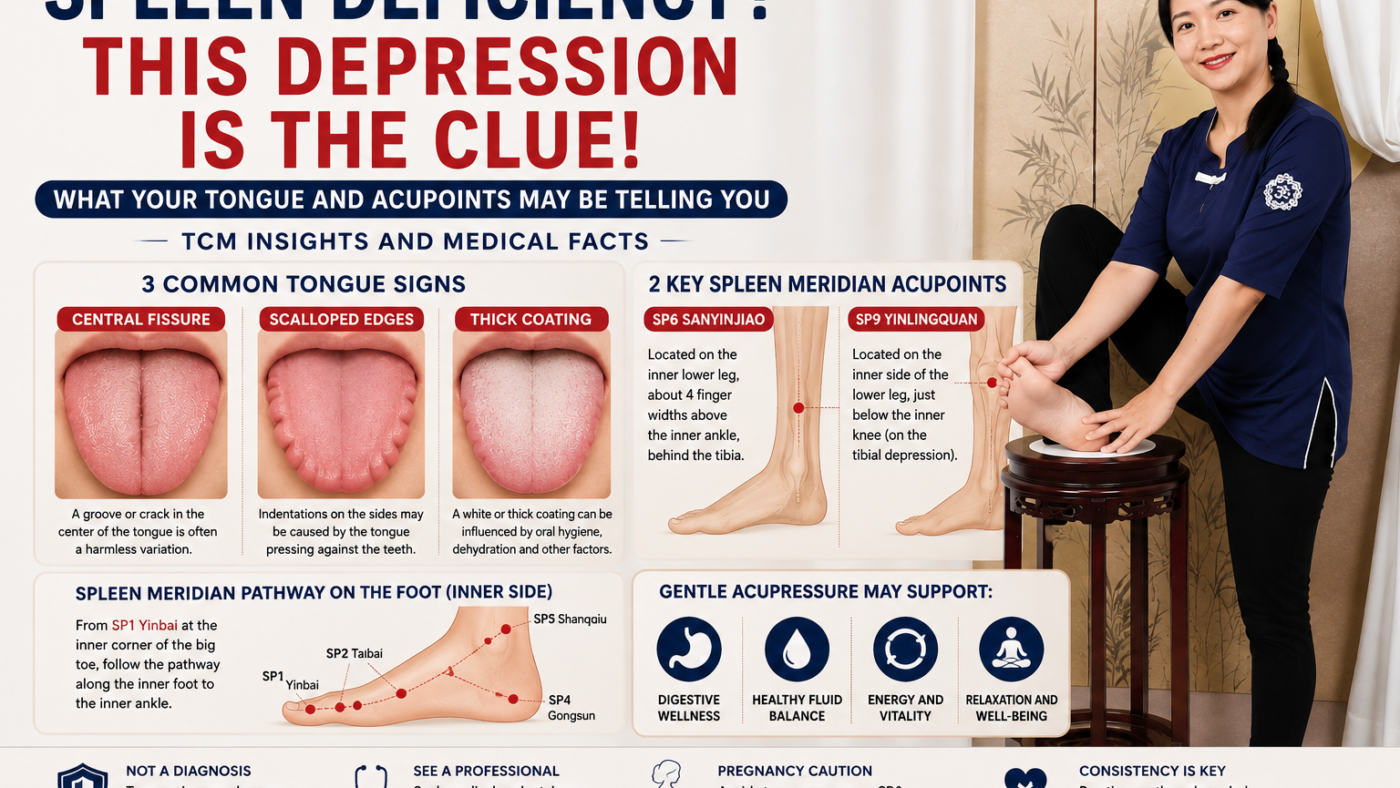
What Does a Fissured or Scalloped Tongue Mean? TCM Insights and Medical Facts
Have you ever looked in the mirror and noticed that your tongue suddenly seems different?
Perhaps there is a deep groove running down the center.
Maybe the edges have small indentations that look like tooth marks.
Or perhaps the tongue is covered by a thicker white coating than usual.
Traditional Chinese Medicine has examined the tongue for centuries as one part of a broader assessment of health patterns. In that system, practitioners consider features such as tongue color, shape, moisture, coating and location of changes.
Modern medicine looks at the tongue differently.
A tongue can provide useful clues about oral and general health, but one specific tongue feature usually cannot diagnose the condition of a particular internal organ.
Understanding both perspectives allows us to appreciate traditional wellness practices without turning a visual observation into an unsupported medical diagnosis.
What a Central Tongue Fissure May Mean
One of the most noticeable tongue changes is a groove or crack running along the center of the tongue.
This is commonly called a fissured tongue.
For many people, a fissured tongue is simply a harmless anatomical variation.
Some people have one prominent central groove, while others have several smaller grooves branching across the surface.
The fissures themselves usually do not require treatment.
The main practical concern is that food particles, bacteria and debris can sometimes become trapped inside deeper grooves.
Good oral hygiene is therefore particularly important.
Gently brushing or cleaning the tongue can help keep the surface clean and reduce the likelihood of irritation or bad breath.
A tongue fissure by itself does not prove that the stomach, spleen or another internal organ is weak.
The Traditional Chinese Medicine Perspective
Traditional Chinese Medicine uses a very different framework from modern anatomy and physiology.
In TCM, the tongue is sometimes described as a visible reflection of internal functional patterns.
Different regions of the tongue are traditionally associated with different organ systems.
The central region is commonly discussed in relation to the Spleen and Stomach systems.
It is important to understand that the TCM concept of the Spleen is not identical to the anatomical spleen recognized in Western medicine.
In traditional theory, the Spleen system is associated with digestion, transformation of food, transportation of nutrients and maintenance of functional energy.
A practitioner might therefore consider a central tongue depression, certain cracks, a swollen tongue, fatigue, poor appetite and digestive complaints together when evaluating what TCM calls Spleen Qi deficiency.
But a tongue photograph alone cannot confirm this traditional pattern.
Nor can a central fissure medically diagnose digestive weakness.
The tongue should always be interpreted in context.
What About Teeth Marks Along the Tongue?
Small indentations around the sides of the tongue are often called a scalloped tongue.
The pattern can appear when the tongue repeatedly presses against the teeth.
There are several possible reasons this may happen.
Some people naturally have a larger tongue relative to the available space in the mouth.
Others may clench their jaw or grind their teeth.
Tongue swelling can also contribute.
Hydration status, nutritional issues, thyroid disorders, sleep apnea and other medical conditions may sometimes be associated with tongue enlargement or scalloping.
This is why tooth marks should not automatically be interpreted as proof of poor digestion or low energy.
If scalloping is persistent, new or accompanied by other symptoms, it is reasonable to discuss it with a doctor or dentist.
What Does a Thick Tongue Coating Mean?
A tongue coating can change considerably from day to day.
A white or thicker coating may occur because bacteria, dead cells and debris become trapped around the small projections on the tongue called papillae.
Dry mouth and dehydration can contribute.
Smoking, mouth breathing, illness, certain medications and inadequate oral hygiene may also affect the tongue surface.
Some tongue coatings are harmless and temporary.
Others may be associated with conditions such as oral thrush or other oral disorders.
Traditional Chinese Medicine also places considerable emphasis on tongue coating.
Practitioners traditionally observe its color, thickness, moisture and distribution as part of pattern differentiation.
The traditional interpretation can be interesting and useful within the TCM framework, but a coating should not be used by itself to diagnose a specific internal disease.
Can Your Tongue Tell You That Your Organs Are Prolapsing?
No reliable medical evidence shows that a central tongue depression predicts stomach prolapse, uterine prolapse or other organ prolapse.
These conditions have their own anatomical and medical causes.
Pelvic organ prolapse, for example, may involve changes in pelvic floor muscles and connective tissues.
If someone experiences pelvic pressure, a vaginal bulge, urinary symptoms or other signs of pelvic floor problems, proper medical assessment is much more useful than examining the tongue.
Similarly, persistent digestive symptoms such as unexplained abdominal pain, difficulty swallowing, repeated vomiting, significant weight loss or major changes in bowel habits deserve medical evaluation.
Traditional Acupressure and the Spleen Meridian
The original traditional practice associated with this topic involves massaging areas along the medial side of the foot and lower leg.
In TCM terminology, this corresponds to part of the Spleen meridian.
Acupressure uses finger pressure rather than needles.
Some people find acupressure relaxing, and gentle massage may help reduce muscle tension and encourage body awareness.
However, it should be considered a complementary wellness practice rather than a treatment that has been proven to restore an internal organ or cure chronic disease.
Two points commonly used in this traditional sequence are Sanyinjiao and Yinlingquan.
Sanyinjiao SP6
Sanyinjiao is traditionally known as SP6.
It is located on the inner lower leg, several finger widths above the highest point of the inner ankle and close to the back edge of the tibia.
The name Sanyinjiao is often translated as Three Yin Intersection because traditional theory describes this region as a meeting point involving the Spleen, Liver and Kidney meridians.
In traditional practice, SP6 is commonly associated with digestive, gynecological and general wellness applications.
Modern scientific research has not established that pressing this point can correct Spleen Qi deficiency or cure digestive disease.
If you choose to use it, think of it as gentle self massage rather than medical treatment.
Pregnancy deserves special caution.
SP6 has traditionally been used in practices related to labor and reproductive health.
Pregnant people should therefore avoid strong or prolonged stimulation of this point unless a qualified maternity healthcare professional advises otherwise.
Yinlingquan SP9
Yinlingquan is known as SP9.
It is traditionally located on the inner side of the upper lower leg, near the lower border of the medial tibial condyle.
In TCM, SP9 is often described as a point associated with the transformation of fluids and what traditional practitioners call dampness.
The word dampness in TCM should not be confused with a measurable accumulation of water or toxins inside the body.
It is a traditional pattern concept.
Pain when pressing SP9 does not prove that you have excess dampness.
Tenderness can occur for many ordinary reasons, including pressure on muscle, connective tissue or sensitive structures.
More pain does not mean the treatment is working better.
How to Practice Gentle Lower Leg Acupressure
Sit comfortably with your leg supported.
You may apply a small amount of unscented lotion or massage oil if this makes the movement more comfortable.
Avoid using products that irritate your skin.
Begin near the inner ankle.
Using the pads of your fingers rather than a sharp fingertip, gently massage upward along the soft tissues beside the inner edge of the tibia.
Pressure should feel comfortable.
You may notice mild tenderness, but the goal is not to create strong pain.
Continue gradually toward the upper inner portion of the lower leg.
When you reach the general region traditionally associated with SP9, use gentle circular pressure for approximately 30 to 60 seconds.
Then relax.
Repeat on the other leg if comfortable.
There is no medical reason that the massage must last exactly three, five or eight minutes.
There is also no evidence that pain disappearing after several sessions means that a blockage or dampness has been removed.
Use comfort rather than pain as your guide.
Acupressure Along the Inner Foot
The traditional Spleen meridian also includes points along the inner side of the foot.
One of the first points is Yinbai, known as SP1.
It is traditionally located near the inner corner of the big toenail.
Moving backward along the inner foot, the traditional pathway includes several other points such as Dadu SP2, Taibai SP3, Gongsun SP4 and Shangqiu SP5.
For a simple self massage routine, there is no need to locate every point perfectly.
Sit in a position that allows you to reach your foot comfortably.
Gently massage from the inner side of the big toe toward the inner arch and ankle.
Use slow, comfortable pressure.
Do not aggressively dig into painful spots or attempt to break up lumps.
A tender or firm area is not proof of a blocked meridian.
If you discover a persistent lump, swelling, unusual warmth or unexplained pain, stop massaging the area and have it assessed appropriately.
Is 9 AM to 11 AM Really the Best Time?
Traditional Chinese Medicine includes a body clock theory in which different meridian systems are associated with different two hour periods of the day.
Within this framework, the Spleen is traditionally associated with approximately 9 AM to 11 AM.
Some practitioners therefore prefer Spleen related practices during this period.
Modern medicine has not established that acupressure on the Spleen meridian becomes more effective specifically between 9 AM and 11 AM.
If you enjoy using the traditional timing as part of a wellness routine, there is generally no need to avoid it.
But consistency and comfort are more important than performing the massage at one exact hour.
Can Acupressure Restore Energy and Digestion?
This is where health claims need to remain realistic.
Acupressure cannot currently be said to rebuild blood, reverse organ prolapse or cure multiple chronic diseases.
Research on acupuncture and acupressure has explored many symptoms and conditions, but results vary considerably depending on the condition and study design.
For digestive disorders such as irritable bowel syndrome, acupuncture has not consistently performed better than sham acupuncture in well controlled studies.
This does not mean that every person experiences no benefit.
Relaxation, touch, expectation, nervous system responses and the experience of receiving care can all influence how someone feels.
But complementary practices should not replace appropriate medical diagnosis or treatment.
A Better Way to Use Traditional Wellness Practices
The most useful approach is not to choose between traditional wisdom and modern medicine.
They can be placed in appropriate roles.
You can use tongue observation as a way to notice changes in your oral health.
You can explore TCM tongue theory as part of a traditional wellness system.
You can use gentle acupressure as a calming self care ritual.
At the same time, use evidence based medical care when symptoms suggest that something needs investigation.
This approach preserves the cultural value of traditional practice without turning an interesting observation into a diagnosis that it cannot reliably provide.
When Tongue Changes Should Be Checked
Many tongue variations are harmless.
However, contact a doctor or dentist if you notice a change that is persistent, painful or difficult to explain.
Seek professional evaluation for an ulcer or sore that does not heal, unexplained bleeding, persistent red or white patches, a firm lump, increasing tongue pain, difficulty swallowing, significant swelling or a tongue change that continues for more than a couple of weeks.
Sudden tongue or throat swelling accompanied by difficulty breathing is an emergency and requires immediate medical attention.
Frequently Asked Questions
Does a Crack in the Middle of the Tongue Mean Spleen Deficiency?
Not in modern medical diagnosis.
Traditional Chinese Medicine may consider central tongue features as part of a broader Spleen and Stomach pattern assessment, but a fissure alone cannot establish Spleen Qi deficiency.
Are Tongue Fissures Dangerous?
Most fissured tongues are harmless.
Keeping the tongue clean is useful because food and bacteria can collect inside deeper grooves.
What Causes Teeth Marks on the Tongue?
A scalloped tongue can occur when the tongue presses against the teeth.
Possible contributors include tongue swelling, jaw clenching, dehydration and several medical conditions.
Persistent changes deserve professional assessment rather than self diagnosis.
Does a Thick White Coating Mean Poor Digestion?
Not necessarily.
Tongue coating can be affected by oral hygiene, dehydration, mouth breathing, smoking, medications and other factors.
Persistent white patches or unusual coatings should be checked by a healthcare professional.
Can I Massage SP6 and SP9 Every Day?
Gentle pressure is generally more sensible than aggressive massage.
Stop if you experience significant pain, bruising, numbness, swelling or worsening symptoms.
Pregnant people should seek professional advice before strongly stimulating SP6.
Does Pain at an Acupressure Point Mean a Meridian Is Blocked?
There is no reliable scientific test showing that tenderness at an acupressure point proves a meridian blockage.
Tenderness can arise from muscles, connective tissue, pressure sensitivity or other local causes.
Can Acupressure Cure Digestive Problems?
Acupressure should not be presented as a cure for digestive disease.
It may be used as a complementary relaxation or self care practice while proven treatments and medical evaluation remain available when needed.
Bottom Line
Your tongue can provide useful clues about oral health, but it is not a simple map that allows you to diagnose individual internal organs.
A central fissure is often harmless.
Scalloped edges can have several possible causes.
A thick coating can arise from common oral and lifestyle factors.
Traditional Chinese Medicine offers another way of interpreting tongue patterns and has a long history of incorporating tongue observation into broader assessments.
Gentle massage along traditional Spleen meridian areas such as SP6 and SP9 can also be practiced as a form of self care when it feels comfortable.
The safest approach is to appreciate these practices for what they are while avoiding unsupported promises.
Acupressure should not be expected to cure chronic disease, eliminate mysterious toxins, reverse organ prolapse or replace necessary medical treatment.
Pay attention to your body, keep your oral health routine consistent and seek professional care when a tongue change is persistent or accompanied by concerning symptoms.
Affiliate Disclosure
This article may contain affiliate links. If you purchase through one of these links, we may earn a commission at no additional cost to you. Affiliate relationships do not influence our editorial standards or health recommendations.
Medical Disclaimer
This article is for educational and informational purposes only and is not medical advice. Traditional Chinese Medicine concepts discussed here represent a traditional health framework and are not equivalent to modern medical diagnoses. Acupressure should not replace evaluation or treatment from a qualified healthcare professional.
This article is for general education and does not replace individualized care from a qualified health professional. Seek appropriate advice for persistent, severe, or concerning symptoms.
Read the full medical disclaimer