What if one minute of movement could become the beginning of a stronger lower body?
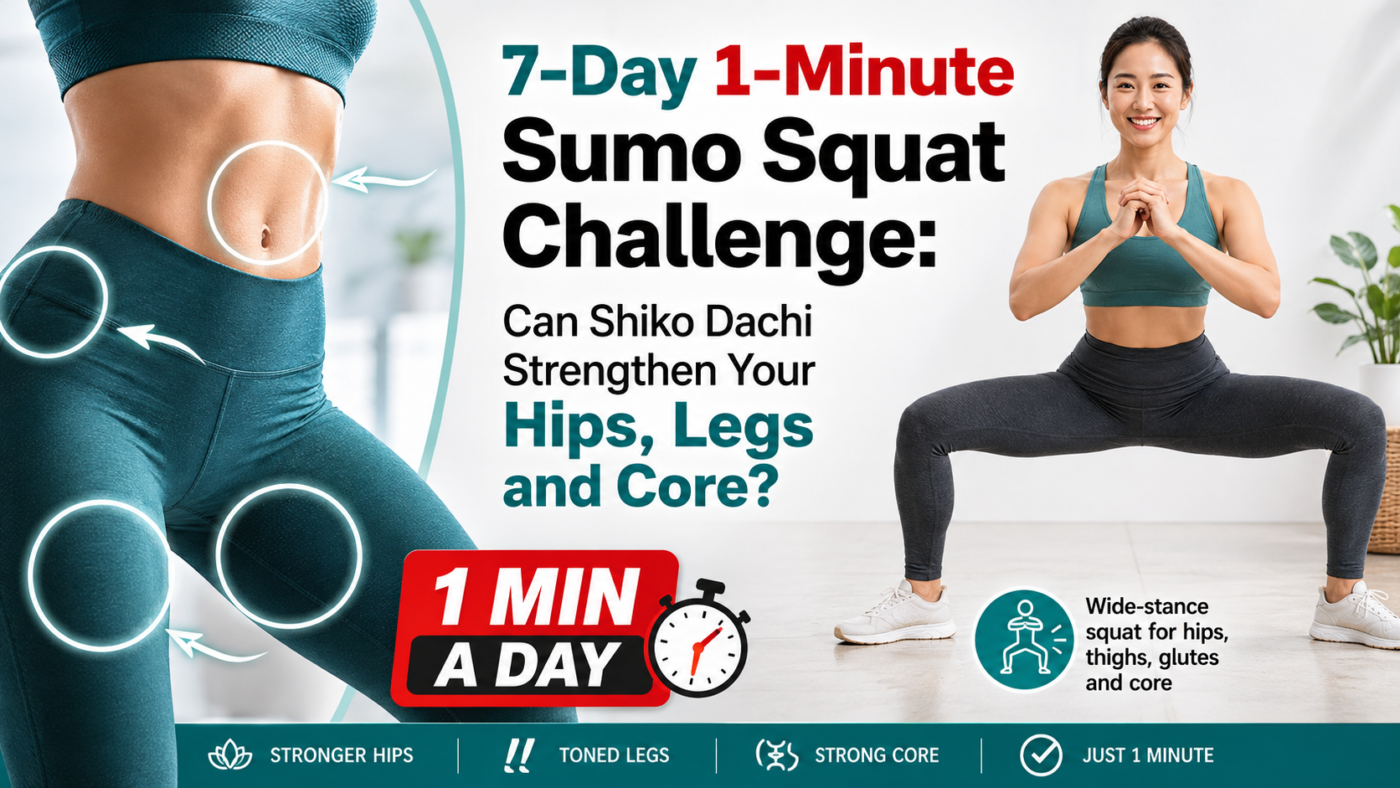
The 7-Day 1-Minute Sumo Squat Challenge is built around a wide, low stance inspired by Shiko Dachi, a traditional stance found in Japanese martial arts. With the feet positioned wider than the shoulders, the toes turned outward and the knees bent, the body settles into a position somewhere between standing and sitting.
It looks simple.
Hold it for long enough, however, and your thighs, hips, glutes and core quickly realize that they are working.
The original challenge promises dramatic changes from only one minute a day. Science calls for more realistic expectations: seven minutes of exercise spread across a week will not fundamentally transform body composition, melt lower-belly fat or dramatically increase metabolism.
But that does not make the exercise useless.
A short daily challenge can introduce resistance training, improve movement awareness, challenge muscular endurance and help people establish a consistent exercise habit. For someone who spends much of the day sitting, even a minute of deliberate lower-body movement can feel surprisingly demanding.
Here is what this Japanese-inspired squat can realistically do—and how to perform it safely.
What Is Shiko Dachi?
Shiko Dachi is a wide, grounded stance used in several Japanese and Okinawan martial-arts traditions, particularly karate.
The feet are positioned relatively wide apart and turned outward, while the knees bend in the same general direction as the toes. The hips descend and the body maintains a stable center of gravity.
The word and movement also have similarities to shiko, a fundamental exercise associated with sumo training, although traditional sumo shiko and the karate stance called Shiko Dachi should not be treated as exactly the same exercise.
For a modern fitness routine, the movement is easiest to understand as a variation of a wide-stance bodyweight squat.
Compared with ordinary standing, the position requires continuous muscular effort from the hips and legs. Compared with sitting in a chair, your muscles—not a seat—must support your body.
That is exactly why the position can become challenging so quickly.
Why Modern Bodies May Find This Position Difficult
Many adults spend hours each day alternating between two positions: sitting and standing.
Neither necessarily requires the hips and knees to remain deeply flexed under muscular tension.
A wide squat changes that.
Your quadriceps help control the knees. Your gluteal muscles contribute to hip extension and stability. Muscles around the hips help maintain the wide stance. Your trunk muscles work to stabilize your torso while your legs remain under tension.
Research examining squat variations also shows that changing stance width changes the mechanical demands placed on the hips and lower-body muscles.
A wider stance does not magically activate every “sleeping muscle,” but it does produce a somewhat different loading pattern from a narrow squat.
That variation can be useful.
What Muscles Does a Wide Sumo Squat Work?
A well-controlled wide-stance squat can challenge several major muscle groups simultaneously.
These include the quadriceps at the front of the thighs, gluteal muscles around the hips, hamstrings, hip rotators, muscles of the inner thighs and the muscles that stabilize the trunk.
Exactly how much each muscle contributes depends on your stance width, squat depth, anatomy, mobility, technique and whether additional resistance is being used.
A wider stance tends to change hip mechanics and may increase demands on portions of the posterior chain and muscles responsible for controlling the hip.
This is one reason the exercise often feels quite different from a conventional bodyweight squat.
Can It Loosen Stiff Hips?
Possibly—but “loosen” needs to be understood carefully.
Moving through a comfortable squat position can expose the hips to ranges of motion they may not experience during normal sitting and walking.
When practiced consistently and without pain, squatting can become part of a mobility program and may help some people feel more comfortable moving their hips.
However, one minute of Shiko Dachi cannot permanently “open” the hip joints.
Mobility is influenced by joint anatomy, muscle strength, nervous-system tolerance, previous injuries and training history.
The goal should therefore be gradual improvement in comfortable movement rather than forcing the knees or hips farther outward.
Does the Exercise Improve Blood Flow?
Working muscles require increased circulation.
When the muscles of the legs repeatedly contract and relax, local blood flow changes and muscular activity can assist venous return.
That is a normal physiological response to movement.
Claims that one particular squat position dramatically “cleans the lymphatic system” or uniquely increases lymph flow, however, go beyond what current evidence can establish.
Regular movement is healthy.
There is simply no need to attach an exaggerated detoxification claim to it.
Can Shiko Dachi Correct Pelvic Misalignment?
This is another popular fitness claim that deserves clarification.
The pelvis is not normally something that needs to be pushed back into a perfect universal alignment.
Human posture naturally varies.
Strengthening the muscles around the hips and trunk can improve control, balance and movement capacity, and learning to maintain a stable trunk during squatting can improve technique.
But a one-minute squat should not be described as mechanically “realigning” the pelvis.
A better goal is pelvic and trunk control.
During the challenge, aim to keep your ribs comfortably stacked over the pelvis, brace the abdomen gently and avoid excessive arching or rounding of the lower back.
Will One Minute of Sumo Squats Boost Your Metabolism?
Every physical activity uses energy.
A demanding squat hold or repeated bodyweight squat therefore increases energy expenditure while you are performing it.
But one minute is still one minute.
It is unlikely to create a large or lasting increase in daily calorie expenditure by itself.
Resistance training performed consistently over time can increase muscular fitness and, when enough training volume is accumulated, support increases in muscle mass. Those adaptations can contribute to long-term metabolic health.
The key words are consistently over time.
A seven-day challenge is a beginning, not a complete metabolic program.
Can It Flatten the Lower Belly?
A sumo squat can train the trunk and lower body, but it cannot selectively remove fat from the lower abdomen.
This is the principle behind the well-established limitation of “spot reduction.”
Working a specific muscle does not mean the body will preferentially burn the fat directly above that muscle.
Losing excess body fat generally depends on the overall balance between energy intake and energy expenditure over time, together with factors such as physical activity, nutrition, sleep and individual biology.
The same applies to the thighs and hips.
Sumo squats can make the muscles in those regions stronger. They cannot command the body to remove fat only from those locations.
That distinction matters.
What About Brown Fat in the Back?
The original challenge makes an especially interesting claim: swinging the arms supposedly activates the shoulder blades, which activates brown fat in the back and causes whole-body fat burning.
Brown adipose tissue is real.
Unlike white fat, which primarily stores energy, brown adipose tissue can produce heat through thermogenesis. Adults retain varying amounts of metabolically active brown fat, commonly around regions such as the neck and upper chest.
However, the relationship between exercise and human brown adipose tissue is much more complicated than social-media fitness claims suggest.
Human studies have produced mixed findings regarding whether exercise meaningfully increases brown-fat activity. Much of the stronger evidence for exercise-induced “browning” of fat tissue comes from animal research.
There is currently no good evidence that simply swinging your arms during a sumo squat specifically activates brown fat around your shoulder blades and causes significant whole-body fat loss.
Swing your arms because they add movement, coordination and perhaps a little additional exercise intensity—not because they supposedly switch on a hidden fat-burning furnace.
The Real Value of the One-Minute Challenge
The most useful part of this challenge may have nothing to do with dramatic fat loss.
It is its simplicity.
“One minute today” feels psychologically easier than “begin a complete strength-training program.”
And once people begin moving regularly, a tiny routine can become a gateway to something more substantial.
During that minute you can challenge muscular endurance, practice squat mechanics, become more aware of the hips and knees, elevate your effort level and establish a daily movement cue.
For a beginner, that is meaningful.
How to Set Up the Sumo Squat Position
Start standing tall.
Place your feet somewhat wider than shoulder width.
Turn your toes outward to a comfortable angle rather than forcing them into an extreme position.
Your knees should generally travel in the same direction as your toes when you bend them.
Gently brace your abdominal muscles.
Keep your torso controlled and your spine comfortable.
Now bend your knees and hips and lower yourself into a wide squat.
There is no requirement to make your thighs perfectly parallel to the floor.
Go only as low as you can while maintaining control and remaining pain-free.
The deeper you squat, the more demanding the movement will generally become.
Beginners should start higher.
A Better Cue Than “Tuck Your Butt In”
The original instructions repeatedly tell you to pull the belly in and tuck the buttocks underneath.
The intention is understandable: avoid letting the stomach fall forward while excessively arching the lower back.
But aggressively forcing the pelvis into a posterior tilt is not necessary.
Instead, think:
Brace your core, keep your rib cage over your pelvis and maintain a comfortable neutral trunk.
Your pelvis will naturally move as you squat.
You do not need to freeze it into one rigid position.
Keep Your Knees and Toes Moving Together
One of the most useful instructions from the original routine is to pay attention to the relationship between the knees and feet.
With the toes turned outward, allow the knees to bend in approximately the same direction.
Do not force the knees excessively inward or push them aggressively outward beyond what feels natural.
The appropriate foot angle and stance width differ between people because hip structure and mobility vary considerably.
Comfort and control matter more than copying an exact angle from another person’s body.
The 30-Second Warm-Up
Before beginning the full minute, spend approximately 30 seconds exploring the position.
Stand with your feet wide.
Bend your knees slightly.
Shift gently toward one side while keeping both feet grounded.
You may feel a stretch through the inner thigh of the opposite leg.
Return to the center and move toward the other side.
Alternate slowly.
You can place your hands lightly on your thighs for support, but avoid aggressively pressing the knees into positions they do not naturally want to reach.
The objective is to prepare the hips—not force them open.
The 1-Minute Sumo Squat Challenge
Now begin the challenge.
Take your wide stance.
Turn your toes comfortably outward.
Bend your knees and lower your hips.
Brace your abdomen gently.
Keep your chest controlled rather than collapsing forward.
Hold a comfortable squat depth.
Now swing your arms naturally from side to side or forward and back while maintaining control through the lower body.
Continue for up to 60 seconds.
Your thighs may start burning surprisingly quickly.
That burning sensation generally reflects muscular fatigue and metabolite accumulation during sustained muscular work—not body fat physically “burning away.”
If 60 seconds is too difficult, rise slightly higher.
If necessary, stop, recover and continue.
There is no prize for sacrificing technique simply to reach the clock.
The Seven-Day Progression
Day 1: Learn the Position
Focus entirely on technique.
Find a stance width and toe angle that feel natural.
Do not worry about squatting deeply.
Your objective is simply to complete the movement comfortably.
Day 2: Control the Knees
Pay attention to how the knees move relative to the toes.
Maintain steady foot contact with the floor.
Avoid letting one knee collapse inward.
Day 3: Find Your Core
Gently brace your abdomen throughout the challenge.
Keep your trunk controlled while breathing normally.
Do not hold your breath unnecessarily.
Day 4: Notice Muscular Endurance
By this stage, the exercise may feel more familiar.
You might notice that the same minute feels slightly easier.
That does not necessarily mean dramatic new muscle has appeared within four days.
Early improvements can reflect better coordination, familiarity with the exercise, improved pacing and nervous-system adaptations.
Day 5: Explore a Slightly Deeper Position
If your technique is stable and the movement is pain-free, try lowering your hips slightly farther.
Only a small change is necessary.
Depth should be earned through control.
Day 6: Improve the Arm Swing
Maintain the squat while allowing the arms to move rhythmically.
Try to keep the lower body stable rather than bouncing or twisting excessively.
Day 7: Complete Your Best Controlled Minute
Your final challenge is not to squat as low as possible.
It is to perform your cleanest minute.
Compare how the position feels with Day 1.
Do you feel more stable?
Can you maintain the stance longer?
Does the movement require less concentration?
Those improvements are more meaningful than expecting a dramatic physical transformation in seven days.
What You May Notice After Seven Days
Seven days is enough time to become familiar with an unfamiliar movement.
Some beginners may notice better confidence in the squat position, greater tolerance for sustained leg tension, improved awareness of their knee and hip position or a subjective improvement in muscular endurance.
You may also simply feel motivated because you successfully exercised every day for a week.
What you should not expect is dramatic muscle growth, substantial fat loss or a major transformation in resting metabolism.
Those outcomes require more training volume and more time.
How to Turn Seven Days Into Real Results
This is where the challenge becomes genuinely valuable.
Do not stop after Day 7.
Instead, use it as an entry point into progressive resistance training.
For example, you might progress from one 60-second round to two or three rounds.
You could alternate static holds with controlled repetitions.
Later, resistance could be added with a dumbbell or kettlebell if appropriate.
You can also combine the squat with other movement patterns such as pushing, pulling, hinging, carrying and walking.
Current resistance-training evidence consistently shows that regular progressive resistance exercise can improve strength, muscular endurance, muscle size and physical function.
Those adaptations occur through repeated training—not through one magical exercise.
One Minute Is a Starting Point, Not the Entire Workout
Public-health recommendations encourage adults to perform muscle-strengthening activities involving the major muscle groups on at least two days each week, alongside regular aerobic activity.
The Shiko Dachi challenge can contribute to that lifestyle, but it should not be mistaken for a complete exercise program.
Think of the one-minute squat as the first page of a longer training plan.
Consistency gives it value.
Progression produces greater adaptation.
Who Should Be Careful?
A wide, deep squat can place substantial demands on the hips, knees and ankles.
People with significant knee or hip pain, recent surgery, acute injury, severe balance problems or other conditions affecting exercise tolerance should modify the exercise or seek individualized professional advice.
During the movement, muscle fatigue is expected.
Sharp pain is not.
Stop if you experience sharp joint pain, dizziness, chest pain, unusual shortness of breath or symptoms that concern you.
Final Takeaway
The 7-Day 1-Minute Sumo Squat Challenge is appealing because it asks for almost nothing: sixty seconds.
And that may be exactly why it works as a habit-building tool.
Shiko Dachi and wide-stance squat variations can challenge the thighs, hips, glutes and trunk. They can introduce the body to a position many sedentary adults rarely practice and provide a simple form of bodyweight resistance exercise.
What they cannot reliably do is selectively burn lower-belly fat, instantly correct pelvic alignment, dramatically boost metabolism or switch on brown fat in the back simply by swinging the arms.
The scientifically stronger message is also the more useful one.
One minute will not transform your body.
But one minute can start a routine.
Seven days can establish momentum.
And if that small challenge grows into months and years of consistent strength training and physical activity, the results can become much more meaningful.
Frequently Asked Questions
Is one minute of sumo squats a day enough to get stronger?
A one-minute squat challenge can provide a small muscular stimulus, particularly for an untrained beginner, but meaningful long-term strength gains generally require progressive resistance training performed consistently over time.
Will sumo squats reduce lower-belly fat?
Not specifically. Sumo squats train muscles in the lower body and trunk, but exercise cannot reliably choose where body fat is lost.
Are sumo squats good for the hips?
They can challenge hip strength and mobility when performed within a comfortable range. People with hip pain or significant mobility restrictions should avoid forcing a deep or excessively wide position.
Should my toes point outward?
A moderately outward toe position is normal for a wide squat. The exact angle should suit your individual anatomy. Allow the knees to travel generally in the same direction as the toes.
How deep should I squat?
Only as deeply as you can maintain comfortable, controlled technique. A shallow squat is completely acceptable for beginners.
Does swinging the arms activate brown fat?
There is no convincing evidence that arm swinging during a squat specifically activates brown adipose tissue in the back enough to produce meaningful fat loss.
Will my body change after seven days?
You may notice improved familiarity, confidence, coordination or muscular endurance. Dramatic changes in body composition or muscle size should not be expected from seven minutes of total exercise.
Can I continue after the seven-day challenge?
Yes. The most useful next step is to gradually increase training volume or integrate the exercise into a balanced resistance-training program.
Medical and Fitness Disclaimer
This article is provided for educational purposes only and is not medical diagnosis, treatment or individualized exercise prescription. Exercise ability varies according to age, health, injury history and physical condition. Stop exercising if you develop sharp pain, chest pain, dizziness, unusual shortness of breath or other concerning symptoms, and seek appropriate medical advice when necessary.
References
American College of Sports Medicine. Resistance Training Prescription for Muscle Function, Hypertrophy, and Physical Performance in Healthy Adults: An Overview of Reviews. Medicine & Science in Sports & Exercise, 2026.
U.S. Department of Health and Human Services. Physical Activity Guidelines for Americans.
Hopkins JE, Hopkins CE, Chiu LZF. Greater Squat Stance Width Alters Three-Dimensional Hip Moment Demands. Journal of Biomechanics.
Lorenzetti S, et al. How to Squat? Effects of Various Stance Widths, Foot Placement Angles and Level of Experience on Knee, Hip and Trunk Motion and Loading.
Mendez-Gutierrez A, et al. Endocrine Mechanisms Connecting Exercise to Brown Adipose Tissue Metabolism: A Human Perspective.
Sanchez-Delgado G, et al. Role of Exercise in the Activation of Brown Adipose Tissue.
This article is for general education and does not replace individualized care from a qualified health professional. Seek appropriate advice for persistent, severe, or concerning symptoms.
Read the full medical disclaimer