You do not need a treadmill, gym membership or complicated choreography to get a meaningful cardiovascular workout.
Sometimes all you need is enough floor space to march.
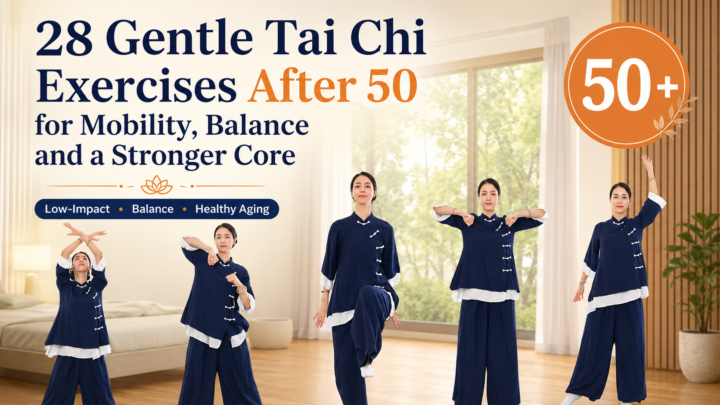
A 30-minute indoor walking workout can combine marching, side steps, arm movements, trunk mobility, knee lifts and rhythmic coordination into a surprisingly complete low-impact session.
For adults over 40, this type of routine has several practical advantages.
It is easy to modify.
It requires no equipment.
It can raise the heart rate without jumping.
It can be performed at home.
And because the movements constantly change, it may feel more like dancing than traditional exercise.
Some versions of this workout also incorporate the traditional Japanese concept of the Tanden, using the lower abdomen as a mental center for balance, posture and movement.
That body-awareness cue can be useful.
What should be avoided are exaggerated promises that the routine will make someone “20 years younger,” activate brown fat so intensely that fat burns 70 times faster, or suddenly begin burning body fat only after the 20-minute mark.
The real benefits are already good enough.
Why Indoor Walking Is More Effective Than It Looks
Marching in place is still physical activity.
Every step requires repeated contraction of the hip flexors, quadriceps, calves and other lower-body muscles.
When the arms are added, more of the upper body participates.
When side steps, reaches and knee lifts are included, balance and coordination demands also increase.
As the pace rises, so does energy expenditure.
The exercise may look simple, but a continuous 20- to 30-minute session can provide legitimate moderate-intensity aerobic activity for many people.
Start With the Basic March
The most important movement in the entire routine is also the easiest.
Stand comfortably.
Begin marching in place.
Allow the arms to swing naturally.
Keep the shoulders relaxed.
Let each heel return toward the floor instead of staying permanently on the toes.
Breathe normally.
This basic march becomes your recovery movement.
Whenever another exercise becomes too difficult, simply return to marching.
That is not quitting.
It is intelligent pacing.
Exercise at Your Own Pace
A low-impact workout should be scalable.
If you are new to exercise, keep the knees lower.
Make the steps smaller.
Use less arm movement.
Slow the rhythm.
If you are fitter, increase the pace, lift the knees higher or make the arm movements larger.
Intensity should match your current ability—not the instructor’s.
You should feel challenged while remaining in control.
Hydration During Exercise
For a routine lasting around 30 minutes, many healthy adults can simply drink according to thirst.
If you need water, take it.
There is no reason to continue dancing simply because the music is still playing.
Exercise quality matters more than uninterrupted perfection.
Does Smiling Make You Burn More Fat?
Smiling may make the workout more enjoyable.
Enjoyment matters because people are more likely to repeat exercise they actually like.
But smiling itself does not meaningfully accelerate fat burning.
The stronger reason to smile is psychological:
A positive experience can make exercise feel less like punishment and more like something worth returning to tomorrow.
That may have a much greater long-term impact than a tiny difference in calorie expenditure.
What Is the Tanden?
The Tanden is a traditional Japanese concept referring to a center of attention in the lower abdomen.
Similar ideas appear in other Asian movement traditions.
In martial arts, breathing practices and traditional movement systems, this area may be treated as a center of balance, stability and internal awareness.
Modern anatomy does not identify the Tanden as a separate physical organ or energy generator.
But it can still be a useful movement cue.
Place your hands gently over the lower abdomen.
Imagine that your body is organized around this center.
Keep the pelvis controlled.
Stand tall.
Allow the legs and arms to move around a stable trunk.
This simple mental cue can improve body awareness.
The “Diamond in the Lower Abdomen” Cue
Some traditional routines ask you to imagine holding a diamond inside the Tanden.
There is no need to interpret this literally.
The image simply encourages attention.
Instead of letting the body move loosely in every direction, you create a stable center and move around it.
This can be particularly helpful during marching and turning movements.
Tanden Awareness Does Not Magically Correct Posture
Focusing on the lower abdomen may help some people organize their posture more naturally.
But it does not automatically reset the skeleton or unlock hidden physical power.
Posture depends on multiple factors including muscular control, joint mobility, fatigue, habit and individual anatomy.
Use the Tanden as a movement-awareness tool, not a magical anatomical switch.
Add Pelvic Awareness
Place one hand over the sacrum at the back of the pelvis.
Notice whether you are standing with the lower back excessively arched.
Gently bring the pelvis toward a more comfortable middle position.
Avoid forcing the pelvis into an extreme tuck.
Keep the abdominal wall lightly active.
Continue marching.
This can make the torso feel more stable.
Do Not Hold the Belly In as Hard as Possible
Your abdominal muscles should participate in movement.
But constant maximal contraction is unnecessary.
Think of the abdomen as responsive rather than permanently rigid.
During faster or more challenging steps, increase trunk tension slightly.
During easier marching, allow some relaxation.
And continue breathing.
Rib-Cage Awareness
Next, bring attention to the rib cage.
Some routines tell you to “lift the ribs as much as possible.”
A better cue is:
Stand tall without forcing the chest upward.
Let the ribs sit comfortably over the pelvis.
Avoid collapsing forward.
Avoid exaggerating the lower-back arch.
This creates a more balanced posture.
Can Rib-Cage Exercise Prevent a Hunched Back?
Movement and strength training can support good posture, but no single exercise guarantees prevention of age-related spinal changes.
A hunched posture can arise from habit, muscular weakness, osteoporosis, vertebral compression fractures, spinal conditions and other factors.
If posture changes are pronounced or painful, medical assessment may be appropriate.
For ordinary sedentary stiffness, however, standing tall and practicing upper-back mobility can be helpful.
Raise the Arms
Continue marching.
Lift both arms overhead.
Keep the shoulders comfortable.
Do not arch the lower back simply to get the hands higher.
If full overhead movement is uncomfortable, keep the arms lower.
Overhead reaching increases the amount of upper-body movement and can make the workout more demanding.
Forward and Back Steps
From marching, step one foot slightly forward.
Return.
Step backward.
Return.
Alternate sides.
Keep the movement controlled.
This introduces directional change without impact.
It also challenges coordination more than marching alone.
Side Steps
Step to one side.
Bring the other foot toward it.
Then move in the opposite direction.
Allow the arms to move with the rhythm.
Side stepping trains a movement direction that ordinary walking uses less often.
That can be valuable for balance and hip control.
Why Lateral Movement Matters After 40
Daily life is dominated by forward movement.
We walk forward.
We climb stairs forward.
We sit and stand mostly in the sagittal plane.
Side steps introduce lateral hip control.
This can challenge the gluteal muscles and balance in a different way.
Variation matters.
Add Arm Patterns
You can now begin changing the upper-body movements.
Reach forward.
Reach overhead.
Open the arms sideways.
Bring them toward the shoulders.
Alternate between patterns.
The legs continue stepping underneath you.
This raises coordination demands and may increase heart rate.
Clapping to the Rhythm
Clapping seems trivial, but it adds coordination and keeps the workout engaging.
March while clapping in front.
Then clap slightly higher.
If comfortable, clap overhead.
You are combining rhythm, arm movement and lower-body activity.
Exercise adherence often improves when the workout feels enjoyable.
Does Clapping Burn More Fat?
Not in any special metabolic way.
But moving the arms increases total muscular activity slightly.
The more important benefit is that it keeps you moving continuously.
Knee Lifts
From the basic march, lift one knee slightly higher.
Lower it.
Alternate.
If your balance is uncertain, keep the knee low.
If you are comfortable, increase the height gradually.
Knee lifts engage the hip flexors and increase the cardiovascular demand of the routine.
Add Arm-to-Knee Coordination
Bring one or both hands toward the lifting knee.
You do not need to touch it.
The goal is coordination.
Keep the torso upright rather than collapsing aggressively forward.
Alternate sides.
Side Step With Raised Arms
Return to side stepping.
Now raise the arms as you step outward.
Lower them when the feet come together.
This combines upper- and lower-body movement.
If the shoulders become tired, keep the arms below shoulder height.
Add Gentle Turning
Take small steps while allowing the torso to rotate.
Think of the movement as dancing rather than twisting the spine forcefully.
Let the feet turn with the body.
Do not keep the feet planted while aggressively rotating the knees and lower back.
Relax the Back
After several minutes of faster movement, reduce the pace.
Return to marching.
Allow the shoulders and arms to loosen.
Gently round the upper back.
Then open the chest.
Repeat slowly.
This changes the movement pattern and provides an active recovery interval.
Shoulder-Blade Movement
Reach both arms forward.
Feel the shoulder blades spread apart.
Then open the arms.
Feel the shoulder blades move back toward each other.
These motions are normal scapular mechanics.
They may feel particularly good after long periods of sitting.
What About Brown Fat Around the Shoulder Blades?
Brown adipose tissue is a real metabolically active tissue involved in heat production.
Adults retain varying amounts of it, especially around regions such as the neck and upper torso.
However, there is no good evidence that extending the arms or moving the shoulder blades activates brown fat in a way that causes whole-body fat to burn 70 times faster.
That claim should not be used as a reason to perform the exercise.
Move the shoulder blades because movement is useful.
Not because you are trying to switch on a hidden metabolic furnace.
A Burning Back Does Not Mean Brown Fat Is Activated
When the muscles between or around your shoulder blades begin to burn, they are becoming fatigued.
That is muscular work.
It is not proof that brown fat has been activated.
The sensation of burning during exercise usually reflects muscular metabolism and fatigue—not body fat physically melting.
Does Fat Burning Start After 20 Minutes?
No.
The human body uses both carbohydrate and fat from the beginning of exercise.
The proportions vary depending on exercise intensity, duration, training status, diet and other factors.
There is no magical threshold at exactly 20 minutes when fat suddenly switches on.
Longer activity does increase total energy expenditure.
That is useful.
But the body has been using energy throughout the session.
Why the 20-Minute Mark Still Feels Important
The 20-minute point can be psychologically meaningful.
You have already completed most of the session.
Your body is warm.
The rhythm feels familiar.
You may have reached a steady exercise intensity.
That can create a satisfying sense of momentum.
Just do not confuse that feeling with an abrupt metabolic switch.
Spread and Gather
Extend the arms outward.
Bring them back in.
Continue stepping.
Repeat.
You may feel increasing fatigue around the shoulders and upper back.
If necessary, lower the arms.
Movement quality matters more than maintaining a particular height.
Forward Reach and Open
Reach both arms forward.
Then open them to the sides.
Continue marching or side stepping.
This alternates scapular protraction and retraction and keeps the upper body active.
Forward and Back With Arms Up and Down
Step forward.
Return.
Step backward.
Return.
Raise and lower the arms with the steps.
This is a simple way to increase whole-body involvement without jumping.
The Final Five Minutes
By now you may be sweating.
Your heart rate may be elevated.
Muscles may feel fatigued.
This is where pacing becomes especially important.
You do not need to make every final movement bigger.
Sometimes the smartest way to finish is to maintain a steady moderate pace.
Higher Knee Lifts
If you still feel comfortable, lift the thigh higher.
Alternate sides.
Keep the movement controlled.
Do not sacrifice balance for speed.
If necessary, immediately return to ordinary marching.
Wrist and Arm Mobility
During an easier march, rotate the wrists.
Open and close the hands.
Move the arms through comfortable ranges.
These movements provide a small active recovery while you continue stepping.
Your Muscles Can Still Improve After 40
One of the most valuable ideas in this routine deserves to be kept.
Age does not mean your muscles have stopped adapting.
Adults in middle age and older adulthood can improve strength, endurance and physical function through regular training.
Aerobic exercise improves cardiovascular fitness.
Resistance training helps preserve and build muscle.
Balance exercises can improve stability.
The body remains trainable.
Walking Alone Is Good—but Add Strength Training
A 30-minute indoor walking session is valuable aerobic activity.
But healthy aging requires more than cardio.
Ideally, combine walking workouts with resistance training that challenges major muscle groups.
Examples include:
Squats or sit-to-stands.
Rows.
Presses.
Hip hinges.
Step-ups.
Calf raises.
Loaded carries where appropriate.
Progressive resistance training provides a stronger stimulus for maintaining muscle than walking alone.
Cool Down Gradually
Do not abruptly stop after the hardest section.
Return to basic marching.
Allow the arms to swing freely.
Gradually slow the steps.
Bring your hands lightly over the lower abdomen if you enjoy the Tanden cue.
Breathe normally.
Let the heart rate come down.
You Do Not Need to “Feel Energy” for the Exercise to Work
Traditional routines may describe warmth or internal energy moving through the body.
If that imagery helps you focus, use it.
From a modern physiological perspective, you may be noticing changes in circulation, breathing, muscle temperature, heart rate and body awareness.
Both interpretations can coexist as long as traditional imagery is not presented as proven medical mechanism.
Can This Workout Make You Look Younger?
Exercise cannot literally remove 20 years from your chronological age.
But regular physical activity can support qualities often associated with healthy aging:
Better cardiovascular fitness.
Improved mobility.
Greater stamina.
Stronger muscles.
Better balance.
Improved mood.
Better sleep.
Greater confidence.
Those outcomes can absolutely change how someone feels and moves.
Can a 30-Minute Workout Burn Fat?
Yes, exercise contributes to energy expenditure.
But a single workout does not automatically produce meaningful fat loss.
Long-term changes in body fat depend on repeated activity and overall energy balance.
The value of the workout becomes much greater when performed regularly.
How Often Should You Do It?
For many healthy adults, this type of low-impact cardio can be performed several times per week.
Public-health guidelines generally encourage adults to accumulate regular moderate-intensity aerobic activity alongside muscle-strengthening exercise.
You do not have to complete all of your activity in one session.
Shorter bouts still count.
How Hard Should It Feel?
A practical guide is the talk test.
At moderate intensity, you should generally be able to speak in short sentences, although singing comfortably may be difficult.
If you cannot say more than a word or two, the intensity may be high.
Beginners should spend more time at comfortable intensities.
Who Should Modify the Routine?
Reduce the pace or seek individualized advice if you have significant balance problems, severe arthritis, recent surgery, uncontrolled cardiovascular disease or other conditions affecting exercise tolerance.
Use support if necessary.
A chair, wall or countertop can provide stability.
Stop for Concerning Symptoms
Stop exercising and seek appropriate medical attention if you experience chest pain, fainting, severe dizziness, unusual shortness of breath or other concerning symptoms.
Normal exercise fatigue is different from medical warning signs.
A Simple 30-Minute Structure
You can organize the entire workout like this:
Minutes 0–5: Basic marching, Tanden awareness and pelvic positioning.
Minutes 5–10: Forward/back steps, side steps and arm movements.
Minutes 10–15: Shoulder patterns, clapping and rhythmic walking.
Minutes 15–20: Knee lifts, side steps and gentle turns.
Minutes 20–25: Larger arm reaches, chest/back mobility and directional steps.
Minutes 25–28: Higher knees or faster marching according to ability.
Minutes 28–30: Easy marching and gradual cool-down.
You do not need to follow this exact timing.
The structure is meant to be flexible.
The Real Fat-Loss Strategy
If fat loss is one of your goals, this workout can contribute.
But the most reliable strategy is broader.
Accumulate regular activity.
Perform strength training.
Eat enough protein.
Choose a nutritious diet you can maintain.
Sleep adequately.
Manage overall calorie intake.
Repeat those habits for months rather than searching for one secret fat-burning movement.
Final Takeaway
A 30-minute indoor walking workout can be far more useful than its simplicity suggests.
Marching, side steps, arm movements, knee lifts and gentle trunk mobility can create a low-impact full-body cardio session requiring no equipment.
Tanden awareness can be retained as a traditional and practical cue for centered movement and posture.
What does not need to be retained are the exaggerated claims.
You do not need to activate brown fat 70 times faster.
You do not need to wait 20 minutes before your body begins using fat.
And you do not need to become “20 years younger” for the workout to be successful.
The real goal is better:
Move for 30 minutes. Raise your heart rate. Improve your coordination. Enjoy the rhythm. Build consistency. And keep giving your body reasons to remain strong and capable as you age.
Frequently Asked Questions
Is marching in place real exercise?
Yes. Continuous marching increases muscular activity and energy expenditure and can raise heart rate enough to provide aerobic exercise.
Does fat burning start only after 20 minutes?
No. The body uses both fat and carbohydrate from the beginning of exercise. Longer workouts simply increase total energy expenditure.
Does shoulder movement activate brown fat?
There is no convincing evidence that moving the shoulder blades causes a dramatic brown-fat response or makes fat loss 70 times faster.
What is Tanden?
Tanden is a traditional Japanese concept describing a center of awareness in the lower abdomen. It can be used as a cue for balance, posture and movement control.
Can Tanden training correct posture?
Focusing on the lower abdomen may improve body awareness, but it does not automatically correct all postural problems.
Is indoor walking good after 40?
Yes. It can be a convenient low-impact form of aerobic activity and is easily modified for different fitness levels.
Does smiling increase fat burning?
There is no meaningful evidence that smiling itself accelerates fat loss. It may make the exercise more enjoyable and easier to maintain.
Can this workout help with weight loss?
It contributes to energy expenditure and can support weight management when combined with regular activity and appropriate nutrition.
Can it replace strength training?
No. Walking and rhythmic cardio are valuable, but resistance training provides additional benefits for muscle strength and preservation.
Do I need to complete the entire 30 minutes?
No. Beginners can start with shorter sessions and gradually build up.
Medical and Fitness Disclaimer
This article is for educational purposes only and is not medical diagnosis or individualized exercise prescription. Exercise ability varies according to age, health, medications, injury history and fitness level. Stop exercising if you experience chest pain, fainting, severe dizziness, unusual shortness of breath or other concerning symptoms, and seek appropriate medical advice when necessary.
This article is for general education and does not replace individualized care from a qualified health professional. Seek appropriate advice for persistent, severe, or concerning symptoms.
Read the full medical disclaimer