What Are Nasolabial Folds?
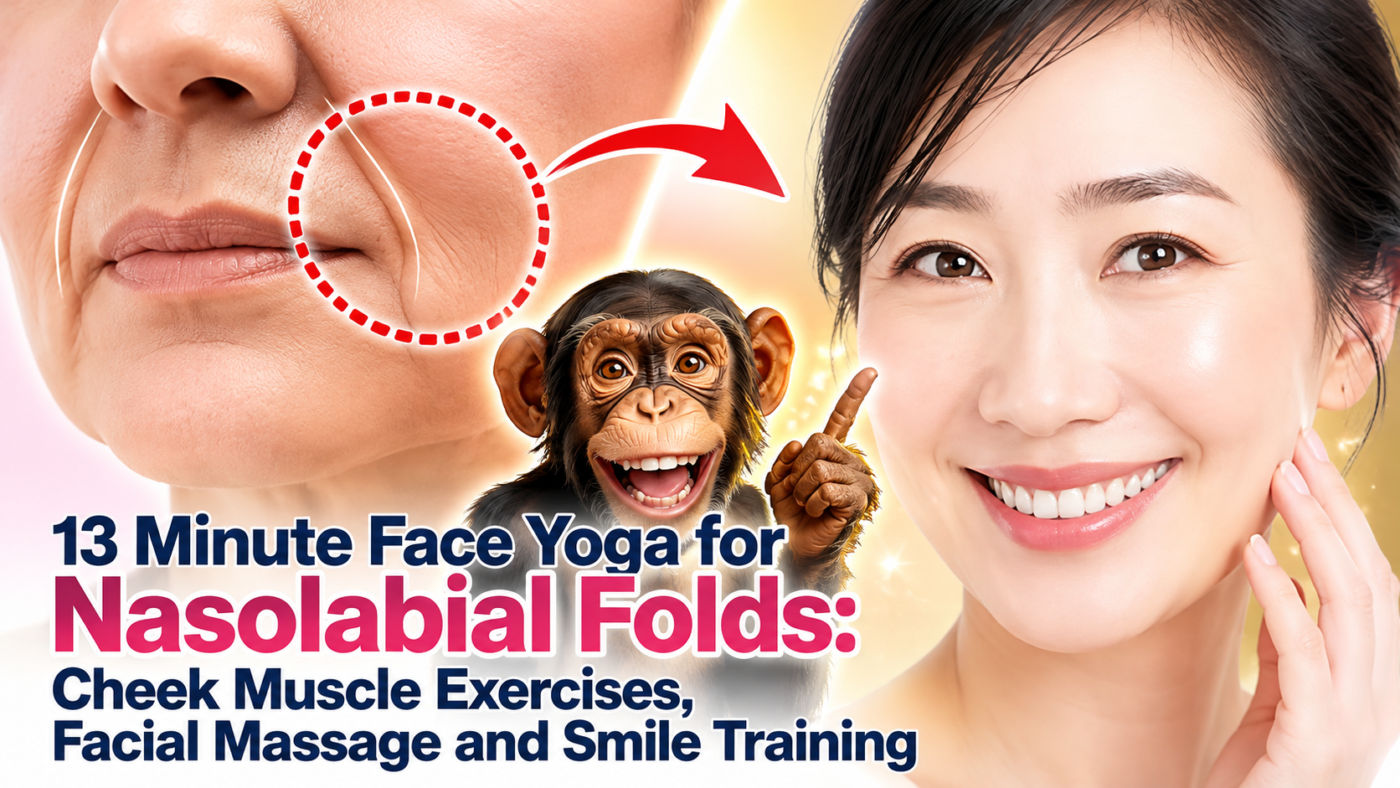
Nasolabial folds are the natural lines that run from the sides of the nose toward the corners of the mouth.
Almost everyone has them.
They become more visible when you smile.
They can also become more noticeable with age.
Their appearance is influenced by facial anatomy, skin thickness, collagen and elastin changes, facial fat distribution, bone structure, repeated facial movement and genetics.
This means nasolabial folds are not caused by one weak facial muscle.
They are also not simply the result of gravity pulling the face downward.
Facial aging is complex.
That matters because it changes what we should realistically expect from face yoga.
A facial exercise may help you become more aware of facial tension and movement.
It may make certain muscles feel more active.
It may temporarily change how your expression looks.
But it should not be promoted as a guaranteed way to erase established facial folds.
Why People Try Face Yoga
Face yoga has become popular because it is inexpensive, noninvasive and easy to practice at home.
It generally combines three things.
Facial muscle movement.
Massage.
Relaxation.
Some routines also include breathing or posture work.
Small studies have explored whether regular facial exercises can influence perceived facial appearance.
However, the evidence remains limited.
The results are not strong enough to say that face yoga reliably reverses facial aging or replaces established dermatological treatments.
A better way to use face yoga is as a facial movement and relaxation practice.
Start With Shoulder Circles
The routine begins away from the face.
Relax your arms.
Slowly rotate one shoulder backward.
Keep your neck comfortable.
Move through a smooth range.
Then rotate forward.
Repeat on the opposite side.
Many people carry unnecessary tension around the neck and shoulders.
Reducing that tension may make the entire upper body feel more relaxed.
However, shoulder tension does not literally stretch nasolabial folds downward like ropes.
That is motivational language, not anatomy.
Neck and face tissues interact through posture and movement, but there is no simple mechanical line that pulls smile lines longer every time your shoulders tighten.
Gentle Neck Massage
Move your fingertips toward the muscular area below or behind the ear.
Use gentle pressure.
Massage the side of the neck slowly.
Avoid pressing deeply into the front of the throat.
Large blood vessels, nerves and other important structures pass through the neck.
Facial beauty massage should remain light.
Then repeat on the other side.
You may notice that one side feels more tense.
That is common.
Do not try to force both sides to feel identical.
Can Neck Massage Lift the Face?
Not permanently.
Relaxing the neck can change how you hold your head and jaw.
That may subtly influence your overall expression.
But neck massage cannot mechanically reverse facial aging or pull sagging facial tissues upward.
If your face looks more relaxed afterward, enjoy the effect.
Just do not interpret it as permanent anatomical lifting.
Temple Massage
Place your fingertips over the temples.
Use small circular movements.
The temporalis muscle is located in this region and plays an important role in chewing.
People who clench their jaw may also carry tension here.
Massage gently.
Do not press excessively.
If the temples feel tender, reduce the pressure.
This should feel calming.
The temporalis is not a hidden lifting cable responsible for holding the cheeks up.
Relaxing it may reduce discomfort or tension.
It does not permanently raise facial tissue.
Cheek Massage
Place your fingertips beneath or around the cheekbone area.
Open your mouth slightly if that makes the muscles easier to relax.
Use small circular movements.
Keep the pressure comfortable.
The cheek contains several muscles involved in smiling and facial expression.
It also contains fat, connective tissue and other structures.
Massage may temporarily increase warmth and make the area feel softer.
It does not permanently reposition cheek fat.
Do not push aggressively upward in an attempt to move the cheek into a new location.
Understanding the Levator Labii Superioris
The original video focuses on the levator labii superioris.
This is a real facial muscle.
It helps elevate the upper lip.
It contributes to expressions involving the upper lip and area beside the nose.
That makes it relevant to facial movement around the nasolabial region.
However, training this muscle does not mean nasolabial folds will automatically disappear.
Facial folds are influenced by much more than muscle strength.
Still, learning to intentionally activate a rarely noticed facial muscle can be an interesting coordination exercise.
The Upper Lip Lift Exercise
Relax your forehead.
Relax your eyebrows.
Keep your eyes soft.
Now gently raise the upper lip.
Try to expose a small amount of the upper gum if possible.
Avoid scrunching the nose excessively.
Do not wrinkle the forehead.
Hold briefly.
Then relax.
The movement may feel strange.
That is normal.
Most people do not consciously isolate this muscle during everyday life.
If you cannot perform it without using other facial muscles, use your fingertips lightly as a guide.
Do not pull the skin aggressively.
Can This Exercise Reduce Nasolabial Folds?
There is not strong evidence that isolating the levator labii superioris permanently reduces nasolabial folds.
You may see temporary changes during the exercise because the facial muscles are moving.
Repeated training could potentially affect muscle coordination or tone.
But established smile lines involve skin and deeper facial structures as well.
A realistic expectation is improved awareness and control of facial expression.
That is different from wrinkle removal.
Avoid Excessive Facial Wrinkling
When practicing facial movements, try not to create unnecessary tension in unrelated areas.
For example, if you are lifting the upper lip, keep the forehead relaxed.
Avoid repeatedly squeezing the eyes.
Avoid scrunching the nose as hard as possible.
Stronger contraction is not automatically better.
Face yoga should not become aggressive facial strain.
Small controlled movements are enough.
Vowel Exercise
The routine next uses vowel sounds.
You can slowly pronounce sounds such as:
A
E
I
O
U
Exaggerate the movement slightly without forcing it.
Notice how the lips and cheeks change shape.
Keep the jaw comfortable.
Relax between repetitions.
This can be used as a facial coordination exercise.
It may also simply be fun.
There is no need to perform it until the muscles hurt.
Lip Control Exercise
Bring your lips together gently.
Shift them slightly toward one side.
Return to the center.
Then shift toward the opposite side.
Keep the jaw relaxed.
Try not to pull the entire head with the movement.
This challenges facial coordination around the lips and cheeks.
Again, the goal is controlled movement.
Not maximum facial distortion.
Can Lip Exercises Sculpt the Jawline?
Not in the way the word sculpt is often used online.
Facial exercises may activate muscles around the mouth and jaw.
But they do not directly remove submental fat or permanently reshape bone.
The jawline is influenced by bone structure, muscle, fat distribution, skin and genetics.
Any immediate change after exercise is likely temporary.
Smile Training
Allow your lips to return to neutral.
Now create a natural smile.
Focus on lifting the corners of the mouth gently.
Avoid squeezing the eyes tightly.
Hold for several seconds.
Relax.
Repeat.
You may notice that one side of your smile moves differently from the other.
Minor asymmetry is common.
Do not obsess over making both sides perfectly identical.
Facial asymmetry is part of normal human anatomy.
One Side at a Time
Try lifting one corner of the mouth slightly.
Return to neutral.
Then try the other side.
This can be surprisingly difficult.
The exercise is more about motor control than beauty transformation.
Keep the movement small.
Do not create pain or cramping.
If one side feels less coordinated, practice gently.
Face yoga should not become a competition with your own face.
Second Upper Lip Lift
Return to the upper lip movement.
Expose the upper gums gently if possible.
Keep your eyes and forehead relaxed.
Hold.
Release.
Repeat a few times.
If the area beside the nose begins to feel fatigued, stop.
Muscle fatigue does not mean the nasolabial fold is being burned away.
It simply means the muscle is working.
The Burning Sensation Does Not Mean Wrinkles Are Disappearing
This is an important correction.
The original video describes the burning feeling as the process that fades nasolabial folds.
There is no evidence for that interpretation.
Muscles can burn during sustained contraction because of normal exercise physiology.
That sensation does not tell you what is happening to wrinkles.
Do not chase facial burning.
Stop when the muscles feel tired.
More intensity is not necessarily more effective.
Can Face Yoga Tighten Sagging Skin?
The evidence is limited.
A small amount of research suggests facial exercise programs may influence perceived facial fullness or appearance in some people.
But we do not have strong evidence that ordinary facial exercises permanently tighten significantly lax skin.
Skin laxity involves collagen, elastin, fat compartments and deeper structural changes.
Muscle exercise addresses only one part of the system.
Face yoga may be a complementary beauty practice.
It should not be sold as a facelift.
What Causes Nasolabial Folds to Become Deeper?
Several age related changes can contribute.
Loss of collagen and elasticity.
Changes in facial fat compartments.
Changes in underlying bone structure.
Repeated facial movement.
Sun exposure.
Genetics.
Smoking can also accelerate visible skin aging.
This is why one muscle exercise cannot completely control the process.
A broader skin care approach is more realistic.
Sun Protection Matters More Than Most Face Yoga Tricks
If your goal is long term prevention of premature facial aging, daily sun protection is important.
Ultraviolet exposure contributes to collagen breakdown, uneven pigmentation and wrinkles.
Apply broad spectrum sunscreen to exposed skin.
Do not rely on facial exercises to compensate for chronic UV exposure.
Face yoga can be optional.
Sun protection should be foundational.
Moisturizer and Skin Barrier Care
Well moisturized skin often looks smoother than dry skin.
That does not mean moisturizer removes deep folds.
But maintaining a healthy skin barrier can improve texture and comfort.
Use products suited to your skin type.
Avoid irritating the face with aggressive massage or excessive facial stretching.
Healthy skin does not require constant manipulation.
Can Facial Massage Improve Blood Flow?
Physical massage can temporarily increase local warmth and blood flow.
That is normal.
It does not mean facial tissue was previously starved of oxygen.
Healthy facial skin already receives continuous circulation.
Temporary redness after massage is not proof of rejuvenation.
If the face becomes painful or strongly irritated, reduce pressure.
What About Stress and Facial Tension?
Stress can influence facial expression.
People may clench the jaw.
Tighten the lips.
Furrow the brow.
Raise the shoulders.
Over time, becoming aware of these habits can be useful.
A facial relaxation routine may help you notice when you are holding unnecessary tension.
That is one of the more realistic benefits of face yoga.
Relaxation can change how your face looks in the moment.
Does Face Yoga Replace Botox?
No.
Botulinum toxin works by temporarily altering nerve signaling to targeted muscles.
Face yoga intentionally moves facial muscles.
They are almost opposite approaches.
Face yoga should not be described as a natural version of Botox.
People may prefer one, both or neither depending on their goals.
They are not equivalent.
Does Face Yoga Replace Fillers?
No.
Dermal fillers add volume to targeted areas.
Facial exercises do not provide the same structural effect.
Nasolabial folds can be influenced by facial volume and anatomy.
If someone wants a significant cosmetic change, a qualified dermatologist or other appropriate clinician can explain available options.
Can Face Yoga Make Wrinkles Worse?
Repeated facial movement contributes to dynamic lines.
That does not mean ordinary facial expression should be avoided.
But extremely aggressive repetitive facial exercises may not always make sense if your goal is minimizing expression lines.
Moderation matters.
Use controlled movements rather than intense grimacing for long periods.
How Often Should You Practice?
There is no established ideal frequency.
You might begin with several short sessions per week.
Five to fifteen minutes is plenty.
If your facial muscles feel sore, allow them to recover.
More is not necessarily better.
Consistency and comfort are more useful than extreme repetition.
Women Over 40
Face yoga is particularly popular among women over 40 because visible facial aging often becomes more noticeable during midlife.
It can be a pleasant addition to a broader routine.
But the basics still matter more.
Sun protection.
Appropriate skin care.
Sleep.
Nutrition.
Avoiding smoking.
Managing health conditions.
And realistic expectations.
Face yoga is an optional extra.
It is not the foundation of healthy skin aging.
Women Over 50
Women over 50 can practice gentle facial exercises if they find them enjoyable.
Use lower intensity if the jaw or facial muscles fatigue easily.
Avoid aggressive pulling of thinner mature skin.
If you have significant temporomandibular joint symptoms, facial nerve problems or recent cosmetic procedures, obtain appropriate professional advice before starting aggressive facial massage.
Do Not Compare Yourself With a Perfectly Lit Before and After
Face yoga videos often show dramatic before and after images.
Be cautious.
Lighting changes facial shadows dramatically.
Camera angle matters.
Expression matters.
Head position matters.
Makeup matters.
Hydration matters.
Even smiling differently can make nasolabial folds appear dramatically different.
Evaluate progress under similar conditions if you want a meaningful comparison.
The Goal Is Better Facial Awareness
Instead of asking whether your smile lines disappeared after one session, ask better questions.
Does your jaw feel more relaxed?
Can you isolate facial movements more easily?
Do you notice less unnecessary tension around your mouth?
Does smiling feel more natural?
Do you enjoy the routine?
Those outcomes are more realistic.
And they can make face yoga a useful self care practice without turning it into pseudoscience.
Frequently Asked Questions
Can face yoga remove nasolabial folds?
There is not strong evidence that face yoga permanently removes established nasolabial folds. It may affect facial muscle control and temporary appearance.
What muscle lifts the upper lip?
The levator labii superioris is one of the muscles involved in elevating the upper lip.
Can exercising the levator labii superioris erase smile lines?
There is no good evidence that training this muscle alone erases nasolabial folds.
Can facial massage lift the cheeks?
Massage may temporarily change muscle tension, skin warmth and facial appearance, but it does not permanently reposition cheek tissues.
Can temple massage reduce nasolabial folds?
There is no strong evidence that temporalis massage directly reduces nasolabial folds.
Can neck relaxation make the face look better?
It may change posture and reduce visible tension, which can contribute to a more relaxed appearance. It does not permanently lift the face.
How often should I practice face yoga?
Several short sessions per week is a reasonable starting point if the routine feels comfortable.
Should facial exercises hurt?
No. Mild muscular fatigue can occur, but sharp pain or strong jaw discomfort is a reason to stop.
Can face yoga replace Botox?
No. Face yoga and Botox work through very different mechanisms.
Can face yoga replace fillers?
No. Facial exercises cannot reproduce the volume changes created by injectable fillers.
Can face yoga make me look younger?
Some people may perceive subtle changes in facial appearance after consistent practice, but dramatic age reversal claims are not supported.
Medical Disclaimer
This article is for general educational and informational purposes only and is not medical advice, diagnosis or treatment. Stop facial exercise or massage if it causes significant pain, jaw locking, persistent headaches, facial numbness, weakness, skin injury or worsening symptoms. Seek appropriate medical or dental assessment for persistent temporomandibular joint pain, facial weakness, sudden asymmetry or other concerning symptoms.
This article is for general education and does not replace individualized care from a qualified health professional. Seek appropriate advice for persistent, severe, or concerning symptoms.
Read the full medical disclaimer