Why Chair Assisted Squats Are Useful
Squats are one of the most practical lower body movement patterns.
You squat when you sit down.
You squat when you stand up from a chair.
You use similar movements when lowering yourself toward the floor or picking something up.
But many people avoid squats because they associate them with heavy gym workouts, knee pain or difficult deep positions.
A chair changes that.
Using a sturdy chair gives you a clear target.
It provides reassurance.
It allows you to reduce squat depth.
And it gives you somewhere to sit if your legs become tired.
That makes chair assisted squats especially useful for beginners, adults returning to exercise and people who want a more controlled introduction to lower body strength training.
What Muscles Does a Chair Squat Use?
A squat primarily challenges several major lower body muscle groups.
These include the quadriceps at the front of the thighs, the gluteal muscles around the hips and buttocks and several muscles that help stabilize the trunk and pelvis.
The calves and muscles around the ankles also contribute to balance and movement control.
Because these are relatively large muscle groups, squat based movements can be an efficient way to train the lower body.
However, one short squat routine should not be described as a complete strength program.
It is a useful starting point.
Start With a Calf Stretch
Before squatting, begin with a comfortable calf stretch.
Place one foot behind you.
Keep the heel supported if possible.
Lean forward slightly until you feel a gentle stretch through the calf.
Do not force it.
Keep breathing.
Hold briefly.
Then switch sides.
Ankle movement influences how comfortable a squat feels.
If your ankles are stiff, you may find it difficult to keep the heels down or allow the knees to move forward comfortably.
A short calf stretch can be a useful preparation.
Inner Thigh Stretch
Next, move into a gentle side position.
Bend one knee slightly while keeping the other leg more extended.
You may feel a stretch along the inner thigh.
Do not push hard on the knee.
Use your hand only for light support if needed.
Keep the movement controlled.
Then repeat on the other side.
This movement helps prepare the hips for the wider stance that some people naturally use during squatting.
Hip Circles
Stand comfortably.
Place your hands around your hips if desired.
Make slow circles through the pelvis.
Keep the movement small at first.
Breathe.
Then reverse direction.
Hip circles do not realign the pelvis or prevent every type of back pain.
Their main value is simple.
They create movement around the hips and lower back before the strength portion begins.
If they feel good, use them.
If they create discomfort, skip them.
Gentle Spinal Flexion and Extension
The routine also includes rounding and opening the torso.
Move gently.
As you exhale, allow the upper body to round slightly.
As you inhale, return toward a more upright position.
Avoid forcing your chin dramatically toward the pelvis.
The spine is meant to move.
You do not need to chase maximum range.
Think smooth and controlled.
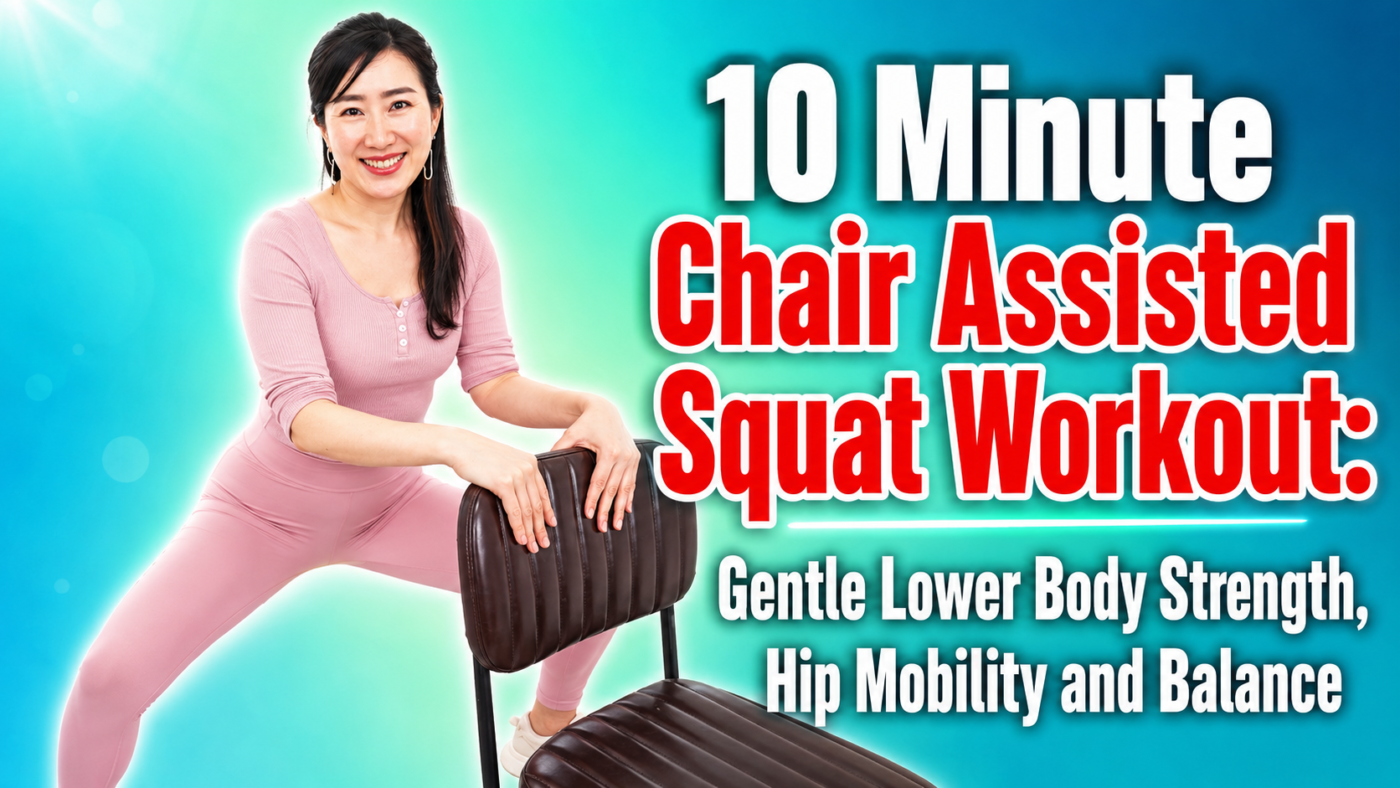
Set Up Your Chair
Use a sturdy chair that will not slide.
Place it behind you.
Stand far enough forward that your hips can move backward toward the seat.
Keep your feet at a comfortable width.
Some people prefer approximately hip width.
Others need a slightly wider stance.
Allow your toes to point in a direction that feels natural.
There is no requirement that every person’s feet point perfectly straight ahead.
First Supported Squat
Begin standing tall.
Shift your hips slightly backward.
Bend your knees.
Slowly lower toward the chair.
You do not have to sit fully down.
If the movement feels difficult, allow your hips to touch the seat.
Then stand again.
That is still a squat.
The chair is there to help.
You are not cheating.
Control the descent.
Avoid dropping suddenly onto the chair.
Keep your feet stable.
How Deep Should You Squat?
Only as deep as you can control comfortably.
Some people can lower until the thighs are near parallel to the floor.
Others need a much shallower squat.
Depth depends on strength, joint mobility, balance, anatomy and experience.
A shallow squat performed with control can be more useful than a deep squat performed with pain.
Progress gradually.
Should Your Spine Be Perfectly Straight?
No.
The spine has natural curves.
Some forward trunk movement normally occurs during squatting.
The goal is not to force a rigid vertical torso.
Instead, keep the movement controlled and avoid collapsing completely forward.
Think about keeping your chest comfortably open and your trunk stable.
Body proportions influence how much forward lean is natural.
Your squat does not need to look identical to someone else’s.
Use the Chair as a Safety Net
If your legs begin shaking or fatigue quickly, sit down.
Rest.
Then stand and continue when ready.
A chair allows you to challenge yourself without worrying as much about losing balance.
This can be especially helpful for beginners.
Muscle shaking during a difficult hold often reflects fatigue.
It does not necessarily mean anything is wrong.
But shaking is also a useful signal to reduce the intensity.
Take a break.
Supported Squat Hold
Lower into a comfortable squat.
Pause above the chair or lightly touch the seat.
Hold for several seconds.
Continue breathing.
You may feel the thighs and glutes working strongly.
Ten seconds may be enough at first.
Over time, you may gradually hold longer.
Do not hold your breath.
Do not turn the exercise into a pain tolerance competition.
Can Chair Squats Strengthen the Legs?
Yes.
Repeated sit to stand and squat movements can train the large muscles of the lower body.
For beginners, even body weight can provide a meaningful challenge.
As strength improves, the exercise may eventually become too easy.
At that point, you can progress by increasing repetitions, slowing the movement or adding appropriate resistance.
Can Chair Squats Strengthen the Glutes?
Yes.
The gluteal muscles help extend the hips as you rise from the squat.
You may feel them working more if you actively stand by driving through the feet and extending the hips.
However, do not exaggerate squeezing or tucking the pelvis.
A natural controlled movement is enough.
Can Squats Strengthen the Core?
The trunk muscles help stabilize the body during squats.
So yes, squatting involves core control.
But squats are not a complete abdominal training program.
If your goal includes trunk strength, other exercises can complement them.
Avoid constantly pulling the stomach inward as hard as possible.
Use enough tension to remain stable while still breathing.
What About the Pelvic Floor?
Squats can involve coordination between the trunk, breathing and pelvic floor muscles.
But a general squat routine should not be promoted as treatment for urinary leakage.
Urinary incontinence can have different causes.
Targeted pelvic floor muscle training may help some people.
Others may need a different approach.
Anyone experiencing persistent leakage, pelvic pressure, bulging or pelvic pain should consider professional assessment.
Exercise can support general function without replacing individualized pelvic health care.
Second Squat Round
After resting, repeat the supported squat.
Lower slowly.
Pause.
Stand.
Focus on control.
Notice whether the second round feels easier or harder.
Fatigue may make the movement more challenging.
That is expected.
Reduce the depth if necessary.
Good exercise adapts to your current ability.
It does not require you to force the same range every repetition.
Arm Swing Squat Variation
The routine later adds arm movement.
Lower into a shallow squat.
Move your arms forward and backward or through a comfortable range.
This increases the coordination challenge.
It can also make the exercise feel more cardiovascular because more of the body is moving.
Keep your balance.
Do not swing the arms so aggressively that your torso loses control.
If this version feels unstable, return to the basic chair assisted squat.
Is This Cardio?
A squat workout can increase heart rate, especially when repetitions are performed continuously.
However, its primary purpose here is lower body muscular endurance and movement practice.
It is not a replacement for all aerobic exercise.
Walking, cycling, swimming or other sustained activities can provide additional cardiovascular training.
Strength and cardio work well together.
Can Chair Squats Help With Weight Loss?
They can contribute to physical activity.
But one exercise does not cause targeted fat loss.
Body weight changes depend on overall energy balance over time.
Exercise supports the process by using energy and helping preserve muscle.
Nutrition, total activity, sleep and other factors also matter.
Think of chair squats as part of a broader fitness routine rather than a weight loss shortcut.
Do Squats Burn Lower Belly Fat?
No.
Squats cannot selectively burn fat from the lower abdomen.
Where fat is lost is influenced by genetics, hormones and overall energy balance.
Squats train the legs and hips.
They do not direct fat loss to one specific body area.
This is an important distinction because many fitness videos confuse working a muscle with removing fat from the same region.
What About Knee Health?
Squats are not automatically bad for the knees.
Knees are designed to bend.
However, joint tolerance varies.
People with arthritis, recent injuries or other conditions may need modifications.
Use the chair.
Reduce depth.
Move slowly.
Keep the knees moving in a direction that feels natural relative to the feet.
If the exercise creates sharp knee pain, stop.
Do not assume pain is necessary for progress.
Can Squats Prevent Back Pain?
Not reliably.
Strengthening the lower body and staying active may contribute to overall function.
But back pain has many possible causes.
No single squat exercise can guarantee prevention.
If you already have persistent or significant back pain, use an appropriate individualized plan.
Exercise can be helpful, but it should not be oversold.
Cool Down With Gentle Rotation
After the squat rounds, stand comfortably.
Allow your arms and torso to rotate gently from side to side.
Keep the movement relaxed.
This is simply a way to reduce tension and transition out of the workout.
There is no need for extreme twisting.
Finish with slow breathing.
Notice how your legs feel.
If they feel pleasantly tired, that is fine.
If you have joint pain, adjust your next session.
Why Sit to Stand Strength Matters With Age
The ability to rise from a chair is a practical marker of lower body function.
As we get older, maintaining leg strength becomes increasingly important for everyday independence.
Strong legs help with stairs.
Walking.
Getting out of vehicles.
Standing from low seats.
Carrying objects.
Recovering balance.
Chair squats train a movement closely related to these daily tasks.
That makes them particularly useful for healthy aging.
Women Over 40 and 50
Midlife is an excellent time to maintain and build strength.
Muscle mass and strength tend to decline with age if they are not challenged.
That decline is not inevitable at the same rate for everyone.
Resistance training can help.
Chair squats are one accessible way to begin.
Eventually, you may progress to body weight squats without a chair or add resistance.
The goal is gradual improvement.
Older Adults
Chair squats can also work well for older adults when appropriate.
Use a stable chair.
Consider placing the chair near a wall so it cannot slide.
Use armrests or another support if needed.
Start with a higher chair if standing from a lower seat is difficult.
Do fewer repetitions.
Rest often.
Safety matters more than intensity.
How Often Should You Practice?
Two or three sessions per week is a reasonable starting point for many beginners.
The video suggests three times per week, which can be practical.
Allow recovery between harder sessions.
You can still walk and perform gentle mobility on other days.
As your strength improves, increase the difficulty gradually.
Progress is more important than performing the identical workout forever.
A Beginner Routine
Try five controlled chair squats.
Rest.
Repeat another five.
That may be enough initially.
Over time, progress toward two or three sets of eight to twelve repetitions if appropriate.
There is no requirement to start with long holds.
Build confidence first.
An Intermediate Routine
Perform ten controlled squats.
Then hold a comfortable squat above the chair for ten to twenty seconds.
Rest.
Repeat two or three rounds.
Add gentle arm movements if balance remains good.
Again, progression should remain comfortable.
How to Make Chair Squats Harder
Use less support from the chair.
Lower more slowly.
Pause before sitting.
Increase repetitions.
Use a slightly lower chair if appropriate.
Add light dumbbells.
Add resistance bands.
Eventually perform free standing squats.
Choose only one progression at a time.
More difficulty is useful only if control remains good.
How to Make Them Easier
Use a higher chair.
Place your hands on your thighs or a stable surface.
Reduce squat depth.
Sit fully between repetitions.
Perform fewer repetitions.
Move more slowly.
There is no shame in modifying exercise.
Adaptation is part of good training.
What If Your Hips Click?
Joint noises can occur during movement.
Clicking without pain is often less concerning than clicking accompanied by pain, swelling or instability.
Do not assume every sound means damage.
If the hip repeatedly catches, becomes painful or feels unstable, seek appropriate evaluation.
Exercise should not be used to diagnose joint problems.
What If Your Knees Shake?
Shaking can happen during muscle fatigue.
Reduce the duration.
Stand up.
Rest.
Then try again.
As strength improves, shaking may decrease.
But do not force yourself to continue through severe fatigue just because a video says the shaking means power is being born.
Your body is simply telling you that the muscles are working hard.
Does Squatting Boost Metabolism?
Strength exercise contributes to overall energy expenditure and muscle maintenance.
But a few minutes of squatting does not activate a special metabolism mode.
Long term muscle maintenance can support metabolic health as part of an active lifestyle.
That is different from claiming one exercise suddenly turns the body into a fat burning machine.
Real fitness does not require exaggerated language.
Balance Training
Squats also challenge balance because your center of mass moves as you lower and rise.
Using a chair reduces the consequences of losing balance.
As you become more confident, you may gradually use less support.
If you have a history of falls or significant balance problems, keep a stable support nearby.
The goal is safer movement, not proving independence.
Combine Squats With Walking
A simple fitness plan can combine chair squats with walking.
Walking provides aerobic activity.
Squats provide a strength challenge.
Together they create a more complete program than either one alone.
For example, you could walk on most days and perform chair squats two or three times per week.
Add upper body resistance training as well for an even more balanced routine.
A Simple Weekly Plan
Monday
Chair squat workout
Tuesday
Easy walk
Wednesday
Upper body strength and mobility
Thursday
Chair squat workout
Friday
Walk
Saturday
Chair squats or full body strength
Sunday
Recovery
Adjust this according to your schedule and recovery.
There is no perfect calendar.
The Goal Is Confidence and Strength
The most useful outcome from a chair squat routine is not losing a specific number of pounds.
It is becoming more capable.
Standing up feels easier.
Your legs fatigue less quickly.
Your balance improves.
You become more comfortable bending the hips and knees.
You trust your body more.
Those changes matter.
Especially as we age.
Frequently Asked Questions
Are chair squats good for beginners?
Yes. A chair provides support and a clear depth target, making squats more approachable for beginners.
Do chair squats strengthen the thighs?
Yes. They primarily challenge the quadriceps and gluteal muscles along with other lower body muscles.
Can chair squats help older adults?
They can be useful for many older adults because they train the sit to stand movement. Individual ability and medical conditions should still be considered.
Are chair squats knee friendly?
They can be modified to reduce depth and provide support. However, people with painful knee conditions may still require individualized exercise guidance.
Can squats reduce belly fat?
No. Squats cannot selectively remove abdominal fat.
Can squats help urinary leakage?
General squats should not be treated as a specific therapy for urinary incontinence. Targeted pelvic floor rehabilitation may be more appropriate depending on the cause.
How often should I do chair squats?
Two or three sessions per week is a practical starting point for many beginners.
How many chair squats should beginners do?
Start with a small number such as five to ten controlled repetitions and increase gradually.
Should my knees go over my toes?
Some forward knee movement is normal during many squat variations. Comfort, control and individual anatomy matter more than an arbitrary rule.
Should I sit completely on the chair?
You can. Sitting fully can make the exercise easier and more accessible. As strength improves, you may pause just above the chair.
Can I use my hands for support?
Yes. Use stable support if needed.
Medical Disclaimer
This article is for general educational and informational purposes only and is not medical advice, diagnosis or treatment. Exercise suitability varies according to joint health, balance, cardiovascular status, injuries and individual physical ability. Stop exercising if you experience sharp or worsening pain, faintness, severe dizziness or unexpected weakness. Consult an appropriate healthcare professional or physical therapist if you have significant knee, hip, back or balance problems before starting a new exercise program.
This article is for general education and does not replace individualized care from a qualified health professional. Seek appropriate advice for persistent, severe, or concerning symptoms.
Read the full medical disclaimer