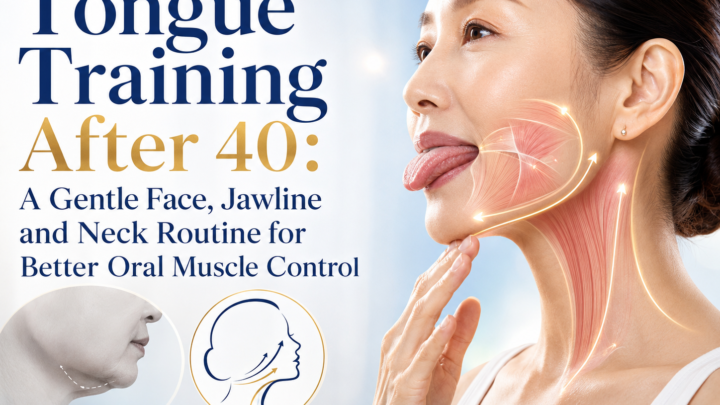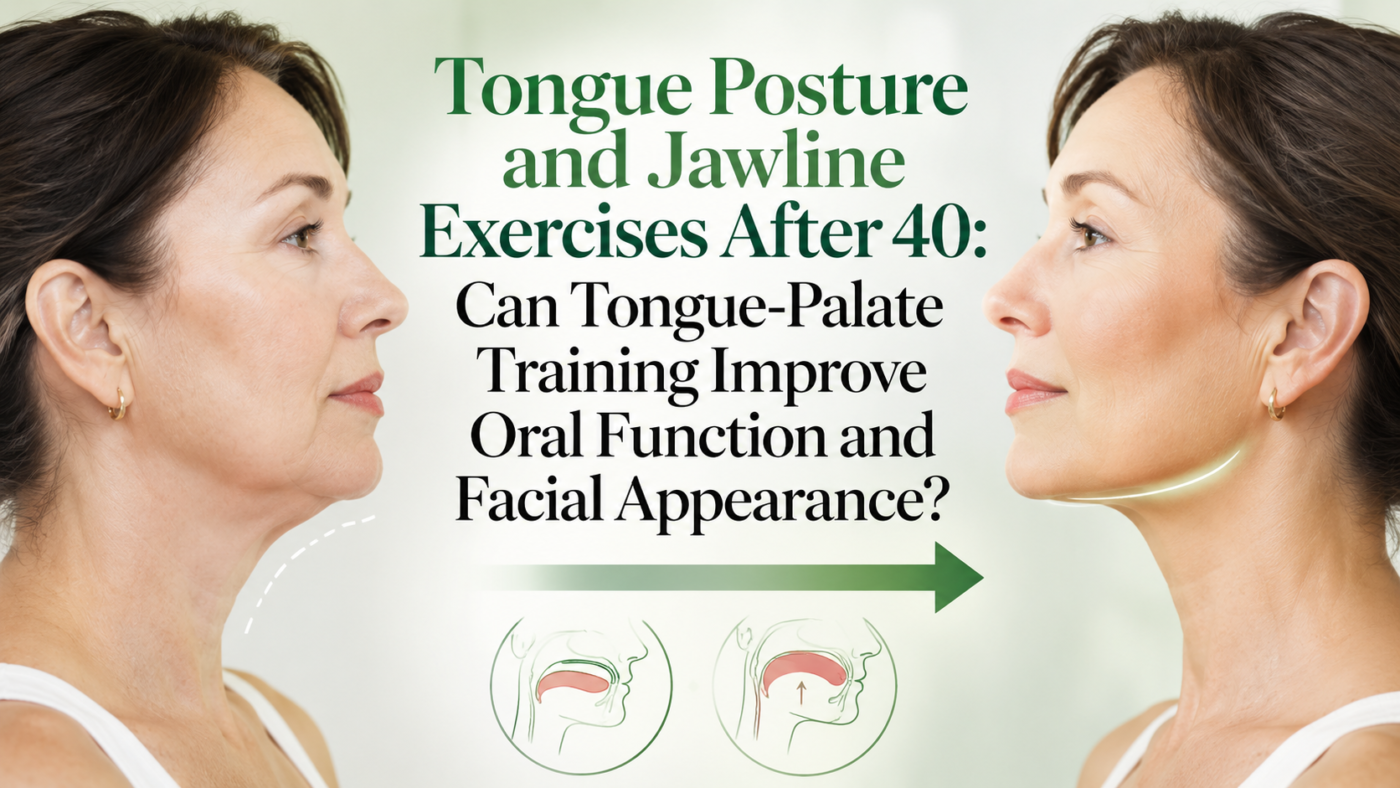
Tongue posture for jawline definition has become increasingly popular among adults over 40 who want to improve oral muscle awareness and the appearance of the lower face. Placing the tongue against the palate can temporarily change tension beneath the chin, but it cannot permanently remove fat or tighten loose skin.A sharper jawline is often associated with youth.
That is why exercises involving the tongue, jaw and neck have become increasingly popular among people looking for noninvasive ways to improve the appearance of the lower face.
One of the simplest techniques is also one of the most interesting:
Place the tongue against the roof of the mouth.
Hold it there.
Then release.
The appearance of the area beneath the chin can change immediately when the tongue and floor-of-mouth muscles contract.
That visible difference is real.
But it does not mean tongue exercise can permanently remove a double chin or tighten loose neck skin.
The more useful question is:
What can tongue-palette training actually do?
The answer lies less in instant cosmetic lifting and more in oral-muscle function, swallowing, posture awareness and movement control.
Why Tongue Position Can Change the Jawline Instantly
Try this in front of a mirror.
Let the tongue rest loosely in the bottom of the mouth.
Look at the area under your chin.
Now press the tongue firmly but comfortably against the roof of the mouth.
You may see the tissue beneath the jaw become slightly tighter.
Why?
Because several muscles in the tongue and floor of the mouth become active.
This changes the shape and tension of the tissues under the chin.
The effect can make the jawline appear temporarily more defined.
But nothing has been removed.
No fat has disappeared.
No loose skin has permanently tightened.
The change is muscular and positional.
The Tongue Is a Complex Muscular Organ
The tongue contains multiple intrinsic and extrinsic muscles.
Intrinsic muscles change the tongue’s shape.
Extrinsic muscles move it forward, backward, upward and downward.
These muscles work together with the jaw, hyoid region, soft palate, pharynx and other structures involved in chewing, speech and swallowing.
That makes tongue training a legitimate form of oral-muscle exercise.
What it does not make it is a guaranteed cosmetic facelift.
Is a “Drooping Tongue” the Cause of Sagging Under the Chin?
Not usually.
A less defined jawline can result from many factors:
Submental fat.
Skin laxity.
Age-related collagen changes.
Genetics.
Jaw and chin structure.
Posture.
Weight changes.
Muscle tone.
Changes in facial and neck tissues over time.
Tongue position can influence the appearance of the floor of the mouth and under-chin region while the muscles are active.
But it is only one piece of a much larger anatomical picture.
What Is Normal Tongue Resting Posture?
At rest, many clinicians describe a comfortable tongue position in which much of the tongue gently contacts the palate, particularly the anterior portion.
The lips are relaxed.
The teeth are not clenched.
Breathing ideally occurs comfortably through the nose when possible.
However, not everyone’s anatomy is identical.
Dental structure, nasal obstruction, oral habits and other factors can influence tongue posture.
The goal should not be to force the tongue into a painful position all day.
What About the Lingual Frenulum?
The lingual frenulum is the fold of tissue beneath the tongue.
It can be seen when the tongue is elevated in many people.
However, whether the frenulum is easily visible is not a reliable at-home diagnostic test of tongue weakness.
Some people have shorter frenula.
Some have longer ones.
Visibility varies with anatomy and how the tongue is positioned.
A clinically significant tongue-tie, or ankyloglossia, is diagnosed based on structure and function—not simply whether you can see one particular piece of tissue in a mirror.
Tongue-Tie Is Different From Weak Tongue Muscles
Tongue-tie refers to a restrictive lingual frenulum that may limit tongue mobility.
Tongue weakness refers to reduced muscular strength or control.
They are not the same thing.
If tongue movement is substantially restricted, swallowing is difficult, speech is affected or there are other functional problems, professional evaluation is more useful than self-diagnosis from a mirror test.
Humans Swallow Hundreds of Times a Day
Swallowing is one of the body’s most frequently repeated coordinated movements.
The tongue plays an essential role.
During swallowing, it helps position food and liquid and pushes material backward toward the pharynx.
Swallowing then requires carefully timed activity of numerous oral, throat and airway structures.
Age-related changes can affect swallowing function in some people.
This is one reason maintaining oral and swallowing health becomes increasingly important later in life.
Does Tongue Strength Decline With Age?
Some aspects of oral and swallowing muscle strength can change with aging.
Tongue pressure and swallowing reserve may decline in some older adults.
These changes do not automatically cause visible neck sagging.
But they can become clinically important if swallowing efficiency declines.
That is why tongue-strengthening exercises are sometimes included in rehabilitation programs for dysphagia.
Can Tongue Training Prevent Swallowing Disorders?
Specific tongue and oropharyngeal exercises can play a role in swallowing rehabilitation.
But they should not be presented as guaranteed prevention for everyone.
Swallowing disorders can result from neurological disease, stroke, structural problems, age-related changes and many other causes.
People with persistent coughing during meals, choking, food sticking, recurrent pneumonia or unexplained weight loss should seek medical evaluation.
A cosmetic tongue workout is not enough.
Tongue Exercise and “Throat Immunity”
The throat does contain immune tissues, and saliva contributes to oral defense.
But saying that weak tongue muscles cause reduced throat immunity and greater susceptibility to viruses is not supported in that simple form.
Tongue strengthening should therefore not be promoted as an antiviral or immune-boosting treatment.
Its strongest role is muscular and functional.
Does Tongue Exercise Activate the Brain?
Every voluntary movement involves the nervous system.
Learning new movements also requires motor coordination and sensory feedback.
That is true for tongue exercise, just as it is for hand, leg or balance exercises.
But claims that tongue training uniquely “activates the brain” enough to improve general cognition need much stronger evidence.
Think motor coordination rather than neurological rejuvenation.
The Tongue-Pop Exercise
One of the most interesting movements in this routine is a tongue pop.
Place the tongue against the palate.
Create gentle suction.
Then release the tongue from the roof of the mouth to produce a popping sound.
Repeat several times.
This requires tongue elevation, palatal contact and controlled release.
It is a genuine oral-motor task.
How to Perform Tongue Pops Safely
Sit or stand comfortably.
Relax the jaw.
Place as much of the tongue as comfortably possible against the palate.
Create mild suction.
Release.
You should hear or feel a small pop.
Repeat slowly.
Do not clench the jaw.
Do not force the tongue into pain.
If the tongue fatigues, rest.
Why Slow Repetitions Matter
Slow repetitions let you notice what the tongue is doing.
Is the jaw trying to help?
Are you tightening the neck?
Are you holding your breath?
Try to isolate the tongue movement while allowing surrounding muscles to remain reasonably relaxed.
Once the movement becomes easy, repetitions can become slightly more rhythmic.
Shoulder Relaxation Before Tongue Training
The original routine begins with shoulder circles.
That is a useful addition.
Rotate the shoulders forward.
Then backward.
Keep the neck relaxed.
Breathe normally.
This does not prevent facial sagging, but it may reduce upper-body tension before the tongue and neck exercises.
Neck Massage
Use your fingertips to massage the sides and back of the neck gently.
Avoid deep pressure over the front of the neck.
Do not squeeze the throat.
Massage may help reduce the sensation of muscular tension.
It does not need to be painful.
Does Neck Massage “Drain Stagnant Lymph”?
Not in the simplistic way often described online.
The lymphatic system continuously transports fluid.
Specialized manual lymphatic drainage exists and is used clinically in selected situations.
It usually uses light, carefully directed pressure.
Rubbing the neck aggressively is not a reliable way to diagnose or clear supposed “lymph stagnation.”
If swelling, lumps or persistent tenderness are present, they should be evaluated rather than repeatedly massaged.
Ear Massage
Gently rubbing the ears is generally a harmless sensory and relaxation practice.
It may feel calming.
It can be included as a self-awareness exercise.
There is no need to assign a specific detoxification or immune mechanism to it.
Sometimes an enjoyable ritual is valuable simply because it encourages relaxation.
Add a Gentle Neck Stretch
Place your hands together or use one hand to guide a mild stretch.
Keep the range comfortable.
Do not force the head backward.
Breathe slowly.
A neck stretch should feel mild and controlled.
Sharp pain means stop.
Tongue Pops With Neck Position
Once tongue pops are comfortable in neutral posture, you can experiment with very small changes in head position.
Look slightly upward.
Perform a few tongue pops.
Return to neutral.
Turn gently to the left.
Pop.
Return.
Turn right.
Pop.
This increases coordination demands.
Avoid extreme neck positions.
Massage the Back of the Head
Use the fingers to massage the base of the skull.
Many people carry tension there.
This can feel especially good after screen-heavy days.
The tongue and upper neck do participate in complex functional relationships during swallowing and head positioning, but tiredness at the back of the skull does not prove that the tongue is weak.
Under-Chin Massage
Use the soft pads of the thumbs.
Apply gentle pressure beneath the jaw.
Avoid pushing deeply into the throat.
Move slowly outward toward the sides of the jaw.
Then perform a few tongue pops.
The combination can increase awareness of the floor-of-mouth muscles.
It should not hurt.
Can Under-Chin Massage Tighten Loose Skin?
Not permanently.
Massage may temporarily alter fluid distribution and muscle tension.
That can change how the area looks for a short period.
But loose skin is influenced by collagen, elastin, genetics, sun exposure and age.
Massage cannot rebuild all of those structures.
A Simple 10-Minute Tongue and Jaw Routine
Minute 1: Shoulder Circles
Forward and backward.
Relax the neck.
Minute 2: Neck Mobility
Turn gently left and right.
Minute 3: Tongue-to-Palate Holds
Press the tongue against the roof of the mouth.
Hold briefly.
Release.
Minutes 4–5: Tongue Pops
Perform slow controlled pops.
Rest when needed.
Minute 6: Tongue Pops With Gentle Head Turns
Turn slightly left and right while maintaining control.
Minute 7: Under-Chin Awareness
Use light thumb pressure beneath the jaw.
Avoid the throat.
Minute 8: Tongue Pops With Light Under-Chin Contact
Feel the muscles work.
Minute 9: Facial Relaxation
Relax the forehead.
Unclench the jaw.
Lift the corners of the mouth gently.
Minute 10: Breathing and Cool-Down
Breathe slowly.
Allow the tongue, jaw and neck to relax.
What About Facial Expression Training?
The routine eventually moves into a broader facial-expression exercise.
It asks you to relax the forehead, move the lips and create a large smile.
This can be thought of as facial motor practice.
Use comfortable expressions.
Do not aggressively wrinkle or stretch the skin.
The goal is movement awareness rather than forcing the face into a permanently lifted configuration.
Smiling Is Not an Anti-Sagging Treatment
A large smile can instantly lift the cheeks because the facial-expression muscles contract.
That effect disappears when the muscles relax.
This does not make smiling useless.
It simply means a smile is an expression—not a permanent tissue-lifting procedure.
Can You Keep the Face “Forever Tight”?
No.
Facial and neck aging are normal biological processes.
Skin changes.
Fat distribution changes.
Muscle and connective tissues change.
Bone structure changes.
No tongue or face exercise can guarantee permanent prevention of sagging.
The goal should be function, healthy movement and realistic cosmetic expectations.
What Can Make the Jawline Look Sharper?
Several factors can change the jawline’s appearance.
Tongue Position
Temporary muscular activation under the jaw may improve definition.
Head and Neck Posture
A forward-head posture can visually reduce jaw-neck definition in some people.
Body Composition
Submental fat can influence contour.
Bone Structure
Chin and jaw anatomy play a major role.
Skin Quality
Skin elasticity affects how sharply the tissues drape over the jaw.
Age
Age-related changes influence all of the above.
Tongue exercise affects only part of this picture.
Does Tongue Exercise Remove a Double Chin?
No exercise can selectively burn fat beneath the chin.
This is another form of spot-reduction mythology.
If excess fat is contributing to the contour, overall fat loss may reduce it in some people.
Where fat is lost first depends on genetics and individual biology.
Why Posture Matters
Stand in front of a mirror.
Let your head drift forward.
Now gently bring the head back over the shoulders without forcing the chin downward.
The jaw-neck angle may change immediately.
Again, this is not fat loss.
It is posture.
Postural awareness can be a useful complement to tongue training.
Can Tongue Training Increase Saliva?
Tongue and oral movements may stimulate saliva temporarily.
Saliva helps lubricate the mouth.
It contributes to digestion.
It helps protect oral tissues.
It also contains components involved in local antimicrobial defense.
Those are meaningful functions.
But increased saliva should not be marketed as a dramatic whole-body immune boost.
Who May Benefit From Tongue Exercises?
Gentle tongue exercises may be interesting for healthy adults who want to:
Improve oral-motor awareness.
Practice tongue elevation.
Challenge tongue coordination.
Support a broader swallowing or myofunctional routine.
Increase awareness of jaw and neck tension.
Explore facial movement after 40.
Who Should Seek Professional Evaluation?
Speak with an appropriate healthcare professional if you have:
Difficulty swallowing.
Frequent choking.
Food sticking in the throat.
Persistent tongue weakness.
Speech changes.
Jaw locking.
Significant oral pain.
New facial weakness.
Recurrent aspiration.
Severe snoring or suspected sleep apnea.
These are medical or functional issues—not beauty concerns.
The Real Anti-Aging Message
One of the strongest ideas behind this routine does not require any anatomical exaggeration.
The body remains trainable with age.
You can continue practicing coordination.
You can continue maintaining muscle function.
You can continue improving mobility.
And you can continue developing body awareness.
That is genuine healthy aging.
Final Takeaway
Tongue posture can change the appearance of the jawline immediately because muscles beneath the tongue and jaw become active.
Tongue-palette holds and tongue pops can also provide a legitimate oral-motor challenge.
Combined with gentle neck mobility and relaxation, these exercises may improve awareness of the tongue, jaw and swallowing-related muscles.
But they cannot guarantee permanent jawline tightening.
They cannot eliminate loose neck skin.
They do not prove immune enhancement.
And tenderness does not mean lymphatic blockage.
The strongest version of the routine is much simpler:
Place the tongue comfortably on the palate. Train controlled movement. Keep the jaw relaxed. Breathe naturally. Protect your neck from aggressive pressure. And focus on oral function before cosmetic promises.
Frequently Asked Questions
Can tongue posture change the jawline instantly?
It can temporarily make the under-chin area look tighter because the floor-of-mouth muscles become active.
Can tongue exercises permanently sharpen the jawline?
There is insufficient evidence that they permanently reshape the jawline.
Does a weak tongue cause a double chin?
Not usually. Under-chin appearance is influenced by fat, skin, anatomy, age, posture and muscle tone.
Should the lingual frenulum be visible?
Visibility varies between people and is not a reliable self-test of tongue strength.
What are tongue pops?
They involve placing the tongue against the palate, creating suction and releasing it with a popping sound.
Can tongue training improve swallowing?
Specific tongue exercises can be useful in swallowing rehabilitation, but dysphagia requires individualized assessment.
Does tongue training increase immunity?
There is no strong evidence that tongue strengthening itself meaningfully boosts whole-body immunity.
Does neck massage clear blocked lymph?
Pain or tenderness does not prove lymphatic blockage. Gentle massage can feel relaxing but should not replace medical evaluation of unexplained swelling.
Can tongue exercises eliminate a turkey neck?
No. They cannot reliably tighten age-related loose neck skin.
Are tongue exercises safe after 40?
Gentle exercises are generally reasonable for healthy adults if they remain comfortable and do not cause pain.
Medical and Fitness Disclaimer
This article is for educational purposes only and is not medical diagnosis, speech therapy, swallowing therapy or individualized cosmetic advice. Difficulty swallowing, choking, persistent tongue weakness, unexplained oral lesions, sudden facial weakness or other concerning symptoms require appropriate medical evaluation. Avoid aggressive pressure over the front of the neck.
This article is for general education and does not replace individualized care from a qualified health professional. Seek appropriate advice for persistent, severe, or concerning symptoms.
Read the full medical disclaimer