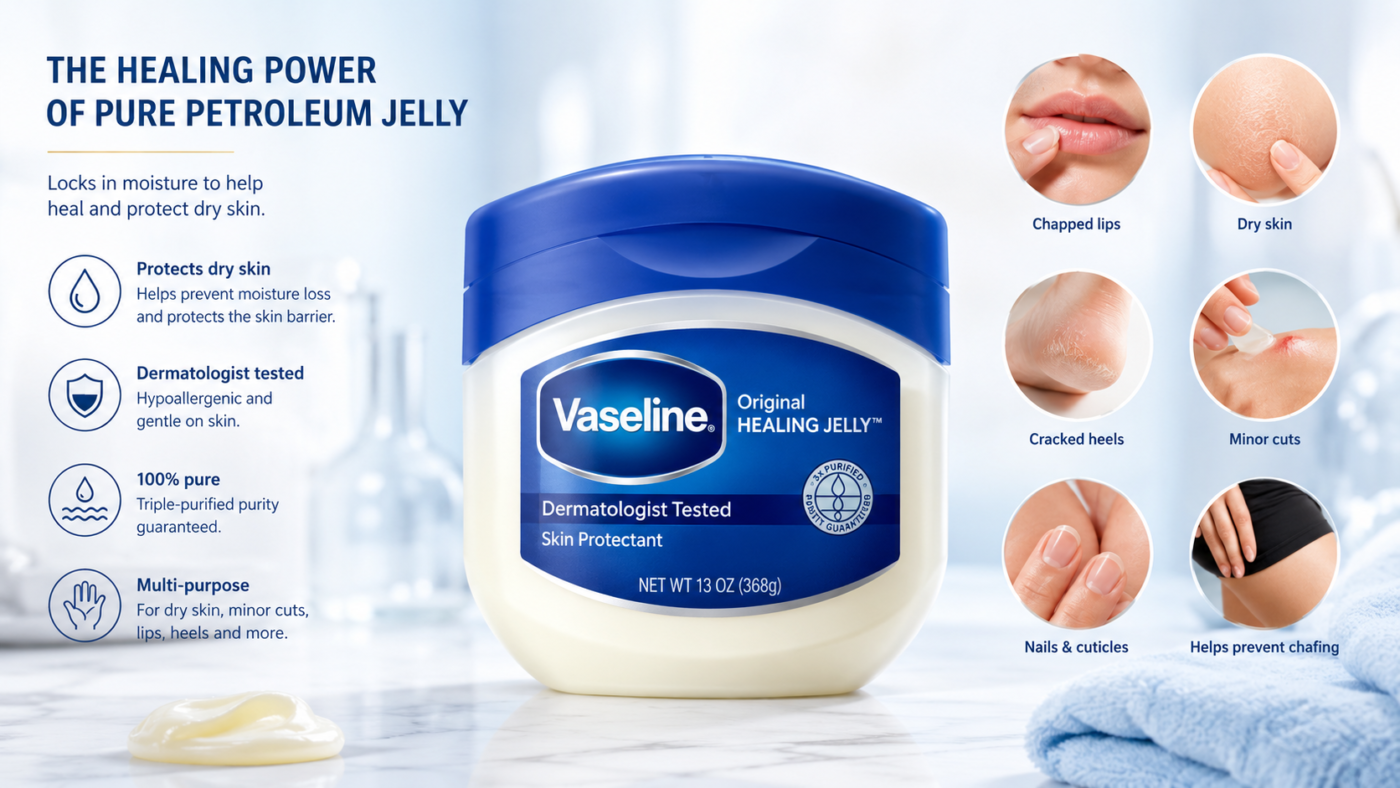
Petroleum jelly for skin is one of the simplest and most versatile products for protecting dry, irritated and moisture-depleted skin.Petroleum jelly is one of the simplest skincare products you can buy.
It contains no trendy peptides, botanical extracts, acids, or complicated anti-aging complexes.
Yet more than a century after it first became widely used, dermatologists still recommend plain petroleum jelly for many everyday skin problems.
That is not because it is old-fashioned.
It is because it performs one basic job extremely well.
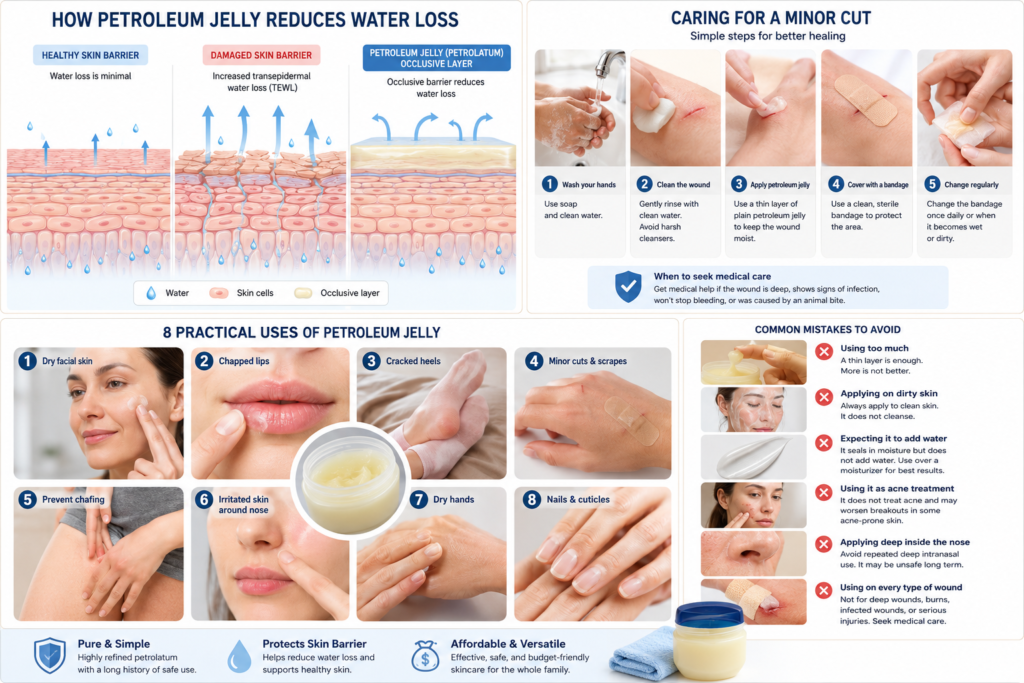
Petroleum jelly forms an occlusive layer over the skin that reduces water loss and helps protect the skin barrier.
Used correctly, it can help with dry skin, cracked heels, chapped lips, minor cuts, friction, irritated skin, and brittle cuticles.
But it is not a cure-all.
It does not erase wrinkles, treat acne, sterilize wounds, or replace medical treatment.
Understanding what it actually does makes this inexpensive product much more useful.
Petroleum Jelly and Vaseline Are Not Exactly the Same Thing
Petroleum jelly is the generic ingredient.
Petrolatum is another name for the same substance.
Vaseline is a well-known brand of petroleum jelly.
In everyday conversation, people often use the word Vaseline to mean any petroleum jelly product.
For skincare purposes, the most important thing is usually to choose a plain, highly purified petrolatum product without unnecessary fragrance or irritating additives.
Is Petroleum Jelly a Moisturizer?
Yes, but it works differently from many creams and lotions.
Moisturizing products generally use three types of ingredients.
Humectants attract water.
Emollients smooth spaces between skin cells.
Occlusives reduce water loss by forming a protective layer over the surface.
Petroleum jelly is primarily an occlusive.
It does not add large amounts of water to your skin by itself.
Instead, it helps keep existing moisture from evaporating.
This is why it works especially well when applied to slightly damp skin or over a moisturizer.
Think of it as putting a lid on moisture that is already there.
Why Skin Loses Water
Your skin constantly loses small amounts of water to the surrounding environment.
This process is known as transepidermal water loss.
Healthy skin has a protective outer barrier that slows this process.
When the barrier becomes damaged by dry weather, frequent washing, harsh cleansers, eczema, friction, aging, or irritating skincare products, water escapes more easily.
The result can be:
Dryness
Flaking
Tightness
Itching
Cracking
Increased sensitivity
Petroleum jelly helps reduce this water loss by creating a physical barrier over the surface.
That is why it remains one of the most effective simple products for very dry skin.
Use 1: Minor Cuts and Scrapes
One of the best-supported uses of petroleum jelly is caring for small, uncomplicated skin injuries.
For a minor cut or scrape:
Wash your hands.
Gently rinse the wound with clean water.
Use a mild cleanser around the area.
Stop any bleeding with gentle pressure.
Apply a thin layer of plain petroleum jelly.
Cover the area with a clean bandage.
Change the dressing regularly.
Keeping a minor wound moist can support normal skin repair and reduce excessive scab formation.
A moist environment allows new skin cells to migrate across the wound more easily than when the surface becomes excessively dry and cracked.
For this reason, plain petroleum jelly is commonly recommended after some minor dermatologic procedures as well.
Do You Need Antibiotic Ointment on Every Cut?
Usually not.
Many people automatically reach for a topical antibiotic whenever they get a small cut.
For a clean, uncomplicated minor wound, that is often unnecessary.
Ingredients such as neomycin and bacitracin can cause allergic contact dermatitis in some people.
The resulting redness, itching, swelling, or rash may even be mistaken for an infection.
For ordinary minor cuts that are cleaned properly, plain petroleum jelly is often sufficient to maintain a moist healing environment.
Antibiotics may still be appropriate when a healthcare professional believes an infection is present or the wound carries a higher infection risk.
Do not automatically treat every wound the same way.
When a Wound Needs Medical Attention
Petroleum jelly is intended for minor wound care, not serious injuries.
Seek medical care if a wound:
Is deep or gaping
Will not stop bleeding
Was caused by an animal or human bite
Contains embedded debris
Shows increasing redness or swelling
Produces pus
Becomes increasingly painful
Is associated with fever
Was caused by a dirty puncture
Occurs in someone with poor circulation or diabetes
Large burns, surgical wounds, infected wounds, and chronic ulcers need individualized care.
Use 2: Dry and Cracked Heels
Cracked heels are often a combination of very dry skin and thickened skin under mechanical pressure.
Simply covering a completely dry heel with petroleum jelly may help, but a layered approach often works better.
A useful nighttime routine is:
Wash your feet gently.
Pat them dry while leaving the skin slightly damp.
Apply a rich moisturizer.
For very thick heel skin, a cream containing urea may help soften the hardened surface.
Apply petroleum jelly over the moisturizer.
Put on clean cotton socks.
Leave it on overnight.
The moisturizer adds or attracts water.
Petroleum jelly helps keep that moisture from escaping.
This is a good example of why hydration first and occlusion second can work better than either alone.
People with diabetes should be especially careful with cracked feet because deep cracks can become infected and may require professional care. The American Academy of Dermatology specifically recommends a urea cream followed by an ointment such as petroleum jelly and cotton socks for dry, cracked heels in appropriate patients.
Use 3: Very Dry Areas of the Face
Petroleum jelly can be useful for dry areas such as:
Around the eyes
Dry eyelids
Around the mouth
Sides of the nose
Dry cheeks
Forehead patches
Neck
The key is quantity.
You usually do not need to coat your entire face with a thick layer.
A very thin film over dry areas is often enough.
Applying it after moisturizer can be especially useful during winter or in air-conditioned environments.
What Is Slugging?
Slugging is the modern skincare name for an old technique.
It means applying an occlusive layer, commonly petroleum jelly, over skincare products at night.
The idea is to reduce evaporation and keep moisture in the skin.
For dry or barrier-damaged skin, this can feel very soothing.
But it is not necessary for everyone.
People with oily or acne-prone skin may find full-face slugging too heavy.
The American Academy of Dermatology specifically advises acne-prone people to be cautious about applying petroleum jelly over the entire face because breakouts can worsen in some individuals.
Does Petroleum Jelly Clog Pores?
The answer is more nuanced than either “yes” or “never.”
Pure petrolatum itself is generally regarded as having low comedogenic potential.
However, putting a highly occlusive layer over acne-prone skin can sometimes worsen breakouts.
It may also increase the penetration of products placed underneath it.
That matters if you are using irritating ingredients such as:
Retinoids
Strong exfoliating acids
Benzoyl peroxide
Some acne medications
Putting a heavy occlusive layer over these products may make irritation stronger.
If you are acne-prone, use petroleum jelly only where you actually need it and monitor how your skin responds.
Use 4: Dry Eyelids and Under-Eye Skin
The skin around the eyes is thin and easily irritated.
A tiny amount of petroleum jelly can help protect very dry eyelid skin and reduce moisture loss.
This can make fine dehydration lines temporarily look softer.
But petroleum jelly does not rebuild lost collagen.
It does not permanently erase crow’s feet.
It does not replace sunscreen, retinoids, or professional treatments when the concern is true photoaging.
Its benefit here is mainly barrier protection and reduced dryness.
That distinction matters.
Petroleum Jelly Is Not an Anti-Wrinkle Treatment
A hydrated surface reflects light differently and looks smoother.
For this reason, dry fine lines may temporarily appear less obvious after petroleum jelly is applied.
But facial wrinkles develop from many factors, including:
Collagen loss
Elastin changes
Repeated facial expressions
Sun exposure
Genetics
Bone and fat changes with aging
Petroleum jelly cannot reverse these structural processes.
Calling it the best anti-wrinkle treatment would be misleading.
It is better described as an excellent occlusive for dry skin.
Use 5: Chapped Lips
Petroleum jelly works very well as a simple lip protectant.
Lips have a thinner protective barrier than much of the rest of the skin and can lose moisture easily.
For best results:
Avoid repeatedly licking your lips.
Apply petroleum jelly when the lips are slightly damp.
Reapply when needed.
Use sun-protective lip balm outdoors.
You do not need to wash your lips with water every single time before applying it.
The more important issue is avoiding chronic lip licking.
Repeated saliva exposure can worsen irritation and dryness.
Use 6: Preventing Chafing
Friction can damage the skin barrier.
Common areas include:
Inner thighs
Heels
Feet
Under bra straps
Areas irritated by clothing
Skin around the nose during a cold
Petroleum jelly can reduce friction between surfaces.
A thin layer applied before walking, running, or wearing shoes that commonly rub may help prevent irritation and blisters.
This is one of its simplest and most useful applications.
Use 7: Protecting the Nose During a Cold
Repeatedly blowing your nose can leave the skin around the nostrils red, dry, and painful.
A small amount of petroleum jelly applied to the external skin around the nostrils can protect irritated skin and reduce friction.
The important word is external.
Do not repeatedly push large amounts deep inside the nasal cavity.
Long-term intranasal use of petroleum-based products has rarely been associated with aspiration into the lungs and a condition called lipoid pneumonia.
For internal nasal dryness, saline spray, humidification, or an appropriate water-based nasal product is generally a better first option.
What About Using Petroleum Jelly to Block Pollen?
Some barrier products applied around the outer nostril may physically trap a portion of airborne particles.
However, petroleum jelly should not be treated as an allergy treatment.
It does not replace:
Antihistamines
Nasal corticosteroids when medically appropriate
Saline irrigation
Environmental allergen control
Professional allergy evaluation
If you choose to use a barrier around the nose, keep it to the external opening rather than inserting large amounts inside.
Use 8: Nails and Cuticles
Petroleum jelly can also be useful for dry nails and cuticles.
Frequent hand washing, alcohol-based sanitizer, nail polish remover, cold weather, and repeated manicures can dry the skin surrounding nails.
Applying a small amount of petroleum jelly to damp cuticles can:
Reduce dryness
Improve flexibility
Decrease splitting
Help protect brittle nails
This is especially useful before bed.
Petroleum jelly will not correct nail disease, however.
Persistent nail thickening, discoloration, separation, pain, or major changes deserve evaluation.
Does Petroleum Jelly Fix Nail Ridges?
Not necessarily.
Longitudinal ridges can become more noticeable with age and dryness.
Moisturizing the nail and surrounding cuticle may improve the appearance of dry, brittle nails.
But ridges can also reflect normal aging, repeated trauma, skin disease, nutritional issues, or other conditions.
Petroleum jelly can condition the nail surface.
It cannot diagnose or treat every cause of nail changes.
Is Petroleum Jelly Safe?
Highly refined petrolatum used in regulated skincare and pharmaceutical products has a long history of topical use.
Modern cosmetic and medical-grade petrolatum is refined before it reaches consumers.
The fact that petrolatum originates from petroleum does not mean putting a regulated skincare product on your skin is equivalent to applying crude oil.
What matters is the finished purified material and manufacturing standards.
For most people, plain petroleum jelly is well tolerated.
Allergic reactions to pure petrolatum are uncommon.
Common Mistake 1: Applying Too Much
You do not need a thick visible coating for everyday dry skin.
More is not automatically better.
A thin film is usually enough to reduce evaporation.
Heavy application can feel greasy, trap heat, stain clothing, and feel uncomfortable.
Common Mistake 2: Applying It Over Dirty Skin
Petroleum jelly forms an occlusive layer.
For facial use, apply it to clean skin.
For minor wound care, clean the wound first.
It does not disinfect skin.
It does not kill bacteria.
Think of it as protection, not cleansing.
Common Mistake 3: Expecting It to Add Water
If your skin is extremely dry, use it after water or moisturizer.
A simple routine is:
Cleanse gently.
Leave the skin slightly damp.
Apply moisturizer.
Seal very dry areas with a thin layer of petroleum jelly.
This usually works better than putting an occlusive product over skin that is already severely dry.
Common Mistake 4: Using It as a Treatment for Acne
Petroleum jelly does not treat the causes of acne.
It does not unclog pores.
It does not reduce acne bacteria.
It does not regulate abnormal follicular keratinization.
If you have acne, treatments such as adapalene, benzoyl peroxide, salicylic acid, or prescription therapies may be more appropriate depending on your skin.
Petroleum jelly may sometimes be useful for protecting irritated areas, but it is not an acne medication.
Common Mistake 5: Applying It Deep Inside the Nose
External skin around the nostrils is one thing.
Repeated deep intranasal application is another.
If your nose is chronically dry or bleeding, find out why.
Dry indoor air, allergies, medications, nasal sprays, structural issues, and other conditions may contribute.
A humidifier or saline-based product may be a safer long-term solution.
Common Mistake 6: Using It on Every Kind of Wound
Petroleum jelly is useful for many minor clean wounds.
It is not appropriate as the only treatment for:
Deep wounds
Severe burns
Infected wounds
Animal bites
Chronic ulcers
Major surgical wounds unless instructed
Diabetic foot wounds
Serious injuries need proper medical assessment.
A Simple Petroleum Jelly Routine
For Dry Skin
Apply moisturizer to slightly damp skin.
Use a thin layer of petroleum jelly only on the driest areas.
For Cracked Heels
Use a rich moisturizer or appropriate urea cream.
Seal with petroleum jelly.
Wear cotton socks overnight.
For Chapped Lips
Stop licking your lips.
Apply a small amount repeatedly as needed.
For Minor Cuts
Clean the area.
Apply a thin layer.
Cover with a clean bandage.
For Chafing
Apply a small amount before friction begins.
For Nails
Apply to slightly damp nails and cuticles, especially before bed.
Frequently Asked Questions
Is Vaseline the same as petroleum jelly?
Vaseline is a brand name.
Petroleum jelly or petrolatum is the ingredient.
Does petroleum jelly actually moisturize skin?
Yes, but primarily by preventing water loss.
It is an occlusive moisturizer rather than a strong humectant.
Can petroleum jelly heal cuts?
It can help create a moist environment that supports healing of minor clean cuts and scrapes.
It does not sterilize wounds or treat infections.
Is antibiotic ointment better?
Not necessarily for uncomplicated minor wounds.
Topical antibiotics can cause allergic contact dermatitis in some people, while plain petrolatum often provides adequate moist wound care.
Can I put petroleum jelly around my eyes?
A small amount can be useful for very dry eyelid skin if you tolerate it.
Avoid getting products directly into the eyes.
Can I use it all over my face?
Some people with dry skin tolerate full-face slugging.
People with acne-prone skin should be more cautious.
Does petroleum jelly erase wrinkles?
No.
It can make dry fine lines look temporarily softer but does not rebuild lost collagen or erase structural wrinkles.
Does petroleum jelly clog pores?
Pure petrolatum is generally considered low risk for comedones, but full-face occlusion can worsen breakouts in some acne-prone individuals.
Can I put it inside my nose?
Long-term deep intranasal use is not recommended.
For nasal dryness, consider saline, humidification, or an appropriate water-soluble product.
Is petroleum jelly safe for cracked heels?
Yes for ordinary dry heels.
Deep cracks, infection, poor circulation, or diabetes require greater caution.
Bottom Line
Petroleum jelly has survived more than a century of changing skincare trends because it does something simple and useful.
It reduces moisture loss.
That one function makes it valuable for dry skin, chapped lips, cracked heels, friction, minor cuts, and dry cuticles.
But its simplicity also makes it easy to exaggerate.
Petroleum jelly is not an antibiotic.
It is not an acne cure.
It is not a collagen treatment.
It is not a permanent wrinkle remover.
And it should not be inserted deeply into the nose for long periods.
Used in the right place and in the right amount, plain petroleum jelly remains one of the least complicated and most versatile products in basic skincare.
Medical Disclaimer
This article is for educational and informational purposes only and is not intended as medical advice, diagnosis, or treatment. Serious wounds, burns, infections, persistent rashes, non-healing cracks, significant acne, chronic nasal bleeding, or skin problems associated with diabetes or poor circulation should be evaluated by a qualified healthcare professional.
This article is for general education and does not replace individualized care from a qualified health professional. Seek appropriate advice for persistent, severe, or concerning symptoms.
Read the full medical disclaimer