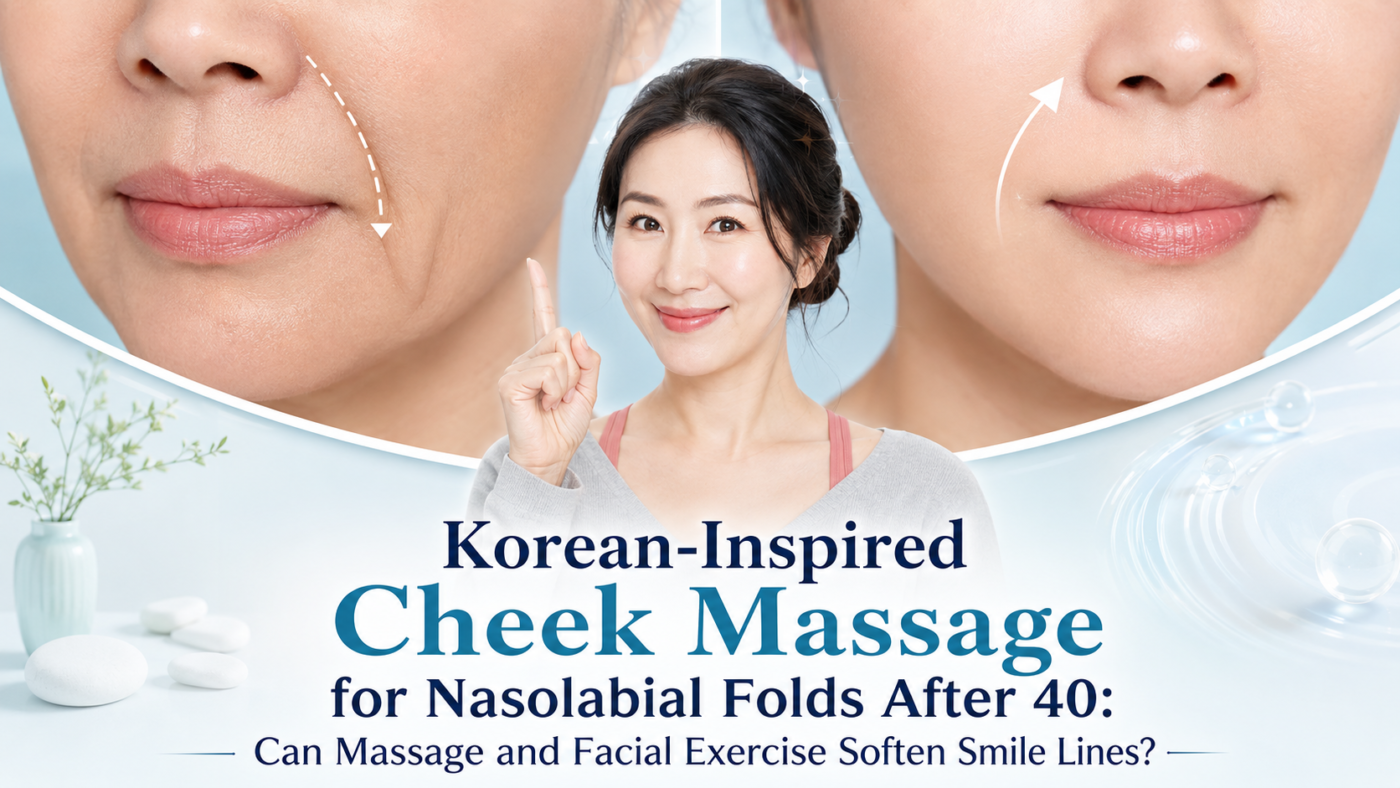
Nasolabial fold massage after 40 has become increasingly popular among people looking for gentle ways to improve facial comfort, cheek mobility and the appearance of smile lines. Nasolabial folds—the lines that run from the sides of the nose toward the corners of the mouth—often become more noticeable with age.Nasolabial folds—the lines that run from the sides of the nose toward the corners of the mouth—often become more noticeable with age. They are a normal part of facial anatomy, but changes in skin elasticity, facial fat distribution, bone structure and muscle function can make them appear deeper over time.
One approach that has become increasingly popular in East Asian beauty routines combines gentle cheek massage with facial-muscle exercises. Rather than promising to permanently erase wrinkles, the more realistic goal is to relax tight facial tissues, improve awareness and control of the cheek muscles, temporarily reduce puffiness, and help the face look more refreshed.
This routine focuses especially on the muscles around the cheekbones and upper lip.
Why Nasolabial Folds Become More Noticeable
Nasolabial folds are not caused by one single factor.
Several age-related changes can contribute:
Skin gradually loses collagen and elasticity.
Facial fat compartments can shift or lose volume.
The midface may lose structural support.
Cheek muscles can become less coordinated or feel tighter.
Repeated facial expressions continually fold the same areas of skin.
Genetics, sun exposure, smoking and overall skin health also influence how prominent these folds become.
This is why simply rubbing one wrinkle cannot permanently “remove” it.
However, manipulating the surrounding soft tissues may temporarily change facial tension and puffiness, making the area look smoother.
The Role of the Cheek Muscles
Several muscles contribute to facial expression around the cheeks, nose and upper lip.
The zygomaticus muscles help raise the corners of the mouth during smiling.
The levator labii superioris helps elevate the upper lip.
Other muscles surrounding the nose and mouth work together to create expressions.
If facial movements become limited because of tension or poor neuromuscular control, deliberately exercising these muscles may improve awareness and movement.
That does not mean facial exercise can rebuild lost facial bone or replace medical anti-aging treatments. But gentle movement may help some people feel better control over their facial expressions.
A Korean-Inspired Approach to Cheek Massage
Some Korean beauty massage traditions place emphasis not only on the skin but also on structures around the cheekbones and jaw.
The routine described here combines three elements:
Gentle massage around the scalp and temples.
Pressure and movement around the cheekbones.
Facial exercises designed to activate the upper-cheek and upper-lip muscles.
The emphasis should always be on controlled, comfortable pressure rather than aggressive manipulation.
Pain is not required for a massage to be effective.
Step 1: Begin With Breathing and Upper-Body Relaxation
Sit comfortably with your spine reasonably upright.
Place your hands on your knees.
Inhale while gently opening the chest.
Exhale while allowing the spine and shoulders to relax.
Repeat several times.
The purpose is not to dramatically change facial structure but to reduce unnecessary neck and shoulder tension before working on the face.
Step 2: Loosen the Shoulders
Slowly rotate the shoulders forward.
Then rotate them backward.
Keep your breathing relaxed.
Many people unknowingly hold tension in the upper trapezius, neck and jaw. Reducing this tension may make the facial massage more comfortable.
Avoid forcing the shoulders into a large range of motion.
Step 3: Gently Massage the Side of the Neck
Using the pads of your fingers, gently massage the muscles along the side of the neck.
Use slow movements rather than digging deeply into the tissues.
Avoid pressing directly over the front of the throat or carotid artery.
If you experience dizziness, sharp pain or unusual symptoms, stop.
Repeat on the opposite side.
Step 4: Release the Scalp and Temple Area
Place one elbow on a table for support.
Rest the side of your head lightly against your hand.
Use your fingertips to move the scalp gently rather than aggressively rubbing the skin.
Try small circular motions around the temple and side of the scalp.
Then switch sides.
Scalp massage may help create a temporary feeling of relaxation and warmth. It should not be interpreted as physically lifting the face or reversing aging.
Step 5: Warm the Ears
Gently hold and rub the outer ears between your fingers.
Move around the entire ear without pulling forcefully.
This is primarily a relaxation step.
The ears contain many sensory nerve endings, which may explain why gentle ear massage feels calming for some people.
Step 6: Massage Around the Upper Cheek
Place your fingertips beneath the cheekbone.
Apply light-to-moderate upward pressure.
Move slowly along the cheekbone rather than pressing aggressively into one point.
The goal is to relax the tissues surrounding the cheek rather than attempting to move the bone itself.
If you have dental pain, recent dental surgery, temporomandibular joint problems or facial nerve symptoms, be especially cautious.
Step 7: Explore the Area Beside the Nose
Place two fingertips beside the nose, where several muscles involved in upper-lip movement originate.
Gently massage the area using small circles.
Avoid pressing directly into the nostril.
This region can be sensitive, so use considerably less pressure than you might use on the shoulders or back.
Step 8: Practice an Upper-Lip Lift
Now move from massage to muscle control.
Without using your hands, try to raise your upper lip enough to reveal part of the upper gums.
Do not strain.
You may notice that one side moves more easily than the other.
Mild asymmetry is common.
The purpose is to become aware of the muscles responsible for lifting the upper lip and cheeks.
Step 9: Add Gentle Finger Resistance
Place two fingers lightly over the upper-cheek area.
Try to raise the cheeks and upper lip while the fingers provide very light resistance.
Think of the fingers as tiny resistance trainers rather than weights.
Hold briefly.
Relax.
Repeat several times.
Muscle fatigue may occur, but sharp pain is a reason to stop.
Step 10: Massage Beneath the Cheekbones
Make a relaxed fist.
Using the broad surface of the knuckles—not sharp pressure—place the hand beneath the cheekbone.
Move gently upward and outward.
Do not attempt to “break up” tissue or force the cheekbone into a new position.
Facial bones cannot be safely reshaped through routine massage.
The useful objective is soft-tissue relaxation.
Step 11: Perform the “E” and “O” Facial Movements
Say a long “Eee” sound while gently lifting the corners of the mouth.
Then form an “O” shape with the lips.
Alternate between the two positions.
Pay attention to areas that feel difficult to control.
Try approximately five to ten slow repetitions.
These movements engage several muscles around the mouth and cheeks.
Step 12: Finish With a Relaxed Smile
Relax the forehead.
Allow the eyebrows to remain natural.
Gently lift the corners of the mouth.
Avoid squeezing the eyes tightly.
Hold a comfortable smile for several seconds and then release.
Finish by placing your palms lightly over the cheeks and taking several slow breaths.
Can Cheek Massage Really Reduce Nasolabial Folds?
Massage may temporarily change how nasolabial folds look.
Possible short-term effects include:
Reduced facial puffiness.
Relaxation of tight muscles.
Temporary improvement in local circulation.
Improved awareness of facial-muscle movement.
A more rested facial expression.
These changes may make smile lines appear softer immediately after a routine.
However, massage has not been proven to permanently eliminate established nasolabial folds.
Deep folds are strongly influenced by skin aging, facial volume, connective tissue and skeletal structure.
What About Facial Exercises?
Research into facial exercises is still limited.
One small study published in JAMA Dermatology found that a structured facial-exercise program was associated with improvements in some measures of facial fullness and estimated appearance age.
However, the study was small and did not establish that facial exercise can reliably erase wrinkles.
The most reasonable interpretation is that facial exercise may improve muscle awareness and possibly facial fullness in some people, but results vary considerably.
How Often Should You Practice?
A gentle routine can usually be performed several times per week.
Ten to fifteen minutes is more than enough for most people.
More pressure does not mean better results.
Consistency and gentle technique matter more than aggressive massage.
If your skin becomes irritated, reduce the frequency or stop.
Important Safety Tips
Facial massage should feel comfortable.
Avoid aggressive pressure around the eyes, nose and jaw.
Do not massage over active acne cysts, infections, open wounds, severe rosacea flares or recently treated skin.
Wait for professional guidance after facial surgery, fillers, threads, laser procedures or other cosmetic treatments.
Anyone with unexplained facial weakness, sudden asymmetry, numbness or severe facial pain should seek medical evaluation rather than treating the problem with massage.
The Bottom Line
A Korean-inspired cheek massage combined with facial exercises can be a pleasant way to relax facial tension and improve awareness of the muscles around the cheeks and upper lip.
Some people may notice that their face looks slightly less puffy or that smile lines appear softer immediately afterward.
That is different from permanently removing nasolabial folds.
The most useful way to think about this routine is as a gentle facial-mobility and self-care practice rather than a substitute for dermatologic or cosmetic treatment.
Performed carefully, it can become a relaxing part of a broader skin-health routine that includes sun protection, adequate sleep, balanced nutrition and appropriate skincare.
FAQ
Can facial massage permanently remove nasolabial folds?
No. Massage may temporarily reduce puffiness or facial tension and make folds look softer, but it cannot permanently remove structural smile lines.
Can facial exercises strengthen cheek muscles?
Facial exercises activate the muscles responsible for smiling and upper-lip movement. Evidence for major anti-aging effects remains limited, although some people may improve muscle awareness and control.
Should facial massage hurt?
No. Mild pressure or tenderness can occur, but intense pain is not necessary and may cause irritation.
How often can I perform this routine?
A gentle routine several times per week is reasonable for most healthy adults. Reduce the frequency if your skin becomes sensitive or irritated.
Can I do this after Botox or fillers?
Do not aggressively massage recently treated areas. Follow the specific aftercare instructions given by your treating clinician.
Medical Disclaimer
This article is for educational purposes only and is not medical advice. Facial massage and exercise cannot diagnose, treat or cure medical conditions and should not replace professional dermatologic or medical care.
This article is for general education and does not replace individualized care from a qualified health professional. Seek appropriate advice for persistent, severe, or concerning symptoms.
Read the full medical disclaimer