Hip pain that appears when you stand after sitting can be easy to dismiss. You shift your weight, walk differently for a few steps and hope it disappears.
Sometimes it does.
Sometimes it keeps returning.
Hip discomfort after 40 can come from many causes, including stiffness, reduced strength, osteoarthritis, tendon irritation, lower-back problems and long periods of sitting. That means one wall-based routine cannot diagnose or cure every hip problem.
But a gentle legs up the wall hip mobility routine can be a comfortable way to move the hips with less weight bearing, explore range of motion and relax the lower body without standing exercise.
The key is to treat it as mobility and recovery work, not as a miracle cure.
Why Hip Pain After Sitting Happens
Hip pain after sitting can have several explanations.
Common possibilities include:
- Hip osteoarthritis
- Gluteal tendon irritation
- Hip flexor stiffness
- Reduced hip mobility
- Lower-back referral
- Bursitis-like symptoms
- Weakness or deconditioning
The location of the pain matters.
Pain in the groin may suggest something different from pain on the outside of the hip or pain that begins in the lower back.
That is why persistent hip pain should not automatically be labeled as “tight fascia” or “blocked circulation.”
Is Hip Osteoarthritis Common?
Hip osteoarthritis becomes more common with age, and women are affected frequently.
It involves changes in the joint, including cartilage degeneration and alterations in surrounding bone and tissue.
Symptoms can include pain, stiffness and reduced mobility.
But not every uncomfortable hip has osteoarthritis.
A proper diagnosis depends on symptoms, examination and sometimes imaging.
Why Legs Up the Wall Can Feel Comfortable
Placing the legs against a wall changes how much load the lower body carries.
You are no longer standing or supporting your full body weight through the hips.
That can make certain movements feel easier.
This does not completely remove joint pressure, and it does not create a true zero-load state.
But it can reduce the demand of standing and let you explore hip motion in a supported position.
Can Gentle Movement Help a Stiff Hip?
Often, yes.
Joints generally benefit from appropriate movement.
Gentle movement can help maintain range of motion and may reduce the feeling of stiffness.
But the goal is not to force the joint.
Movement should stay within a comfortable range.
Pain is not required for progress.
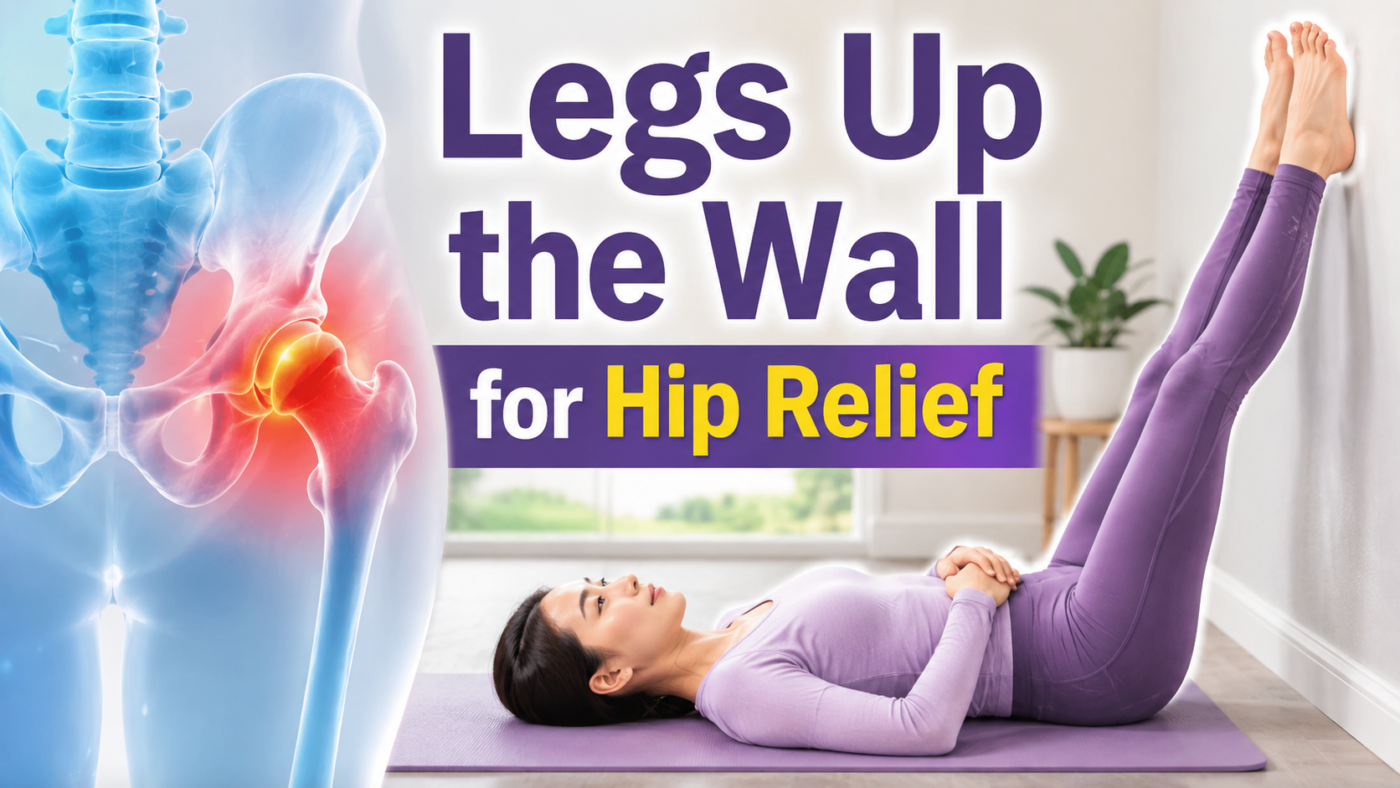
Exercise 1: Legs Up the Wall
Sit sideways next to a wall.
Carefully lower yourself onto your back while bringing your legs up the wall.
Adjust your distance from the wall.
You do not need your hips pressed directly against it.
If the backs of your legs feel too tight, move farther away.
Stay here for 30 to 60 seconds.
Breathe normally.
What This Position May Do
Elevating the legs can make the lower body feel lighter.
For some people, it may temporarily reduce the sensation of heaviness in the legs.
It may also be relaxing.
However, this position does not “reverse aging” in blood vessels, and it should not be described as a proven longevity treatment.
Exercise 2: Ankle Pumps
With your legs supported on the wall, point your toes gently away.
Then bring them back toward you.
Repeat 10 to 20 times.
This activates the calf muscles and moves the ankle joints.
It is a simple way to add circulation-related movement without standing.
Are Calves Really the “Second Heart”?
The calf muscles help support venous return when they contract during movement.
That is why people sometimes call them the “second heart.”
It is a metaphor.
The calves do not function like another heart, but ankle and calf movement can support normal lower-leg circulation.
Exercise 3: Gentle Hip Rocking
With your knees slightly bent, allow your pelvis to move gently side to side.
Keep the movement small.
Do not force a stretch.
Continue for approximately 30 seconds.
This can help reduce the sensation of stiffness around the hips and lower back.
Exercise 4: Wall Butterfly
Bring the soles of your feet toward each other.
Allow your knees to move outward.
Let gravity do most of the work.
Do not press your knees down with your hands.
Stay for 30 to 60 seconds.
You should feel a mild stretch around the inner thighs or hips.
Stop if you feel sharp groin pain.
Can Gravity “Open” the Hips?
Gravity can assist a passive stretch.
But it does not permanently reshape the hip joint.
The goal is simply to spend a short period in a comfortable range that you may not use often during the day.
Exercise 5: Figure-Four Hip Stretch
Bend both knees.
Cross one ankle over the opposite thigh.
Adjust how high or low your feet are on the wall until you feel a comfortable stretch.
Hold for 20 to 30 seconds.
Switch sides.
This may stretch muscles around the back and outside of the hip.
Avoid forcing the knee outward.
Exercise 6: Knee In-and-Out Movement
Place both feet on the wall with knees bent.
Slowly allow one knee to move inward, then outward.
Repeat on the other side.
Then move both knees gently together if comfortable.
Perform 8 to 10 slow repetitions.
The goal is controlled hip rotation.
Can Hip Movement “Lubricate” the Joint?
Movement helps distribute synovial fluid within healthy synovial joints.
That is one reason gentle movement often feels better than complete inactivity.
But phrases such as “oiling the joint from the inside” are simplified metaphors.
Movement does not repair worn cartilage in a few minutes.
Exercise 7: Supported Hip Circles
With your knees bent, make a small circular movement with one knee.
Keep the motion controlled.
Repeat five circles in each direction.
Switch sides.
Use a very small range if your hip feels sensitive.
Exercise 8: Gentle Heel Tapping
Bring your feet away from the wall if needed.
Lightly tap your heels toward the gluteal area only if the movement is comfortable.
This should feel playful and mild.
Do not strike the body hard.
It is not necessary for hip health.
Exercise 9: Legs-Up Shaking
Extend your legs upward or against the wall.
Relax the knees.
Gently shake the legs for 10 to 20 seconds.
This can reduce muscular tension and make the legs feel less stiff.
It does not “drain toxins” or reverse vascular aging.
Exercise 10: Knees-to-Chest Recovery
Bring both knees toward your chest.
Hold behind the thighs or around the shins.
Take several slow breaths.
Do not force your chin toward your knees.
Allow your lower back to relax.
Stay for 20 to 30 seconds.
A Simple 13-Minute Wall Routine
Try this sequence:
1. Legs up the wall — 2 minutes
Settle and breathe.
2. Ankle pumps — 1 minute
Move slowly.
3. Hip rocking — 1 minute
Keep it comfortable.
4. Wall butterfly — 2 minutes
Let gravity assist.
5. Figure-four stretch — 1 minute per side
Adjust the angle.
6. Knee in-and-out mobility — 2 minutes
Move gently.
7. Light leg shaking — 1 minute
Stay relaxed.
8. Knees-to-chest recovery — 1 minute
Finish with slow breathing.
Can This Help Hip Pain?
It may help some people with stiffness or mild nonspecific discomfort.
It is less likely to solve pain caused by structural injury, advanced arthritis or significant tendon problems.
A routine can make you feel better without curing the underlying condition.
That distinction matters.
Can It Help Lower-Back Pain?
Sometimes.
Hip mobility and lower-back comfort can influence each other.
A supported wall position may feel relaxing if prolonged standing or sitting aggravates your back.
But some back conditions do not tolerate certain hip positions well.
Stop if pain increases.
Can It Reduce Leg Swelling?
Elevation can temporarily help some forms of dependent leg swelling.
Gentle ankle movement may also support venous return.
But persistent or unexplained swelling needs attention.
One-sided swelling, redness, warmth or calf pain can be a warning sign of a blood clot and requires urgent medical evaluation.
Can It Improve Sleep?
A relaxing bedtime routine may help some people wind down.
Slow breathing and a supported position can feel calming.
But there is not enough evidence to say this specific sequence reliably improves sleep quality for everyone.
Think of it as a relaxation option rather than a proven sleep treatment.
Is “Legs Up the Wall” Safe for Everyone?
Not always.
Use caution if you have:
- Severe glaucoma
- Uncontrolled high blood pressure
- Significant heart failure
- Severe reflux in inverted positions
- Recent abdominal or pelvic surgery
- Advanced vascular disease
- Pain that worsens when lying flat
If you are unsure, use a more moderate leg-elevation position instead.
What About the “Cockroach Exercise”?
Some Japanese wellness routines involve lying on the back and gently shaking the arms and legs in the air.
It is sometimes promoted as a traditional longevity exercise.
The movement itself is harmless for many people when done gently.
But claims that it has been proven to reverse vascular aging or uniquely explain Japanese longevity are not established.
Use it as light movement, not as medicine.
Why Aggressive Stretching Is Not Better
If your hip is painful, forcing range can irritate it.
Stretching should feel mild.
A sharp pinch in the groin is not something to push through.
Neither is deep lateral hip pain.
Mobility improves through consistent exposure, not punishment.
When Hip Pain Needs Medical Evaluation
Seek professional assessment if you have:
- Severe or worsening hip pain
- Pain after a fall
- Inability to bear weight
- Fever
- Significant swelling
- Night pain that is progressive
- Sudden loss of motion
- Numbness or weakness
- Pain radiating from the spine
- Persistent symptoms lasting several weeks
Early evaluation can prevent months of compensating around a problem.
Hip Pain After 40 Is Not Something You Have to Ignore
One of the worst habits is quietly adapting to pain without understanding it.
You shorten your stride.
You stop climbing stairs.
You sit differently.
You stop doing movements you enjoy.
Over time, the reduction in activity can create more weakness and stiffness.
That is why mild pain should be respected early.
Not feared.
Not ignored.
Strength Still Matters
Mobility alone is not enough for long-term hip health.
The hips also need strength.
Useful exercises may include:
- Sit-to-stand
- Bridges
- Side steps
- Step-ups
- Supported squats
- Hip abduction exercises
A wall routine can be a comfortable starting point.
Strength training is often the next step.Legs up the wall hip mobility can be a comfortable option when standing exercises make your hips feel stiff or irritated.
Regular legs up the wall hip mobility may help you explore hip movement in a supported, low-load position.
The goal of legs up the wall hip mobility is gentle movement and relaxation, not forcing the joint into a deeper stretch.
The Bottom Line
A legs-up-the-wall hip routine can be a gentle way to explore hip movement after sitting, especially if standing exercise feels uncomfortable.
It may help reduce stiffness, provide a supported stretch and make the legs feel lighter.
It cannot cure osteoarthritis, permanently lubricate damaged joints, reverse vascular aging or guarantee better sleep.
Use it for what it does well:
comfortable movement, relaxation and low-load mobility.
Then build strength gradually.
And if hip pain keeps returning, do not simply learn to live around it.
Find out why.
FAQ
Can legs up the wall help hip pain?
It may reduce stiffness and make movement feel easier for some people, but it cannot treat every cause of hip pain.
Is legs up the wall good for hip osteoarthritis?
Gentle movement may be useful for some people with osteoarthritis, but exercise should be adapted to symptoms and medical guidance.
How long should I keep my legs up the wall?
A few minutes is enough for most people. You do not need to remain there for long periods to benefit from gentle mobility.
Can this reduce swollen legs?
Elevation and ankle movement may temporarily help mild dependent swelling, but persistent or one-sided swelling requires medical assessment.
Does hip movement lubricate the joint?
Movement helps distribute synovial fluid, but it does not rebuild damaged cartilage or permanently “oil” the joint.
Can I do this routine before bed?
Yes, if the position feels comfortable and does not worsen reflux, dizziness or other symptoms.
Is the cockroach exercise scientifically proven?
It is a light movement exercise, but claims that it reverses vascular aging or uniquely promotes longevity are not well established.
Should hip stretches hurt?
No. Mild stretching is acceptable, but sharp or pinching pain is a reason to stop.
What if my hip pain gets worse after sitting?
Persistent or worsening hip pain should be evaluated rather than repeatedly ignored.
Medical Disclaimer
This article is for educational and informational purposes only and is not medical advice. Stop if you experience sharp pain, numbness, dizziness, unusual swelling or worsening symptoms. Seek urgent medical care for sudden one-sided leg swelling, redness, warmth or severe calf pain. People with significant cardiovascular, vascular, eye or joint conditions should consult an appropriate healthcare professional before beginning a new exercise routine.
This article is for general education and does not replace individualized care from a qualified health professional. Seek appropriate advice for persistent, severe, or concerning symptoms.
Read the full medical disclaimer