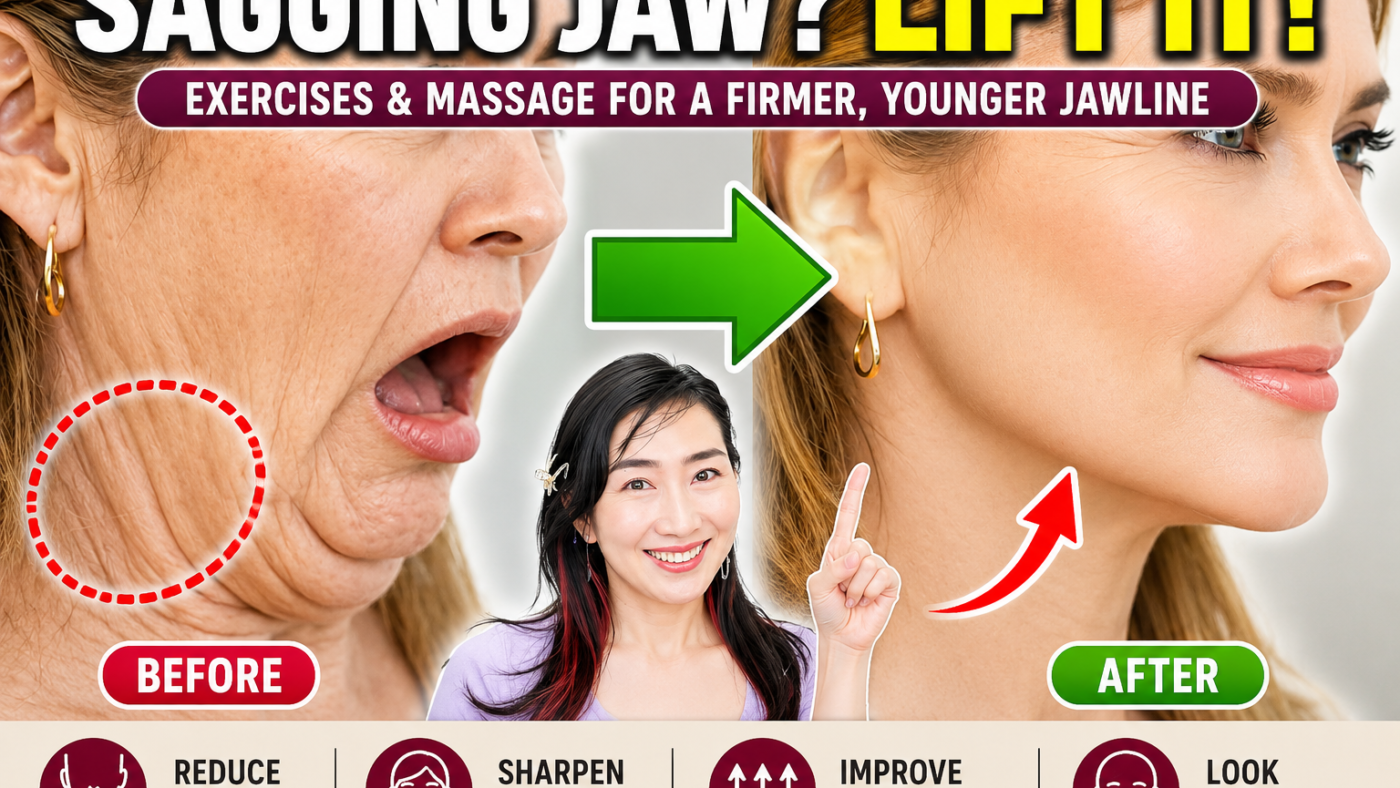
A more defined jawline is often marketed as something that requires weight loss, cosmetic procedures, or expensive devices. Social media face-yoga routines offer a much simpler idea: loosen the jaw and neck, change the way you use your tongue and facial muscles, and your face may begin to look sharper and more lifted.
Some parts of this idea are anatomically reasonable. Others—such as claims that massage “flushes out fat,” permanently lifts sagging tissue, or reverses facial aging—go beyond what current evidence can support. The more realistic question is whether gentle jaw, tongue, neck, and facial exercises can improve muscle awareness, reduce tension, and temporarily change how the lower face looks and feels.
Why Your Jawline Can Look Different From Day to Day
Your jawline is influenced by much more than body weight. Genetics, bone structure, facial fat distribution, skin elasticity, posture, muscle tone, hydration, and age all contribute to its appearance.
Temporary puffiness can also make the lower face appear softer. Sleep, sodium intake, alcohol, allergies, hormonal changes, and fluid retention may affect facial appearance from one day to another.
Muscle tension matters too. People who clench their jaw, grind their teeth, spend hours looking downward at screens, or habitually hold their head forward may develop tension around the jaw, neck, and shoulders.
Releasing that tension will not reshape your facial bones, but it may help the face and neck rest in a more comfortable and natural position.
What Face Yoga Is Actually Training
Face yoga usually combines exaggerated facial expressions, controlled movements, massage, stretching, breathing, and resistance exercises.
For the jawline, routines commonly involve the tongue, cheeks, lips, jaw muscles, platysma, and neck.
These tissues participate in speaking, chewing, swallowing, facial expression, and head positioning. Becoming more aware of how you use them may help reduce unnecessary tension.
That is a more realistic explanation than the idea that every word you speak can permanently “sculpt” your jaw.
Jawline Face Yoga and Muscle Awareness
One useful exercise is surprisingly simple: notice what happens to your jaw while speaking.
Some people habitually open the jaw more than necessary or tense the lower face while talking. Try speaking normally while keeping the jaw relaxed and allowing the lips, tongue, and cheeks to participate naturally.
The objective should not be to immobilize the jaw. Normal jaw movement is necessary for comfortable speech and chewing.
Instead, think of the exercise as awareness training. You are identifying unnecessary tension rather than forcing your face into a fixed position.
Can Tongue Exercises Improve the Jawline?
The tongue is a complex muscular structure involved in speech, swallowing, chewing, and oral function. Tongue exercises can therefore be useful in specific rehabilitation and oral-motor contexts.
A simple awareness exercise is to place the tongue gently against the roof of the mouth, relax the jaw, breathe normally through the nose if comfortable, and then release.
Another option is to slowly move the tongue around the inside of the mouth without straining.
You may feel muscles beneath the chin working during these movements.
However, tongue exercises should not be described as a nonsurgical facelift. There is not strong evidence that tongue training alone permanently eliminates a double chin or substantially remodels facial contours.
Neck Tension and the Appearance of the Lower Face
The sternocleidomastoid muscles run along the sides of the neck and help rotate and flex the head. The platysma is a thin superficial muscle extending across portions of the neck and lower face.
When the neck and shoulders feel chronically tight, gentle mobility work can be useful.
Try sitting upright and allowing your shoulders to relax. Slowly rotate your head within a comfortable range. You can then gently tilt one ear toward the corresponding shoulder before returning to center.
Avoid aggressive stretching or pulling on the neck.
Improved posture may make the neck appear longer and the jawline more visible, but this is primarily a change in positioning—not the removal of fat or loose skin.
Can Massage “Drain” a Double Chin?
This is where many viral beauty claims become misleading.
A double chin may result from submental fat, genetics, skin laxity, anatomy, posture, or a combination of these factors. Massage cannot selectively burn or permanently remove fat cells from underneath the chin.
Gentle massage may temporarily influence superficial fluid movement and reduce the sensation of tension or puffiness in some people.
That temporary improvement can make facial contours look slightly different, especially when fluid retention is contributing to puffiness.
But massage should not be presented as a substitute for fat loss or a medical treatment for significant skin laxity.
A Gentle Jaw and Neck Massage Routine
Start with clean hands and relaxed shoulders.
Using your fingertips, gently massage the muscles along the sides of the jaw. Small circular movements are enough; painful pressure is unnecessary.
Move toward the area in front of the ears and then gently massage the sides of the neck. Avoid strong pressure over the front of the throat or major blood vessels.
Next, relax your jaw and slowly open and close your mouth several times. The movement should feel smooth and comfortable.
Finish by sitting upright, relaxing your shoulders, and taking several slow breaths.
Five minutes is plenty for a basic routine.
A Simple Tongue and Cheek Exercise
Keep your head comfortably upright.
Place the tongue gently against the roof of your mouth and hold for several seconds without clenching your teeth.
Release.
Next, make a comfortable smile without forcing the corners of your mouth upward. Notice the cheek muscles activating.
Relax completely between repetitions.
Perform five to ten slow repetitions.
The goal is controlled movement and awareness—not exhaustion.
What About the Platysma?
Some face-yoga routines involve looking upward and extending the tongue to activate tissues underneath the chin and along the neck.
This can certainly create a strong stretching sensation, but more intensity does not necessarily produce better results.
If you want to try it, raise your chin only slightly, keep your neck comfortable, and gently extend your tongue. Hold briefly and relax.
Stop immediately if you experience neck pain, dizziness, jaw discomfort, numbness, or headache.
Does Face Yoga Really Make You Look Younger?
Research on facial exercise remains limited.
A frequently discussed small study found that a structured facial exercise program was associated with improvements in certain measures of facial appearance after several months. However, the study was small and did not establish that facial exercises can reliably reverse aging.
That distinction matters.
Face yoga may improve awareness, relaxation, muscle coordination, or certain aspects of facial appearance. We do not yet have strong evidence that it can permanently tighten loose skin, eliminate facial fat, rebuild collagen to a clinically significant degree, or reproduce the effects of cosmetic procedures.
What Results Are Realistic?
After a jaw and neck routine, you might notice that your face feels warmer, your jaw feels less tense, your shoulders sit more comfortably, or your facial expression looks more relaxed.
If puffiness is present, the face might temporarily appear somewhat more defined.
Long-term improvements are more uncertain and are likely to be subtle.
Photographs can also exaggerate apparent changes because lighting, focal length, head position, facial expression, makeup, hydration, and camera distance can dramatically change how a jawline looks.
For that reason, dramatic before-and-after images should always be interpreted cautiously.
What Face Yoga Cannot Do
Jawline face yoga cannot reliably change adult facial bone structure, selectively burn chin fat, permanently drain “toxins,” or guarantee reversal of age-related skin laxity.
Claims that stiffness causes fat to accumulate because lymphatic “drains” are blocked are also oversimplifications of human physiology.
The lymphatic system is important, but ordinary facial fat does not accumulate simply because a neck muscle becomes tight.
Keeping these distinctions clear allows face yoga to remain a potentially pleasant wellness practice without turning it into an unsupported medical treatment.
A Practical 5-Minute Jawline Routine
Spend the first minute relaxing your shoulders and breathing slowly.
During the second minute, gently massage the jaw muscles and the area immediately in front of the ears.
For the third minute, perform slow, comfortable neck rotations and side bends.
During minute four, practice gentle tongue-to-palate movements and relaxed smiling.
Finish with one minute of quiet breathing while consciously releasing your jaw, tongue, forehead, and shoulders.
Consistency is more sensible than intensity. There is no need to perform painful massage or hundreds of repetitions.
Who Should Be Careful?
Avoid aggressive facial or neck exercises if you have recent facial surgery, dental surgery, acute temporomandibular joint pain, unexplained facial swelling, an active skin infection, significant neck problems, or another condition for which a clinician has advised you to limit these movements.
Persistent jaw pain, locking, clicking accompanied by pain, facial weakness, sudden swelling, difficulty swallowing, or new neurological symptoms deserve professional medical evaluation rather than a face-yoga routine.
The Bottom Line
Jaw, tongue, and neck exercises may be useful for relaxation, body awareness, posture, and gentle facial muscle activity. Massage may also temporarily reduce the sensation of tightness or puffiness.
Those benefits are very different from claiming that face yoga melts facial fat or permanently reverses aging.
Think of jawline face yoga as a low-cost wellness practice rather than a facelift. If a few gentle minutes leave your jaw relaxed, your posture better, and your face looking more refreshed, that is already a reasonable result.
FAQ
Can face yoga permanently sharpen my jawline?
There is not enough high-quality evidence to show that face yoga can permanently reshape the jawline. Temporary changes related to posture, muscle activity, relaxation, or puffiness are more plausible.
Can massage remove a double chin?
Massage cannot selectively remove submental fat. It may temporarily influence puffiness or help tense tissues feel more relaxed.
Do tongue exercises help the face?
Tongue exercises activate muscles involved in oral function and may improve muscle awareness, but evidence that they significantly lift the face or eliminate a double chin is limited.
How often should I practice jawline face yoga?
A gentle five- to ten-minute routine several times per week is a reasonable starting point. Avoid painful pressure and excessive repetitions.
How long does it take to see results?
Relaxation or reduced puffiness may be noticeable immediately, while any potential longer-term muscular changes would require consistent practice over weeks or months and are not guaranteed.
Medical Disclaimer: This article is for educational and informational purposes only and is not medical advice. Facial exercises and massage are not proven treatments for facial aging, excess facial fat, or medical conditions. Stop if an exercise causes pain, dizziness, numbness, or other concerning symptoms, and consult a qualified healthcare professional when appropriate.
This article is for general education and does not replace individualized care from a qualified health professional. Seek appropriate advice for persistent, severe, or concerning symptoms.
Read the full medical disclaimer