Why Walking Does Not Have to Be About 10,000 Steps
For years, 10,000 steps per day has been treated almost like a universal health rule.
It is not.
Ten thousand steps can certainly be a useful activity target for some people, but health benefits are not determined by one magical daily number.
How you walk also matters.
Speed matters.
Intensity matters.
Duration matters.
Fitness level matters.
And consistency matters.
This is where interval walking becomes interesting.
Instead of trying to accumulate as many steps as possible, interval walking deliberately changes the intensity of those steps.
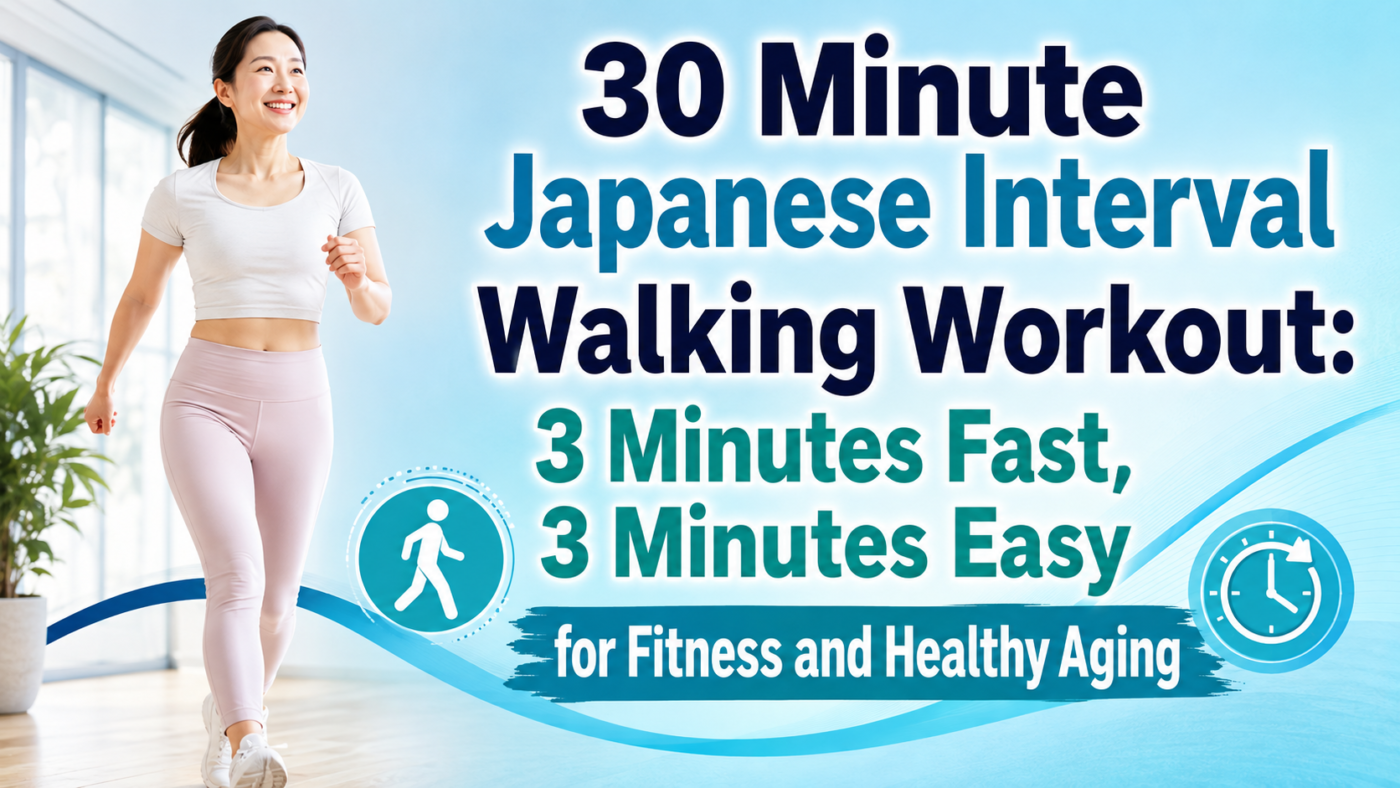
A typical Japanese interval walking approach alternates approximately three minutes of faster walking with three minutes of easier walking.
The pattern is simple.
Three minutes easy.
Three minutes brisk.
Repeat.
That simplicity makes it accessible to people who do not enjoy running or complicated cardio programs.
What Is Japanese Interval Walking?
Interval walking training was studied by researchers in Japan as a practical exercise strategy, particularly among middle aged and older adults.
Rather than maintaining one walking speed for the entire session, participants alternated lower and higher intensity periods.
The faster sections were intended to be meaningfully challenging.
The easier sections provided active recovery.
Over time, this creates a workout that may challenge the cardiovascular system more than continuously strolling at an easy pace.
Research has reported improvements in aerobic capacity, leg strength and blood pressure measures with sustained interval walking programs.
The important word is sustained.
The benefits were associated with repeated training over time, not one 15 minute workout.
How the 3 and 3 Method Works
The basic format is easy to remember.
Walk easily for approximately three minutes.
Then walk briskly for approximately three minutes.
Return to easy walking.
Then repeat.
One complete cycle takes six minutes.
Five cycles would produce approximately 30 minutes of interval walking.
Beginners do not need to start with five cycles.
Two or three cycles can be enough initially.
The goal is to gradually build an exercise habit rather than exhausting yourself on day one.
What Counts as Easy Walking?
The easy interval should feel comfortable.
Your breathing should remain relatively relaxed.
You should be able to speak normally.
Your shoulders should not feel tense.
Use this period to recover from the harder interval.
This is not wasted time.
Recovery is part of interval training.
Without easier periods, the workout simply becomes continuous higher intensity walking.
Use the recovery phase intentionally.
Relax your arms.
Let your breathing settle.
Maintain a comfortable rhythm.
What Counts as Fast Walking?
The faster interval should clearly feel different.
Increase your pace.
Allow your arms to swing naturally.
Use purposeful steps.
Your breathing should become deeper.
Talking may become more difficult, although you should not feel completely out of control.
For many beginners, a useful target is an intensity where you can still say a short sentence but would not comfortably hold a long conversation.
You do not need to run.
You do not need to sprint.
The challenge comes from walking considerably faster than during the recovery interval.
Do Not Chase Someone Else’s Speed
Your brisk walking speed may be very different from another person’s.
Age matters.
Fitness matters.
Body size matters.
Joint health matters.
Walking experience matters.
A fast pace for one person may be an easy pace for another.
Use relative intensity.
Ask yourself whether the fast interval is meaningfully more challenging than your easy interval.
If yes, the structure is working.
Start With an Easy Warm Up
Begin with several minutes of relaxed walking.
Move your arms naturally.
Let your breathing settle.
Give your ankles, knees and hips time to transition into activity.
Indoor walking is completely acceptable.
You do not need a treadmill.
Marching in place, stepping around a room or walking along a hallway can all work if you have sufficient space.
Remove obstacles that could cause you to trip.
Use supportive footwear if needed.
Think Tall, Not Rigid
The video emphasizes posture.
That can be useful, but posture should not become rigid.
Imagine your head moving gently upward.
Allow the chest to remain comfortable.
Keep the shoulders relaxed.
Do not pull them aggressively backward.
Allow your arms to swing.
Your spine does not need to be perfectly straight.
The goal is simply to avoid collapsing into an uncomfortable position as fatigue increases.
What Is Tanden?
The routine mentions Tanden, a traditional Japanese concept associated with the lower abdominal region.
In Japanese martial arts and mind body traditions, Tanden is often treated as a center of balance, breathing or awareness.
It is a traditional concept rather than a specific anatomical power organ.
You can still use it practically.
Place a hand over your lower abdomen for a moment.
Notice your posture.
Notice your breathing.
Then resume walking.
There is no need to claim that touching this area directly activates fat burning.
Use Your Arms
During the fast interval, allow the arms to swing more actively.
The elbows can remain comfortably bent.
Move the arms in opposition to the legs.
When the right leg moves forward, the left arm typically moves forward.
Do not exaggerate the motion so much that your shoulders become tense.
Natural arm movement can increase the overall activity of the walking pattern.
It can also make indoor marching feel more dynamic.
Does Better Posture Turn On Fat Burning?
Not in the way fitness videos sometimes suggest.
Standing taller does not flip a metabolic switch.
However, posture can influence movement comfort and breathing mechanics.
An efficient walking pattern may help you maintain a stronger pace.
That may allow you to perform more work during the session.
That is a much more realistic explanation.
Marching in Place Works Too
If outdoor walking is inconvenient, you can perform intervals indoors.
March easily during the recovery section.
Then increase knee lift and arm movement during the faster section.
Use enough floor space to avoid hitting furniture.
If balance is a concern, stay near a stable chair or countertop.
You can also use side steps during recovery periods.
The method is flexible.
The important feature is alternating lower and higher effort.
First Fast Interval
After your warm up, increase the pace.
Swing your arms.
Take quicker steps.
Keep breathing.
You should feel your heart rate increasing.
Maintain the brisk pace for approximately three minutes if appropriate.
If three minutes is too difficult, shorten the interval.
You might begin with one minute brisk and two minutes easy.
The classic protocol is not a requirement for beginners.
Fitness programs should adapt to the person.
Easy Recovery
Slow your pace again.
Do not stop completely unless necessary.
Keep walking.
Let your breathing return toward normal.
Relax your shoulders.
This active recovery prepares you for the next fast interval.
You may feel tempted to make every interval hard.
Do not.
The contrast between easier and harder walking is what defines the workout.
Should You Lift Your Knees High?
High knee marching can increase exercise intensity.
It is optional.
For some people, ordinary brisk walking is enough.
If you use higher knees, maintain control.
Do not force the knees toward the chest.
People with balance limitations or hip discomfort can keep the knees lower.
The goal is cardiovascular challenge, not performing the biggest movement possible.
Second Fast Interval
Increase the pace again.
Notice how your body responds during the second round.
Your breathing may accelerate more quickly than during the first interval.
That is normal.
Maintain a challenging but controllable pace.
If you become excessively breathless, reduce the intensity.
Exercise should challenge you.
It should not feel like a medical emergency.
Talk Test for Interval Walking
The talk test is a simple way to estimate intensity without a fitness tracker.
During easy walking, conversation should feel comfortable.
During brisk walking, talking should become noticeably harder.
You may still be able to speak short phrases.
If you cannot say several words without gasping, the intensity may be too high for your current ability.
Reduce your speed.
Fitness improves through repeated training, not through proving how much discomfort you can tolerate.
Can Interval Walking Improve Aerobic Fitness?
Yes, regular interval walking can provide an aerobic training stimulus.
The Japanese research that popularized this approach found improvements in aerobic capacity after consistent training.
Importantly, the participants trained repeatedly over a period of months.
Do not interpret those findings as evidence that a single session radically transforms cardiovascular fitness.
Fitness adaptations take time.
Can Interval Walking Strengthen the Legs?
Walking uses the muscles of the hips and legs.
Brisker walking generally requires greater muscular work than very slow strolling.
Japanese interval walking research has reported improvements in measures of leg strength alongside aerobic improvements.
However, walking should not completely replace resistance training if maintaining muscle is a major goal.
Strength training provides a more direct stimulus for muscle and bone.
Walking and resistance training can complement each other.
Can Interval Walking Improve Blood Pressure?
Regular aerobic exercise is one of the established lifestyle strategies associated with cardiovascular health.
Research on interval walking has reported improvements in blood pressure measures among study participants.
Again, the effect comes from consistent training rather than one workout.
People with diagnosed hypertension should continue following their clinician’s recommendations and prescribed treatment.
Exercise does not automatically replace medication.
Can Interval Walking Help With Fat Loss?
It can contribute.
Walking uses energy.
Brisk walking generally uses more energy per minute than slow walking.
Alternating faster sections may therefore increase the energy demand of a walking session.
However, interval walking does not guarantee fat loss.
Body fat changes depend on overall energy balance over time.
Nutrition matters.
Total physical activity matters.
Sleep matters.
Genetics and medications can matter.
Think of interval walking as one useful component of weight management rather than a fat burning trick.
Does Smiling Burn More Fat?
No.
Smiling can make a workout more enjoyable.
Enjoyment may make you more likely to continue exercising.
That is useful.
But smiling itself does not significantly increase fat burning efficiency.
You do not need a metabolic explanation for everything that makes exercise more pleasant.
Sometimes fun is valuable simply because it improves adherence.
Can Interval Walking Replace 10,000 Steps?
This is the wrong way to frame the question.
Ten thousand steps measures volume.
Interval walking emphasizes intensity.
They are not direct substitutes.
You could accumulate many steps and still perform intervals.
Or you could complete a shorter interval session without reaching 10,000 steps.
Both activity volume and intensity can contribute to health.
The best routine is one that fits your goals and that you can maintain consistently.
Why the 10,000 Step Number Is Not Sacred
The 10,000 step target was not originally established as a universal biological threshold.
Modern research suggests that health benefits can occur below 10,000 steps and generally increase across a range of activity levels.
This means you should not consider a day with 7,000 or 8,000 steps a failure.
Walking intensity can add another dimension to your exercise.
Rather than obsessing about one number, think about total movement across the week.
Indoor Interval Walking
An indoor session can follow the same structure.
Three minutes easy marching.
Three minutes faster marching.
Three minutes easy.
Three minutes fast.
Repeat according to your fitness.
During fast intervals, you can add controlled arm swings or moderate knee lifts.
During easy intervals, return to simple marching or side steps.
No treadmill is necessary.
The biggest advantage is convenience.
Bad weather no longer becomes an excuse.
A Beginner Version
If the classic three minute intervals feel too difficult, start smaller.
Two minutes easy.
One minute brisk.
Repeat five times.
That gives you a 15 minute session.
After several weeks, increase the fast section.
Eventually you might progress toward two minutes brisk.
Later, try the full three minute interval.
Progression does not have to happen quickly.
Your body adapts through repetition.
A More Experienced Version
If three minutes of brisk walking becomes easy, do not immediately start running unless you want to.
You can increase walking speed.
Increase arm movement.
Use gentle hills outdoors.
Increase total cycles.
Or slightly increase the intensity of the fast interval.
The goal is progressive challenge.
Keep the recovery interval easy enough that you can perform another quality fast interval afterward.
How Hard Should the Fast Interval Feel?
Think challenging but sustainable.
On a 0 to 10 effort scale, an easy interval might feel around 2 to 3.
A brisk interval might feel around 6 to 7 for many people.
These numbers are approximate.
You should still remain in control.
Older beginners, people returning from inactivity and those with health conditions may need lower intensities.
Individualization matters more than chasing a generic number.
Women Over 40 and 50
Interval walking can be particularly attractive during midlife because it is accessible and does not require complicated equipment.
It can support cardiovascular fitness.
It can challenge the legs.
It can be performed indoors or outdoors.
And it can be scaled according to current ability.
However, walking should ideally be combined with strength training.
Maintaining muscle becomes increasingly important with age.
A complete healthy aging routine usually benefits from both aerobic and resistance exercise.
Older Adults
Some older adults may also benefit from interval walking, but intensity should be appropriate.
Begin conservatively.
Use supportive footwear.
Choose a safe surface.
Consider walking with another person if balance is uncertain.
If you use a walking aid, do not abandon it simply to follow an exercise video.
Safety comes first.
A clinician or physical therapist can help determine an appropriate program for people with substantial mobility limitations.
What About Knee Pain?
Walking should not automatically hurt the knees.
But individuals with arthritis, previous injuries or other knee conditions may experience symptoms.
Shorten your stride if necessary.
Reduce speed.
Avoid excessive high knee marching.
Choose a level surface.
Supportive footwear may help some people.
Persistent or worsening knee pain deserves appropriate assessment.
The video suggests that posture can turn off knee pain.
That is far too strong.
Knee pain has many possible causes and cannot be switched off through one walking posture.
Hydration
Keep water available, particularly during longer sessions or hot weather.
You do not necessarily need to stop repeatedly for water during a short indoor workout if you are comfortable.
Hydration needs vary.
Drink according to thirst and environmental conditions.
People with medical conditions requiring fluid restriction should follow individualized medical guidance.
How Often Should You Do Interval Walking?
Three or four sessions per week can be a practical starting point for many healthy adults.
The original Japanese interval walking programs involved repeated weekly training over extended periods.
You can also combine interval walking with ordinary easy walking on other days.
A weekly schedule might include three interval sessions, two easier walking days and two strength training sessions.
The exact schedule should fit your recovery and fitness.
Sample Weekly Routine
Monday
30 minute interval walking
Tuesday
Strength training
Wednesday
Easy walk
Thursday
30 minute interval walking
Friday
Strength training
Saturday
Interval walking or recreational activity
Sunday
Easy walking or recovery
This is only an example.
You do not need to follow it exactly.
Do You Need 30 Minutes?
No.
A shorter session can still be useful.
Beginners might start with 12 to 18 minutes.
More experienced walkers may enjoy 30 minutes.
Consistency matters more than completing an arbitrary duration.
A short workout that you repeat is more useful than an ambitious workout you abandon.
Walking for Healthy Aging
Walking is simple enough that its value is easy to underestimate.
It supports cardiovascular activity.
It requires coordination.
It uses the lower body.
It gets people away from prolonged sitting.
It can also be social and accessible.
Interval walking adds a structured intensity challenge to this already useful activity.
For healthy aging, that combination can be particularly practical.
But it is still only one component.
Strength, balance, sleep, nutrition and preventive healthcare also matter.
Interval Walking Versus Normal Walking
Normal easy walking is valuable.
Interval walking is not inherently superior in every situation.
Easy walking may be better for recovery.
It may be better for someone beginning after a long period of inactivity.
It may be more enjoyable for long outdoor walks.
Interval walking is useful when you want a stronger cardiovascular challenge in less time.
You do not have to choose one permanently.
Use both.
What the Research Actually Says
The most important correction to viral descriptions of Japanese interval walking is that the benefits should not be presented as 29 times better aerobic fitness, 10 times stronger legs or three times better blood pressure.
The underlying research reported statistically meaningful improvements with interval walking compared with other walking approaches.
But converting those findings into sensational multiplication claims distorts the study.
A responsible interpretation is simpler.
Structured alternating fast and slow walking can improve fitness and cardiovascular measures when practiced consistently.
That conclusion is already useful without exaggeration.
Do Not Forget Recovery
After your final fast interval, continue walking slowly for several minutes.
Allow your heart rate to decrease gradually.
Relax the arms.
Let your breathing become easier.
You can add gentle side steps if comfortable.
There is no need for elaborate stretching immediately afterward unless you enjoy it.
A short gradual cool down is enough for most people.
Notice how your body feels.
Progress Over Time
After several weeks, ask yourself different questions.
Can you walk faster during the hard interval?
Does the same pace feel easier?
Can you complete another cycle?
Does your breathing recover more quickly?
Can you walk uphill more comfortably?
These are useful signs of improved fitness.
Scale victories and appearance changes are not the only measures that matter.
Cardiorespiratory fitness has value of its own.
Frequently Asked Questions
What is Japanese interval walking?
It is a walking method that alternates easier and higher intensity walking periods. A commonly studied format uses approximately three minutes of faster walking followed by three minutes of easier walking.
Is Japanese interval walking better than 10,000 steps?
They measure different things. A step target focuses primarily on movement volume, while interval walking deliberately changes exercise intensity.
How long should I do interval walking?
Many people can build toward approximately 30 minutes, but beginners can start with much shorter sessions.
Do I need a treadmill?
No. Interval walking can be performed outdoors, indoors or by marching in place.
Can interval walking help with weight loss?
It can contribute to physical activity and energy expenditure, but fat loss still depends on overall energy balance and multiple lifestyle factors.
Can interval walking improve aerobic fitness?
Regular interval walking can provide an aerobic training stimulus, and Japanese studies have reported improvements in aerobic capacity after consistent training.
Can it strengthen the legs?
Walking challenges the lower body, and interval walking research has reported improvements in leg strength measures. Resistance training remains valuable for more direct strength development.
Can it lower blood pressure?
Regular aerobic exercise may support blood pressure management, and interval walking studies have reported favorable changes. People with hypertension should continue following medical advice.
How often should I practice?
Around three sessions per week can be a reasonable starting point for many people, with frequency adjusted to fitness and recovery.
Is interval walking appropriate after 50?
It can be, provided the intensity is appropriate for the individual. People with significant cardiovascular, balance or joint conditions may need professional guidance.
What if three fast minutes are too difficult?
Shorten the hard interval. For example, begin with one minute brisk and two or three minutes easy.
Do I still need strength training?
Yes. Walking and strength training provide different benefits and can complement each other.
Medical Disclaimer
This article is for general educational and informational purposes only and is not medical advice, diagnosis or treatment. Exercise suitability varies according to medical history, cardiovascular health, medications, balance, joint conditions and physical ability. Stop exercising and seek appropriate medical attention for chest pain, fainting, severe or unusual shortness of breath, sudden weakness or other concerning symptoms. Consult an appropriate healthcare professional before beginning higher intensity exercise if you have significant cardiovascular disease or other relevant medical conditions.
This article is for general education and does not replace individualized care from a qualified health professional. Seek appropriate advice for persistent, severe, or concerning symptoms.
Read the full medical disclaimer