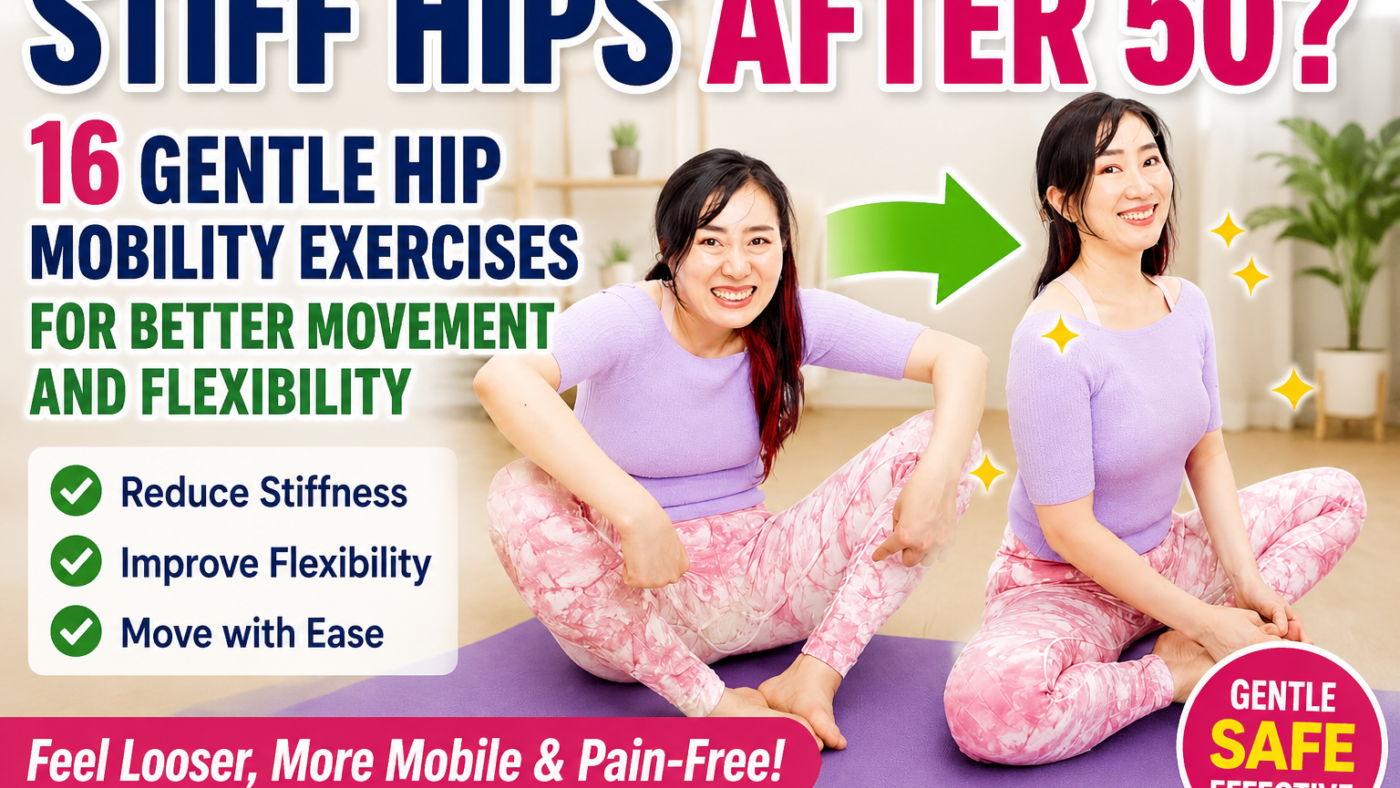
Hip mobility exercises can be a practical way to support flexibility, comfortable movement, and everyday function after 50.Hip stiffness can sneak up on you. One day you get out of a chair without thinking about it; another day, standing up after sitting for an hour suddenly feels much harder than it used to.
For many adults over 50, tightness around the hips, buttocks, hamstrings, and lower back can make everyday movements such as walking, bending, climbing stairs, exercising, or getting out of a car feel less comfortable.
The encouraging news is that you do not necessarily need an intense workout to start moving more freely. A gentle mobility routine that combines comfortable hip movement, stretching, breathing, and light self-massage may help reduce the sensation of stiffness and gradually improve range of motion.
The key word is gentle. Your goal is not to force your hips into extreme positions. It is to give the joints and surrounding muscles opportunities to move comfortably and regularly.
Why Do Hips Often Feel Stiffer After 50?
Hip stiffness does not have one single cause.
Changes in physical activity, muscle strength, previous injuries, osteoarthritis, prolonged sitting, reduced mobility, and age-related changes in muscles and connective tissues can all contribute.
For women, the menopausal transition may also coincide with more musculoskeletal symptoms. Research suggests that muscle and joint discomfort is common during the menopausal years, although the relationship between estrogen changes and specific joint problems is complex.
A 2025 systematic review reported that musculoskeletal pain is common during and after menopause, while another large systematic review found substantial rates of muscle and joint symptoms across the menopausal transition. However, this does not mean that most hip problems are caused by menopause or that estrogen loss alone explains hip stiffness.
Hip osteoarthritis is another possible cause of persistent stiffness and pain, particularly later in life. Osteoarthritis commonly affects the hips and can cause pain, reduced movement, and difficulty with everyday activities.
Whatever the cause, movement should generally be approached according to your symptoms and abilities rather than your age alone.
Can Hip Mobility Exercises Really Help?
For many people, yes.
Therapeutic exercise is considered a core component of osteoarthritis management. NICE recommends exercise tailored to the individual, including strengthening and general aerobic activity, and notes that consistent exercise can help reduce pain while improving physical function and quality of life.
That does not mean one stretching session can permanently “unlock” a stiff hip.
You may notice that movement feels easier immediately after warming up or stretching, but meaningful long-term improvements usually depend on repetition, appropriate strengthening, overall activity, and addressing any underlying condition.
Think of mobility training as practice rather than a quick fix.
Before You Begin: Check Your Comfortable Range of Motion
Sit in a comfortable position with your legs arranged in a way that feels stable.
Take a slow breath in.
As you breathe out, gently lean forward without forcing yourself downward.
Notice:
- how far you can move comfortably
- where you first feel tension
- whether one side feels different from the other
- whether the sensation is a mild stretch or actual pain
Remember how the movement feels.
You can repeat this simple check at the end of the routine. Do not worry about reaching farther. The useful comparison is whether the movement feels easier and more comfortable.
1. Gentle Lower-Back Self-Massage
Begin standing or sitting in a stable position.
Using your fingers or palms, gently massage the soft tissues around the lower back and the upper part of the pelvis.
You can use small circular movements, light kneading, or gentle shaking.
Avoid pressing directly and aggressively onto the spine.
This type of self-massage may temporarily reduce the sensation of muscular tension and help you relax before moving your hips. It should not be described as “putting fascia back into place.” Fascia does not simply become twisted and then mechanically return to its correct position after pinching.
Breathe normally throughout the movement.
2. Massage the Back of the Thighs
Sit comfortably and support yourself so you do not have to strain.
Use your hands to gently massage the hamstrings along the back of one thigh.
You can knead, rub, or lightly tap the muscle.
Spend around 20 to 30 seconds on one side before changing legs.
The goal is simply to warm the area and reduce the feeling of tension—not to press as deeply as possible.
If massage causes numbness, tingling, bruising, or sharp pain, stop.
3. Relax and Gently Shake the Legs
Let your legs relax.
Using small movements from the hips, gently shake or roll the thighs from side to side.
Keep the movement loose rather than muscular and forceful.
This is a simple transition between massage and larger hip movements and can help you become more aware of how freely your legs are moving.
4. Seated Hip Rotation
Sit comfortably with one leg positioned in front of you.
Using your hands for support if necessary, gently rotate the thigh inward and outward.
Allow the hip joint to guide the movement rather than twisting through the knee.
Keep the movement slow.
Perform several comfortable repetitions, then change sides.
Your available range may be small at first. That is completely fine.
Mobility work should gradually explore comfortable motion rather than force your hip past resistance.
5. Gentle Knee Side-to-Side Movement
Sit with your knees bent and feet supported.
Slowly allow the knees to move from side to side within a comfortable range.
Think about the movement coming from the hips.
If your hips are particularly stiff, make the movement smaller.
There is no benefit to pushing your knees toward the floor if doing so causes joint pain.
Continue for approximately 30 to 60 seconds while breathing naturally.
6. Figure-Four Hip Stretch
Sit comfortably and place one ankle across the opposite thigh.
Allow the bent knee to relax outward.
You may already feel a stretch through the buttock or outside of the hip.
If you need more intensity, gently hinge forward from your hips while keeping your spine comfortable.
Do not press aggressively on the knee.
Hold for about 20 to 30 seconds while breathing slowly, then switch sides.
This position can be particularly strong for people with limited hip rotation, so use a smaller range if necessary.
7. Pelvic Side-to-Side Movement
Return both legs to a comfortable position.
Gently shift or rock the pelvis from side to side.
Keep your shoulders relaxed.
There is no need to make the movement large.
Slow rhythmic movement can be useful for exploring comfortable hip and pelvic motion while reducing unnecessary muscle guarding.
8. Wide-Knee Child’s Pose
Start on your knees if this position is comfortable for you.
Bring your hips gradually toward your heels and allow your knees to separate.
Reach your arms forward and lower your upper body toward the floor.
Your forehead can rest on the floor, a cushion, or a folded towel.
Take several slow breaths.
Instead of trying to stretch farther, use each exhalation as an opportunity to relax your shoulders, back, and hips.
If kneeling bothers your knees, skip this movement or place additional padding beneath them.
9. Gentle Pelvic Rocking
From a comfortable kneeling or hands-and-knees position, slowly move your pelvis forward and backward.
Allow your lower spine and pelvis to move naturally.
Avoid forcing your lower back into an exaggerated arch.
Perform 8 to 12 slow repetitions.
This movement can help you practice coordination between the pelvis and lower spine while keeping the hips moving.
10. Diamond Hip Stretch
Sit down and bring the soles of your feet toward one another, leaving some distance between your feet and pelvis so your legs form a loose diamond shape.
Keep your spine comfortable.
Slowly hinge forward until you feel a gentle stretch around the hips, inner thighs, or buttocks.
Stop well before pain.
Hold the position for approximately 20 to 30 seconds while breathing steadily.
Flexibility varies widely from person to person, so there is no correct distance that your knees or torso need to reach.
11. Seated Hip-Rotation Stretch
From a seated position, arrange your legs so that one thigh rotates inward while the other rotates outward.
Use your hands or elbows for support rather than forcing the knees downward.
Make small rocking movements if they feel comfortable.
Then reverse the position and repeat on the other side.
This type of movement explores both internal and external hip rotation, two motions that can become limited when people spend much of the day sitting.
12. Gentle Seated Forward Hip Stretch
Bring one foot closer toward your body while allowing the other leg to extend somewhat farther forward or outward.
Rest your hands where they feel stable.
Slowly lean forward until you notice mild tension through the hips or inner thigh.
Stay there and take several deep breaths.
You do not need to bend deeply.
Over time, repeatedly practicing comfortable ranges of motion can be more useful than forcing yourself into a dramatic stretch during one session.
13. Hamstring Stretch
Extend one leg comfortably in front of you.
Keep the knee reasonably straight without locking it aggressively.
Hinge forward from your hips until you notice a gentle stretch along the back of the thigh.
Hold for around 20 to 30 seconds.
Keep breathing.
Then repeat on the other side.
Avoid bouncing, and stop if the stretch produces sharp pain or tingling down the leg.
14. Reclined Figure-Four Stretch
Lie on your back with your knees bent.
Place one ankle over the opposite thigh.
If that already creates enough stretch, stay there.
For a deeper version, draw the supporting thigh gently toward your torso while keeping your head and shoulders relaxed.
Hold for 20 to 30 seconds and repeat on the opposite side.
This variation often provides a controllable way to stretch the buttock and outer hip muscles without placing much body weight through the joint.
15. 90/90 Hip Rotation Stretch
Sit with both knees bent, arranging the front and back legs roughly into right angles if your mobility comfortably allows it.
You do not need to achieve perfect 90-degree angles.
Turn your torso gently toward one side.
Hold briefly and notice the stretch around the hips.
Then change sides.
Keep both movements comfortable and controlled.
People with significant hip arthritis, previous hip surgery, or substantial joint restriction may need a modified position.
16. Prone Bent-Knee Hip Movement
Lie comfortably on your stomach.
Bend one knee and gently allow the lower leg to move through a comfortable range.
Keep your pelvis relatively relaxed instead of twisting aggressively.
Repeat slowly, then switch legs.
This is not a “magic move,” but it can be another gentle way to explore hip rotation and relax surrounding muscles before finishing the routine.
Recheck Your Hip Mobility
Return to the same position you used for your initial mobility check.
Take a breath in.
Exhale and gently move forward again.
Ask yourself:
Does the movement feel easier?
Do your hips feel warmer?
Has the sensation of tension changed?
Can you move more comfortably even if you do not move dramatically farther?
An immediate change can happen because your body is warm and you have practiced the movement repeatedly. It does not necessarily mean that the underlying structure of the joint has permanently changed.
Long-term progress comes from consistency.
How Often Should You Work on Hip Mobility?
For gentle mobility exercises that do not aggravate your symptoms, short regular sessions can often be more practical than occasional intense stretching.
You might begin with 10 to 20 minutes several days per week.
You also do not have to perform every movement in this routine. Choose the exercises that feel comfortable and useful.
Mobility training works particularly well when combined with other forms of physical activity, including:
- walking
- hip and leg strengthening
- balance exercises
- moderate aerobic activity
- resistance training appropriate for your ability
For people with osteoarthritis, clinical guidance emphasizes individualized therapeutic exercise rather than relying on passive treatments alone. NICE specifically notes that manual techniques should be considered alongside therapeutic exercise rather than as a stand-alone treatment.
What About Menopause and Hip Stiffness?
Many women notice more aches, stiffness, or musculoskeletal discomfort around menopause, so these symptoms should not automatically be dismissed.
At the same time, hip pain after menopause should not automatically be blamed on low estrogen.
Possible explanations include osteoarthritis, tendinopathy, bursitis or greater trochanteric pain syndrome, referred pain from the lower back, muscle weakness, previous injury, or other medical conditions.
Research into menopause, estrogen, hormone therapy, and musculoskeletal pain remains complex. A recent systematic review found substantial variation across studies and did not establish a simple relationship in which hormone therapy consistently improves generalized musculoskeletal pain.
Persistent symptoms deserve proper assessment rather than assumptions.
When Hip Pain Needs Medical Attention
A gentle mobility routine is intended for ordinary stiffness and should not be used to push through significant pain.
Seek medical advice if you have persistent or worsening hip pain, significant limitation in walking or daily activities, or pain that repeatedly wakes you at night.
Seek prompt medical care if hip symptoms follow a major fall or injury, you suddenly cannot bear weight, the joint becomes significantly swollen or hot, or pain is accompanied by fever or unexplained illness.
Numbness, progressive weakness, or new bowel or bladder problems also require medical evaluation.
If you have undergone hip replacement surgery or have osteoporosis, inflammatory arthritis, a recent fracture, or another significant musculoskeletal condition, ask an appropriate healthcare professional which exercises are suitable for you.
The Bottom Line
Stiff hips after 50 do not automatically mean that you have to stop moving.
Gentle hip rotation, comfortable stretching, light self-massage, pelvic movement, and regular strengthening can all form part of a sensible mobility routine.
You may feel looser after one session, but the real goal is not an instant transformation.
It is maintaining enough mobility, strength, and confidence to keep doing the activities that matter to you—walking, exercising, traveling, gardening, dancing, playing with family, or simply standing up from a chair comfortably.
Move slowly, respect pain, and practice consistently.
Your hips do not need to “melt like butter.”
They simply need regular opportunities to move.
Frequently Asked Questions
Can hip stretches help stiffness after 50?
They may help reduce the sensation of tightness and temporarily improve range of motion. For longer-term function, mobility exercises are best combined with regular physical activity and appropriate muscle strengthening.
How long should I hold a hip stretch?
For gentle static stretches, around 20 to 30 seconds is a practical starting point. The stretch should feel mild to moderate rather than painful.
Should hip mobility exercises hurt?
No. Mild muscular tension during stretching can be normal, but sharp, catching, severe, or worsening joint pain is a reason to stop.
Can menopause cause hip pain?
Musculoskeletal pain and joint symptoms are commonly reported during the menopausal transition, but menopause is only one possible contributor. Persistent hip pain may have many causes and should not automatically be attributed to declining estrogen.
Can hip exercises help osteoarthritis?
Exercise is a core treatment for osteoarthritis. Guidelines recommend individually tailored therapeutic exercise to improve symptoms and physical function. The best program may include strengthening and aerobic exercise as well as mobility work.
Will hip mobility exercises flatten my belly or boost metabolism?
A hip mobility routine by itself should not be expected to rapidly flatten the abdomen or meaningfully increase metabolism. Body composition and metabolic health are influenced by overall physical activity, nutrition, muscle mass, sleep, health status, and many other factors.
Medical Disclaimer
This article is for educational and informational purposes only and is not medical advice, diagnosis, or treatment. Hip pain and stiffness can have many causes. Stop any exercise that causes sharp, severe, or worsening pain, dizziness, numbness, or unusual symptoms. If you have persistent hip pain, a recent injury, significant mobility limitations, osteoporosis, arthritis, previous hip surgery, or another medical condition, consult a qualified healthcare professional before beginning a new exercise program.
References
National Institute for Health and Care Excellence (NICE). Osteoarthritis in over 16s: diagnosis and management (NG226). Therapeutic exercise is recommended as a core treatment and should be tailored to individual needs.
American Academy of Orthopaedic Surgeons (AAOS). Clinical Practice Guideline for the Management of Osteoarthritis of the Hip, updated 2024.
Recent systematic reviews examining menopause and musculoskeletal symptoms show that joint and muscle symptoms are common during the menopausal transition, while the effects of hormone therapy on musculoskeletal pain remain uncertain and heterogeneous.
This article is for general education and does not replace individualized care from a qualified health professional. Seek appropriate advice for persistent, severe, or concerning symptoms.
Read the full medical disclaimer