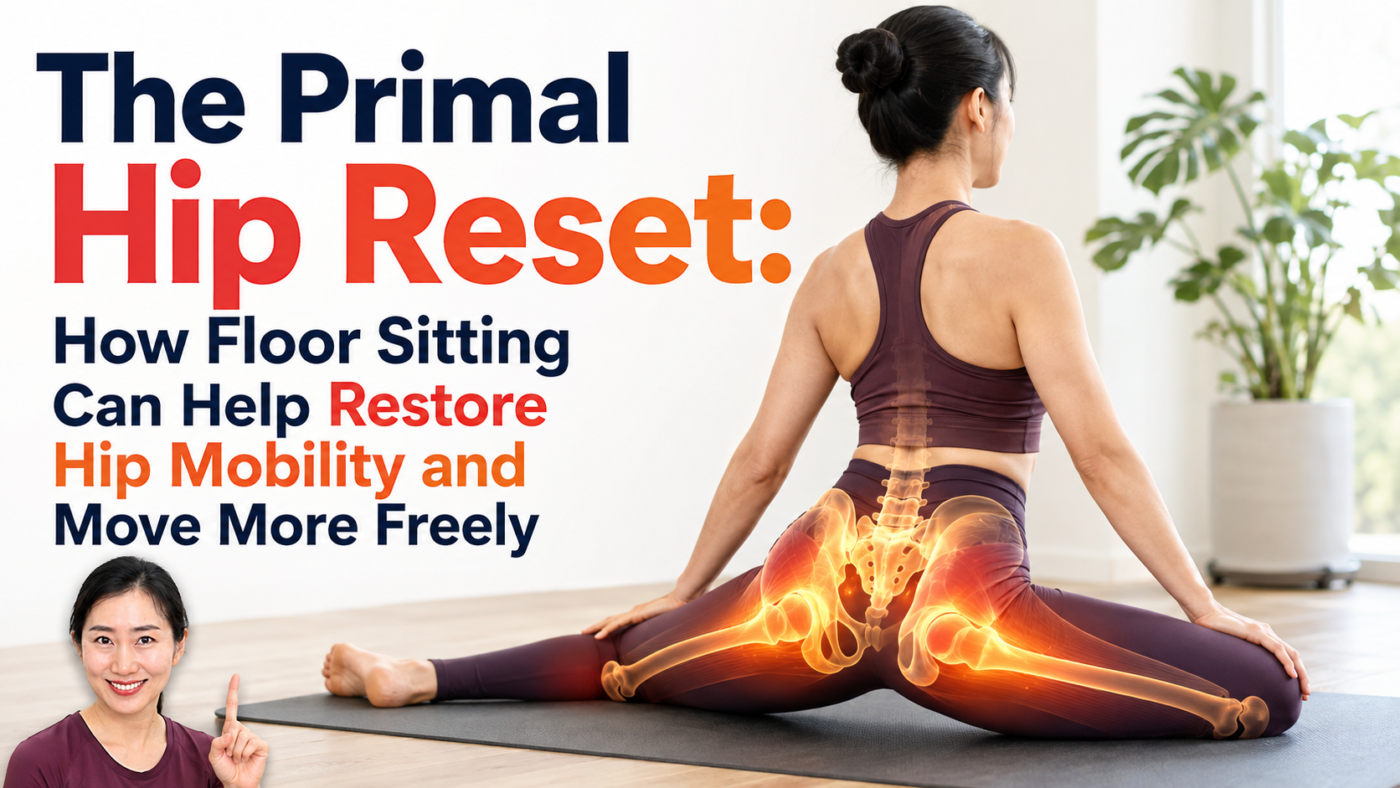
Floor sitting for hip mobility is a simple way to reintroduce your hips, knees, ankles, pelvis, and spine to movement patterns that modern chair-based life rarely requires. Modern life has made sitting easier than ever – and moving close to the ground surprisingly difficult.Modern life has made sitting easier than ever—and moving close to the ground surprisingly difficult.
You drop something on the floor and immediately wonder whether bending down is worth the effort. You spend an afternoon walking through shops, finally sit down, and then discover that standing back up feels like a major event. Crossing your legs, kneeling, squatting, or simply sitting comfortably on the floor may feel far more difficult than you remember.
It is tempting to assume that this is simply what happens with age.
But sometimes the body has not completely lost its ability to move. It has simply stopped practicing certain movements.
One surprisingly simple way to begin exploring those forgotten ranges again is to spend more time on the floor.
Not in an extreme yoga pose. Not by forcing your knees toward the ground. And not by trying to become flexible overnight.
Instead, the idea is to gradually reintroduce your hips, knees, ankles, pelvis, and spine to positions that modern chair-based life rarely requires.
Think of it as a gentle “primal hip reset.”
Why Modern Hips Can Start to Feel Stiff
The human body is capable of moving through many different levels and positions: standing, walking, kneeling, squatting, side-sitting, cross-legged sitting, rising from the ground, rotating the hips, and shifting weight from one side to another.
Modern life dramatically reduces that variety.
We sit at desks. We sit in cars. We sit on sofas. We sit while eating, working, traveling, watching television, and using our phones.
Most chairs keep the hips and knees within a relatively narrow range for long periods of time.
Research has found an association between prolonged sitting, lower physical activity, and reduced passive hip extension. In one study, people who were more active and spent less time sitting demonstrated greater passive hip extension than people who were less active and sat for prolonged periods. This does not prove that chairs alone “cause” stiff hips, but it supports the broader idea that movement habits influence the ranges of motion we regularly maintain. citeturn235138search6
The answer is not necessarily to throw away your chairs.
It is to give your body more movement options.
Floor Sitting Is Not a Magic Stretch
There is nothing magical about touching the floor.
The potential value comes from variability.
When you move between cross-legged sitting, side-sitting, kneeling, 90/90 positions, supported squatting, and other low positions, your hips are asked to flex, externally rotate, internally rotate, abduct, and stabilize in combinations that ordinary chair sitting rarely provides.
Your knees and ankles also experience different joint angles, while the trunk and pelvis continually adjust to help you remain balanced.
Over time, appropriately dosed exposure to these movements may help you become more comfortable using ranges of motion that have become unfamiliar.
That distinction matters.
Your pelvis is not literally being “reshaped” during a short mobility session, and your joints do not need to be forced into place. What can change with practice is your tolerance, coordination, muscular control, flexibility, and access to particular ranges of motion.
That is a much more realistic—and useful—goal.
The Real Goal: Build a Body That Has More Options
Mobility is not simply about stretching farther.
Useful mobility means being able to enter a position, breathe there, control it, move out of it, and adapt when circumstances change.
A deep squat illustrates this well.
Research examining squat mechanics shows that squat depth depends on movement across several joints, particularly the hips, knees, and ankles. Ankle dorsiflexion and lower-limb range of motion can substantially influence how a person performs a deep squat. Floor sitting for hip mobility can expose the hips to positions and rotational ranges that normal chair sitting rarely uses.
A recent systematic review also found that heel elevation changes squat mechanics and can increase available ankle and knee range of motion during the movement. That helps explain why placing something under the heels can make squatting easier for some people.
So instead of judging yourself because you cannot immediately sit deeply or place both heels on the floor, modify the position.
Use cushions.
Use a wall.
Use the sofa.
Raise your hips.
Support your heels.
Make the movement fit your current body rather than forcing your body to fit an idealized picture.
The Primal Hip Reset Routine
Move slowly through the following sequence. There is no prize for reaching the deepest position. Stay within a comfortable range, breathe normally, and use as much support as necessary.
- Begin With Knee Swings
Sit on the floor with your hands behind you for support. Bend your knees, keep your feet comfortable, and gently allow both knees to move from side to side.
Think of the movement as windshield wipers for the hips.
You do not need to force either knee toward the floor. Allow the pelvis to move naturally as the legs rotate.
This is an easy way to introduce hip internal and external rotation before spending more time in deeper positions.
If sitting directly on the floor causes your lower back to round excessively or makes the hips uncomfortable, sit on one or two cushions.
The height is not cheating. It is simply an adjustment.
Move slowly for about 30–60 seconds.
Then continue into a relaxed side-sitting position.
Allow both knees to move toward one side. Place your hands behind you if necessary and lean backward slightly.
Stay tall enough that you can breathe comfortably.
At first, this position may feel surprisingly demanding. With repeated exposure, however, a supported side-sit can become a relaxed everyday position rather than a formal “stretch.”
Change sides regularly instead of always sitting in your favorite direction.
Next, move into a folded-leg and extended-leg position.
Fold one leg comfortably while extending the opposite leg outward.
Do not worry about reaching the floor perfectly with every part of the bent leg. Sit on a cushion if necessary.
Instead of tightening your face and holding your breath, deliberately slow your breathing.
Take a comfortable breath in.
Then allow a longer, relaxed exhalation.
Many people instinctively brace when entering unfamiliar ranges of motion. Slower breathing can help reduce unnecessary tension and make it easier to explore the position without fighting it.
Change sides and repeat.
Now move into the 90/90 hip position.
The 90/90 position places one hip primarily in external rotation and the other in internal rotation, making it a useful way to explore rotational mobility.
Arrange your legs so that both knees are comfortably bent, approximately forming two right angles if your mobility allows.
Do not obsess over perfect geometry.
If your knees remain high or your pelvis tips dramatically, place cushions underneath your hips until you can sit comfortably.
Keep your spine reasonably tall.
You may gently place your hands near the front knee and allow your torso to lean forward slightly. You should notice tension around the gluteal and outer-hip region, but not sharp pain in the knee or hip joint.
Never push the knee aggressively toward the floor.
Then return upright.
Place one hand near the opposite knee and gently rotate your torso.
You may notice the movement not only around the hip but also along the side of the torso and waist.
Return to center and change sides.
This side-to-side difference is often revealing. One hip may rotate easily while the other feels completely unfamiliar. That does not necessarily mean something is wrong. Human bodies are rarely perfectly symmetrical.
The goal is simply to practice both directions.
Next, find a comfortable cross-legged or elevated sitting position and begin gentle hip circles.
If sitting cross-legged is difficult, build what might be called a small cushion throne underneath your hips.
Use as many cushions as you need.
Place your hands on your knees or thighs and slowly circle the pelvis and torso.
Move forward, around to one side, backward, and around the other side.
Then reverse direction.
Coordinate the movement with relaxed breathing.
These circles do not “massage away belly fat,” nor do they literally reposition internal organs. What they can do is introduce gentle movement through the pelvis, lumbar spine, hips, and trunk while reducing the amount of time your body spends completely stationary.
Think movement, not magic.
Then explore Seiza, the traditional Japanese kneeling position.
Kneel with the lower legs beneath you and gradually sit your hips toward your heels.
For many people, especially those unfamiliar with kneeling, this can initially place substantial demands on knee flexion and ankle mobility.
Do not force it.
Place cushions, a yoga bolster, or another firm support between your hips and heels. Raise yourself as high as necessary.
From this supported kneeling position, gently rock the pelvis forward and backward.
Breathe in as you comfortably move forward.
Breathe out as you return.
Allow the pelvis and lower spine to move together rather than aggressively arching or rounding the back.
Traditional movement systems sometimes describe such exercises using concepts of grounding or energy centers. From a modern physiological perspective, the practical focus here is simpler: coordinated breathing, pelvic movement, trunk control, and awareness of the pelvic-floor region.
If desired, you can add a very gentle pelvic-floor contraction during the movement, then fully relax it.
Avoid constant gripping.
Finally, explore a supported resting squat.
Place your feet at a comfortable width and descend only as far as you can control.
If the squat feels difficult, place a cushion or low support underneath your hips.
You can also lean your back against a wall, sofa, or sturdy piece of furniture.
If your heels rise from the ground, you do not need to fight them.
Place a stable wedge, folded mat, or suitable support underneath your heels. Heel elevation can alter squat mechanics and make the position more accessible for people whose ankle mobility currently limits their depth.
Once comfortable, place your elbows lightly against the inner thighs and slowly shift from side to side.
Do not aggressively pry the knees apart.For beginners, floor sitting for hip mobility does not need to involve extreme stretching.
Simply explore the available space.
If you have more mobility, gently bring your torso toward one thigh and then toward the other.
Return to the center.
Then slowly come out of the squat using your hands or nearby furniture if necessary.
Finish by extending the legs and gently moving the ankles from side to side.
That is enough.
You Do Not Need a Perfect Deep Squat
Social media can make mobility look like a competition.
It is not.
Some people naturally squat deeply with little practice. Others have differences in ankle mobility, hip anatomy, limb proportions, previous injuries, strength, or movement experience that make the same position much more demanding.
A deep squat is therefore not a universal test of whether your body is “good” or “bad.”
Research does suggest that deep squatting can be a safe movement for appropriately prepared individuals, and a 2024 review found little evidence that properly performed deep squatting inherently damages healthy knees. But suitability still depends on the person, their history, symptoms, loading, and technique.
You are allowed to modify.
You are allowed to stop higher.
You are allowed to hold a wall.
And you are allowed to use cushions.
Why Getting Comfortable Near the Floor Matters More as We Age
Floor mobility is not only about flexibility.
It is also part of functional independence.
As people grow older, getting down to and rising from the floor can become more difficult. Research comparing younger and older adults has found age-related differences in deep-squat movement, including reduced squat depth and differences in ankle, knee, hip, and trunk mechanics. Regular floor sitting for hip mobility can become part of an everyday movement routine.
More importantly, recent research on older adults has shown that actually practicing floor-rise movements can improve the ability to get up from the floor. In a 2026 pilot randomized trial, older adults who practiced floor-rise training improved their floor-rise times and independent floor-rise ability compared with a demonstration-only group.
That gives floor-based training a practical purpose beyond simply “becoming more flexible.”
Being able to safely lower yourself toward the ground and return to standing is a real-world skill.
It is worth preserving.
Make Floor Time Part of Ordinary Life
You do not necessarily need another formal 45-minute mobility workout.
Start by changing your environment.
Sit on a cushion on the floor while reading.
Change from cross-legged sitting to side-sitting.
Watch part of a television program from a supported floor position.
Have tea at a low table.
Spend a few minutes in 90/90 while listening to music.
Practice getting down and getting back up using a sofa for assistance.
Change positions frequently.
The key idea is movement diversity.
Instead of searching for one perfect posture, give your body many comfortable postures.
Five relaxed minutes repeated regularly may be more useful than one heroic session that leaves you sore enough to avoid the floor for another month.
Your Body Does Not Need to Win a Fight Against the Floor
Mobility work should not feel like punishment.
A mild stretching sensation, muscular effort, or unfamiliarity can be normal.
Sharp pain is different.
If a position produces sharp joint pain, pinching, numbness, tingling, instability, or symptoms that continue to worsen, come out of the position.
People with significant hip or knee arthritis, recent surgery, joint replacement, acute injury, osteoporosis-related concerns, neurological conditions, major balance problems, or other medical limitations may need individualized guidance before attempting deep floor positions.
There is no benefit in forcing a joint through pain simply because someone else can sit differently.
The Bigger Lesson: Use What You Want to Keep
Perhaps your body has not suddenly become incapable.
Perhaps some movements have simply become unfamiliar because modern life stopped asking you to perform them.
Mobility tends to respond to practice.
Coordination responds to practice.
Strength responds to practice.
Confidence responds to practice.
You do not need to recover every range of motion today.
You simply need to begin giving your body opportunities to move differently.
Start higher.
Use cushions.
Use the wall.
Move slowly.
Change sides.
Breathe.
Come back tomorrow.
Little by little, movements that once felt foreign may begin to feel ordinary again.
The goal is not to recreate some imaginary prehistoric body.
The goal is to build a modern body that still knows how to move.
A body that can sit high or low.
A body that can rotate, kneel, squat, stand, and adapt.
A body with options.
And ultimately, a body that feels a little easier to live in.
Frequently Asked Questions
Can sitting on the floor really improve hip mobility?
Floor sitting can expose the hips to positions and rotational ranges that normal chair sitting rarely uses. Regular, comfortable practice may therefore help improve tolerance and control in those ranges. It should be considered one part of an overall mobility and strength program rather than a guaranteed cure for stiffness.
How long should I sit on the floor?
There is no universal requirement. Beginners can start with a few minutes and change positions frequently. Comfort and consistency matter more than remaining in one position for a long time.
Is 90/90 sitting good for the hips?
The 90/90 position is commonly used to explore hip internal and external rotation. It can be useful when performed comfortably, but the knees should never be aggressively pushed toward the floor.
What if I cannot sit upright in 90/90?
Raise your hips with one or more cushions. Elevating the pelvis can make the position considerably more comfortable while still allowing you to practice hip rotation.
What if my heels cannot touch the floor during a squat?
Use support. A wall or sofa can help with balance, and a stable heel wedge or similar support can make the position more accessible. Your heels do not need to touch the ground immediately for the exercise to be worthwhile.
Is deep squatting bad for the knees?
For healthy, appropriately prepared individuals, current evidence does not support the idea that deep squatting is inherently harmful to the knees when performed with suitable technique and loading. Individual injuries, symptoms, and medical conditions still matter.
Does hip circling burn belly fat or massage the organs?
There is no good evidence that hip circles selectively reduce abdominal fat. They can provide gentle movement through the hips, pelvis, trunk, and lower spine, but localized fat loss requires broader changes in energy balance and physical activity.
Can older adults practice floor mobility?
Many can, but the exercises should match the person’s strength, balance, joint health, and ability to safely return to standing. Using furniture, cushions, or professional supervision may be appropriate.
Medical Disclaimer
This article is provided for educational purposes only and is not medical advice. Mobility exercises should be performed within a comfortable, controlled range. Stop if you experience sharp pain, numbness, tingling, dizziness, instability, or worsening symptoms. If you have a joint replacement, significant arthritis, osteoporosis, recent surgery or injury, neurological disease, persistent hip or knee pain, or substantial balance limitations, consult an appropriately qualified healthcare professional before beginning unfamiliar floor-based exercises.
This article is for general education and does not replace individualized care from a qualified health professional. Seek appropriate advice for persistent, severe, or concerning symptoms.
Read the full medical disclaimer