Your skincare routine may be consistent. You cleanse carefully, exfoliate, moisturize, and buy products that promise smoother skin.
Yet the pores on your cheeks or nose may still look more noticeable than they did several years ago.
The natural reaction is often to scrub harder, exfoliate more frequently, or search for another product that promises to “close” pores.
But visible pores are not simply a cleanliness problem.
Their appearance is influenced by several factors, including oil production, clogged follicles, genetics, skin elasticity, sun exposure, acne, and aging.
Understanding what actually makes pores look larger can help you build a much simpler and more effective skincare routine.
What Are Facial Pores?
When people talk about visible facial pores, they are usually referring to the openings of hair follicles associated with sebaceous glands.
These glands produce sebum, the natural oil that helps protect and lubricate the skin.
Some follicles contain extremely fine hairs that are almost impossible to see without magnification.
Pores themselves are normal.
You cannot permanently erase them, and healthy skin does not need to be completely poreless.
The realistic goal of skincare is to make enlarged pores less noticeable rather than trying to eliminate them.
Why Do Pores Look Larger?
There is no single cause of enlarged pores.
Research has identified several important contributors.
High Sebum Production
People with oily skin often have more visible pores.
As more sebum travels through the follicle, the opening can become more noticeable.
This is one reason pores are often most obvious around the nose, forehead, and central cheeks.
Clogged Pores
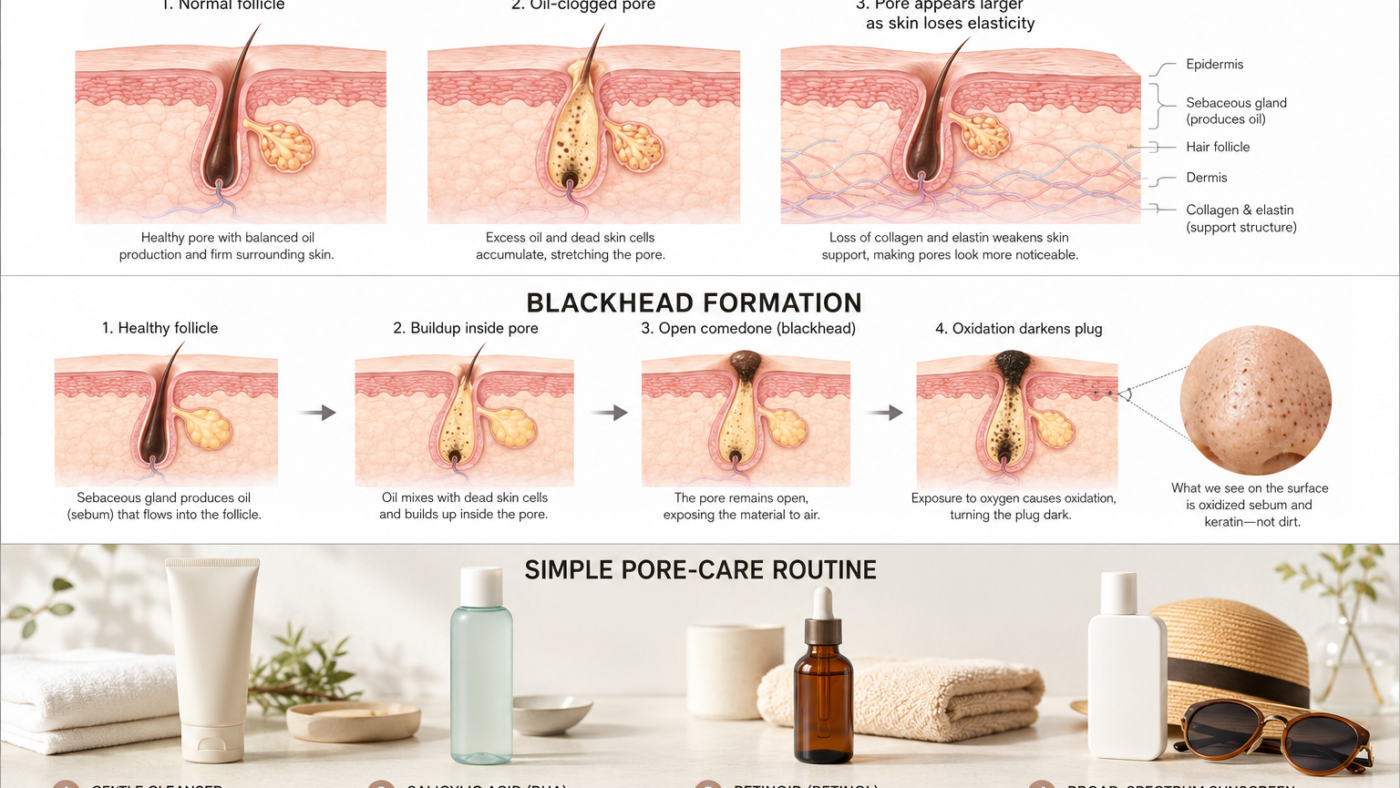
Oil and dead skin cells can accumulate inside follicles.
When this material builds up, the pore may appear larger.
Blackheads are a common example.
They are not simply dirt trapped in your skin.
A blackhead is an open comedone containing sebum and dead skin cells. The dark appearance develops when material at the surface is exposed to oxygen.
Reduced Skin Elasticity
The skin surrounding a pore helps determine how noticeable the opening appears.
As skin loses firmness and elasticity with age and cumulative sun exposure, pores may look wider or more elongated.
This is one reason some people notice more visible pores as they get older even when their cleansing routine has not changed.
Genetics and Hormones
Your natural skin type also matters.
People who produce more sebum may naturally have more noticeable pores.
Hormonal activity can influence oil production as well.
Men, on average, often have oilier skin because androgens stimulate sebaceous gland activity, although there is considerable variation between individuals.
Acne
Repeated acne and inflammation can also affect the appearance of follicles.
This is another reason that controlling acne early may help prevent some pores from becoming more noticeable over time.
Do Pores Become Wrinkles?
Not exactly.
It is more accurate to say that both enlarged pores and wrinkles can become more noticeable as skin loses firmness.
Aging skin gradually experiences changes in collagen, elastin, hydration, and structural support.
These changes can affect the skin surrounding follicles and make pore openings more visible.
But a pore should not simply be described as an unfinished wrinkle.
The two problems can share some underlying contributors, especially loss of elasticity and sun damage, but they are not the same structure.
Can You Actually Shrink Pores?
You cannot make a pore permanently open and close like a door.
Pores do not contain tiny muscles that you can tighten with cold water, toner, or a special mask.
However, you can make pores look less noticeable.
The most useful strategies generally focus on four things:
Keeping follicles from becoming clogged
Managing excessive oil
Improving the condition of the surrounding skin
Preventing additional sun damage
Retinol and the Appearance of Pores
Retinol is one of the more useful over-the-counter ingredients for people concerned about both visible pores and signs of aging.
Retinol belongs to the retinoid family.
Retinoids influence skin cell turnover and can support changes in photoaged skin over time.
They are also useful in acne-prone skin because they can reduce the tendency for follicles to become clogged.
For people whose pores appear larger because the surrounding skin has become less firm, consistent use of a well-tolerated retinol product may gradually improve overall skin texture.
Results are not immediate.
Meaningful changes in skin texture usually require weeks to months of consistent use.
How to Start Retinol More Safely
More is not better.
If you are new to retinol, begin conservatively.
Use a small amount at night.
Start only a few nights per week.
Apply it to dry skin.
Use a moisturizer.
Increase frequency slowly if your skin tolerates it.
A mild degree of dryness or flaking can occur when starting a retinoid.
Severe burning, persistent redness, swelling, or painful irritation is not something you should simply force yourself to tolerate.
Reduce frequency, stop the product temporarily, or consult a dermatologist if significant irritation develops.
Using multiple acids, scrubs, and retinoids simultaneously can easily damage the skin barrier.
Introduce active ingredients one at a time.
What About Adapalene?
Adapalene is another topical retinoid.
In the United States, adapalene 0.1 percent is available over the counter for treating acne.
Its main role is not cosmetic pore shrinking.
It helps treat acne by influencing abnormal follicular keratinization and reducing the formation of clogged pores.
Therefore, it may be particularly useful for someone whose visible pores are associated with blackheads, whiteheads, or acne.
It should be used according to the product label or guidance from a healthcare professional.
Dryness, scaling, redness, burning, or stinging can occur, particularly when treatment begins.
Some people also notice temporary changes in acne when beginning treatment.
Do not assume that severe worsening means the product is “pushing dirt out.”
Persistent or significant irritation deserves attention rather than simply being ignored.
Salicylic Acid for Clogged Pores
Salicylic acid is especially useful when excess oil and clogged follicles are part of the problem.
It is a beta hydroxy acid commonly used in acne skincare.
Salicylic acid can help remove dead skin cells and reduce follicular blockage.
For oily or combination skin, a salicylic acid cleanser can be a convenient option.
Some formulas are gentle enough for regular use.
If your skin becomes dry or irritated, alternate it with a mild cleanser instead of continuing to exfoliate aggressively.
A leave-on salicylic acid product can also be useful for some people, but it should not automatically be combined with several other strong active ingredients every night.
Gentle Cleansing Matters More Than Scrubbing
Visible pores are not evidence that your face is dirty.
Scrubbing harder will not make pores disappear.
In fact, aggressive cleansing and physical scrubs can irritate the skin.
Inflamed or dehydrated skin may make texture and pores appear even more noticeable.
For most people, a gentle, non-comedogenic cleanser is sufficient.
Use lukewarm rather than very hot water.
Massage gently.
Avoid repeatedly squeezing or digging at pores.
The goal is clean, comfortable skin rather than the tight, squeaky feeling that comes from stripping away too much oil.
Blackheads Are Not Dirt
One of the most persistent skincare myths is that blackheads are dirt trapped inside pores.
They are not.
Blackheads form when a follicle becomes filled with sebum and dead skin cells while remaining open at the surface.
Exposure to oxygen causes chemical changes that darken the material.
That is why aggressive scrubbing does not permanently solve blackheads.
The problem occurs inside the follicle.
Ingredients such as salicylic acid and topical retinoids can be more useful because they address follicular plugging rather than merely cleaning the surface.
Can Vitamin C Help Pores?
Vitamin C should not be marketed as a direct pore-shrinking treatment.
Its role is more indirect.
Well-formulated topical vitamin C acts as an antioxidant and has evidence supporting its use in photoaging and uneven pigmentation.
Vitamin C also participates in collagen biology.
For someone concerned about sun-related aging, vitamin C may be a useful addition to a morning skincare routine.
However, it is optional.
If you already use a gentle cleanser, moisturizer, retinoid when appropriate, and sunscreen, vitamin C is an additional step rather than the foundation of the routine.
L-ascorbic acid formulations can also oxidize over time.
A product that becomes dramatically darker may no longer perform as intended.
Store vitamin C according to the manufacturer’s instructions and avoid keeping opened products indefinitely.
Sunscreen May Be the Most Important Long-Term Step
If you want pores to remain less noticeable as you age, sunscreen deserves more attention than many expensive pore treatments.
Ultraviolet radiation contributes to photoaging.
Over time, sun exposure damages the collagen and elastin that help maintain skin firmness.
As skin loses firmness, pores may become more noticeable.
Use a broad-spectrum sunscreen with SPF 30 or higher.
Apply it generously to exposed skin.
When spending extended time outdoors, reapply as directed, especially after swimming or heavy sweating.
Sunscreen does not shrink pores overnight.
Its value comes from reducing additional cumulative damage over many years.
What About Sunlight Through Windows?
Glass blocks much of UVB radiation, but some UVA radiation can pass through ordinary windows.
UVA contributes to skin aging.
This is most relevant for people who spend substantial amounts of time beside sunny windows or driving.
You do not need to become afraid of every window.
But regular sun protection is sensible when you receive significant daylight exposure.
Do Nose Strips Shrink Pores?
Nose strips can pull some material from the surface of follicles.
This can make the nose temporarily look clearer.
But they do not permanently change pore structure.
Sebum and keratin gradually accumulate again, so the effect is temporary.
Occasional use may provide cosmetic satisfaction for some people, but nose strips should not be considered a long-term treatment for enlarged pores.
Do Pore-Tightening Toners Work?
A toner may temporarily make the skin feel tighter.
That sensation does not mean the pore has permanently contracted.
Products containing alcohol or other irritating ingredients can sometimes produce tightness because the skin has become dry or irritated.
A product does not need to sting to be effective.
If a toner makes your face repeatedly burn, sting, or become red, that is not evidence that your pores are closing.
Does Cold Water Close Pores?
No.
Cold water can temporarily change how the skin feels and looks.
It does not permanently close pores.
Likewise, hot water does not literally open them.
Very hot water can actually irritate the skin, so lukewarm water is usually the better choice for routine cleansing.
What About Makeup Primer?
A silicone-based or blurring primer can make pores look dramatically smoother.
That is a perfectly legitimate cosmetic effect.
But it is makeup, not treatment.
Primer works by changing how light reflects from the skin and filling small surface irregularities.
There is nothing wrong with using it.
Just understand what it does.
It improves appearance immediately but does not permanently alter the follicle underneath.
Are Pore Vacuums Worth It?
Home pore vacuums use suction to pull oil and debris from the skin.
They may produce a temporary visible effect.
Evidence that they provide meaningful long-term improvement in enlarged pores is limited.
Excessive suction can also irritate skin and may cause bruising.
People with sensitive skin, rosacea, fragile capillaries, or active inflammatory acne should be especially cautious.
Gentle skincare is usually more useful long term than repeatedly trying to extract everything from the skin.
A Simple Routine for Visible Pores
You do not need ten products.
Morning
Use a gentle cleanser if needed.
Apply vitamin C if you enjoy it and tolerate it.
Use moisturizer as needed.
Finish with broad-spectrum SPF 30 or higher sunscreen.
Evening
Cleanse gently.
For clogged or oily skin, consider salicylic acid.
For acne or photoaging concerns, consider an appropriate retinoid.
Use moisturizer.
Avoid introducing several strong active ingredients at once.
If you are new to skincare actives, add one product and give your skin time to adapt before introducing another.
Who Should Be More Careful With Retinoids?
Retinoids are effective ingredients, but they are not appropriate for everyone.
People with very sensitive skin, eczema, rosacea, or a damaged skin barrier may need a slower approach or professional advice.
Topical retinoids are generally avoided during pregnancy unless specifically advised otherwise by a healthcare professional.
If you are pregnant, trying to become pregnant, or breastfeeding, discuss retinoid use with your doctor.
People using prescription acne medications or undergoing professional skin procedures should also check before combining multiple active products.
When Should You See a Dermatologist?
Consider professional evaluation if you have:
Persistent or severe acne
Painful cysts or nodules
Acne scarring
Severe irritation from skincare products
Sudden unexplained changes in your skin
Significant redness or visible broken blood vessels
Pores or texture concerns that do not improve with a reasonable skincare routine
Dermatologists can also offer procedures for selected patients, including chemical peels, lasers, microneedling, radiofrequency treatments, and other approaches aimed at texture, acne scars, and skin firmness.
These treatments are not necessary for everyone and should be individualized.
Frequently Asked Questions
Can pores permanently disappear?
No.
Pores are normal structures of the skin. Skincare can make them less noticeable, but completely poreless skin is not a realistic biological goal.
Does washing your face more often shrink pores?
No.
Gentle cleansing can prevent oil and debris from making pores appear more noticeable, but excessive washing may irritate the skin.
Does retinol really help enlarged pores?
It may.
Retinol may improve the appearance of pores in some people, particularly when oiliness, mild acne, or reduced skin firmness contributes to the problem.
Results require consistent use over time.
Is Differin better than retinol for pores?
They serve somewhat different purposes.
Adapalene is an acne medication and is particularly useful for clogged pores and comedonal acne.
Cosmetic retinol is often chosen for broader concerns such as photoaging and texture.
The right choice depends on the cause of your visible pores.
Should I use salicylic acid and retinol together?
Some people can tolerate both, but using too many active products at once increases the risk of irritation.
Beginners are usually better served by introducing one product at a time.
Can sunscreen improve existing enlarged pores?
Sunscreen is primarily preventive.
It reduces additional ultraviolet damage that contributes to loss of skin firmness.
Over the long term, that helps protect the skin structures surrounding pores.
Do blackheads mean my skin is dirty?
No.
Blackheads are open comedones formed by oil and dead skin cells. Their dark color results from oxidation rather than poor hygiene.
Bottom Line
Visible pores are not simply a sign that your face needs deeper cleaning.
They can become more noticeable because of oil production, clogged follicles, acne, genetics, reduced skin elasticity, and cumulative sun damage.
Trying to scrub pores away often creates more irritation without solving the actual problem.
A better strategy is surprisingly simple.
Cleanse gently.
Keep clogged follicles under control.
Consider retinol or another appropriate retinoid when suitable.
Use salicylic acid if oil and congestion are major concerns.
Protect your skin from ultraviolet damage with daily sunscreen.
And give your routine time to work.
You cannot erase the normal structure of your skin.
But with consistent, evidence-based care, you can often make pores considerably less noticeable while improving the overall health and appearance of your skin.
Medical Disclaimer
This article is for educational and informational purposes only and is not intended as medical advice, diagnosis, or treatment. Individual skin conditions and treatment needs vary. Consult a qualified dermatologist or healthcare professional if you have persistent acne, severe irritation, a skin disorder, or questions about whether a skincare ingredient is appropriate for you.
This article is for general education and does not replace individualized care from a qualified health professional. Seek appropriate advice for persistent, severe, or concerning symptoms.
Read the full medical disclaimer