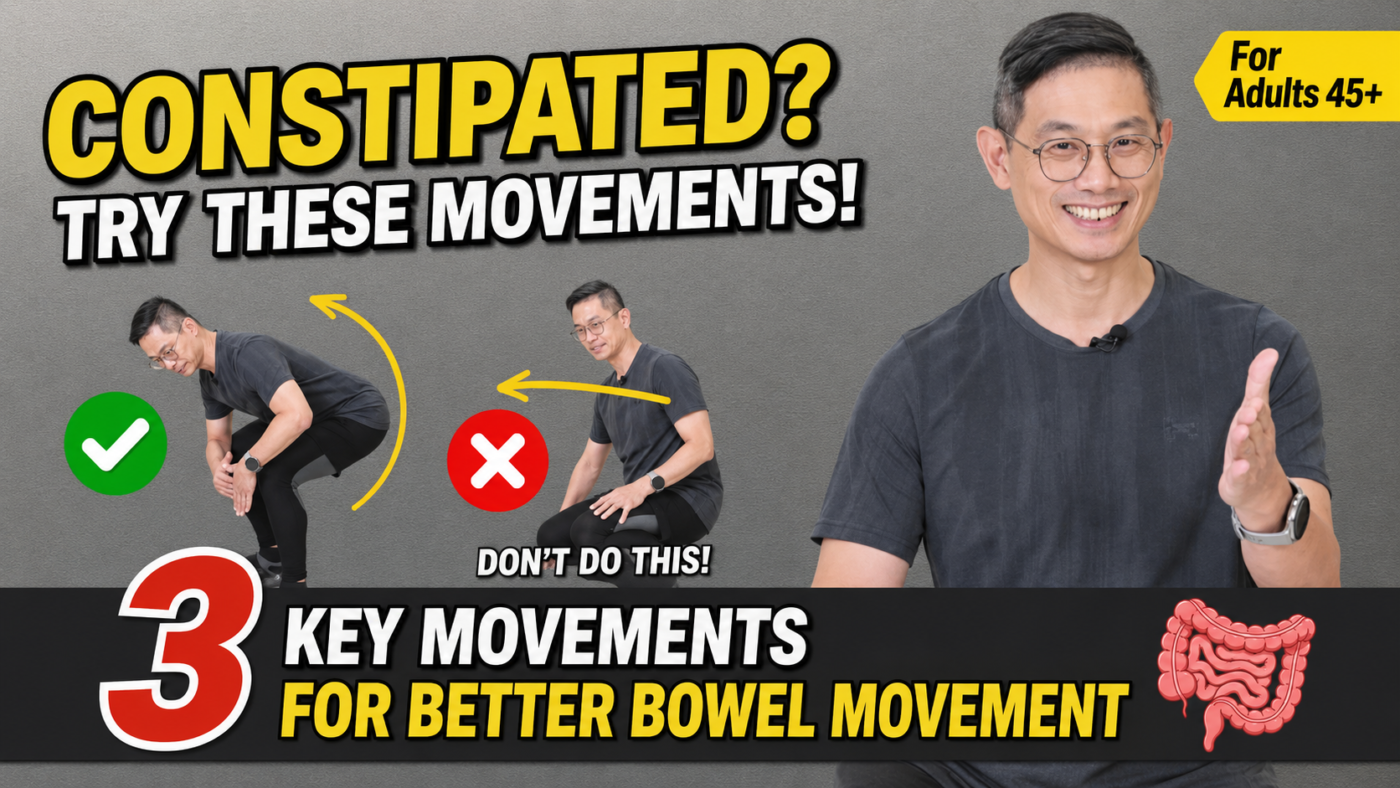
Constipation after 45 is often blamed entirely on diet: not enough fiber, not enough water, or simply getting older. Those factors certainly matter, but they are not the whole story. For some adults, especially people who spend long hours sitting, the problem may also involve bowel motility, toileting habits, medications, physical activity, or difficulty coordinating the abdominal and pelvic-floor muscles during a bowel movement.
This helps explain a frustrating experience many people recognize. You improve your diet, drink more fluids and add fiber, yet you still sit on the toilet for a long time, strain repeatedly, or feel that you have not completely emptied your bowels.
That does not mean everyone with constipation has a weak pelvic floor or a damaged gut-brain axis. Constipation has many possible causes. The most useful approach is to identify what type of problem may be present and then combine appropriate toileting technique, movement, diet and, when necessary, medical evaluation.
Key Takeaways
Constipation is not simply about failing to have a bowel movement every day. It can involve hard stools, difficult evacuation, excessive straining or a feeling of incomplete emptying.
Persistent constipation after 45 should not automatically be dismissed as a normal part of aging.
Raising the feet on a small stool and leaning slightly forward may make toileting more comfortable for some people, although research on footstools is mixed.
A full squat changes the anorectal position, but squat toilets are not automatically safer or better, especially for people with knee, hip or balance problems.
Regular physical activity is reasonable for overall bowel health, but no particular twisting or leg-raising exercise has been proven to switch on intestinal movement.
Abdominal massage has emerging evidence suggesting that it may improve symptoms in some people with chronic constipation.
Some people have a defecatory disorder in which the pelvic-floor muscles do not relax and coordinate appropriately during evacuation.
For confirmed pelvic-floor defecatory disorders, professional biofeedback and pelvic-floor retraining have stronger clinical support than simply performing more Kegel exercises.
Blood in the stool, unexplained weight loss, persistent abdominal pain, vomiting, fever or inability to pass gas require medical attention.
What Constipation Really Means
Constipation is broader than simply having fewer bowel movements.
The National Institute of Diabetes and Digestive and Kidney Diseases describes constipation as potentially involving fewer than three bowel movements per week, hard or lumpy stools, stools that are difficult or painful to pass, or a feeling that stool has not completely passed.
Some people have a bowel movement every day and are still constipated because evacuation requires excessive straining or feels incomplete.
Other people may go only several times per week yet have soft, comfortable bowel movements and no significant symptoms.
Frequency is therefore only one part of the picture.
Why Constipation Can Become More Common After 45
There is nothing biologically special about the 45th birthday, and constipation should not be considered an inevitable consequence of middle age.
However, several factors that become more common as people get older can contribute. These include reduced physical activity, longer periods of sitting, changes in diet, inadequate fluid intake, medications, neurological disorders, metabolic disease, pelvic-floor dysfunction and changes in bowel motility.
Many commonly used medications can also contribute to constipation. Examples include some opioid pain medicines, iron supplements, calcium-containing products, anticholinergic medicines and certain medications used for depression or neurological conditions.
This means that someone who develops new constipation should not automatically assume that the solution is simply to eat more fiber.
Sometimes a medication review or medical assessment is more important.
Is Functional Constipation Simply a Body Function Problem?
The term functional constipation can easily be misunderstood.
It does not simply mean that the intestine looks normal but the body has forgotten how to work.
Constipation can involve several different mechanisms.
One person may have relatively slow movement of stool through the colon.
Another may have difficulty evacuating stool because the pelvic floor and abdominal muscles do not coordinate appropriately.
Another may experience constipation associated with irritable bowel syndrome.
Some people may have more than one mechanism at the same time.
Medical research recognizes both slow stool movement and delayed evacuation related to pelvic-floor disorders among the possible causes of chronic constipation.
The idea that bowel function and muscular coordination matter is therefore valuable. However, reducing most constipation to a vague gut-brain axis imbalance goes beyond what current evidence can support.
The Pelvic Floor and the Anorectal Angle
One of the most important anatomical concepts in this area involves the puborectalis muscle.
This pelvic-floor muscle forms a sling around the rectum and contributes to the angle between the rectum and anal canal.
During normal defecation, coordinated relaxation of the pelvic floor and puborectalis muscle helps stool pass more easily.
In some people with chronic constipation, however, these muscles do not relax appropriately. They may even tighten when the person is trying to pass stool.
This is sometimes described as a defecatory disorder or dyssynergic defecation.
Impaired pelvic-floor relaxation and coordination can be an important contributor to chronic constipation.
This helps explain why some people describe a frustrating sensation in which the harder they push, the more blocked they feel.
If this happens repeatedly, increasing the amount of straining is not necessarily the answer.
Sitting Versus Squatting for Constipation
Squatting changes hip position and can alter the anorectal angle.
This anatomical concept has contributed to the popular claim that everyone should use a squat toilet.
The evidence is more nuanced.
A small footstool placed under the feet while using a seated toilet can change toileting posture and may feel more natural for some people. Raising the knees can also help some people relax the pelvic-floor region more comfortably.
However, clinical research has not shown that a footstool reliably improves evacuation in every person with constipation.
The most scientifically responsible conclusion is that a footstool may help some people, but it is not a cure for every type of constipation.
The same principle applies to squat toilets.
A deep squat may be uncomfortable or unsafe for people with knee osteoarthritis, hip problems, limited ankle mobility, dizziness, poor balance, muscle weakness or increased fall risk.
For many adults over 45, particularly older adults, a standard seated toilet with a stable footstool may be more practical.
1. Raise Your Feet Slightly
When using a seated toilet, try placing your feet on a stable stool.
The goal is to increase hip flexion rather than keeping the thighs completely horizontal.
The knees can be somewhat higher than the hips while the feet remain fully supported.
Do not balance on your toes and do not place your feet on an unstable object.
For anyone with limited mobility or fall risk, safety is more important than trying to reproduce a deep squat.
2. Lean Forward Comfortably
A slight forward lean may make evacuation easier for some people.
Keep the feet supported, allow the knees to remain comfortably apart, rest the forearms lightly on the thighs and lean the torso slightly forward.
Keep the jaw, shoulders and abdominal region as relaxed as possible.
There is no need to force the body into an extreme position.
The objective is comfort and pelvic-floor relaxation.
3. Avoid Prolonged Breath-Holding and Hard Straining
Repeated forceful straining is not a good long-term toileting strategy.
Instead, allow the abdominal wall to participate naturally while avoiding prolonged breath-holding.
A slow, comfortable exhalation may help reduce unnecessary bracing and tension.
If stool consistently feels physically blocked despite a strong urge to defecate, especially when incomplete evacuation happens repeatedly, a pelvic-floor disorder should be considered.
4. Do Not Sit on the Toilet for Long Periods
A seated toilet is comfortable enough that many people turn a bowel movement into a prolonged phone or reading session.
Smartphone use does not directly cause every defecatory disorder, but it can encourage people to remain on the toilet much longer than necessary.
If nothing is happening, do not continue sitting and straining indefinitely.
It is often better to get up, move around and try again when a natural urge returns.
The toilet should not become a place where you routinely spend twenty or thirty minutes.
5. Stay Physically Active
Regular movement is commonly recommended as part of constipation management.
Useful activities may include walking, brisk walking, cycling, swimming, strength training and other forms of recreational exercise.
The goal is consistent physical activity rather than finding a single special intestinal exercise.
There is currently no strong evidence that a particular number of torso twists, arm swings or high-knee movements directly creates a specific bowel rhythm.
These movements can still be useful as gentle physical activity, particularly for people who spend long periods sitting.
6. Consider Gentle Abdominal Massage
Research on abdominal massage has become increasingly interesting.
Recent systematic reviews suggest that abdominal massage may increase bowel-movement frequency and improve constipation symptoms in some adults.
However, techniques vary considerably between studies, and it is not appropriate to describe abdominal massage as a guaranteed way to activate or wake up the bowel.
It is better viewed as a potentially useful non-drug addition to an overall constipation-management plan.
People who have recently undergone abdominal surgery, have unexplained severe abdominal pain, significant inflammatory conditions, pregnancy-related concerns or other major abdominal disorders should seek professional advice before performing vigorous abdominal massage.
7. Work on Pelvic-Floor Relaxation When Appropriate
Not everyone with constipation needs a stronger pelvic floor.
Some people need to learn how to relax and coordinate it more effectively.
For confirmed defecatory disorders, professionally guided pelvic-floor biofeedback has meaningful clinical support.
Pelvic-floor retraining can teach a person how to coordinate abdominal pressure with relaxation of the muscles involved in evacuation.
This approach has considerably stronger evidence than simply telling every person with constipation to perform more Kegel exercises.
Gentle Standing Torso Rotation
Stand comfortably with the feet approximately hip-width apart.
Keep the knees relaxed and slowly rotate the torso from side to side without forcing the range of motion.
Allow the arms to move naturally.
About eight to twelve comfortable repetitions on each side can be enough.
Stop if you experience dizziness, sharp back pain or abdominal pain.
This movement is best understood as general mobility exercise and a way to break up prolonged sitting rather than a direct medical treatment for constipation.
Alternating Knee Raises
Stand beside a stable chair or counter if you are uncertain about your balance.
Lift one knee to a comfortable height, lower it and then repeat on the opposite side.
An opposite-arm reach can be added if your balance allows.
Eight to twelve comfortable repetitions on each side are sufficient for many people.
Knee raises are a simple way to add movement to the day, but claims that they directly massage the intestines or restore bowel motility through the psoas muscle are not well established.
Walking
Walking may be the simplest and most practical movement in this entire discussion.
A comfortable walk lasting approximately ten to thirty minutes can help reduce prolonged sedentary time and contributes to overall health.
Walking after meals may also be comfortable and beneficial for many people.
There is generally no need to wait exactly one hour after eating before taking a gentle walk unless movement soon after meals causes discomfort.
Breathing and Pelvic-Floor Coordination
Some exercise programs describe a special form of 360-degree or 365-degree breathing.
There is no special physiological significance to those numbers.
What matters is comfortable diaphragmatic breathing and the ability to avoid unnecessary muscular tension.
Sit comfortably and place the hands around the lower ribs.
Breathe gently through the nose and allow the lower ribs and abdomen to expand naturally.
Then exhale slowly without forcing the breath.
Repeat for several comfortable breaths.
During a bowel movement, the purpose is not to perform a complicated breathing exercise. The goal is to avoid excessive breath-holding and allow the abdominal and pelvic-floor muscles to coordinate normally.
The Pelvic Floor Is Not Only About Strength
A pelvic floor can be weak, but it can also be overactive, poorly coordinated or unable to relax appropriately.
For that reason, performing more Kegel contractions is not automatically the answer for constipation.
Kegel exercises have legitimate uses, particularly for certain forms of urinary or fecal leakage.
However, constipation caused by a defecatory disorder is different.
When the pelvic floor fails to relax appropriately during evacuation, treatment often focuses on coordination and relaxation, particularly through professionally guided biofeedback.
Should You Try the Frog-Leg Position?
A comfortable lying position with the knees open and the feet supported may help some people become more aware of tension around the hips and pelvic-floor region.
This can be reasonable as a relaxation exercise.
However, there is insufficient evidence to claim that performing a particular number of frog-leg repetitions treats chronic constipation.
If pelvic-floor dysfunction is suspected, a pelvic-floor physical therapist can assess whether a person needs strengthening, relaxation, coordination training, breathing retraining or biofeedback.
What About a Yoga Squat?
A supported deep squat can improve hip mobility and may help some people practice pelvic relaxation.
However, it is not suitable for everybody.
People with significant knee pain, severe hip arthritis, poor balance, recent surgery, dizziness or difficulty rising safely from the floor should modify or avoid the position.
A chair-supported squat or a seated toilet with a stable footstool is often safer for older adults.
There is no need to force the body into the deepest possible squat.
Fiber Still Matters
Improving movement and toileting posture does not make diet irrelevant.
Fiber remains an important part of constipation management for many people.
Dietary fiber should generally be increased gradually so that the digestive system has time to adjust.
Foods naturally rich in fiber include vegetables, fruit, legumes, oats, whole grains and seeds.
Psyllium is also among the better-supported fiber supplements for chronic constipation.
However, more fiber is not always better.
Some people with severe bloating, pelvic-floor dysfunction or certain gastrointestinal disorders may feel worse after aggressively increasing fiber intake.
If symptoms persist, individualized medical evaluation is often more useful than continually adding more bran or fiber supplements.
How Much Water Do You Need?
Hydration matters, particularly when dehydration contributes to hard stools.
However, drinking as much water as possible is not evidence-based advice.
Fluid requirements vary according to body size, climate, physical activity, diet, medications, kidney function and heart function.
People with heart failure, kidney disease or other medical conditions may even have specific fluid restrictions.
The goal should be appropriate hydration rather than forcing excessive amounts of water.
Medical Treatment Is Not a Failure
Constipation treatment often combines lifestyle measures and medical care.
Evidence-based approaches can include diet, exercise, bowel routines, fiber, osmotic laxatives such as polyethylene glycol, other over-the-counter treatments, prescription medications, pelvic-floor biofeedback and treatment of underlying medical conditions.
Polyethylene glycol is one of the better-supported treatments for chronic idiopathic constipation when medication is appropriate.
Several prescription medications are also available when simpler treatments are inadequate.
Using medical treatment does not mean someone has failed at natural health.
Likewise, exercising and eating well do not eliminate the need for medical evaluation when symptoms are persistent or concerning.
The correct approach depends on the underlying cause.
When Constipation Needs More Than Home Exercises
Talk with a healthcare professional if constipation persists despite reasonable self-care, changes significantly from your normal bowel pattern, repeatedly requires substantial straining, causes a persistent sensation of blockage, involves repeated incomplete evacuation, develops after beginning a new medication or significantly affects your quality of life.
Prompt medical attention is particularly important when constipation occurs with rectal bleeding, blood in the stool, persistent abdominal pain, inability to pass gas, vomiting, fever or unexplained weight loss.
New or persistent bowel changes in middle-aged and older adults should not automatically be attributed to aging.
When to Ask About Pelvic-Floor Testing
If you repeatedly feel that you need to have a bowel movement but stool seems stuck at the outlet, or if pushing harder seems to make evacuation more difficult, ask a healthcare professional whether a defecatory disorder should be considered.
Evaluation may include anorectal manometry or balloon expulsion testing.
For appropriate patients, pelvic-floor biofeedback can be considerably more useful than indefinitely experimenting with exercises at home.
A Simple 10-Minute Constipation-Friendly Routine
For an otherwise healthy adult who is comfortable exercising, begin with about three minutes of walking around the home or gentle marching.
Spend another two minutes performing slow torso rotations.
Then perform approximately two minutes of comfortable alternating knee raises.
Finish with about three minutes of slow diaphragmatic breathing while sitting or lying comfortably.
This should be viewed as a general mobility and relaxation routine rather than a treatment guaranteed to produce an immediate bowel movement.
Consistency is more important than chasing an instant result.
A Better Toilet Routine
When a natural bowel urge appears, go to the bathroom rather than repeatedly postponing it.
Sit comfortably and place the feet on a stable stool if that position feels easier.
Keep the knees comfortably apart and lean slightly forward.
Relax the shoulders and jaw and breathe naturally.
Avoid prolonged forceful straining.
If nothing happens after a reasonable period, get up and try again later when the urge returns.
This approach is safer and more defensible than repeatedly trying to force a bowel movement.
The Bottom Line
Constipation after 45 is not always a fiber problem, and it is not always a posture problem.
It can involve bowel motility, medications, diet, physical activity, toileting behavior and, for some people, poor coordination between the abdominal wall and pelvic floor.
Several principles are useful. Move regularly, avoid excessive straining, experiment with a comfortable toileting position, learn to relax rather than constantly brace and pay attention to pelvic-floor coordination.
However, the scientific limitations also matter.
Squat toilets are not automatically best for everyone. A footstool may help some people but does not work for every form of constipation. Specific twisting movements have not been proven to restore bowel motility. Special 360-degree breathing is not a unique constipation treatment.
If the pelvic floor fails to relax appropriately during evacuation, professionally guided biofeedback may be considerably more useful than simply doing more Kegel exercises.
The goal is not to force the body. It is to identify what is interfering with normal evacuation and choose the safest and most appropriate solution.
Frequently Asked Questions
Why am I constipated even though I eat fiber and drink water?
Constipation can have causes beyond diet, including medications, slow bowel transit and pelvic-floor defecatory disorders. Persistent symptoms should be evaluated rather than assuming that more fiber or water will always solve the problem.
Is constipation common after 45?
Constipation becomes more common with increasing age, but it should not automatically be dismissed as a normal part of aging. New or persistent bowel changes deserve attention.
Is squatting better than sitting for bowel movements?
Squatting changes the anorectal position and may make evacuation easier for some people. However, deep squatting is not appropriate for everyone, particularly people with joint problems, poor mobility or increased fall risk.
Does a toilet footstool help constipation?
A footstool changes toileting posture and some people find it useful, but clinical evidence remains mixed. It should be regarded as a low-risk option to try rather than a universal constipation treatment.
Should I push hard when constipated?
Repeated forceful straining is not ideal. If bowel movements regularly require major straining or feel physically blocked, discuss the possibility of a pelvic-floor disorder with a healthcare professional.
Can abdominal massage help?
Recent systematic reviews suggest that abdominal massage may improve bowel frequency and constipation symptoms in some adults, although study methods and techniques vary.
Can walking help constipation?
Regular physical activity is commonly recommended as part of constipation management and offers many additional health benefits. Walking is best considered part of an overall healthy routine rather than an immediate laxative.
Should I do Kegels for constipation?
Not automatically. If constipation involves failure of the pelvic floor to relax during evacuation, repeatedly strengthening those muscles may not address the underlying problem. Professional assessment and biofeedback may be more appropriate.
What is pelvic-floor dyssynergia?
Pelvic-floor dyssynergia is a defecatory disorder in which the muscles involved in evacuation do not coordinate appropriately. A person may strain significantly yet still feel blocked or incompletely emptied. Biofeedback-based pelvic-floor retraining is an established treatment option.
When should I see a doctor?
Seek medical advice for persistent constipation or significant changes in bowel habits. Prompt evaluation is especially important when constipation occurs with blood in the stool, rectal bleeding, unexplained weight loss, persistent abdominal pain, vomiting, fever or inability to pass gas.
References
National Institute of Diabetes and Digestive and Kidney Diseases. Constipation: Symptoms, Causes, Treatment, Diet and Nutrition.
American Gastroenterological Association and American College of Gastroenterology. Clinical Practice Guideline on Pharmacological Management of Chronic Idiopathic Constipation.
American Gastroenterological Association. Evaluation and Management of Refractory Constipation. Clinical Practice Update, 2026.
American College of Gastroenterology. Guidance on Disordered Defecation and Biofeedback Therapy.
Huang SY, Chiao CY, Chien LY. Effectiveness of Abdominal Massage on Chronic Constipation in Adults: Systematic Review and Meta-analysis. International Journal of Nursing Studies, 2025.
Mayo Clinic. Pelvic-Floor Dysfunction and Healthy Defecation Technique.
Medical Disclaimer
This article is for general educational purposes only and is not a substitute for medical diagnosis or individualized treatment. Constipation can result from medications, gastrointestinal disorders, pelvic-floor dysfunction, neurological disease and other medical conditions. Consult a qualified healthcare professional for persistent or worsening symptoms. Seek prompt medical attention for rectal bleeding, blood in the stool, severe or persistent abdominal pain, vomiting, fever, inability to pass gas or unexplained weight loss.
This article is for general education and does not replace individualized care from a qualified health professional. Seek appropriate advice for persistent, severe, or concerning symptoms.
Read the full medical disclaimer