A chair exercise for neck stiffness can be a simple way to add movement after long periods of sitting or computer work.Long hours at a computer, frequent phone use, prolonged sitting, and staying in one position for too long can leave the neck, shoulders, and upper back feeling stiff and uncomfortable.
For some people, age-related changes in the cervical spine—often called cervical spondylosis—may also contribute to neck pain and stiffness. Cervical spondylosis is common, particularly with increasing age, and symptoms can vary considerably from person to person.
Gentle movement, posture awareness, and appropriate exercise are commonly included in conservative management of neck discomfort. Both the NHS and the American Academy of Orthopaedic Surgeons note that exercise and physical therapy may help improve movement, strength, flexibility, and symptoms in appropriate patients.
However, one important distinction needs to be made:
Headache, dizziness, numbness, or weakness should not automatically be blamed on “cervical spondylosis,” and a chair exercise should not be promoted as a guaranteed treatment for these symptoms.
The following exercise is better viewed as a gentle movement break for uncomplicated neck, shoulder, and upper-back stiffness.
What This Exercise Is Designed to Do
The original routine is sometimes described as a “spine-pinching” or “back-clamping” exercise.
A more useful modern description is:
a chair-supported chest-opening and shoulder-blade exercise.
The movement encourages you to:
open the chest,
reduce a slumped sitting position,
gently move the upper back,
activate muscles around the shoulder blades,
and take a brief break from prolonged sitting.
It is not intended to “push the vertebrae back into place.”
Nor should you try to squeeze the spine itself.
The goal is comfortable movement of the shoulders and upper back.
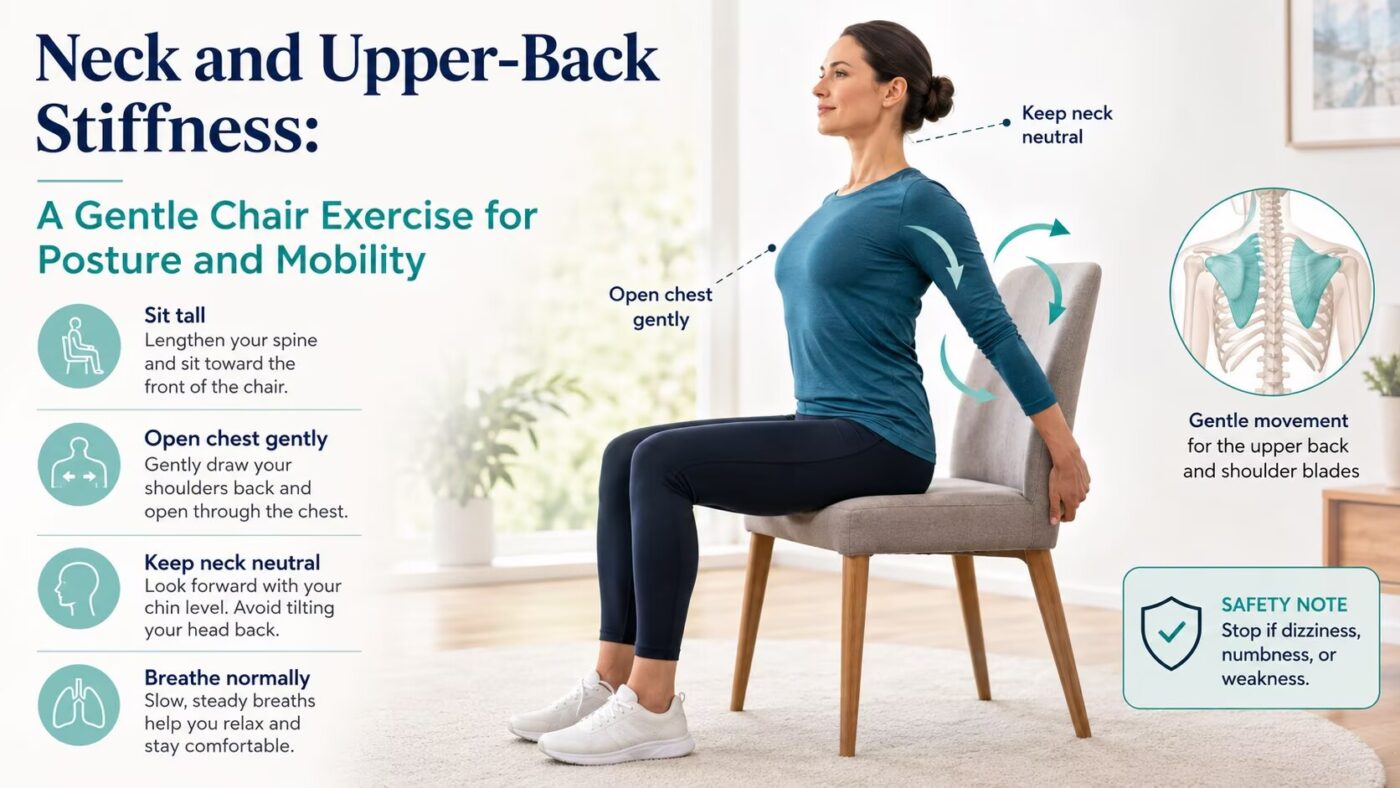
How to Set Up the Exercise
Choose a stable chair without wheels.
Sit toward the front half of the seat rather than leaning into the backrest.
Place both feet comfortably on the floor.
Sit tall without forcing yourself into an exaggerated military posture.
Allow the shoulders to relax.
If the chair design allows it, place your hands lightly behind you or hold the sides or back of the chair for support.
Do not use a chair that feels unstable.
Step 1: Gently Open the Chest
Begin by slowly moving your shoulders backward.
Allow the chest to open naturally.
Think of the collarbones becoming slightly wider rather than aggressively pushing the chest forward.
At the same time, gently draw the shoulder blades toward the back of the rib cage.
Do not squeeze them together as hard as possible.
There should be no sharp pain.
Step 2: Keep the Neck Comfortable
The original video instructs people to tilt the head backward.
That is not appropriate for everyone.
If you have neck pain, dizziness, headaches, balance problems, or cervical spine disease, exaggerated neck extension may aggravate symptoms.
A safer starting position is to keep the head relatively neutral, with the eyes looking forward.
If a small amount of upward movement feels completely comfortable, it may be acceptable, but there is no need to force the head backward.
An NHS neck-pain exercise resource specifically advises stopping repeated backward neck movements if they consistently provoke dizziness and seeking medical advice.
Step 3: Hold Briefly and Breathe
Once you reach a comfortable chest-open position, breathe normally.
Do not hold your breath.
You might maintain the position for several comfortable seconds.
Then slowly release the shoulders and return to your normal sitting position.
Move the shoulders gently before repeating.
A beginner might try two or three comfortable repetitions.
There is no medical requirement to count exactly to ten.
What Should You Feel?
You may notice a gentle stretch across the front of the chest and shoulders.
You may also feel the muscles between and around the shoulder blades working.
A mild sense of muscular effort is reasonable.
What you should not feel is:
sharp neck pain,
increasing headache,
dizziness,
numbness,
tingling,
arm weakness,
electric or shooting pain,
or a loss of balance.
If any of these occur, stop the exercise.
Exercises should not be something you force your body through simply because a video says discomfort is “normal.”
AAOS rehabilitation guidance similarly emphasizes that exercises should not provoke pain.
Why Movement Breaks Matter
For people who spend much of the day sitting, periodically changing position can be more useful than trying to maintain one rigid “perfect posture.”
Ongoing neck pain is often managed with activity and exercise rather than prolonged immobilization. NHS musculoskeletal guidance describes exercise, education, and lifestyle advice as central parts of managing persistent neck complaints, including cervical spondylosis.
A practical desk routine may include:
standing up regularly,
walking briefly,
changing sitting position,
gently moving the shoulders,
performing comfortable neck movements,
and doing strengthening exercises appropriate to your condition.
The purpose is to reduce long periods of static loading—not to repeatedly force the neck into extreme positions.When performed gently, a chair exercise for neck stiffness may help improve posture awareness, shoulder-blade control, and upper-back mobility.
Can This Exercise Treat Cervical Spondylosis?
No single chair exercise can be considered a treatment for all cases of cervical spondylosis.
Cervical spondylosis refers to age-related changes affecting structures in the cervical spine. Some people have imaging changes with very few symptoms, while others experience pain, stiffness, or neurological symptoms.
Conservative treatment may include appropriate exercise, physical therapy, posture modification, pain management, and other measures depending on the individual. nhs.uk
If nerves are compressed, symptoms may include pain, numbness, tingling, or weakness in the arm or hand.
Those symptoms deserve more attention than simply repeating a posture exercise.
What About Shoulder or Arm Numbness?
Persistent numbness should not be treated as ordinary muscle stiffness.
Nerve irritation or compression in the cervical spine can cause numbness, tingling, pain, or weakness extending into the shoulder, arm, or hand.
If numbness is new, worsening, persistent, or accompanied by weakness, seek medical evaluation.
Do not repeatedly stretch harder in an attempt to “release” the nerve.
Dizziness Should Not Automatically Be Blamed on the Neck
This is one of the most important corrections to the original material.
Dizziness has many possible causes involving the inner ear, medications, blood pressure, neurological conditions, cardiovascular issues, and other health problems.
MedlinePlus recommends medical assessment for first-time, new, or worsening dizziness.
Therefore, someone with repeated dizziness should not simply assume:
“My cervical spine is causing this, so I only need to stretch my neck.”
That assumption can delay diagnosis of another condition.
Headaches Also Have Many Causes
Neck tension can sometimes occur together with headaches, but persistent or unusual headaches should not automatically be labeled “cervical headaches.”
Particular caution is needed when a headache is sudden or severe, or when dizziness occurs together with neurological symptoms.
Emergency evaluation may be needed when dizziness occurs with symptoms such as weakness, vision or speech changes, fainting, severe headache, chest pain, or inability to move an arm or leg.
Can You Do This Every Hour at Work?
A brief movement break every hour can be a reasonable habit for someone who sits for long periods.
But that does not mean this exact exercise needs to be performed forcefully every hour.
You can alternate between:
standing,
walking,
shoulder rolls,
gentle chest opening,
comfortable neck movement,
and changing your workstation position.
Variety is preferable to repeatedly forcing the same movement.
If an exercise repeatedly increases your symptoms, stop doing it and seek individualized advice.
Will Seven Days Fix the Problem?
There is no good basis for promising that one week of this exercise will “greatly improve” cervical spondylosis, dizziness, headache, and numbness.
Musculoskeletal rehabilitation generally depends on the cause of the symptoms, their duration, individual health, exercise selection, and consistency.
Some people may feel temporarily looser after a few repetitions.
Others may need several weeks of structured exercise or physical therapy.
And people with nerve or spinal cord involvement may require medical evaluation and a different treatment plan.
A better expectation is:
Use gentle movement consistently and judge progress over time rather than expecting a seven-day cure.
When Cervical Symptoms Need Medical Evaluation
Seek professional assessment if neck symptoms persist, worsen, or interfere significantly with daily activities.
Medical attention is particularly important if you develop:
persistent numbness or tingling in an arm or hand,
arm or hand weakness,
difficulty walking or maintaining balance,
loss of coordination,
severe or worsening neck pain,
symptoms following a fall or significant injury,
or problems controlling bladder or bowel function.
These symptoms may indicate neurological involvement and should not simply be managed with online exercises.
A Safer Desk Routine
Instead of thinking of one movement as a “cervical spondylosis cure,” build a broader routine.
Every so often:
stand up,
walk for a few minutes,
allow your shoulders to relax,
gently open the chest,
move the neck within a comfortable range,
change your sitting position,
and look away from the screen.
If neck problems continue to return, a physical therapist can assess strength, mobility, posture, and neurological symptoms and prescribe exercises suited to your individual situation. Physical therapy and targeted exercises are established components of conservative care for many neck conditions.
The Bottom Line
A simple chair-supported chest-opening exercise can be a useful movement break for people who develop neck, shoulder, and upper-back stiffness after prolonged sitting.
Performed gently, it may help improve posture awareness and activate the muscles around the upper back and shoulder blades.
But it should not be promoted as a cure for cervical spondylosis.
And it should never be assumed to treat persistent:
dizziness,
headache,
numbness,
weakness,
or neurological symptoms.
The safest approach is simple:
Move regularly, keep the exercise comfortable, avoid aggressive neck extension, and seek appropriate medical evaluation when symptoms go beyond ordinary muscular stiffness.
This article is provided for general educational and wellness purposes only. It is not intended to diagnose, treat, cure, or prevent cervical spondylosis or any other medical condition.
Stop exercising if you develop dizziness, significant headache, numbness, tingling, weakness, severe pain, or loss of balance. Persistent or worsening neurological symptoms, difficulty walking, bowel or bladder changes, or symptoms following a significant injury require medical evaluation.
This article is for general education and does not replace individualized care from a qualified health professional. Seek appropriate advice for persistent, severe, or concerning symptoms.
Read the full medical disclaimer