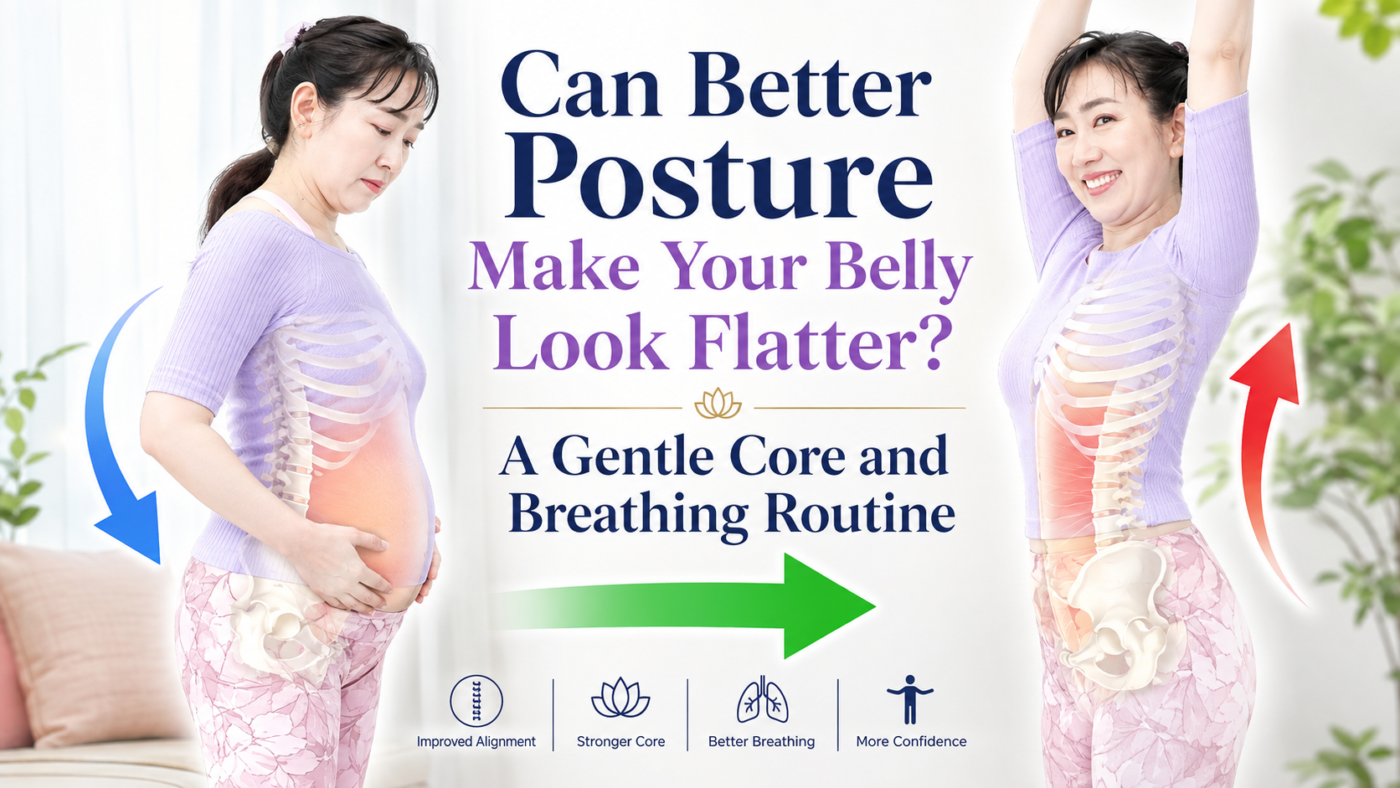
A belly that looks more prominent does not always mean that you suddenly gained a large amount of abdominal fat. The way you stand, breathe, position your pelvis and support your trunk can change the appearance of your midsection. When the rib cage drifts forward, the lower back arches excessively or the abdominal wall relaxes, the stomach may appear to project farther forward.Better posture can sometimes make your belly look flatter or more supported, even though posture itself does not reduce abdominal fat.
That does not mean posture is secretly “moving your organs back into place,” nor does a single exercise melt lower-belly fat. Instead, posture-focused movement may help you stand taller, improve awareness of your abdominal muscles and create a more supported appearance through the waist.
If your goal is to feel stronger through your middle and look more naturally upright, a combination of breathing, gentle pelvic mobility, core engagement and full-body movement may be worth practicing regularly.
Why Can Your Belly Look More Prominent Even When Your Weight Has Not Changed Much?
Several factors can influence the appearance of your abdomen. Body fat is one of them, but it is not the only one.
Your abdominal muscles help stabilize your trunk, assist movement between the rib cage and pelvis and contribute to posture. They also help regulate pressure inside the abdomen.
If your pelvis tips forward while your ribs flare upward, your lower back may become more arched and the abdominal wall can appear more prominent. Changing that position does not remove fat, but improving body alignment and muscular control may temporarily change how your midsection looks.
Other factors can also affect abdominal appearance, including bloating, digestive changes, constipation, muscle tone, pregnancy-related changes and overall body-fat distribution.
This is why it is important not to assume that every protruding belly is simply the result of “weak abs.”
Can Posture Actually Flatten Your Stomach?
Posture can influence appearance, but it should not be confused with fat loss.
Core exercises can strengthen and tone the muscles underneath the abdominal area. However, exercising the abdomen alone does not selectively burn belly fat. Reducing excess abdominal fat generally requires broader lifestyle changes that affect overall energy balance and body composition.
So a posture routine might make you feel taller, more supported and less collapsed through the torso, but claims that one movement can permanently flatten the belly are unrealistic.
There is also no single “perfect posture” that everyone needs to maintain all day. Current physiotherapy guidance emphasizes movement variety rather than rigidly holding one supposedly ideal position.
The goal is therefore not to force your body into a stiff pose. It is to improve comfortable control.
Start With Breathing Instead of Sucking In Your Stomach
One of the easiest places to begin is breathing.
Your diaphragm is the primary muscle responsible for breathing, while the abdominal muscles help coordinate pressure and movement during respiration. Diaphragmatic breathing can encourage more efficient use of the diaphragm and help reduce unnecessary breathing effort.
Stand comfortably with your feet roughly hip-width apart.
Allow your knees to remain soft rather than locked.
Imagine your rib cage resting over your pelvis instead of pushing your chest dramatically forward.
Place one hand around your lower ribs and the other near your lower abdomen.
Inhale slowly through your nose and allow the ribs and abdomen to expand naturally.
Then exhale slowly without aggressively sucking your stomach inward.
Near the end of the exhalation, gently tighten the lower abdominal area.
Take approximately five slow breaths.
The contraction should feel controlled rather than forceful.
Step 2: Gentle Pelvic Circles
Next, loosen the hips and pelvis.
Place your hands on your hips and slowly circle your pelvis in one direction. Keep the movement comfortable and relatively small.
Perform five to eight circles, then reverse direction.
Pelvic mobility movements can be a useful component of gentle back and trunk exercise programs. NHS-affiliated physiotherapy guidance also includes pelvic tilting and abdominal activation among common mobility exercises.
Avoid forcing the lower back into an extreme arch.
The purpose is simply to explore comfortable movement.
Step 3: Practice a Small Pelvic Tilt
Return to a neutral standing position.
Imagine bringing the front of your pelvis and lower rib cage slightly closer together while gently engaging your abdominal muscles.
Then return to your comfortable starting position.
Repeat approximately eight times.
This should be a subtle movement.
You do not need to “push the sacrum inside,” as some fitness videos describe it. The sacrum is part of your pelvis, and the more useful goal is simply to gain better awareness of pelvic position.
If the movement produces pain, reduce the range or stop.
Step 4: Add an Overhead Reach
Stand tall and gently engage your abdomen.
Raise both arms overhead only as far as your shoulders comfortably allow.
As your arms rise, imagine lengthening upward through your spine rather than excessively arching your lower back.
Take a comfortable breath.
Slowly lower your arms.
Repeat three to five times.
If you have limited shoulder mobility, your elbows can remain bent.
You do not need to force your arms completely overhead for the exercise to be useful.
Step 5: Reach Up While Maintaining Rib-Pelvis Control
Now combine the previous movements.
Stand with your rib cage comfortably positioned over your pelvis.
Exhale and gently engage your abdominal muscles.
Raise your arms and reach upward.
Try to maintain the same comfortable trunk position rather than allowing the lower ribs to flare dramatically forward.
Hold briefly while breathing normally, then lower your arms.
Repeat three times.
Avoid prolonged breath-holding or aggressive abdominal squeezing.
Step 6: March in Place
Keep your torso comfortably upright and begin marching slowly.
Alternate lifting one foot and then the other for about 30 to 60 seconds.
You may keep your hands on your hips or raise your arms if that feels comfortable.
Marching engages the hips, legs and trunk together and may help you practice maintaining control while moving.
However, marching does not cause the psoas muscle to physically “lift sagging belly fat.” Fat tissue cannot be pulled upward or selectively burned by activating a nearby muscle.
The value of this movement is functional: your trunk and hips learn to coordinate during upright activity.
Step 7: Practice Gentle Abdominal Engagement
Place your hands lightly around your waist.
Breathe in normally.
As you breathe out, gently tighten your lower abdominal muscles.
Think of creating mild tension around the middle rather than sucking your belly as far inward as possible.
Keep breathing.
Hold that comfortable activation for several seconds, then release.
Repeat three to five times.
Clinical exercise guidance similarly describes gentle lower-abdominal contraction while continuing to breathe normally.
Step 8: Finish With Relaxed Movement
Finally, relax your shoulders and gently swing your arms from side to side.
Allow your torso to rotate naturally.
Continue for about 30 seconds.
Your goal is not to maintain abdominal tension all day. Muscles need to alternate between contraction and relaxation.
Comfortable movement variety is generally more useful than trying to hold your body rigidly in one position for hours.
What This Routine May Realistically Do
With regular practice, exercises like these may help improve body awareness, trunk control, mobility and confidence during everyday movement.
They may also make your posture appear more upright, which can sometimes make the abdomen look less prominent.
But they should not be marketed as a guaranteed belly-flattening treatment.
A flatter-looking stomach after one session is more likely to reflect temporary changes in posture, muscle activation and how you are holding your torso—not immediate loss of abdominal fat.
For meaningful fat loss, overall physical activity, nutrition, sleep and long-term energy balance matter much more. Mayo Clinic notes that although abdominal exercises can strengthen and tone abdominal muscles, they do not by themselves eliminate belly fat.
What About “Tanden”?
Some Japanese movement traditions use the concept of tanden, generally referring to an area in the lower abdomen associated with balance, breathing, awareness and movement practice.
It can be a useful mental cue for focusing attention on your center of gravity.
However, it should not be described medically as the “headquarters of all nerves and blood flow.” There is no anatomical structure called the tanden that performs that function.
You can still use the lower abdomen as a focus point during breathing and movement without turning a traditional practice concept into an unsupported medical claim.
Posture Is Only One Piece of the Puzzle
If you want your abdomen to look and feel stronger, think beyond a single exercise.
Regular walking, resistance training, cardiovascular exercise, sufficient protein, nutritious food choices, adequate sleep and sustainable weight management can all contribute to body composition and physical function.
Core training then becomes one part of a larger wellness strategy rather than a shortcut.
And remember that there is no requirement to constantly pull your stomach inward.
Strong bodies move, breathe, relax and adapt.
A better goal than chasing the “perfect flat stomach” is developing a midsection that supports you comfortably through everyday life.
The Bottom Line
Better posture and abdominal control can change how your midsection looks, particularly if you habitually stand with the ribs flared forward, the pelvis tilted or the abdominal muscles completely relaxed.
Breathing exercises, gentle pelvic movements, overhead reaching and marching may therefore help you feel taller and more supported.
But they cannot reposition your internal organs, selectively burn lower-belly fat or guarantee a permanently flat stomach after one session.
Practice the movements for mobility, strength and body awareness—and allow improvements in appearance to be a possible bonus rather than an unrealistic promise.
FAQ
Can poor posture make your stomach look bigger?
Yes, body position can change how your abdomen appears. Rib flare, pelvic position and relaxed abdominal muscles may make the abdomen project farther forward, although body fat, bloating and other factors also matter.
Can core exercises burn lower-belly fat?
Not selectively. Core exercises can strengthen and tone abdominal muscles, but reducing abdominal fat requires overall fat loss rather than exercising one specific area.
Can raising your arms activate your core?
Raising your arms changes the demands placed on the trunk and may require abdominal and back muscles to help stabilize the body. However, it does not directly burn belly fat.
Does exercise move internal organs back into position?
Normal posture exercises do not need to “lift” or reposition healthy internal organs. Abdominal muscles already contribute to supporting and protecting the organs.
How often can I practice this routine?
For generally healthy adults, gentle breathing and mobility exercises can often be practiced regularly as long as they remain comfortable. Stop if you experience pain, dizziness, unusual shortness of breath or other concerning symptoms.
Medical Disclaimer
This article is for educational and informational purposes only and is not medical advice. Exercise may not be appropriate for everyone. If you have persistent abdominal swelling or pain, a hernia, pelvic-floor problems, significant back pain, recent surgery, pregnancy-related concerns, cardiovascular disease or another medical condition, consult a qualified healthcare professional before beginning a new exercise routine. Stop exercising if you develop pain, dizziness, chest discomfort or unusual shortness of breath.
This article is for general education and does not replace individualized care from a qualified health professional. Seek appropriate advice for persistent, severe, or concerning symptoms.
Read the full medical disclaimer