
Why am I tired all the time? It is a question many people ask in a world where work, responsibilities, digital stimulation, and constant demands leave little room for genuine recovery. Modern life rewards speed. Messages arrive instantly, work follows us home, responsibilities multiply, and even rest can feel like another task to complete.Modern life rewards speed. Messages arrive instantly, work follows us home, responsibilities multiply, and even rest can feel like another task to complete. Many people wake up tired, rely on caffeine to get moving, rush through meals, spend the day shifting from one obligation to another, and finally collapse into bed with a mind that is still working.
Feeling tired occasionally is normal. But when low energy becomes the background condition of everyday life, it deserves attention.
Fatigue is not simply a lack of motivation. It can affect concentration, mood, physical performance, decision-making, social life, and overall quality of life. Sometimes the cause is straightforward: too little sleep, too much stress, poor nutrition, inactivity, overtraining, or an overloaded schedule. In other cases, persistent fatigue can be linked to a medical condition and should be evaluated rather than dismissed.
The goal is not to become endlessly productive. It is to build a life in which energy is used wisely, restored regularly, and protected from unnecessary depletion.
The Modern Energy Problem
Human beings are capable of short periods of intense effort. The problem begins when short-term urgency becomes a permanent lifestyle.
A typical cycle may look familiar: inadequate sleep, a rushed morning, caffeine instead of breakfast, prolonged sitting, constant notifications, mentally demanding work, convenience food, little outdoor time, evening screen exposure, and difficulty switching off at night.
Individually, each habit may seem minor. Together, they can gradually erode physical and mental resilience.
Stress also has a cumulative effect. A demanding job, family responsibilities, financial concerns, caregiving, relationship difficulties, poor sleep, and lack of recovery time can overlap. Even when no single problem appears overwhelming, the total load may be.
This is why restoring energy is rarely about finding one miracle supplement, one perfect exercise, or one productivity trick. More often, it requires improving the entire pattern.
Fatigue Is a Symptom, Not a Diagnosis
One important distinction is often overlooked: fatigue describes an experience, but it does not explain the cause.
Common contributors can include:
- insufficient or poor-quality sleep
- chronic psychological stress
- irregular meals or inadequate nutrition
- dehydration
- too little physical activity
- excessive physical training
- alcohol or other substance use
- some medications
- anxiety or depression
- anemia
- thyroid disorders
- diabetes
- sleep apnea
- infections
- chronic inflammatory or medical conditions
This is why persistent fatigue should not automatically be labeled “burnout,” “low energy,” “weak constitution,” or “chronic fatigue syndrome.”
Myalgic encephalomyelitis/chronic fatigue syndrome, commonly called ME/CFS, is a specific and complex illness. It is not the same as ordinary tiredness. People with ME/CFS may experience substantial reductions in their previous level of activity, unrefreshing sleep, problems with thinking or concentration, and worsening symptoms after physical or mental exertion.
There is currently no single test that confirms ME/CFS. Evaluation generally involves a careful medical history, symptom assessment, examination, and appropriate testing to rule out other conditions.
The practical lesson is simple: persistent fatigue deserves curiosity rather than assumptions.
The Difference Between Being Busy and Being Well
Modern culture often treats exhaustion as evidence of commitment. Long hours, constant availability, and a packed schedule may be praised as signs of ambition.
But activity and vitality are not the same thing.
A person can be extremely busy and still have poor health, low energy, little joy, and almost no true recovery.
The better question is not, “How much can I fit into one day?”
It is, “Which activities genuinely support the life I want to live?”
That shift matters because energy is finite. Every commitment has a cost. Every interruption demands attention. Every late night borrows from the next day.
A healthier life therefore requires not only adding good habits, but also removing unnecessary demands.
Sometimes energy returns not because we do more, but because we finally stop doing what drains us.
Balance Is a Practical Health Skill
“Balance” can sound vague, but in daily life it is highly practical.
Balance means alternating effort with recovery. It means recognizing that concentration needs breaks, muscles need rest, sleep needs protection, and emotional stress needs somewhere to go.
It also means accepting that no one can do everything.
When work, social obligations, family duties, digital stimulation, exercise, errands, and personal goals compete for the same limited hours, something must be prioritized.
A balanced life does not mean every day is perfectly calm. It means the overall pattern contains enough recovery to make effort sustainable.
Useful questions include:
- Am I sleeping enough to feel reasonably restored?
- Do I regularly eat meals that support stable energy?
- Am I moving my body most days?
- Do I have periods without work, notifications, or demands?
- Am I saying yes to more than I can realistically handle?
- Do I spend any time outdoors?
- Do I have meaningful social connection?
- Do I make room for activities that are enjoyable rather than productive?
- Is my fatigue improving with healthier habits, or does it remain unexplained?
These questions can reveal where energy is being lost.
Sleep: The Foundation of Daily Energy
It is difficult to compensate for inadequate sleep with caffeine, supplements, or willpower.
Sleep supports attention, memory, immune function, emotional regulation, metabolic health, and physical recovery. A person who regularly sleeps too little may feel as if every other part of life has become harder.
Improving sleep does not require a complicated ritual. Start with consistency.
Try to wake up and go to bed at roughly similar times. Make the bedroom dark, quiet, and comfortable. Reduce stimulating work late at night. Limit heavy meals and excessive alcohol close to bedtime. If caffeine affects your sleep, move it earlier in the day.
Most importantly, stop treating sleep as leftover time.
It is not the period after everything important is finished. Sleep is one of the things that makes everything else possible.
Nutrition and Stable Energy
Energy crashes are often blamed on a lack of motivation when the real issue may be irregular eating.
A balanced eating pattern generally includes sufficient protein, fiber-rich carbohydrates, vegetables, fruits, healthy fats, and fluids. Large swings between skipping meals and eating heavily later can leave some people feeling sluggish.
Caffeine can temporarily improve alertness, but it does not replace sleep or nutrition. Excessive use may also interfere with sleep, creating a cycle in which poor sleep increases caffeine intake and caffeine then contributes to another poor night.
A better approach is to use food and hydration as part of a stable daily rhythm rather than emergency fuel.
No single food can “cure fatigue.” The larger pattern matters more.
Movement Can Create Energy
When people feel tired, exercise can seem like the last thing they need. Yet regular physical activity often supports better sleep, mood, cardiovascular health, muscle strength, and general well-being.
The key is appropriate intensity.
For a generally healthy person who has become sedentary, walking is an excellent starting point. Short sessions of strength training, mobility work, cycling, swimming, tai chi, or other enjoyable movement can also help.
Exercise should not become another source of exhaustion.
And this point is especially important for people with suspected or diagnosed ME/CFS: worsening symptoms after exertion can be a defining feature of the condition, so generic advice to “push through” fatigue may be inappropriate.
When activity repeatedly causes a significant delayed worsening of symptoms, medical guidance is more appropriate than simply increasing exercise.
Mental Load Is Still Load
Physical work is only one form of effort.
A person can sit at a desk all day and still feel exhausted because attention, decision-making, emotional regulation, worry, conflict, and constant switching between tasks consume mental resources.
Digital life adds another layer. Messages, alerts, news, social media, and work platforms can keep the nervous system engaged long after the official workday has ended.
A useful recovery practice is to create periods when nothing is demanding a response.
Read. Walk. Listen to music. Sit quietly. Spend time with someone you enjoy. Prepare food slowly. Garden. Stretch. Practice breathing exercises. Pray or meditate if those practices are meaningful to you.
The activity itself matters less than its ability to reduce unnecessary stimulation.
Rest is not laziness. It is part of sustainable performance.
Learn to Protect Your Energy
Many exhausted people are not failing to manage time. They are failing to protect limits.
They agree to too many requests. They remain available at all hours. They feel guilty saying no. They underestimate how long tasks take and overestimate how much energy they will have later.
A simple but powerful habit is to pause before committing.
Instead of answering immediately, ask:
“Do I realistically have the time and energy for this?”
If the answer is no, declining can be healthier than accepting and becoming resentful, exhausted, or unreliable.
Boundaries are not a rejection of other people. They are a way of allocating limited resources responsibly.
The Eastern Idea of Conserving Vitality
Traditional East Asian health systems have long emphasized moderation, rhythm, rest, movement, seasonal adaptation, and the avoidance of excessive strain.
Traditional Chinese medicine often describes vitality using the concept of qi. In traditional practice, qi is part of a broader philosophical and medical framework used to describe function, vitality, and balance.
It should not be confused with a scientifically measured form of biological energy.
Even so, some traditional lifestyle principles overlap with modern wellness advice in practical ways: avoid chronic overexertion, maintain regular sleep and meals, move the body, manage emotional strain, and preserve periods of quiet recovery.
Practices such as tai chi, qigong, gentle stretching, breathing exercises, and mindful movement can be valuable when used appropriately, especially because they combine physical activity with attention and controlled breathing.
They should complement, not replace, appropriate medical care.
Simplification Can Be Therapeutic
When life feels exhausting, people often search for something new to add.
A supplement. A new app. A complicated morning routine. A productivity system. A demanding fitness program.
But sometimes the most restorative change is subtraction.
Fewer unnecessary commitments.
Fewer late-night screens.
Fewer hours spent responding to nonurgent messages.
Less alcohol.
Less perfectionism.
Less multitasking.
Fewer activities performed only out of guilt or social pressure.
A simpler schedule creates space for the basics that are frequently neglected: sleep, movement, real food, relationships, sunlight, quiet, and unstructured time.
Health is often improved by returning to fundamentals.
Build a Personal Recovery Routine
A recovery routine does not need to transform your entire life overnight.
Start with changes that are small enough to maintain.
Morning
Get out of bed at a consistent time when possible. Seek daylight early in the day. Drink water. Eat a nourishing breakfast if that works well for you. Avoid beginning the day with an immediate flood of notifications.
During the Day
Take brief movement breaks. Eat regular meals. Step outside. Separate important work from constant digital interruption. Notice whether you are becoming tense, hungry, dehydrated, or mentally overloaded before exhaustion becomes severe.
Evening
Reduce stimulation. Avoid turning the final hour of the day into an extension of work. Dim the environment, read, stretch, listen to music, prepare for the next day, or practice a quiet activity that signals the transition toward sleep.
Weekly
Protect at least some time that is not optimized for productivity. Spend time in nature, with family or friends, or doing something purely because it is enjoyable.
Recovery should be scheduled before exhaustion forces it upon you.
When Fatigue Should Be Medically Evaluated
Lifestyle changes can help many people, but persistent fatigue should not always be handled alone.
Consider speaking with a qualified healthcare professional if fatigue:
- lasts for several weeks without a clear reason
- is getting worse
- significantly interferes with normal daily activities
- remains severe despite adequate rest
- is accompanied by unexplained weight change
- occurs with shortness of breath or palpitations
- is associated with loud snoring, gasping, or choking during sleep
- occurs with significant mood changes
- develops with persistent pain, fever, weakness, or other concerning symptoms
Urgent medical attention may be necessary when severe fatigue occurs with symptoms such as chest pain, significant shortness of breath, fainting, severe headache, unusual bleeding, or other acute warning signs.
The important point is not to become alarmed by tiredness, but to avoid normalizing symptoms that deserve evaluation.
Self-Help Works Best When It Is Realistic
Self-help is valuable because everyday habits genuinely influence health.
But self-help should not become self-blame.
You cannot control every illness, responsibility, work demand, family crisis, or external circumstance. Nor should every health problem be treated as a personal failure to exercise, sleep, think positively, or manage stress.
The useful form of self-help is practical and compassionate.
Identify what is within your control.
Change one or two things.
Observe what happens.
Keep what works.
Seek professional help when the problem exceeds what lifestyle changes can reasonably address.
That is not weakness. It is good judgment.
A Better Definition of Energy
Real energy is not the ability to stay busy from morning until midnight.
It is the ability to engage fully with what matters and still have enough capacity to recover.
It is waking with reasonable alertness, thinking clearly, moving comfortably, connecting with other people, and having something left for life beyond obligation.
That kind of energy usually grows from balance rather than intensity.
You do not need to escape modern life completely.
You may simply need to stop allowing every demand to have equal access to your attention, time, and body.
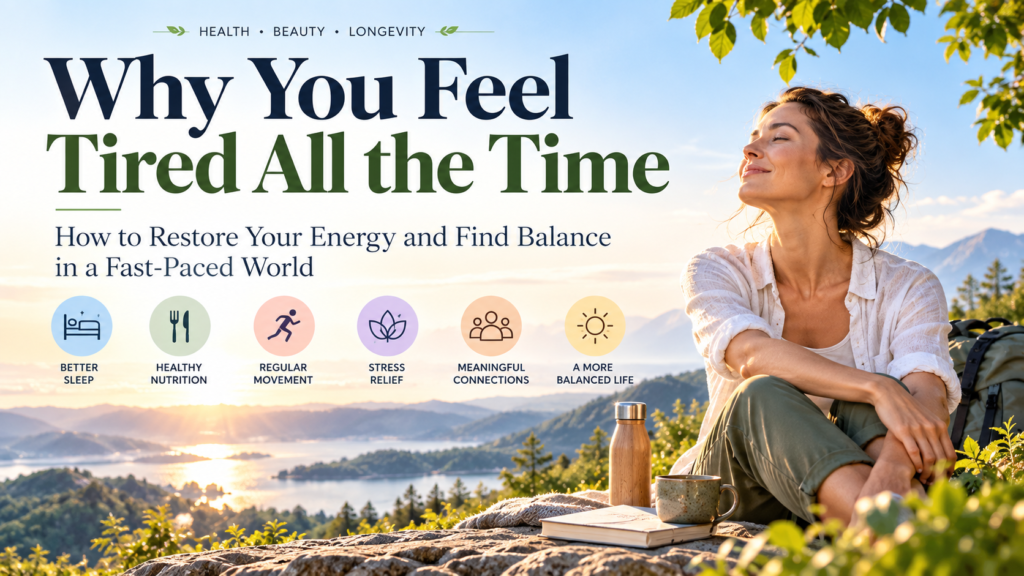
Protect sleep. Eat well. Move regularly. Reduce unnecessary stress. Make room for quiet. Spend time outdoors. Maintain meaningful relationships. Say no when necessary. Seek medical advice when fatigue is persistent or unexplained.
The goal is not to become a machine with unlimited output.
The goal is to become more fully alive.
FAQ
Why do I feel tired all the time even when I sleep?
Sleep duration is only one factor. Poor sleep quality, stress, sleep apnea, depression, anemia, thyroid problems, diabetes, medication effects, infections, and other medical conditions can also contribute to fatigue. Persistent or unexplained fatigue should be discussed with a healthcare professional.
Can stress really make you physically tired?
Yes. Long-term psychological stress can affect sleep, muscle tension, attention, mood, appetite, and daily behavior, all of which may contribute to physical and mental exhaustion.
Does exercise help with fatigue?
Appropriate regular activity may improve energy, sleep, mood, and physical conditioning in many people. However, people with ME/CFS can experience post-exertional worsening of symptoms, so exercise recommendations should be individualized.
Is chronic fatigue the same as ME/CFS?
No. “Chronic fatigue” can simply describe ongoing tiredness. ME/CFS is a specific complex illness with defined clinical features, including substantial impairment in activity and post-exertional symptom worsening.
Can caffeine fix low energy?
Caffeine can temporarily increase alertness, but it does not correct inadequate sleep, poor nutrition, excessive stress, or an underlying medical problem. Heavy or late caffeine use can also interfere with sleep.
What is the best first step if I am always tired?
Start by reviewing sleep, stress, diet, hydration, physical activity, alcohol, caffeine, medications, and daily workload. If fatigue has persisted for several weeks, affects daily life, or has no obvious explanation, seek medical evaluation.
Medical Disclaimer
This article is for general educational and informational purposes only and is not intended as medical advice, diagnosis, or treatment. Fatigue can have many causes, including medical conditions that require professional evaluation. Always seek advice from a qualified healthcare professional regarding persistent, severe, unexplained, or worsening symptoms. Do not delay or disregard professional medical care because of information presented on this website.
Affiliate Disclosure
Some pages on Health, Beauty & Longevity may contain affiliate links. If you purchase a product or service through an eligible link, we may receive a commission at no additional cost to you. Affiliate relationships do not determine our editorial conclusions, and health information is presented for educational purposes rather than as individualized medical advice.
This article is for general education and does not replace individualized care from a qualified health professional. Seek appropriate advice for persistent, severe, or concerning symptoms.
Read the full medical disclaimer

