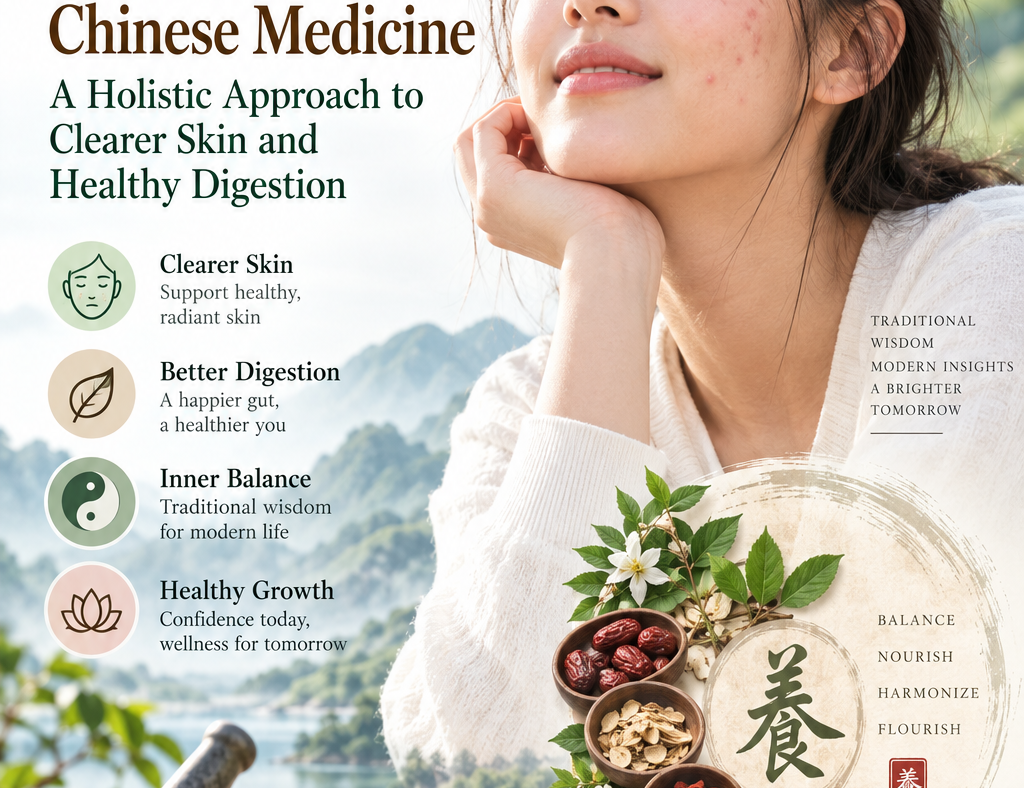
Understanding the relationship between puberty, skin health, traditional Lung and Kidney theory, digestive balance, and the foundations of lifelong wellness.
Adolescence is a remarkable period of physical, hormonal, and emotional development. As the body transitions from childhood into adulthood, changes in the skin often become particularly noticeable.
Acne, commonly known as teenage pimples, is one of the most familiar dermatological concerns during this stage of life.
Although acne appears on the surface of the skin, its development involves several internal and external biological processes, including hormonal activity, sebum production, inflammation, and the behavior of microorganisms within hair follicles.
Traditional Chinese Medicine (TCM) approaches skin health through a broader framework. Rather than focusing exclusively on visible blemishes, it considers the relationship between the skin, the body’s functional systems, dietary habits, digestion, and overall constitutional balance.
Understanding the traditional perspective alongside modern dermatology provides a more comprehensive way to explore acne, digestive health, and healthy skin throughout life.
Why Teenage Acne Develops During Puberty
Puberty brings substantial changes in the body’s hormonal environment.
During adolescence, increasing androgen activity stimulates the sebaceous glands, which produce sebum, the natural oil that helps protect and lubricate the skin.
When excess sebum combines with dead skin cells, hair follicles may become blocked.
These blocked follicles can develop into blackheads, whiteheads, or inflammatory acne lesions.
The skin bacterium Cutibacterium acnes, which normally lives within hair follicles, can also contribute to inflammation under certain conditions.
Genetic predisposition, hormonal fluctuations, certain skin-care products, and other individual factors influence how severely acne develops.
This explains why some teenagers experience only occasional blemishes while others develop persistent inflammatory acne.
Acne is not simply a consequence of poor hygiene, nor does it necessarily indicate that the body is unhealthy.
The Traditional Chinese Medicine Perspective on Acne
Traditional Chinese Medicine describes health in terms of the dynamic relationships among Qi, Blood, Yin, Yang, and the functional systems associated with the internal organs.
Within this framework, visible skin changes may reflect broader patterns of imbalance.
Traditional practitioners may consider acne in relation to patterns described as Lung Heat, Damp-Heat, Blood Heat, Spleen dysfunction, or deficiencies involving the body’s nourishing and regulating functions.
These terms represent traditional diagnostic concepts rather than established biomedical causes of acne.
The Traditional Relationship Between the Lungs and Skin
One of the classical principles of Chinese medicine states:
“The Lungs govern the skin and body hair.”
In traditional theory, the Lung system is responsible for regulating Qi, supporting the body’s defensive functions, and distributing nourishment and fluids toward the surface of the body.
When these functions are considered balanced, the skin is traditionally described as well-nourished and capable of maintaining its natural resilience.
When the Lung system is believed to be disturbed by Heat or other pathogenic influences, practitioners may associate this pattern with redness, inflammation, or visible skin eruptions.
The term “Lung” in this context should not be interpreted as referring solely to the anatomical lungs.
Modern dermatology does not establish acne as a diagnostic sign of impaired lung function, and ordinary acne is not known to cause chronic lung disease.
Nevertheless, the traditional framework illustrates how Chinese medical practitioners historically considered skin symptoms within a broader understanding of bodily health.
Kidney Essence, Puberty, and Hormonal Development
Another important principle of TCM concerns the relationship between Kidney Essence and human growth.
In classical Chinese medicine, the Kidneys are considered fundamental to development, reproduction, maturation, and aging.
The Huangdi Neijing, or Yellow Emperor’s Inner Canon, describes human development through age-related cycles associated with Kidney Essence and reproductive maturity.
Within this traditional framework, puberty represents a period in which the body’s developmental processes become particularly active.
Because adolescence involves significant physiological changes, traditional practitioners may examine the balance among the Kidney, Lung, Liver, and Spleen systems when evaluating skin concerns.
Modern medicine explains puberty primarily through hormonal communication involving the brain, pituitary gland, and reproductive organs.
These hormonal changes can increase sebaceous gland activity and contribute to acne.
The traditional concept of Kidney Essence should therefore be understood as a cultural and historical explanation of development rather than a direct equivalent of modern endocrinology.
The Lung and Large Intestine Connection in Traditional Chinese Medicine
Traditional Chinese Medicine also describes a close relationship between the Lungs and Large Intestine.
This association is commonly expressed through the principle that the Lungs and Large Intestine are internally and externally related.
Within this framework, the Lung system is associated with the regulation and distribution of Qi, while the Large Intestine is responsible for the movement and elimination of waste.
Traditional practitioners may therefore consider digestive symptoms when evaluating certain patterns of skin imbalance.
For example, constipation, abdominal discomfort, dietary habits, and irregular bowel movements may form part of a broader traditional assessment.
However, modern medicine does not establish constipation as a direct cause of acne.
Having both conditions does not necessarily mean that one is responsible for the other.
Acne and constipation should each be evaluated according to their underlying causes.
Can Digestive Health Influence the Appearance of Skin?
The relationship between digestive health and skin health is an area of growing scientific interest.
The intestinal microbiome, immune system, nutritional status, and inflammatory signaling are interconnected biological processes.
Researchers continue to investigate whether changes in gut microbial communities may influence certain inflammatory skin conditions.
However, these associations do not establish that treating constipation will eliminate acne.
A balanced diet may help support both digestive function and overall skin health, but no single dietary intervention has been established as a universal cure for acne.
Supporting Digestive Balance Naturally
Healthy digestion begins with consistent daily habits.
Foods rich in dietary fiber can support normal bowel function. These include vegetables, fruit, whole grains, legumes, nuts, and seeds.
Adequate fluid intake helps dietary fiber work effectively.
Regular physical activity and consistent bathroom habits may also contribute to more comfortable bowel movements.
Individuals who experience constipation may benefit from gradually increasing fiber intake, maintaining hydration, and establishing a regular toileting routine.
Persistent constipation should not be dismissed as a simple constitutional imbalance, particularly when accompanied by bleeding, unexplained weight loss, significant abdominal pain, or other concerning symptoms.
The Role of the Spleen in Traditional Skin and Digestive Health
Traditional Chinese Medicine considers the Spleen and Stomach essential for transforming food and fluids into substances that nourish the body.
This process is often described as the transformation and transportation of nutrients and fluids.
The traditional Spleen system is not equivalent to the anatomical spleen recognized in modern medicine.
Within TCM theory, impaired Spleen function may be associated with patterns involving digestive discomfort, fatigue, and the accumulation of Dampness.
When Dampness combines with Heat, traditional practitioners may describe a pattern known as Damp-Heat.
Certain forms of acne have historically been interpreted through this framework, particularly when digestive symptoms or an oily complexion occur alongside inflammatory skin lesions.
Although these concepts remain important within TCM, they should not replace dermatological examination or evidence-based treatment.
Nutrition, Lifestyle, and Acne Management
Supporting healthy skin involves more than choosing the right facial cleanser.
Nutrition, sleep, physical activity, stress management, and appropriate skin care all contribute to general well-being.
A balanced diet provides nutrients required for tissue maintenance, immune function, and normal physiological processes.
Foods such as vegetables, fruit, whole grains, fish, legumes, and other nutrient-rich choices can form part of a sustainable wellness routine.
Some research has explored associations between acne and dietary glycemic load or particular dairy products. However, evidence remains insufficient to recommend one specific diet as a treatment for everyone with acne.
Similarly, spicy foods do not universally cause acne, although individuals may notice that certain foods or habits coincide with their own symptoms.
Rather than following restrictive diets or aggressive cleansing routines, teenagers benefit from developing consistent, balanced habits that support both physical health and psychological well-being.
Why Gentle Skin Care Matters
Acne-prone skin requires appropriate care rather than excessive cleansing.
Harsh scrubbing, frequent washing, and irritating skin-care products may damage the skin barrier and worsen discomfort.
A gentle routine may include washing the face twice daily with a suitable cleanser, using a non-comedogenic moisturizer, and applying sunscreen when appropriate.
Avoiding the habit of squeezing or picking acne lesions is also important because repeated manipulation can increase inflammation and the risk of scarring.
For persistent acne, evidence-based treatments may include benzoyl peroxide, topical retinoids, and other therapies selected according to the severity of the condition.
Moderate or severe inflammatory acne may require professional dermatological treatment.
Because improvements often take several weeks, consistency and appropriate follow-up are important.
Understanding Constipation Through Traditional Chinese Medicine
Constipation is another condition frequently discussed in traditional health cultivation.
In TCM, different patterns may be associated with difficulty passing stool.
One traditional explanation involves insufficient Qi, which is believed to impair the movement of intestinal contents.
Another involves Blood deficiency, which is traditionally associated with inadequate nourishment and lubrication of bodily tissues.
Other traditional patterns include Heat accumulation, dryness, and disturbances in the movement of Qi.
These descriptions reflect the traditional theory of pattern differentiation and should not be considered direct substitutes for modern medical diagnoses.
Why Constipation May Become More Common With Age
Constipation can affect people at any age, but certain circumstances make it more likely.
Reduced physical activity, inadequate fiber intake, insufficient fluid consumption, certain medications, and changes in bowel habits can all contribute.
Some older adults may experience several of these factors simultaneously.
Constipation may also be associated with underlying medical conditions or pelvic floor dysfunction.
Women may experience constipation in connection with hormonal changes, pregnancy, medications, or other individual factors.
Identifying the contributing causes is more useful than assuming all constipation results from one traditional deficiency pattern.
Should People With Constipation Avoid Laxatives?
Traditional wellness literature sometimes emphasizes avoiding excessive purging or overly aggressive methods of bowel evacuation.
This principle can be understood as a reminder to avoid unnecessary or inappropriate treatment.
However, it should not be interpreted as a recommendation to avoid all laxatives.
Modern medicine recognizes that different types of laxatives have different mechanisms and safety considerations.
Fiber supplements, osmotic laxatives, and stimulant laxatives may be appropriate for different individuals and circumstances.
Some people benefit from short-term treatment, while others with chronic constipation require a longer-term management plan under professional guidance.
The choice depends on the underlying cause, symptom severity, other medical conditions, and individual response.
Persistent constipation should be evaluated rather than repeatedly treated without understanding its cause.
Integrating Traditional Wellness With Modern Dermatology
Traditional Chinese Medicine emphasizes the importance of observing the whole person rather than treating visible symptoms in isolation.
Modern dermatology provides specific explanations for acne development and established treatment options that address follicular blockage, sebum production, and inflammation.
These perspectives can coexist when their differences are clearly recognized.
Healthy nutrition, adequate sleep, regular movement, emotional well-being, and appropriate skin care can support general health while evidence-based medical treatment addresses acne directly.
Traditional wellness practices may be incorporated as complementary approaches, provided they are safe and do not delay necessary treatment.
Herbal remedies should not be assumed safe simply because they are natural. Their quality, possible adverse effects, and interactions with medications require consideration, particularly for teenagers, pregnant individuals, and people with medical conditions.
The Foundations of Lifelong Skin Health
Clear, healthy-looking skin is influenced by many interacting factors.
Hormonal development, genetics, nutrition, inflammation, environmental exposure, and daily skin-care habits all contribute to individual differences in skin health.
Traditional Chinese Medicine provides a historical perspective on the relationships among the body’s functional systems, digestive balance, and visible changes in the skin.
Modern medicine allows these concerns to be investigated through specific biological mechanisms and evidence-based care.
The goal of holistic wellness is not to promise that every blemish can be eliminated through internal nourishment alone.
It is to support the body’s general health while recognizing when targeted treatment is necessary.
Healthy skin begins with consistent care, balanced living, an understanding of individual needs, and the willingness to address both visible symptoms and their underlying causes.
FAQ
- What causes teenage acne?
Teenage acne commonly develops when hormonal changes increase sebum production, contributing to clogged hair follicles and inflammation. Genetics, skin biology, and other individual factors may influence acne severity. - How does Traditional Chinese Medicine explain teenage acne?
Traditional Chinese Medicine may interpret acne through patterns involving Lung Heat, Damp-Heat, Blood Heat, and imbalances in the body’s functional systems. These traditional concepts are not equivalent to modern dermatological diagnoses. - Can constipation cause teenage acne?
Constipation is not an established direct cause of teenage acne. Although digestive health and skin inflammation are areas of scientific research, treating constipation does not guarantee improvement in acne. - Can diet help improve acne-prone skin?
A balanced diet supports overall health. Some research suggests that dietary glycemic load may influence acne in certain individuals, but no single diet has been established as a universal treatment. - Can Traditional Chinese Medicine cure teenage acne?
Current evidence does not establish Traditional Chinese Medicine as a universal cure for acne. Traditional wellness practices may complement healthy living, but persistent or severe acne should be assessed by a qualified healthcare professional. - What is the best daily routine for teenage acne?
A gentle routine generally includes washing the face twice daily, using suitable non-comedogenic skin-care products, avoiding picking or squeezing pimples, and seeking dermatological treatment when necessary.
Medical Disclaimer
This article is intended for educational purposes only and does not constitute medical advice. Traditional Chinese Medicine concepts are presented as historical and cultural health frameworks and should not be interpreted as established biomedical diagnoses. Consult a qualified healthcare professional for persistent or severe acne, chronic constipation, or other concerning symptoms. Traditional remedies should not replace appropriate medical treatment.
This article is for general education and does not replace individualized care from a qualified health professional. Seek appropriate advice for persistent, severe, or concerning symptoms.
Read the full medical disclaimer