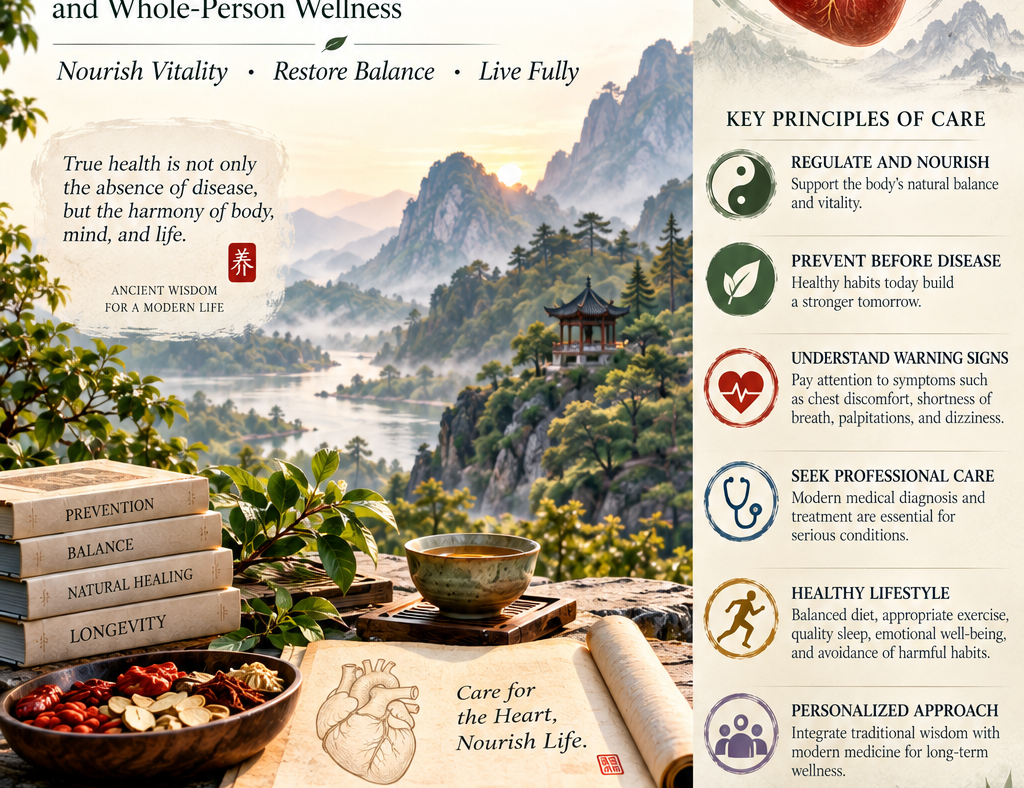
Coronary artery disease is a common cardiovascular condition caused primarily by atherosclerotic plaque building up in the arteries that supply blood to the heart. Modern treatment focuses on reducing heart-attack risk, controlling cholesterol and blood pressure, relieving symptoms, restoring blood flow when necessary, and building long-term heart-healthy habits. Traditional Chinese wellness practices may provide complementary support for lifestyle, movement, stress management, and recovery, but they should not replace evidence-based cardiovascular care.Traditional Chinese health culture often uses the word tiaoyang—regulation and nourishment—to describe a long-term approach to supporting health.
The idea is broader than simply reacting to symptoms. It emphasizes maintaining daily habits, nourishing the body, protecting vitality, adapting to individual conditions, and addressing imbalance before it becomes more serious.
This philosophy can be meaningful when discussing chronic disease, but it must be used carefully.
Coronary artery disease is not something that should be managed through traditional wellness practices alone. It is a potentially serious cardiovascular condition that requires modern medical assessment, appropriate treatment, and evidence-based risk reduction.
Traditional concepts may complement healthy living.
They should never replace urgent or necessary cardiac care.
Coronary artery disease requires long-term risk management rather than relying only on relief of chest discomfort.
What Is Coronary Artery Disease?
The heart is a powerful muscular pump that continuously circulates blood through the body.
Like every other organ, the heart muscle itself requires oxygen and nutrients.
These are delivered through the coronary arteries.
Coronary artery disease, often abbreviated CAD, develops when plaque accumulates within the walls of these arteries. The plaque contains cholesterol and other substances and can gradually narrow the artery.
This process is known as atherosclerosis.
Reduced coronary blood flow may limit the amount of oxygen reaching the heart muscle, particularly when the heart is working harder.
If a plaque ruptures and a blood clot suddenly blocks blood flow, a heart attack may occur.
CAD is therefore not simply a matter of “poor circulation.”
It is a complex disease involving blood vessels, lipids, inflammation, metabolism, genetics, lifestyle, aging, and other cardiovascular risk factors.
What Does Angina Feel Like?
Angina is chest discomfort caused when the heart muscle does not receive enough oxygen-rich blood.
People often describe it as:
Pressure.
Tightness.
Squeezing.
Heaviness.
Burning.
Or an uncomfortable sensation in the chest.
Discomfort may spread to the shoulder, arm, neck, jaw, back, or upper abdomen.
Some people experience shortness of breath, fatigue, nausea, dizziness, or sweating instead of obvious chest pain.
Stable angina often occurs when the heart is working harder—for example during physical activity or emotional stress—and may improve with rest or prescribed medication.
However, symptoms vary considerably.
Women, older adults, and people with diabetes may have less typical presentations.
Symptoms Alone Cannot Diagnose Coronary Disease
It is dangerous to assume that having two or more symptoms proves that someone has coronary artery disease.
Chest discomfort, shortness of breath, palpitations, dizziness, or fatigue can arise from many different conditions.
Likewise, some people with substantial coronary artery disease may have few symptoms.
Diagnosis may involve medical history, physical examination, electrocardiography, blood tests, imaging, stress testing, coronary CT angiography, invasive coronary angiography, or other investigations according to the clinical situation.
The correct principle is simple:
Symptoms can raise suspicion.
They do not establish the diagnosis by themselves.
When Chest Pain Is an Emergency
New, severe, persistent, or rapidly worsening chest pressure or discomfort should never be casually attributed to stress, indigestion, or a traditional pattern of imbalance.
Possible warning signs of a heart attack include:
Chest pressure, squeezing, heaviness, or pain.
Pain spreading to the arm, shoulder, jaw, neck, back, or upper abdomen.
Shortness of breath.
Cold sweating.
Nausea or vomiting.
Sudden weakness or extreme fatigue.
Light-headedness or fainting.
When a heart attack is suspected, emergency medical evaluation is required.
Do not wait for symptoms to resolve through rest, herbs, massage, breathing exercises, or other home remedies.
Nitroglycerin Is Not a General Self-Treatment
Nitroglycerin can be an important medicine for some people with diagnosed angina.
It works by relaxing blood vessels and reducing the heart’s workload.
But it is not appropriate for everyone.
People should use nitroglycerin according to the instructions of the healthcare professional who prescribed it.
Someone experiencing unexplained chest pain should not simply purchase medication and attempt to diagnose or treat themselves.
The priority is determining whether the symptoms represent a cardiac emergency.
Palpitations, Fear, and the Heart
Traditional Chinese medicine connects the Heart with Shen, a concept encompassing aspects of consciousness, emotional stability, and mental presence.
This historical framework helps explain why classical texts often associated palpitations with anxiety, fear, or restlessness.
Modern medicine recognizes that the heart and emotional state also interact, but the relationship is not as simple as saying that becoming easily frightened means the coronary arteries are diseased.
Palpitations can occur with:
Stress or anxiety.
Caffeine.
Sleep deprivation.
Fever.
Anemia.
Thyroid disorders.
Arrhythmias.
Medications.
Alcohol.
And many other conditions.
Persistent or concerning palpitations deserve evaluation rather than being used as a stand-alone sign of coronary disease.
Dizziness and Fainting
Dizziness is another nonspecific symptom.
It may result from dehydration, low blood pressure, medication effects, inner-ear conditions, anemia, arrhythmias, neurological conditions, or many other causes.
Sudden fainting is more concerning, particularly when it occurs during exertion or is associated with chest pain, palpitations, or breathlessness.
Such episodes should be medically evaluated.
What Causes Coronary Artery Disease?
The development of CAD is influenced by multiple factors.
Important risks include:
High LDL cholesterol.
High blood pressure.
Smoking.
Diabetes.
Physical inactivity.
Obesity.
Unhealthy dietary patterns.
Advancing age.
Family history and genetic factors.
These risks do not act independently.
They often interact over many years.
Atherosclerosis is therefore not simply caused by “weak circulation,” nor is cholesterol irrelevant.
LDL cholesterol is directly involved in atherosclerotic plaque formation and remains one of the major modifiable cardiovascular risk factors.
Traditional Chinese Views of Chest Pain
Traditional Chinese Medicine has described chest discomfort through patterns such as xiong bi, sometimes translated as chest impediment.
Historical explanations may involve concepts such as Qi deficiency, Yang deficiency, Blood stasis, Phlegm, Cold, or disruption of circulation.
These are traditional diagnostic frameworks rather than modern pathological mechanisms.
They should not be used to determine whether someone has a narrowed coronary artery.
A person can appreciate these traditional concepts while still receiving appropriate cardiovascular testing and treatment.
The two should not be confused.
Zheng Qi, Vitality, and Resilience
Traditional Chinese medicine often places strong emphasis on Zheng Qi—the body’s healthy or upright vitality.
In a modern wellness context, this can be understood metaphorically as resilience.
Cardiovascular resilience is supported by many measurable factors:
Good blood-pressure control.
Healthy cholesterol levels.
Stable blood glucose.
Regular physical activity.
Adequate sleep.
Avoiding tobacco.
Appropriate nutrition.
Medication adherence.
Cardiac rehabilitation when indicated.
Managing other chronic conditions.
None of these makes someone immune to heart disease.
Together, however, they can substantially influence cardiovascular risk.
Modern Treatment Does More Than Relieve Symptoms
It is incorrect to describe modern coronary care as merely suppressing symptoms.
Treatment aims to achieve several different goals:
Reduce the risk of heart attack and death.
Prevent blood clots.
Slow atherosclerosis.
Lower LDL cholesterol.
Control blood pressure.
Reduce angina.
Improve exercise tolerance.
Manage diabetes and other risk factors.
Restore blood flow when necessary.
Modern coronary treatment is therefore both preventive and therapeutic.
Cholesterol-Lowering Treatment
Statins are among the most established medications used for people with coronary artery disease.
They lower LDL cholesterol and can slow the progression of atherosclerotic plaque.
Depending on individual risk, additional cholesterol-lowering therapies may also be used.
This is not simply “fighting cholesterol.”
It is targeting one of the major biological processes involved in atherosclerotic cardiovascular disease.
Medication decisions should be individualized according to risk, tolerance, laboratory results, and medical history.
Stents and Coronary Angioplasty
Percutaneous coronary intervention, or PCI, can open narrowed or blocked coronary arteries.
A small balloon may be used to widen the artery, and a stent may be placed to help keep it open.
A stent is not appropriate in every case.
Nor does every coronary blockage require one.
Its role depends on the clinical situation, symptoms, anatomy of the coronary arteries, severity of disease, and whether the person is experiencing an acute coronary syndrome.
A stent should not be viewed as something that automatically “consumes vitality” or shortens life simply because it is a foreign material.
Modern stents are medical devices designed for specific cardiovascular indications.
Coronary Artery Bypass Surgery
Coronary artery bypass grafting, or CABG, creates new pathways for blood to reach heart muscle beyond severely narrowed coronary arteries.
Surgeons may use arteries or veins from other parts of the body.
CABG is particularly useful for certain patterns of severe or complex coronary disease.
Like every major procedure, it carries risks and requires recovery.
But it is not simply a temporary detour that inevitably makes the underlying condition worse.
For appropriate patients, it can improve symptoms and outcomes.
Pacemakers and Slow Heart Rhythms
A pacemaker should not be compared with “whipping a sick animal.”
That analogy is medically misleading.
A pacemaker provides electrical impulses when the heart’s own electrical system is beating too slowly or conduction is seriously impaired.
For people with appropriate indications, pacing can relieve symptoms, prevent dangerous bradycardia, and sometimes be lifesaving.
It does not force a damaged heart to work beyond its natural limits in the manner suggested by the traditional analogy.
The underlying condition still matters, but pacing itself is an established medical therapy.
Physical Activity Is Usually Part of Heart Care
Another important misconception is that people with coronary artery disease should generally avoid exercise because movement “consumes Qi.”
In modern cardiovascular care, appropriately prescribed physical activity is an important part of treatment.
Exercise can help improve:
Cardiorespiratory fitness.
Blood pressure.
Blood glucose.
Cholesterol.
Body composition.
Endothelial function.
Mood.
Physical independence.
The correct intensity depends on the individual’s condition.
Someone with unstable symptoms or an acute cardiovascular problem may need to restrict activity temporarily.
People with stable disease are often encouraged to exercise according to medical guidance.
Cardiac rehabilitation provides a particularly valuable supervised pathway after heart attacks, PCI, CABG, and other cardiovascular events.
Start Gradually
Traditional Chinese wellness often favors gentle movement rather than sudden excessive exertion.
That principle can fit well with modern cardiac rehabilitation.
Walking, Tai Chi, low-impact aerobic exercise, and gradually progressed activity can be appropriate for many people.
The important point is not that gentle exercise is always safer simply because it is traditional.
The program should match the person’s cardiac condition, fitness, medications, symptoms, and professional recommendations.
Constipation and Straining
The original tradition of caution during bowel movements contains a useful practical observation.
Straining can temporarily increase pressure within the chest and alter blood pressure and heart rate.
People with cardiovascular disease should avoid chronic constipation and excessive straining when possible.
Helpful measures may include sufficient fiber, fluid, physical activity, and appropriate treatment when constipation persists.
Severe constipation should not simply be accepted as part of aging.
Emotional Stress and the Heart
Strong emotional stress can temporarily increase heart rate and blood pressure.
Chronic stress can also influence sleep, smoking, alcohol use, eating behavior, physical activity, and adherence to treatment.
Traditional Chinese health culture often emphasizes emotional moderation.
The useful modern lesson is not that happiness itself is dangerous for coronary patients.
People do not need to suppress joy out of fear that it will “scatter Heart Qi.”
Instead, cardiovascular care should focus on avoiding extreme physical or emotional strain when medically relevant while promoting healthy emotional well-being.
Early-Morning Heart Risk
Cardiovascular events can show daily patterns, and some occur more frequently during certain morning hours.
But there is no reliable rule that sweating specifically between 3:00 a.m. and 5:00 a.m. proves that a coronary patient is approaching death.
Night sweats can have many causes.
However, waking with severe chest discomfort, shortness of breath, cold sweating, faintness, or other acute symptoms should be treated seriously regardless of the hour.
Clock time should never delay emergency care.
Sleep and Cardiovascular Health
Traditional Chinese medicine places considerable emphasis on nighttime restoration.
Modern medicine also recognizes sleep as an important component of cardiovascular health.
Persistent insufficient sleep can adversely affect blood pressure, metabolism, appetite, and stress regulation.
Sleep apnea is particularly relevant because it is associated with cardiovascular disease and may remain undiagnosed.
Loud snoring, witnessed pauses in breathing, excessive daytime sleepiness, or repeated nighttime choking deserve evaluation.
Sexual Activity and Coronary Disease
Sexual activity increases heart rate and cardiovascular workload temporarily.
Most people with stable cardiovascular disease can continue sexual activity safely once their condition is appropriately assessed and controlled.
Sex should not automatically be prohibited because someone has CAD.
However, people with unstable angina, severe uncontrolled symptoms, or recent cardiovascular events may need individualized advice before resuming sexual activity.
Traditional recommendations about preserving essence should therefore not replace cardiovascular assessment.
A Heart-Healthy Lifestyle
Modern coronary care works best when medication or procedures are combined with long-term lifestyle management.
Important priorities include:
Do not smoke.
Control blood pressure.
Manage cholesterol.
Manage diabetes.
Remain physically active according to individual capacity.
Eat a heart-supportive diet.
Maintain an appropriate body weight.
Get adequate sleep.
Limit excessive alcohol.
Take prescribed medication consistently.
Attend follow-up appointments.
Recognize changes in symptoms.
These actions address major cardiovascular risks in ways that can be measured and monitored.
Traditional Wellness as Complementary Support
Traditional Chinese practices can still play a constructive role when used appropriately.
Tai Chi may support gentle movement, balance, and stress reduction.
Qigong may provide a structured form of mindful physical activity.
Traditional food culture can encourage regular meals, vegetables, legumes, teas, and minimally processed foods when incorporated appropriately.
Breathing and relaxation practices may help some people manage stress.
But complementary practices should support—not replace—cardiovascular treatment.
Do Not Stop Heart Medication Because You Feel Better
Coronary artery disease can remain clinically important even when symptoms improve.
A person may feel well while atherosclerosis or other cardiovascular risks remain present.
For this reason, prescribed medications should not be stopped because an herbal product, dietary change, exercise routine, or traditional therapy appears to improve symptoms.
Medication changes should be made with the healthcare professional managing the condition.
This is particularly important for antiplatelet treatment after certain stent procedures, where inappropriate discontinuation can have serious consequences.
Prevention Begins Before Symptoms
The strongest connection between traditional Chinese wellness and modern cardiovascular medicine may be prevention.
Both approaches emphasize acting before severe disease develops.
Modern prevention provides measurable targets:
Know your blood pressure.
Know your cholesterol.
Know your blood glucose when appropriate.
Do not smoke.
Exercise regularly.
Maintain healthy nutrition.
Understand your family history.
Address obesity and metabolic risk.
Receive appropriate preventive care.
Atherosclerosis often develops silently over many years.
Prevention therefore begins long before the first episode of chest pain.
The Modern Meaning of “Tiaoyang”
The traditional idea of tiaoyang—regulation and nourishment—can be translated into a responsible modern heart-health philosophy.
“Nourishment” may mean supplying the body with adequate nutrition, sleep, activity, recovery, and social support.
“Regulation” may mean controlling blood pressure, cholesterol, glucose, smoking, stress, medication use, and other measurable risks.
In this interpretation, traditional wellness does not compete with cardiology.
It encourages patients to participate actively in their long-term health.
The Deeper Lesson
Coronary artery disease is a powerful example of why traditional wisdom and modern medicine must be distinguished carefully.
The traditional language of Qi, Blood, Zheng Qi, Yin and Yang, and organ networks can provide a cultural framework for thinking about vitality, balance, lifestyle, and recovery.
Modern cardiovascular science explains coronary disease through atherosclerosis, plaque biology, cholesterol, blood pressure, diabetes, smoking, genetics, inflammation, thrombosis, and other measurable processes.
Both can encourage attention to the whole person.
But when chest pain, serious arrhythmia, coronary obstruction, or heart attack is involved, evidence-based medical treatment is essential.
The goal should never be to choose between “East” and “West.”
The goal is to protect the heart.
Prevent what can be prevented.
Treat what needs to be treated.
Support recovery.
And use every safe, responsible tool available to preserve function, independence, and quality of life.
The safest modern approach to coronary artery disease combines evidence-based cardiovascular treatment, prevention, appropriate physical activity, healthy daily habits, and complementary wellness practices when they are safe.
FAQ
What is coronary artery disease?
Coronary artery disease occurs when atherosclerotic plaque builds up in the coronary arteries that supply blood to the heart. Narrowing or blockage can reduce blood flow and may cause angina, heart attack, or other cardiovascular complications.
What are common symptoms of coronary artery disease?
Possible symptoms include chest pressure, tightness, heaviness or discomfort, shortness of breath, fatigue, dizziness, sweating, nausea, or discomfort spreading to the arm, shoulder, neck, jaw, back, or upper abdomen. Some people may have few or atypical symptoms.
Can symptoms alone diagnose coronary artery disease?
No. Symptoms can raise suspicion but cannot confirm the diagnosis. Medical assessment may involve an ECG, blood tests, stress testing, cardiac imaging, coronary CT angiography, invasive angiography, or other tests depending on the situation.
When is chest pain an emergency?
New, severe, persistent, or worsening chest pressure or pain—especially with breathlessness, sweating, nausea, faintness, or pain spreading to the arm, jaw, back, or shoulder—requires urgent medical assessment.
Does cholesterol cause coronary artery disease?
LDL cholesterol is one of the major modifiable factors involved in atherosclerotic plaque formation. Other important risks include high blood pressure, smoking, diabetes, physical inactivity, age, obesity, and family history.
Are coronary stents harmful?
Coronary stents are established medical devices used in appropriate patients to restore blood flow through narrowed or blocked coronary arteries. Whether a stent is needed depends on symptoms, coronary anatomy, disease severity, and the clinical situation.
Can someone with coronary artery disease exercise?
Many people with stable coronary artery disease benefit from appropriately prescribed physical activity. The type and intensity should be matched to individual cardiovascular status, and cardiac rehabilitation may be recommended after certain heart events or procedures.
Can Traditional Chinese Medicine replace heart medication?
No. Traditional wellness practices may support lifestyle, movement, relaxation, or general well-being, but they should not replace prescribed cardiovascular medication, stents, bypass surgery, cardiac rehabilitation, or other necessary treatment.
Can coronary artery disease be prevented?
Risk can often be reduced through smoking avoidance, healthy blood pressure and cholesterol levels, diabetes management, regular physical activity, balanced nutrition, appropriate weight management, sufficient sleep, and preventive medical care.
Medical Disclaimer
This article is for educational and informational purposes only. Traditional Chinese concepts such as Qi, Blood, Yang, Zheng Qi, and organ patterns reflect historical medical frameworks and should not be interpreted as direct equivalents of modern cardiovascular physiology. This content is not intended to diagnose or treat coronary artery disease or replace professional cardiovascular care. Chest pain, severe shortness of breath, fainting, or symptoms suggestive of a heart attack require urgent medical assessment. Do not start, stop, or change nitroglycerin, antiplatelet medication, cholesterol-lowering medication, blood-pressure treatment, or other cardiovascular therapies without appropriate professional guidance.
This article is for general education and does not replace individualized care from a qualified health professional. Seek appropriate advice for persistent, severe, or concerning symptoms.
Read the full medical disclaimer