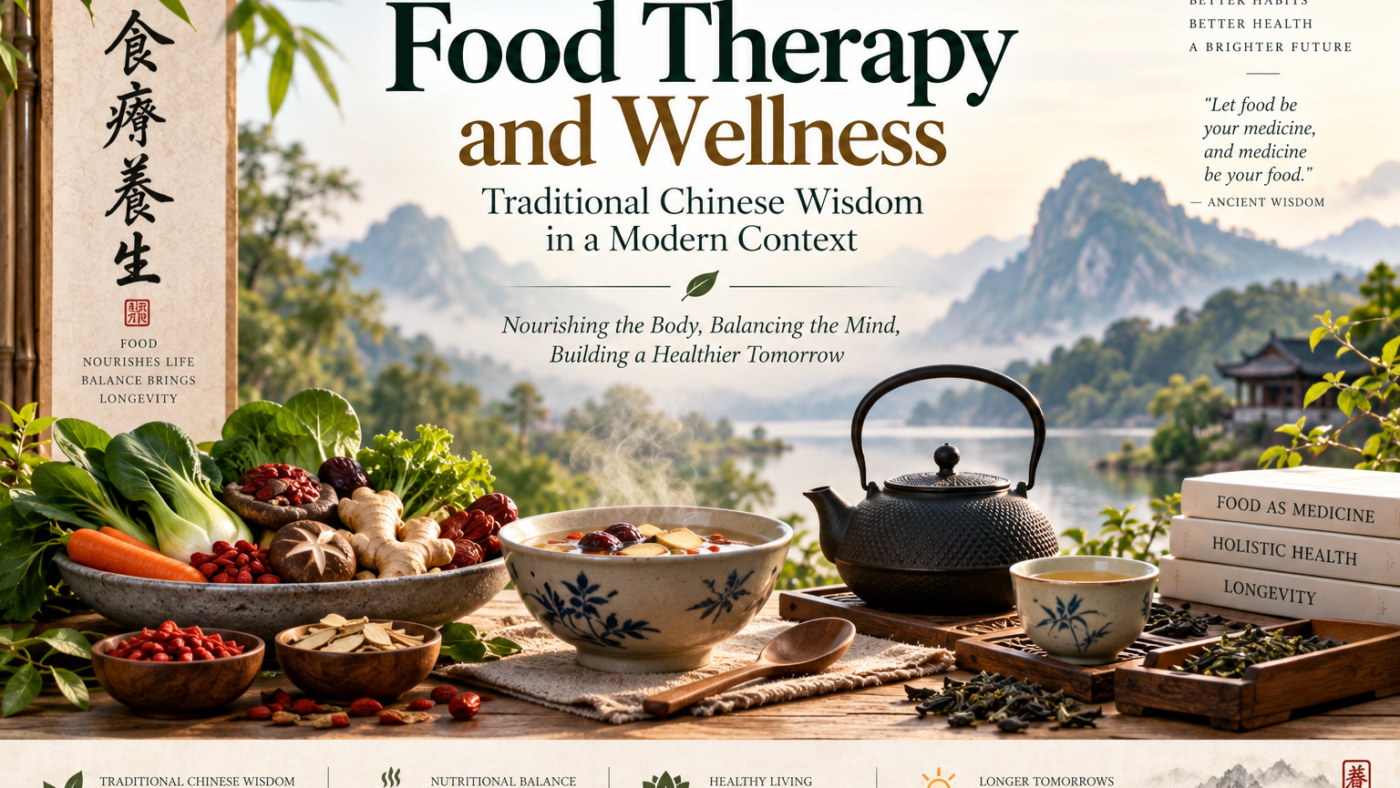
Chinese food therapy is a traditional approach to everyday wellness that uses food, seasonal ingredients, cooking methods, and eating habits as part of yangsheng—the Chinese art of nourishing life. When understood alongside modern nutrition science, it offers a useful framework for thinking about balance, digestion, healthy eating, individual needs, and long-term well-being.Food has always occupied a special place in Chinese health culture.
It is not simply fuel, pleasure, or tradition. In classical Chinese wellness philosophy, everyday food was also viewed as part of the broader practice of yangsheng—the art of nourishing life.
This is where the idea of shiliao, or food therapy, comes in.
Traditional Chinese food therapy uses ordinary foods, culinary herbs, seasonal ingredients, and eating patterns as tools for supporting balance and general well-being. Rather than focusing only on calories, protein, vitamins, or individual nutrients, the traditional system also considers qualities such as warming and cooling, dryness and moisture, season, constitution, digestion, appetite, and the overall condition of the individual.
Modern nutrition science uses a very different framework.
It studies nutrients, metabolism, energy balance, the microbiome, cardiovascular risk, blood glucose, inflammation, food safety, and disease prevention through measurable biological processes.
These two systems should not be treated as identical.
Yet they can meet in one useful principle:
What we eat regularly can influence long-term health.
What Is Traditional Chinese Food Therapy?
Traditional Chinese food therapy is based on the idea that diet should be adapted to the person rather than applied mechanically.
A food that suits one person may not suit another.
A meal that feels appropriate in winter may feel too heavy in summer.
Someone recovering from illness may have different nutritional needs from someone who is physically active and healthy.
Traditional practitioners historically described these differences through concepts such as Yin and Yang, Qi, Blood, Dampness, Heat, Cold, and the functional systems of the Spleen, Stomach, Liver, Lung, and Kidney.
These are traditional medical concepts.
They should not be interpreted as direct equivalents of modern anatomical organs, hormones, immune markers, or laboratory measurements.
The value of food therapy lies primarily in its emphasis on individual context, moderation, preparation, seasonality, and long-term eating habits.
“Food and Medicine Share the Same Origin”
One of the best-known ideas in Chinese health culture is:
Yao shi tong yuan—medicine and food share the same origin.
Historically, the boundary between food and medicine was often less rigid than it is today.
Ginger, jujube, lotus seed, Chinese yam, goji berry, hawthorn, sesame, adzuki beans, mung beans, barley, mushrooms, and many other ingredients have appeared both in ordinary cooking and in traditional health practices.
This does not mean every food is a medicine.
Nor does it mean that eating a particular ingredient can replace treatment for a diagnosed disease.
A more useful modern interpretation is that everyday diet can influence health gradually and continuously.
Nutrition affects body weight, cardiovascular health, blood glucose regulation, digestive function, bone health, energy, and many other aspects of well-being.
Food matters.
But food is not automatically a drug.
Two Different Ways of Understanding Health
Traditional Chinese Medicine and modern biomedicine developed from very different intellectual traditions.
Traditional Chinese Medicine emphasizes patterns, relationships, balance, and the interaction of the whole person with the environment.
Modern medicine studies anatomy, physiology, pathology, genetics, microbiology, pharmacology, imaging, and measurable biological mechanisms.
Neither system should be caricatured.
Modern medicine is not simply “treating disease instead of treating people.”
Contemporary medical care increasingly emphasizes prevention, lifestyle, rehabilitation, mental health, shared decision-making, and management of the whole person.
Likewise, Traditional Chinese Medicine should not be reduced to a collection of herbs or mysterious energy concepts.
Its historical strength lies in pattern recognition, individualized observation, lifestyle guidance, and its holistic philosophical framework.
A responsible modern approach does not need to create a competition between the two.
It can ask a more practical question:
Which ideas are useful, which are culturally meaningful, and which claims require scientific evidence?
The Traditional Concept of Supporting Zheng Qi
Classical Chinese medicine often speaks of Zheng Qi, sometimes translated as “upright Qi” or “correct Qi.”
Traditionally, this refers to the body’s capacity to maintain internal stability and resist harmful influences.
The famous idea that “when Zheng Qi is strong, pathogenic influences have difficulty invading” expresses this philosophy.
It can be tempting to equate Zheng Qi directly with immunity.
That comparison can be useful as a metaphor, but the two concepts are not identical.
The modern immune system includes cells, antibodies, cytokines, tissues, barriers, and highly specific biological processes.
Zheng Qi belongs to a much broader traditional framework involving vitality, resistance, recovery, and systemic balance.
Food therapy traditionally aimed to support this general resilience rather than target a single pathogen.
Chinese food therapy is most useful when it supports a balanced dietary pattern rather than promising that a single food or herb can cure disease.
Food Therapy Is Not a Substitute for Infection Treatment
Older discussions sometimes contrast Traditional Chinese Medicine with modern medicine by suggesting that Western medicine simply “kills germs” while Chinese medicine restores the internal environment.
That comparison is too simplistic.
Modern infectious-disease treatment includes much more than antimicrobial drugs.
It can involve vaccination, sanitation, hydration, respiratory support, surgery, immune therapies, public-health measures, and careful decisions about when antibiotics are or are not appropriate.
Antibiotics are useful only against susceptible bacteria.
They do not treat viral infections, and unnecessary or inappropriate antibiotic use can contribute to antimicrobial resistance.
This is an important modern health problem.
But antibiotic resistance does not mean that bacterial infections should simply be left for the body to eliminate naturally.
Some infections can become life-threatening without appropriate antimicrobial treatment.
Food therapy may support nutrition and recovery, but it should not replace necessary treatment for serious infection.
What Antimicrobial Resistance Really Means
Bacteria can develop resistance when genetic changes allow them to survive antimicrobial exposure.
The widespread or inappropriate use of antibiotics creates selection pressure that favors resistant organisms.
Resistant bacteria may then spread between people, communities, healthcare settings, animals, and environments.
This is why responsible antibiotic use is so important.
Drug-resistant tuberculosis is one example of a serious infectious-disease challenge.
Its emergence is linked to resistant bacterial strains, incomplete or ineffective treatment, transmission, and broader public-health factors.
It should not be interpreted simply as proof that modern medicine has “created a stronger enemy.”
The lesson is more precise:
Powerful treatments must be used appropriately.
Food Therapy and Chronic Disease
Food plays a particularly important role in long-term health.
Dietary patterns can influence cardiovascular risk, blood pressure, blood glucose, body weight, digestive health, and nutritional status.
This is where traditional food-therapy philosophy can be especially interesting.
Instead of waiting for a problem to appear and then searching for a single corrective ingredient, food therapy encourages people to think about daily patterns.
How often do you eat?
How much do you eat?
Are meals varied?
Are vegetables, legumes, fruits, whole grains, healthy fats, and appropriate sources of protein included regularly?
Does the diet support your actual health needs?
Does eating late at night interfere with sleep?
Does a particular food repeatedly cause discomfort?
These questions are more useful than searching for one “miracle” ingredient.
Balance Matters More Than a Single Superfood
Traditional Chinese dietary thinking rarely treats one food as universally ideal.
The principle is balance.
Modern nutrition points in a similar direction.
Overall dietary patterns matter more than isolated foods.
A cup of tea cannot compensate for smoking.
A medicinal soup cannot compensate for chronic sleep deprivation.
A herbal porridge cannot cancel the metabolic effects of overeating every day.
A single supplement cannot replace a varied diet.
Healthy eating works through repetition.
Small choices accumulate.
Warming and Cooling Foods
Traditional Chinese dietetics classifies foods using qualities such as Cold, Cool, Neutral, Warm, and Hot.
These terms do not refer simply to the physical temperature of food.
They describe traditional observations about how different foods were believed to affect the body.
Ginger, for example, is traditionally described as warming.
Watermelon is commonly described as cooling.
These classifications remain culturally important and can influence how people choose foods according to season and personal preference.
Modern nutrition does not use the same classification system.
A food’s effects are instead understood through nutrients, bioactive compounds, digestion, metabolism, and individual tolerance.
Both perspectives can coexist as long as traditional categories are not presented as experimentally proven physiological mechanisms.
Seasonal Eating
Chinese health-preservation traditions frequently recommend adapting food to the seasons.
Spring is associated with renewal.
Summer with heat and activity.
Autumn with dryness.
Winter with storage and conservation.
The exact traditional explanations belong to classical Chinese medicine, but seasonal eating can still have practical value.
Seasonal foods are often fresher, more available, and culturally appropriate.
People may also naturally prefer lighter meals in hot weather and warmer, more substantial foods during cold seasons.
The useful principle is flexibility.
Healthy eating does not need to look exactly the same every month of the year.
Cooking Methods Matter
Traditional food therapy pays considerable attention to preparation.
Soup, steaming, simmering, porridge, roasting, stir-frying, fermentation, and raw foods were not regarded as interchangeable.
Modern nutrition also recognizes that cooking changes food.
Heating can improve digestibility, reduce some pathogens, alter nutrient availability, and change texture.
In other cases, prolonged heating may reduce heat-sensitive nutrients.
There is therefore no single “healthiest” cooking method for every ingredient.
A varied approach is usually more sensible.
Herbal Foods Require More Caution
The phrase “food and medicine share the same origin” can sometimes lead people to assume that herbal ingredients are harmless because they are natural.
That is not always true.
Botanical ingredients can contain biologically active compounds.
Some may interact with prescription medications.
Some may alter blood pressure, blood glucose, bleeding risk, liver enzymes, or kidney function.
Others may be unsuitable during pregnancy or for certain medical conditions.
Traditional herbal foods deserve the same basic principle applied to all health products:
Natural does not automatically mean safe.
Traditional Formulas and Modern Evidence
Classical Chinese medicine contains thousands of historical formulas.
Some have been used for centuries.
Historical longevity of use can provide valuable cultural and observational information, but it does not automatically establish modern clinical effectiveness or safety for every condition.
Modern evaluation asks additional questions:
What ingredients are present?
At what dose?
How consistent is the preparation?
What are the risks?
Does it interact with medications?
Has it been tested in controlled studies?
Who should avoid it?
These questions do not diminish tradition.
They help make traditional practices safer.
Food Products Should Not Be Presented as Disease Treatments
A food, tea, soup, culinary herb, or traditional wellness product may support general nutrition or wellness.
That does not automatically make it a treatment for hypertension, diabetes, cancer, infection, liver disease, kidney disease, or other medical conditions.
This distinction is particularly important for health websites.
Educational content should clearly separate:
Traditional use.
General wellness.
Nutritional value.
Preliminary research.
And established medical treatment.
The more serious the condition, the more important that distinction becomes.
The Danger of “Detox” Thinking
Traditional texts often use concepts such as clearing Heat, removing Dampness, transforming Phlegm, or supporting elimination.
These ideas belong to the language of Traditional Chinese Medicine.
In modern wellness marketing, however, they are often simplified into the word “detox.”
That can be misleading.
The human body already has highly developed systems for processing and eliminating waste products, particularly through the liver, kidneys, gastrointestinal tract, lungs, and skin.
A healthy diet can support normal organ function.
But ordinary foods do not need to “flush toxins” in the dramatic way commercial detox claims often suggest.
The Importance of Digestion
One of the strongest themes in Chinese food therapy is respect for digestion.
Traditional Chinese Medicine places particular emphasis on the Spleen and Stomach systems, describing them as central to transforming food into usable nourishment.
Modern medicine explains digestion through the stomach, intestines, liver, pancreas, enzymes, microbiome, hormones, nerves, and nutrient absorption.
The language is different, but the practical lesson is valuable:
Food must not merely be consumed.
It must be tolerated, digested, absorbed, and integrated into everyday life.
A theoretically nutritious diet that repeatedly causes severe discomfort is not an ideal diet for that person.
Eating for the Individual
Traditional food therapy is fundamentally individualized.
One person may tolerate spicy foods easily.
Another may experience reflux.
One person may digest dairy products well.
Another may be lactose intolerant.
One person may thrive on a high-fiber diet.
Another with a particular gastrointestinal condition may temporarily need different advice.
Modern nutrition increasingly recognizes this variability as well.
There is no single menu that is perfect for everyone.
Health conditions, allergies, medications, age, pregnancy, activity level, cultural preferences, and personal tolerance all matter.
Food Therapy and Healthy Aging
As people age, nutrition becomes increasingly important.
Older adults may face changes in appetite, chewing, digestion, muscle mass, bone health, hydration, medication use, and nutrient requirements.
A thoughtful food-therapy approach can focus on practical priorities:
Adequate protein.
Nutrient-dense foods.
Sufficient hydration.
Appropriate fiber.
Calcium and vitamin D when needed.
Maintaining muscle through nutrition and resistance exercise.
Avoiding unnecessary dietary restriction.
And adapting food texture when chewing or swallowing becomes difficult.
The goal is not simply to live longer.
It is to preserve function.
Food as Culture and Connection
Food therapy is not only about nutrients or traditional medical theory.
Food also carries memory, identity, family, and belonging.
Soup prepared by a parent.
Tea shared with a guest.
A seasonal dish eaten every year.
A porridge associated with childhood.
These experiences influence well-being in ways that cannot be reduced to laboratory values.
Eating together can strengthen social connection.
Cooking can provide purpose.
Traditional food practices can preserve cultural identity.
These are genuine dimensions of wellness.
A Modern Interpretation of Shiliao
The strongest modern interpretation of Chinese food therapy does not claim that food can cure every disease.
It recognizes something more realistic and more useful.
Daily eating patterns matter.
Nutrition can reduce some health risks.
Diet can support recovery.
Meals can influence energy, digestion, sleep, and quality of life.
Traditional cooking practices can offer culturally meaningful ways to build healthier habits.
And thoughtful eating can become part of a larger approach to healthy aging.
But food therapy works best when it knows its limits.
Serious illness still requires appropriate diagnosis and treatment.
Traditional Wisdom Without False Competition
There is no need to portray Traditional Chinese Medicine and modern medicine as enemies.
They ask different questions and use different methods.
Traditional Chinese health culture offers a rich philosophical language of balance, rhythm, moderation, constitution, and relationship with nature.
Modern medicine offers anatomy, physiology, diagnostics, pharmacology, surgery, epidemiology, genetics, nutrition science, and clinical research.
A responsible health culture can learn from both without confusing them.
Traditional wisdom should not be exaggerated into scientific certainty.
Modern medicine should not be reduced to a caricature of “killing germs.”
The goal is not to decide which civilization wins.
The goal is better health.
The Deeper Meaning of Food Therapy
The deepest lesson of shiliao is not that every illness has a particular food cure.
It is that eating is one of the most repeated health behaviors in human life.
We eat every day.
That means diet becomes one of the most powerful long-term opportunities for either supporting or undermining health.
A modern food-therapy philosophy can therefore be simple:
Choose mostly nutrient-dense foods.
Eat with reasonable regularity.
Avoid chronic excess.
Pay attention to digestion and individual tolerance.
Adapt food to age, season, activity, and health needs.
Be cautious with medicinal herbs and concentrated extracts.
Do not replace necessary medical care with food remedies.
And remember that health is built less by one extraordinary ingredient than by thousands of ordinary meals.
This is where traditional Chinese food wisdom remains most relevant.
Not as a promise that food can cure everything.
But as a reminder that nourishment, balance, moderation, and daily habits shape the conditions in which health is maintained.
A modern understanding of Chinese food therapy preserves the traditional values of nourishment, moderation, seasonality, and individual care while respecting the limits of food-based health claims.
FAQ
What is Chinese food therapy?
Chinese food therapy, traditionally called shiliao, is a dietary approach rooted in Chinese health culture. It uses foods, cooking methods, seasonal patterns, and traditional ideas about balance to support general well-being.
What does “food and medicine share the same origin” mean?
The traditional phrase yao shi tong yuan reflects the historical overlap between food and medicinal ingredients in Chinese culture. Some ingredients have been used both in ordinary cooking and traditional health practices, but this does not mean every food is a medicine.
Can Chinese food therapy cure disease?
Food therapy can support nutrition and healthy lifestyle habits, but it should not replace appropriate diagnosis or medical treatment for serious or chronic conditions.
What are warming and cooling foods in Traditional Chinese Medicine?
Traditional Chinese dietetics classifies foods as Cold, Cool, Neutral, Warm, or Hot according to their traditional effects on the body. These categories are part of TCM theory and are not identical to modern nutritional or physiological classifications.
What is Shiliao?
Shiliao means food therapy or dietary therapy. It refers to the traditional Chinese practice of using foods and dietary patterns to support health and balance.
Are medicinal foods and herbal teas always safe?
No. Herbal ingredients can contain biologically active compounds and may interact with medications or affect blood pressure, blood sugar, liver function, kidney function, or pregnancy. Natural products are not automatically risk-free.
Is seasonal eating part of Chinese food therapy?
Yes. Traditional Chinese dietary culture often adapts foods and cooking styles to the seasons. Modern nutrition does not require the same theoretical framework, but seasonal eating can encourage variety, freshness, and flexibility.
Can food therapy help with healthy aging?
A nutritious diet can support muscle, bone, cardiovascular, metabolic, and digestive health as people age. Traditional food-therapy principles such as moderation, variety, digestion, and adapting food to individual needs can fit within a broader healthy-aging approach.
Is Chinese food therapy the same as modern nutrition?
No. Chinese food therapy uses traditional concepts such as Yin and Yang, Qi, warming and cooling properties, and organ systems. Modern nutrition uses measurable concepts such as nutrients, metabolism, energy balance, and physiology. They are different systems.
Medical Disclaimer: This article is for educational and informational purposes only. Traditional Chinese concepts such as Qi, Yin and Yang, Zheng Qi, food properties, and organ systems reflect historical health theories and should not be interpreted as direct equivalents of modern biomedical mechanisms. Food therapy, herbal foods, teas, and supplements should not be used as substitutes for diagnosis or treatment of medical conditions. People who are pregnant, take prescription medications, or have chronic health conditions should use herbal or concentrated traditional products with appropriate professional guidance.
This article is for general education and does not replace individualized care from a qualified health professional. Seek appropriate advice for persistent, severe, or concerning symptoms.
Read the full medical disclaimer