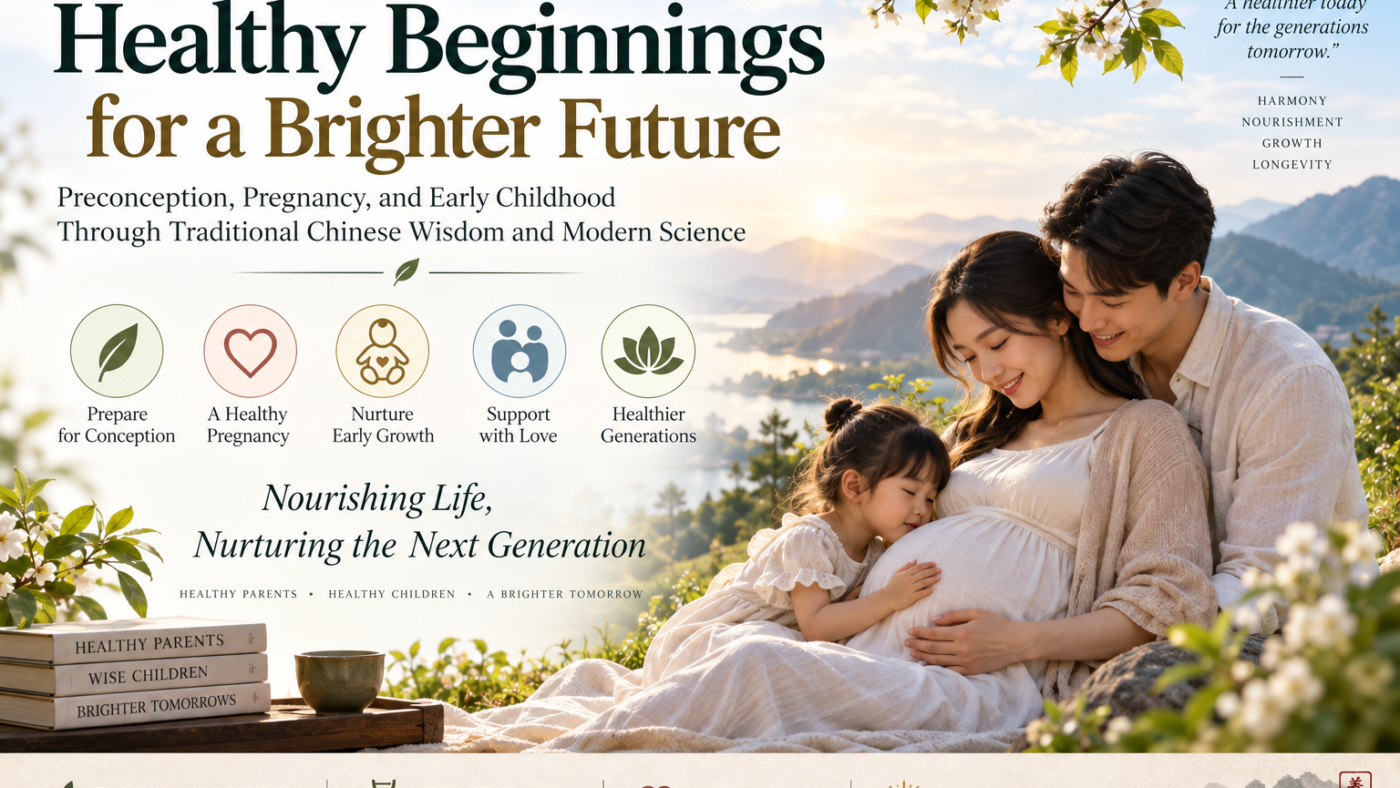
The desire to give a child the healthiest possible beginning is universal.
Long before modern genetics, reproductive medicine, prenatal screening, or neonatal care existed, Chinese health-preservation traditions were already asking an important question: how should prospective parents prepare themselves before conception, and how should pregnancy and early childhood be protected?
Classical Chinese writings approached this through the broader philosophy of yangsheng—the art of nourishing life. They emphasized physical health, moderation, emotional balance, adequate rest, harmonious relationships, and respect for the rhythms of nature.
Modern science explains reproduction very differently. We now understand chromosomes, DNA, sperm production, ovarian aging, fertilization, embryonic development, placental function, maternal health, fetal growth, and early childhood development in far greater detail.
Yet one broad principle remains remarkably relevant:
Healthy beginnings often start before conception.
The most useful modern approach is therefore not to treat every ancient reproductive teaching as literal medical fact. Instead, traditional ideas about preparation and balance can be placed alongside evidence-based preconception and prenatal care.
Healthy Conception Begins Before Pregnancy
A new pregnancy begins when a sperm fertilizes an egg, creating a fertilized cell known as a zygote.
The genetic material inherited from both biological parents contributes to the developing embryo. However, the quality of reproductive health is not determined by vague concepts such as how much “knowledge” or social experience a sperm or egg contains.
Sperm and eggs carry genetic information through DNA.
They do not store a parent’s education, memories, professional experience, wisdom, or learned knowledge in the way classical texts sometimes imagined.
That distinction is important.
A child’s future intelligence, personality, physical health, and abilities arise from an extraordinarily complex interaction among genetics, pregnancy, birth, nutrition, relationships, education, environment, development, opportunity, and many other factors.
No single moment of conception predetermines the whole person.
Age and Reproductive Health
Traditional texts sometimes suggested that older fathers might produce wiser children because they had accumulated more experience, while younger mothers were thought to provide stronger reproductive vitality.
Modern reproductive science does not support the idea that acquired knowledge is transferred to offspring through sperm.
Age does matter, but in different ways.
Female fertility generally declines with age, particularly as both the number and chromosomal quality of available eggs decrease. Increasing maternal age is associated with greater difficulty conceiving and higher risks of miscarriage and some chromosomal abnormalities.
Male reproductive aging is usually more gradual, but advancing paternal age can also be associated with changes in sperm quality and with small increases in certain genetic and developmental risks.
This does not mean that there is one universally perfect age for parenthood.
Many people have healthy pregnancies and healthy children across a broad range of reproductive ages.
What matters most is individualized reproductive health, medical history, fertility, lifestyle, and access to appropriate prenatal care.
Preparing Sperm and Egg Health
Classical Chinese health culture encouraged future parents to “nourish essence” before trying to conceive.
Modern preconception care has a similar goal, but it focuses on measurable health factors.
For prospective parents, useful preparation may include:
Maintaining a nutritious and varied diet.
Getting regular physical activity.
Obtaining sufficient sleep.
Avoiding smoking and recreational drugs.
Limiting or avoiding alcohol when trying to conceive, especially for the person who may become pregnant.
Reviewing prescription medicines, over-the-counter medicines, and supplements with an appropriate healthcare professional.
Managing diabetes, hypertension, thyroid disorders, epilepsy, and other chronic conditions before pregnancy where possible.
Addressing sexually transmitted infections when relevant.
Reviewing vaccination status.
Reducing exposure to known reproductive toxins.
For people who may become pregnant, adequate folic acid before conception and during early pregnancy is especially important because it helps reduce the risk of neural-tube defects.
This is a far more useful interpretation of “preparing essence” than trying to build up an imagined store of reproductive energy.
Is Long-Term Abstinence Necessary Before Conception?
Some traditional health writings recommend a prolonged period of sexual abstinence before trying to conceive.
Modern reproductive medicine does not support the idea that couples need to avoid sex for approximately 100 days in order to produce a healthier child.
Sperm production is a continuous biological process that takes several weeks, but that does not mean semen should be “stored” for months.
Very long periods of abstinence do not automatically improve fertility and may worsen some semen characteristics.
For couples trying to conceive naturally, regular intercourse during the fertile window is generally more practical than prolonged abstinence.
The important preconception period is better used to improve overall health rather than to accumulate semen.
The Fertile Window Matters More Than a Special Hour
Ancient reproductive traditions sometimes recommended conception at particular hours of the day, including the early morning, because these periods were associated with the rising Yang energy of nature.
This is culturally interesting, but modern fertility science identifies a different timing factor as much more important:
Ovulation.
Pregnancy is most likely when intercourse occurs during the fertile window surrounding ovulation.
Sperm can survive within the female reproductive tract for several days under favorable conditions, whereas the egg remains fertilizable for a much shorter period after ovulation.
For couples trying to conceive, understanding the fertile window is far more useful than selecting a particular lunar date, solar term, weather condition, or hour of the night.
There is no established evidence that conception at 3:00 a.m., sunrise, midnight, during rain, or under a particular moon phase determines a child’s intelligence, personality, appearance, longevity, or developmental outcome.
Sexual Arousal and Conception
Traditional Chinese sexual literature placed great importance on mutual arousal before intercourse.
That principle has value for comfort, pleasure, intimacy, and relationship quality.
Modern physiology also recognizes that sexual arousal produces real changes in genital blood flow, lubrication, muscle activity, and nervous-system responses.
But an important distinction is necessary:
A woman does not need to have an orgasm in order to become pregnant.
Simultaneous orgasm is also not required for successful fertilization, nor is there evidence that it produces a more intelligent, healthier, or better-tempered child.
Pregnancy depends primarily on viable sperm, ovulation, functioning reproductive anatomy, appropriate timing, and many other biological factors.
The quality of the parents’ relationship can certainly influence emotional well-being and family life, but it should not be confused with a biological guarantee of offspring quality.
Alcohol, Smoking, Fatigue, and Preconception Health
Traditional writings often warned against conception during intoxication or severe exhaustion.
The ancient explanations were different from those used today, but this is an area where modern preconception care does emphasize healthy behavior.
Smoking can adversely affect fertility and pregnancy.
Alcohol exposure during pregnancy can harm fetal development, and there is no established safe amount of alcohol during pregnancy.
Chronic sleep deprivation, severe stress, poor nutrition, obesity, uncontrolled disease, and exposure to some environmental toxins can also affect reproductive health.
This does not mean that a single bad day automatically produces an unhealthy child.
Human reproduction is not that mechanically determined.
Preconception care is about reducing avoidable risks across time rather than trying to create one “perfect” moment.
Lunar Calendars, Weather, and the Ancient “Seven Prohibitions”
Historical Chinese texts such as works associated with classical sexual cultivation sometimes listed days or situations considered unsuitable for conception.
These could include certain lunar dates, storms, eclipses, intoxication, exhaustion, emotional disturbance, bathing, or other circumstances.
Such recommendations belong to a traditional cosmological worldview in which human life was believed to correspond directly with celestial and environmental events.
Modern reproductive medicine does not recognize lunar dates, thunderstorms, eclipses, wet hair, or specific solar terms as causes of congenital disability, autism, intellectual disability, or poor temperament.
Claims that conception between 11:00 p.m. and 1:00 a.m. can cause autism are particularly important to reject.
Autism is a complex neurodevelopmental condition influenced by multiple genetic and biological factors. It is not caused by choosing the wrong hour for conception.
Historical teachings can still be discussed as cultural history.
They should not be presented as predictive medical rules.
The Embryonic Period: A Sensitive Stage of Development
After fertilization, the developing organism undergoes a remarkable series of changes.
The early embryonic period is especially important because fundamental body structures begin forming during these weeks.
In modern developmental terminology, the embryonic period generally extends through approximately the first eight weeks after fertilization. After this stage, the developing baby is usually referred to as a fetus.
The early weeks are particularly important for organ formation.
This is one reason preconception planning matters: a person may not yet know they are pregnant during part of this critical developmental period.
Medicines During Early Pregnancy
Traditional writings often advised pregnant women to avoid medicine whenever possible.
The modern principle is more precise.
Pregnant people should not stop necessary medicines simply because they are pregnant, nor should they assume that all medications are dangerous.
Some medications are safe or necessary during pregnancy.
Others may require dose changes or substitution.
Some should be avoided.
The correct approach is medication review with an appropriate healthcare professional before pregnancy whenever possible and again once pregnancy is confirmed.
Stopping essential treatment without guidance can sometimes be more dangerous than continuing it.
Nutrition During Pregnancy
Adequate maternal nutrition supports fetal growth and development.
Pregnancy nutrition should focus on a balanced diet containing appropriate protein, carbohydrates, healthy fats, vitamins, minerals, fruits, vegetables, whole grains, and other nutrient-dense foods according to individual needs.
Some nutrients deserve particular attention during pregnancy, including folate, iron, iodine, choline, vitamin D, and others depending on diet and health status.
Food safety is equally important.
Certain foods may need to be avoided or handled carefully because of risks from pathogens, contaminants, or excessive mercury.
Traditional advice to “eat naturally” can therefore be useful only when combined with modern nutritional and food-safety knowledge.
Maternal Emotional Well-Being
Traditional prenatal teachings often emphasized that a pregnant woman should remain peaceful, happy, and emotionally supported.
This should not be interpreted to mean that ordinary anger, sadness, anxiety, or stress permanently imprints a baby’s personality.
Pregnant people experience the full range of human emotions.
Feeling upset does not mean someone has harmed their child.
However, sustained severe stress, untreated depression, anxiety, interpersonal violence, social isolation, and inadequate support can affect maternal well-being and may also influence pregnancy outcomes.
Emotional support therefore matters.
A supportive partner, family environment, adequate rest, good prenatal care, and access to mental-health support when needed can benefit both parent and baby.
The goal should be support rather than demanding emotional perfection from pregnant women.
Sex During Pregnancy
Some traditional teachings recommend stopping sexual activity after a particular stage of pregnancy.
Modern medicine does not impose a universal ban after the fourth month.
In an uncomplicated pregnancy, sexual activity is generally considered safe unless an obstetric professional advises otherwise.
Certain circumstances may require avoiding intercourse or modifying sexual activity—for example, particular placental problems, unexplained bleeding, ruptured membranes, risk of preterm labor, or other pregnancy complications.
Recommendations should therefore be individualized.
Sexual activity does not need to be eliminated simply because pregnancy has reached a certain month.
The Fetal Period and Growth
After the embryonic period, the fetal period is characterized by continued growth, maturation, and increasingly complex development of organ systems.
The brain, lungs, cardiovascular system, muscles, skeleton, and sensory systems continue developing throughout pregnancy.
There is no single moment at seven months when a fetus suddenly becomes capable of surviving outside the uterus.
With modern neonatal intensive care, survival may sometimes be possible at substantially earlier gestational ages, although the risks of death and serious complications increase dramatically with extreme prematurity.
Every additional week of appropriate fetal development can matter.
This is one reason preventing avoidable preterm birth and obtaining appropriate prenatal care are so important.
Birth Is a Beginning, Not a Predetermined Destiny
Traditional philosophy sometimes described the moment of birth as revealing the broad trajectory of a person’s destiny.
Modern developmental science paints a more dynamic picture.
Genes matter.
Pregnancy matters.
Birth circumstances matter.
But childhood experiences, education, nutrition, relationships, healthcare, community, opportunities, and personal development continue shaping the individual for decades.
A newborn does not arrive with an unchangeable intellectual, emotional, or social destiny.
Human development is remarkably plastic.
Biology creates tendencies and possibilities.
Life continues shaping them.
The Newborn and Infant Period
After birth, the infant begins interacting directly with the surrounding world.
This stage is extraordinarily important for physical, emotional, sensory, language, and social development.
Babies learn through relationships.
They benefit from responsive caregiving, affectionate touch, eye contact, conversation, singing, reading, play, movement, and safe opportunities to explore.
A parent’s gentle touch is not a mysterious transfer of “information energy.”
Its benefits can be understood through attachment, sensory development, emotional regulation, stress responses, social interaction, and the developing nervous system.
Touch, comfort, and responsiveness help infants feel secure.
That security supports exploration and learning.
Preconception wellness is most useful when it focuses on long-term health rather than trying to create a single “perfect” moment of conception.
Early Learning Without Excessive Pressure
Many parents understandably want to give their children every possible educational advantage.
But early development should not become an academic competition.
Babies and young children learn through play, movement, language, imitation, curiosity, relationships, and exploration.
Talking to children, reading aloud, singing, playing, drawing, building, exploring nature, and allowing age-appropriate physical activity can all support development.
Early childhood education is valuable when it is developmentally appropriate.
The goal is not to force advanced academic performance at the earliest possible age.
A child is not “winning” simply because they memorized numbers or characters earlier than another child.
Healthy development involves cognition, language, physical skills, creativity, emotional regulation, social relationships, curiosity, and resilience.
A Better Meaning of “Giving a Child the Best Start”
Traditional Chinese health preservation was correct about one fundamental point:
Parenthood begins before birth.
But modern knowledge allows us to redefine what preparation means.
It means entering pregnancy as healthy as reasonably possible.
It means understanding reproductive timing.
It means avoiding tobacco and harmful substances.
It means obtaining folic acid and appropriate nutrition.
It means managing chronic diseases.
It means reviewing medications.
It means receiving prenatal care.
It means supporting the pregnant person emotionally rather than demanding perfection.
It means recognizing complications early.
And after birth, it means providing affection, safety, nutrition, healthcare, stimulation, play, language, and responsive caregiving.
These factors are more meaningful than searching for a perfect lunar date, cosmic moment, or predetermined formula for producing an exceptional child.
Traditional Wisdom and Modern Responsibility
Ancient reproductive teachings emerged from a genuine desire to protect future generations.
That intention deserves respect.
But respect for tradition does not require treating every historical explanation as scientific fact.
We now know that children do not inherit their parents’ learned knowledge directly through sperm.
We know that prolonged sexual abstinence is not required for healthy conception.
We know that simultaneous orgasm is not necessary to produce a healthy baby.
We know that the hour of conception does not determine autism.
We know that pregnancy does not require universal sexual abstinence after four months.
And we know that early childhood development depends on far more than the supposed “energy” present at conception.
The strongest modern interpretation of reproductive yangsheng is therefore simple:
Prepare thoughtfully.
Protect health.
Reduce avoidable risks.
Support the pregnant person.
Respect the developing child.
Provide responsive care after birth.
And remember that no parent can manufacture a perfect child.
What parents can do is create the healthiest and most supportive conditions they reasonably can for a new life to begin, grow, learn, and flourish.
A modern approach to preconception wellness combines thoughtful preparation, evidence-based care, healthy relationships, and support throughout pregnancy and early childhood.
FAQ
What is preconception wellness?
Preconception wellness refers to improving health before pregnancy. It may include nutrition, folic acid, physical activity, sleep, chronic disease management, medication review, vaccination, avoiding harmful substances, and understanding fertility.
How long before pregnancy should preconception care begin?
Ideally, health preparation can begin several months before trying to conceive. Some steps, such as improving nutrition, reviewing medications, managing chronic conditions, and taking appropriate folic acid, are especially useful before pregnancy begins.
Is long-term sexual abstinence necessary before conception?
No. Modern reproductive medicine does not require couples to abstain from sex for months before conception. Regular intercourse during the fertile window is generally more relevant to natural conception.
Does the time of day affect the health of a future baby?
There is no established evidence that conception at a particular hour determines a child’s intelligence, personality, appearance, autism risk, or future health. Ovulation timing is much more relevant to the likelihood of conception.
Does a woman need to have an orgasm to become pregnant?
No. Female orgasm is not required for fertilization or pregnancy, and simultaneous orgasm is not necessary to produce a healthy baby.
Why is folic acid important before pregnancy?
Folic acid taken before conception and during early pregnancy helps reduce the risk of neural-tube defects in the developing baby.
Is sex safe during pregnancy?
Sex is generally considered safe in an uncomplicated pregnancy unless an obstetric professional advises otherwise. Certain complications may require avoiding or modifying sexual activity.
Can stress during pregnancy affect the baby?
Ordinary emotional ups and downs do not mean a pregnant person has harmed the baby. However, severe or persistent stress, untreated depression or anxiety, and inadequate support can affect maternal well-being and may influence pregnancy outcomes.
Does parental age affect fertility?
Yes. Female fertility generally declines with age, especially because egg number and chromosomal quality decrease. Male reproductive aging is usually more gradual, but paternal age can also influence some reproductive and genetic risks.
Does early childhood stimulation improve development?
Responsive caregiving, talking, reading, play, affectionate touch, movement, and safe exploration can all support healthy early development. Excessive academic pressure, however, is not necessary.
Medical Disclaimer: This article is for educational and informational purposes only. Traditional Chinese concepts discussed here reflect historical health-preservation theories and should not be interpreted as established reproductive or genetic mechanisms. Preconception, fertility, pregnancy, medication, and prenatal-care decisions should be individualized with appropriate healthcare professionals.
This article is for general education and does not replace individualized care from a qualified health professional. Seek appropriate advice for persistent, severe, or concerning symptoms.
Read the full medical disclaimer