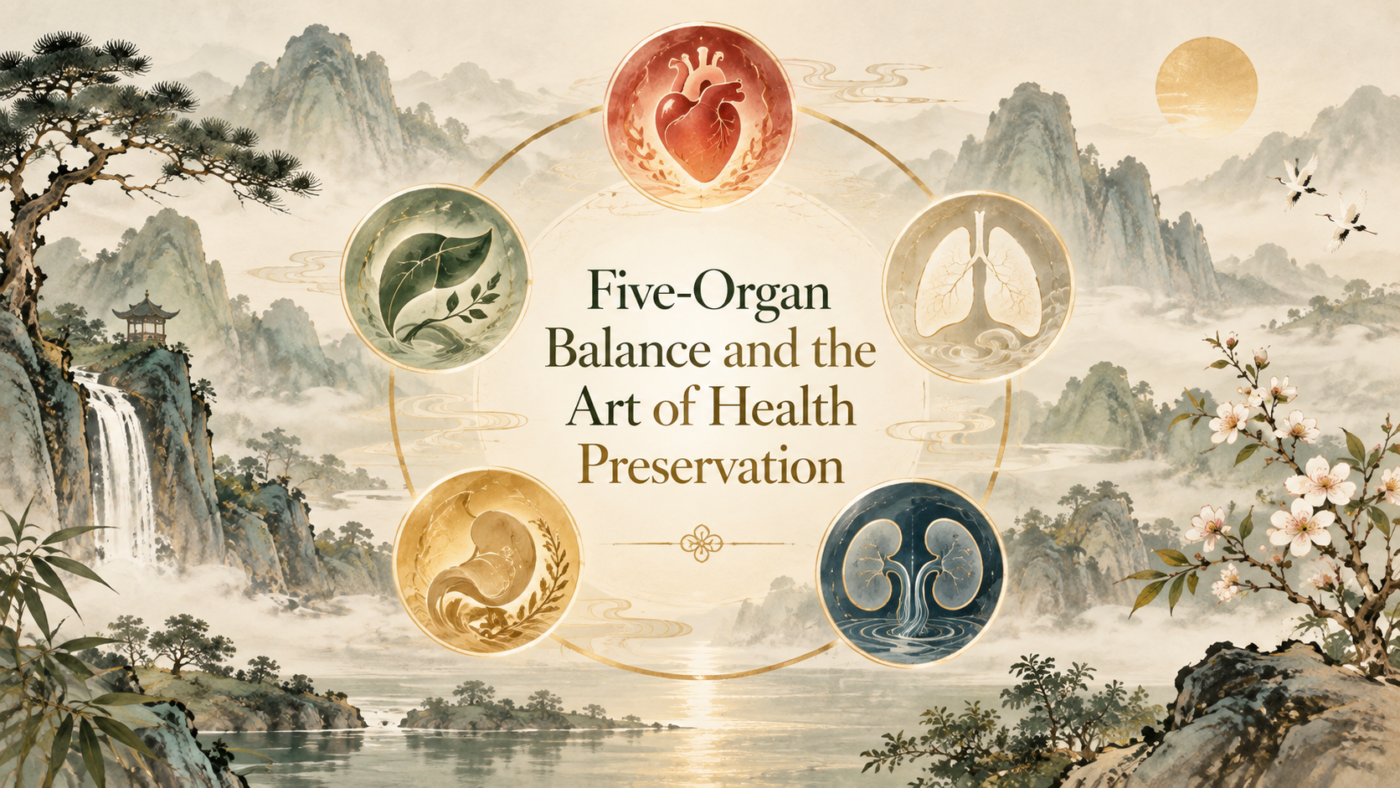
In the classical medical philosophy of the Huangdi Neijing—the Yellow Emperor’s Inner Canon—the human body is understood as an interconnected whole rather than a collection of isolated parts. Health depends on balance, coordination, circulation, nourishment, rest, and the ability of the body to adapt to changing internal and external conditions.
At the center of this traditional framework are the Five Zang systems: Heart, Liver, Spleen, Lung, and Kidney.
These terms should not be interpreted as exact equivalents of the anatomical organs described in modern medicine. In Traditional Chinese Medicine, each “organ” represents a broader functional network. The Liver system, for example, is traditionally associated not only with the physical liver but also with the regulation of qi, blood storage, tendons, the eyes, and certain emotional patterns. The Kidney system includes traditional concepts involving reproduction, development, bones, hearing, vitality, and aging.
The Five Zang theory is therefore best understood as a classical model for observing patterns in the human body. It offers a way of thinking about relationships among physical function, emotions, lifestyle, sleep, diet, movement, and the environment.
From this perspective, maintaining health means supporting harmony among all five systems rather than concentrating on only one.
The Heart
The Huangdi Neijing famously describes the Heart as the “sovereign” or “ruler” of the body.
Within traditional Chinese medicine, the Heart is associated with blood circulation, consciousness, mental clarity, emotional stability, facial complexion, the tongue, and perspiration. It is also traditionally paired with the Small Intestine.
The concept goes far beyond the anatomical heart. Classical physicians used the Heart system as a framework for thinking about both circulation and what they called Shen—the mind, spirit, awareness, and emotional presence of a person.
When the Heart system is considered balanced, traditional descriptions include a calm mind, clear thinking, restful sleep, healthy social engagement, and a lively appearance.
A person who feels energetic and emotionally settled often speaks clearly, interacts comfortably with other people, and maintains an interest in everyday life. Classical medicine interpreted these outward qualities as reflections of harmonious Heart qi and Shen.
Persistent palpitations, chest discomfort, fainting, severe shortness of breath, or unexplained changes in mental state, however, should never be assumed to be simply a matter of “Heart qi.” These symptoms may have important medical causes and deserve professional evaluation.
The Heart and Complexion
Traditional medicine says that the Heart “governs the blood vessels and manifests in the face.”
This idea reflects an ancient observation: circulation can influence how the face looks and feels. Classical texts therefore associated a bright, lively complexion with adequate circulation and vitality, while pallor or a dull appearance was sometimes interpreted as a sign that the Heart-Blood system needed attention.
Modern skin appearance is influenced by many factors—including circulation, hydration, sun exposure, hormones, sleep, nutrition, genetics, medications, and skin disease—so facial appearance alone cannot diagnose the condition of the heart or any other organ.
The traditional lesson remains useful in a broader sense: healthy-looking skin often reflects the cumulative effects of sleep, nutrition, circulation, movement, stress management, and overall health.
The Heart, Sweat, and the Tongue
Traditional Chinese medicine describes sweat as being closely connected with the Heart and regards the tongue as the Heart’s external opening.
Excessive sweating, night sweats, changes in tongue appearance, or persistent dryness may therefore be considered alongside other signs when a traditional practitioner evaluates a person.
These findings are not specific to the Heart, however. Excessive sweating, for example, can result from environmental heat, exercise, anxiety, infection, hormonal changes, medications, metabolic disorders, and many other conditions.
The practical principle is simple: observe the body as a whole rather than interpreting one isolated sign.
The Liver
The Liver occupies an especially important position in traditional Chinese medicine.
It is traditionally said to “store Blood,” maintain the smooth movement of qi, nourish the tendons, open into the eyes, and manifest in the nails. The Liver and Gallbladder form an interior-exterior pair within the classical system.
The Liver is also associated with planning, adaptability, and the smooth expression of emotions.
The Liver and the Eyes
The classical statement “the Liver opens into the eyes” reflects the traditional observation that visual comfort and eye appearance may change with fatigue, illness, sleep deprivation, and overall health.
In TCM theory, adequate Liver Blood nourishes the eyes, while imbalance may be associated with sensations such as dryness, tired eyes, or blurred vision.
This does not mean that eye diseases are caused simply by “Liver deficiency.” Glaucoma, cataracts, retinal disorders, infections, and sudden changes in vision require appropriate eye examinations and medical treatment.
From a wellness perspective, protecting the eyes includes adequate sleep, controlling chronic medical conditions, taking regular breaks from prolonged screen use, protecting the eyes from excessive ultraviolet exposure, and obtaining professional eye examinations when appropriate.
The Liver, Tendons, and Movement
Traditional Chinese medicine states that “the Liver governs the tendons.”
This concept connects Liver health with flexibility, smooth movement, and the ability of muscles and tendons to function comfortably.
Classical practitioners therefore paid attention to stiffness, cramps, tremors, numbness, reduced flexibility, and the condition of the nails when evaluating Liver-related patterns.
Modern musculoskeletal health is more complex. Muscles, tendons, joints, nerves, hydration, electrolyte balance, physical activity, age, previous injuries, and many diseases can all influence movement.
Still, one traditional principle remains highly relevant: the body benefits from regular movement.
Walking, gentle stretching, tai chi, qigong, mobility exercises, and appropriately designed resistance training can all help maintain physical function as we age.
The Liver and Emotional Flow
One of the best-known TCM concepts is that the Liver helps maintain the smooth flow of qi.
When this movement is harmonious, classical texts describe a person as flexible, composed, energetic, and emotionally adaptable.
Prolonged frustration, emotional suppression, chronic stress, and irritability were traditionally associated with stagnation of Liver qi.
This does not mean that anger or irritability proves the existence of a Liver disorder. Emotions are influenced by brain function, psychological health, relationships, sleep, stress, hormones, medications, and countless life circumstances.
Yet the ancient observation contains an important wellness message: persistent stress affects the body.
Regular physical activity, adequate sleep, time outdoors, breathing practices, social connection, and healthy methods of emotional expression can help support both physical and psychological well-being.
Rest and Restoration
Traditional medicine places particular emphasis on rest because the Liver is said to store Blood when the body is at rest.
Although modern physiology describes this process differently, adequate sleep unquestionably plays an essential role in metabolic regulation, immune function, memory, cardiovascular health, and emotional well-being.
A consistent sleep schedule is therefore one of the simplest foundations of long-term health.
The Spleen
The Spleen system in traditional Chinese medicine differs substantially from the anatomical spleen of modern medicine.
Within TCM, the Spleen represents much of the body’s digestive and nutrient-transforming capacity. It is traditionally responsible for “transforming and transporting” food and fluids, helping produce qi and Blood, nourishing the muscles and limbs, and keeping Blood within its proper pathways.
The Spleen is paired with the Stomach and is traditionally called part of the “foundation of postnatal life”—meaning the energy and nourishment obtained after birth through food and drink.
The Spleen and Digestion
Traditional theory teaches that good Spleen function allows food to be efficiently transformed into nourishment.
When digestion feels comfortable, appetite is appropriate, bowel habits are stable, and energy remains relatively steady after meals, the digestive system is functioning effectively.
When digestive health is disturbed, people may experience symptoms such as poor appetite, abdominal discomfort, bloating, diarrhea, constipation, nausea, or fatigue.
These symptoms can have many causes. Persistent or severe digestive problems, unexplained weight loss, blood in the stool, recurrent vomiting, anemia, or significant abdominal pain warrant medical assessment.
The Spleen and Muscles
“The Spleen governs the muscles and the four limbs” is another traditional principle.
Because food provides the raw materials needed to maintain muscle tissue and energy, classical physicians connected digestive health with physical strength.
Modern science expresses the relationship differently but arrives at a compatible practical conclusion: adequate nutrition is essential for maintaining muscle.
Protein intake, resistance exercise, physical activity, adequate calories, micronutrients, sleep, and recovery all become increasingly important as people grow older.
Preserving muscle is not merely a cosmetic goal. Muscle strength contributes to mobility, metabolic health, balance, independence, and healthy aging.
The Spleen and the Mouth
Traditional texts say that the Spleen “opens into the mouth and manifests in the lips.”
Appetite, taste, oral comfort, and lip appearance were therefore traditionally observed as part of the broader digestive picture.
Dry, pale, cracked, swollen, or discolored lips can arise from many causes and should not be used alone to diagnose a TCM pattern.
Good hydration, varied nutrition, dental care, protection from excessive sun exposure, and attention to persistent oral changes remain practical foundations of health.
Food, Stress, and Digestion
Classical Chinese medicine repeatedly warns against two habits believed to weaken the Spleen: inappropriate eating and excessive thinking or worry.
There is wisdom in this observation.
Irregular eating, frequent overeating, extreme diets, chronic stress, and insufficient sleep can all influence digestive comfort and eating behavior.
Rather than pursuing rigid dietary rules, a sustainable pattern is usually more valuable: regular meals, adequate vegetables and fruits, sufficient protein, minimally processed foods, appropriate portions, and attention to individual tolerance.
The Lung
In traditional Chinese medicine, the Lung is said to govern qi and respiration.
It participates in the movement of qi throughout the body, is traditionally associated with the skin and body hair, “opens into the nose,” helps regulate the distribution of fluids, and is paired with the Large Intestine.
The Lung system therefore represents more than breathing alone.
The Lung and Breathing
Breathing is fundamental to life.
Traditional physicians observed the rhythm, depth, strength, and ease of respiration as important signs of health.
Healthy lungs exchange oxygen and carbon dioxide efficiently, while the cardiovascular system transports oxygen throughout the body.
Regular movement can help maintain cardiorespiratory fitness. Walking, cycling, swimming, tai chi, and other suitable forms of exercise can gradually improve endurance when practiced consistently.
Persistent shortness of breath, coughing up blood, blue lips, severe chest pain, or sudden breathing difficulty requires medical attention rather than self-treatment through traditional wellness practices.
The Lung and the Skin
“The Lung governs the skin and body hair” is a distinctive concept of Chinese medicine.
Traditional theory views the skin as one of the body’s outer defensive boundaries and connects its condition with Lung qi.
Modern dermatology recognizes that skin health depends on a much broader combination of factors, including genetics, immune function, hormones, environmental exposure, nutrition, sleep, stress, and skin-care habits.
Nevertheless, the classical idea reminds us that skin is not isolated from the rest of the body.
Adequate sleep, balanced nutrition, hydration, exercise, sun protection, and avoidance of smoking can support both general health and skin health.
The Lung and the Nose
Because the Lung is said to open into the nose, nasal breathing, smell, congestion, and nasal comfort were traditionally observed when evaluating Lung patterns.
Many nasal symptoms have straightforward modern explanations, including allergies, viral infections, structural problems, environmental irritation, and sinus disease.
Persistent nasal symptoms therefore deserve appropriate evaluation when necessary.
The Lung and Emotion
Traditional medicine associates the Lung with grief and sadness.
Grief is a normal human response to loss and does not represent an organ disorder. Yet prolonged emotional distress can influence sleep, appetite, energy, activity, and physical symptoms.
TCM’s emotional associations are most useful when treated as reminders that mental and physical well-being constantly interact.
The Kidney
Few concepts are more important in traditional Chinese wellness than the Kidney system.
The Kidney is described as the “root of prenatal life” and the repository of Jing, often translated as Essence.
Traditional theory associates Kidney Essence with growth, development, reproduction, maturation, aging, bones, marrow, hearing, teeth, hair, fluid metabolism, and constitutional vitality.
The Kidney is paired with the Bladder and is also said to “grasp” the qi received by the Lung.
Again, the TCM Kidney system should not be confused with the anatomical kidneys alone.
The Kidney and Healthy Aging
Traditional texts describe Kidney Essence as gradually changing throughout life.
This provided ancient physicians with a framework for discussing childhood development, puberty, fertility, adulthood, menopause, physical aging, bone strength, hair changes, and declining resilience.
Modern biology explains aging through numerous interacting mechanisms, but the practical lesson remains compelling: healthy aging begins long before old age.
Regular physical activity, resistance training, cardiovascular exercise, adequate sleep, balanced nutrition, avoiding tobacco, moderating alcohol, maintaining social relationships, managing blood pressure and metabolic health, and obtaining appropriate preventive care can all contribute to healthier aging.
The Kidney, Bones, and Teeth
Traditional Chinese medicine says that “the Kidney governs the bones” and that the teeth are an extension of bone.
Modern bone health depends on genetics, hormones, age, physical activity, nutrition, medications, and many medical conditions.
Weight-bearing exercise and resistance training can help preserve skeletal strength, while adequate calcium, protein, vitamin D, and other nutrients are important components of bone health.
Persistent back pain, unexplained fractures, loss of height, severe neck pain, or loose adult teeth should not simply be attributed to “Kidney deficiency.” Appropriate medical and dental evaluation is important.
The Kidney and Hair
Hair is traditionally regarded as another external reflection of Kidney Essence and Blood.
Hair naturally changes with age. Genetics, hormones, nutrition, stress, autoimmune conditions, medications, thyroid disorders, and many other factors can contribute to thinning or hair loss.
Traditional self-care practices may support general wellness, but sudden or severe hair loss deserves proper evaluation.
The Kidney and Hearing
“The Kidney opens into the ears” is a classical statement linking Kidney vitality with hearing.
Hearing frequently changes with age, but hearing loss and tinnitus have many potential causes, including prolonged noise exposure, ear disorders, medications, infections, circulatory factors, and neurological conditions.
Sudden hearing loss is especially important because it may require urgent treatment.
Protecting hearing throughout life—particularly from repeated exposure to excessively loud sound—is a practical modern extension of the traditional concern for preserving sensory function.
The Kidney and Reproductive Vitality
Traditional Chinese medicine closely connects Kidney Essence with fertility and reproductive development.
Reproductive health, however, is influenced by numerous biological factors involving the reproductive organs, hormones, genetics, age, lifestyle, medications, and general health.
Fertility difficulties or sexual dysfunction should therefore not automatically be interpreted as Kidney deficiency.
Good cardiovascular health, sufficient sleep, regular physical activity, stress management, healthy relationships, and professional medical care when problems persist all play important roles.
The Kidney and Urination
Because the Kidney and Bladder are paired in traditional theory, urinary frequency, urgency, nighttime urination, and changes in urine were traditionally considered when assessing Kidney patterns.
Modern medicine recognizes many possible explanations for urinary changes, including fluid intake, medications, urinary tract conditions, prostate enlargement, diabetes, sleep disorders, pelvic-floor dysfunction, kidney disease, and aging.
Persistent blood in the urine, pain with urination, significant changes in urinary frequency, or difficulty passing urine should be medically evaluated.
The Kidney and Willpower
Traditional Chinese medicine says that “the Kidney stores Zhi”—often translated as willpower or determination.
The observation is partly philosophical: people tend to feel more capable and determined when they are rested, physically strong, and psychologically well.
Chronic illness, inadequate sleep, depression, anxiety, prolonged stress, pain, and exhaustion can all undermine motivation.
The deeper lesson is not that ambition depends on one organ, but that physical health provides an important foundation for the activities we want to pursue throughout life.
The Five Systems Work Together
The Five Zang are not intended to function independently.
Traditional Chinese medicine emphasizes relationships.
The Heart circulates Blood and houses Shen.
The Liver promotes smooth movement and stores Blood.
The Spleen transforms nourishment from food.
The Lung governs respiration and the movement of qi.
The Kidney stores Essence and represents the deeper foundation of growth and aging.
Each supports the others.
This interconnected view is one of the most enduring ideas in classical Chinese medicine.
Modern physiology uses very different terminology, but it also recognizes that human health depends on complex interactions among the nervous, cardiovascular, respiratory, digestive, endocrine, immune, musculoskeletal, and reproductive systems.
No major body system truly operates alone.
What Five-Organ Balance Means for Modern Wellness
The most useful way to approach Five Zang theory today is not to turn every symptom into a diagnosis of “Heart deficiency,” “Liver stagnation,” or “Kidney weakness.”
Instead, it can serve as a traditional framework encouraging us to pay attention to patterns.
How well are you sleeping?
How is your energy during the day?
Are you moving regularly?
Is your digestion comfortable?
Are you eating a varied and nourishing diet?
Are you under persistent stress?
Do you allow adequate time for recovery?
Are you maintaining muscle strength and mobility?
Are you protecting your cardiovascular and respiratory health?
Are you maintaining meaningful relationships and emotional connection?
These questions capture much of the practical wisdom behind classical health cultivation.
The Huangdi Neijing repeatedly presents health as something cultivated through daily life rather than something pursued only after disease develops.
Moderation matters.
Movement matters.
Rest matters.
Food matters.
Emotional balance matters.
Seasonal adaptation matters.
And consistency matters more than occasional extremes.
The traditional goal of Yang Sheng—the cultivation of life—is therefore not simply to live as long as possible. It is to preserve function, clarity, resilience, independence, and enjoyment of life for as many years as possible.
That is perhaps the most valuable meaning of Five-Organ balance for the modern reader.
FAQ
What are the Five Organs in Traditional Chinese Medicine?
The Five Zang systems are the Heart, Liver, Spleen, Lung, and Kidney. In TCM, these terms represent broad functional networks rather than only the anatomical organs recognized in modern medicine.
What does Five-Organ Balance mean?
Five-Organ Balance refers to the traditional concept that health depends on harmonious relationships among the Heart, Liver, Spleen, Lung, and Kidney systems.
Are TCM organs the same as anatomical organs?
No. TCM organ systems are traditional functional concepts. For example, the TCM Kidney system includes ideas related to development, reproduction, bones, hearing, aging, and vitality, which extend beyond the anatomical kidneys.
What is Yang Sheng?
Yang Sheng can be translated as “nourishing life” or “cultivating health.” It traditionally emphasizes appropriate food, movement, rest, emotional balance, seasonal living, and moderation.
What is the role of the Huangdi Neijing in Chinese wellness?
The Huangdi Neijing, or Yellow Emperor’s Inner Canon, is one of the foundational classical texts of Chinese medicine and contains influential theories about health, balance, prevention, lifestyle, and the Zang-Fu systems.
Can Five-Organ theory diagnose disease?
Five-Organ theory is a traditional medical framework and should not be used by itself to diagnose modern medical conditions. Persistent or serious symptoms require appropriate professional medical evaluation.
How can Five-Organ philosophy be applied to modern wellness?
Its most practical modern application is to encourage attention to sleep, nutrition, physical activity, stress management, digestion, mobility, recovery, and overall lifestyle balance.
Medical Disclaimer: This article discusses concepts from Traditional Chinese Medicine for historical, cultural, and educational purposes. TCM organ systems are not equivalent to anatomical organs or diagnostic categories in modern medicine. Traditional concepts should not be used to diagnose or treat serious disease without appropriate medical evaluation. Seek professional medical care for persistent, severe, or unexplained symptoms.
This article is for general education and does not replace individualized care from a qualified health professional. Seek appropriate advice for persistent, severe, or concerning symptoms.
Read the full medical disclaimer