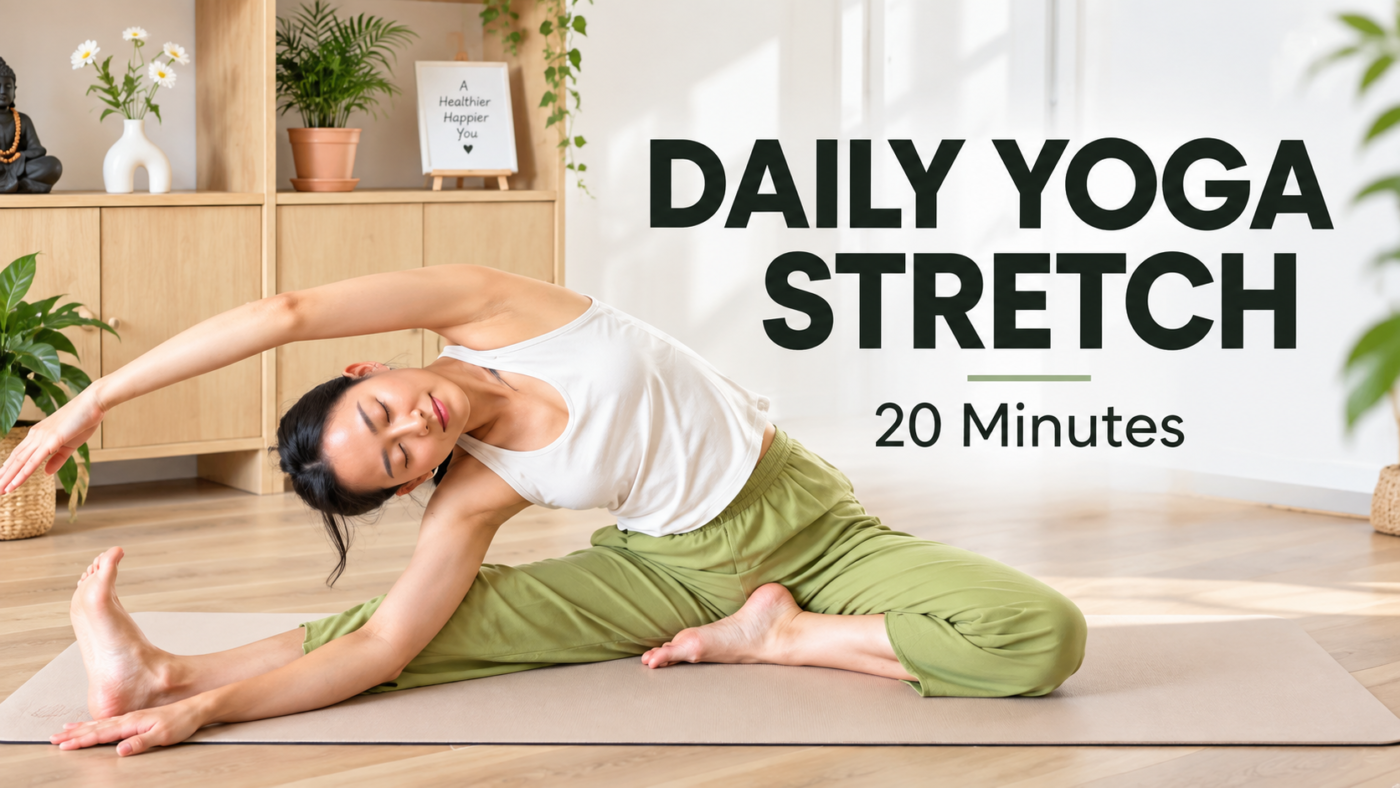
A full body yoga stretch can be a gentle way to move stiff joints, explore comfortable ranges of motion, and create a calmer transition into or out of your day.A gentle full-body yoga stretch can be an effective way to move stiff joints, explore comfortable ranges of motion, and create a calmer transition into or out of your day.
This 22-minute practice combines seated neck stretches, hip openers, forward folds, spinal rotations, side bends, shoulder mobility, hamstring stretching, and restorative breathing.
The emphasis is not on forcing flexibility or reaching the deepest possible pose. Instead, the goal is to move slowly, breathe steadily, and allow each position to feel spacious and controlled.
This routine can work well in the morning when the body feels stiff, after long periods of sitting, or in the evening when you want a quieter form of movement.
What This Full-Body Yoga Stretch Works
This sequence moves through several areas that commonly feel restricted after prolonged sitting or repetitive daily activity.
You will gently work on neck mobility, shoulders, upper back, thoracic rotation, hips, glutes, hamstrings, side body, spine, and breathing awareness.
Regular mobility and stretching practice may help maintain comfortable movement and flexibility, but deeper is not always better. A mild stretching sensation is enough.
Sharp pain, numbness, tingling, dizziness, or joint discomfort are signs to reduce the range of motion or stop.
1. Seated Neck Side Stretch
Begin in a comfortable cross-legged seated position.
Sit tall through your spine and allow your shoulders to relax away from your ears.
Bring both hands behind your back and interlace your fingers.
Move your hands gently toward the left side of your waist.
Take a slow inhale.
As you exhale, tilt your head toward the left shoulder.
Do not pull the head aggressively downward.
Instead, allow the weight of the head and the position of the arms to create a gentle stretch through the right side of the neck.
Keep your jaw relaxed and breathe slowly.
Return your head to center.
Move the interlaced hands toward the right side of your waist and repeat on the opposite side.
This stretch can be especially useful after long periods of computer work or phone use, when the neck and upper shoulders may feel tense.
2. Gentle Front-of-Neck Opening
Release your hands.
Interlace your fingers again and place your thumbs gently underneath your chin.
Keep your elbows relatively close together.
Inhale and lengthen upward through your spine.
As you exhale, lift your chin slightly and allow the head to move backward only within a comfortable range.
Think about creating length through the front of the neck rather than compressing the back of it.
Keep your shoulders relaxed.
Avoid forcing this movement if you experience dizziness, neck pain, or discomfort.
Return slowly to neutral.
3. Upper-Back and Back-of-Neck Stretch
Bring your interlaced hands behind your head.
Take a slow inhale.
As you exhale, gently allow your chin to move toward your chest.
Bring your elbows slightly toward each other.
Let the upper back round naturally and allow the shoulder blades to spread.
You may feel a gentle stretch through the upper back, shoulders, and back of the neck.
Do not pull forcefully on the head.
Let your arms provide only light guidance.
Return to upright as you inhale.
4. Seated Single-Leg Forward Fold
Extend your right leg out to the side.
Bring your left heel comfortably toward your body.
Place your hands on the mat in front of you.
Inhale and lengthen through the spine.
As you exhale, walk your hands forward.
Hinge from the hips rather than collapsing through the lower back.
Stop when you reach a position where you can still breathe comfortably.
Your forehead does not need to reach the mat.
Keep both sitting bones grounded as much as possible and think about extending the chest forward.
This position gently stretches the inner thigh, hamstrings, hips, and lower back.
Hold for several slow breaths.
5. Seated Spinal Twist
Slowly walk your hands back toward your body and return upright.
Place your right hand on your left knee.
Bring your left hand behind you for light support.
Inhale and lengthen upward through your spine.
As you exhale, rotate gently toward the left.
The movement should come gradually through your torso rather than being forced through the neck.
Keep your chest lifted and shoulders relaxed.
Look over your left shoulder only if it feels comfortable.
Take several slow breaths.
Then turn your head forward before slowly releasing the twist.
6. Seated Side Bend
Return to center.
Bring your right hand toward the inside of your extended right leg.
Reach your left arm upward.
Turn your chest slightly toward the ceiling.
Then extend your left arm overhead toward the right.
Keep your left sitting bone grounded as much as possible.
Rather than collapsing toward the floor, think about lengthening both sides of your waist.
Breathe into the left side of your rib cage.
This position stretches the side body, shoulder, upper back, and tissues around the hip.
Return slowly to center.
7. Supported Seated Hip Lift and Chest Opener
Bring your fingertips behind your hips.
Press lightly through your hands.
Lift your chest.
If comfortable, begin to raise your hips slightly away from the mat and move them forward.
Open across the front of the body while keeping the neck relaxed.
The goal is a gentle hip and chest opening, not a deep backbend.
Keep breathing.
Lower your hips slowly and return to your seated position.
Repeat the Sequence on the Other Side
Extend the left leg outward and draw the right heel toward your body.
Repeat the forward fold, spinal twist, side bend, and supported chest-opening movement on the second side.
Try to notice whether one side feels different from the other.
Unequal flexibility from side to side is common.
There is no need to force both sides into identical positions.
8. Seated Cat-Cow With Legs Extended
Extend both legs forward into a seated position.
Flex your feet gently.
Sit evenly through both sitting bones.
Hold your shins or ankles.
As you inhale, lift your chest and gently lengthen the front of your body.
Allow the pelvis to tilt slightly forward.
As you exhale, round your spine and spread your shoulder blades.
Move slowly between these two positions.
This seated version of cat-cow mobilizes the spine without requiring you to bear weight through the wrists and knees.
Complete several slow repetitions.
Let the breath guide the rhythm.
9. Seated Forward Fold
Return to a neutral spine.
Hold your ankles, shins, or feet depending on your mobility.
Inhale and lengthen upward.
As you exhale, hinge forward from the hips.
Keep your spine as long as comfortably possible.
Avoid forcing your chest toward your thighs.
You may feel a stretch through the hamstrings, calves, glutes, and lower back.
The sensation should remain gentle and controlled.
Stay for several slow breaths.
With each exhale, allow unnecessary tension to soften rather than trying to push yourself deeper.
Return slowly to upright.
10. Seated Glute and Outer-Hip Stretch
Bring one foot toward the opposite outer hip.
Cross the other leg over so the knees move toward a stacked position.
Do not worry if your knees do not stack perfectly.
Sit evenly through both sitting bones.
Inhale and lengthen your spine.
As you exhale, hinge forward slightly.
You should feel the stretch primarily around the glute and outer hip of the upper leg.
Stay within a comfortable range.
Breathe slowly.
Then return upright.
11. Seated Spinal Twist
Place the foot of the upper leg flat on the floor near the opposite knee.
Bring the opposite elbow toward the outside of the bent knee.
Place the other hand behind you for support.
Inhale to sit taller.
Exhale and rotate gently toward the bent-knee side.
Keep your chest lifted.
Avoid using the arm to force a deeper twist.
The rotation should feel controlled and comfortable through the mid and upper spine.
Return to center.
Repeat the glute stretch and spinal twist on the opposite side.
12. Wide-Knee Child’s Pose
Move carefully onto your knees.
Bring your knees slightly wider than your hips if comfortable.
Reach your arms forward.
Lower your hips back toward your heels and allow your chest to move toward the mat.
Rest your forehead on the mat or on a folded towel or cushion.
Let your shoulders soften.
Take several slow breaths.
Child’s pose can provide a quiet transition from active stretching toward relaxation.
People with significant knee discomfort can place additional padding under the knees or avoid the position if it is uncomfortable.
13. Thread-the-Needle Shoulder Stretch
From child’s pose or a kneeling position, lift your chest slightly.
Slide your right arm underneath your chest toward the left.
Allow your right shoulder and side of the head to move gently toward the mat.
Keep the left arm extended forward or use it for support.
You may feel a stretch through the back of the right shoulder and upper back.
Keep your breathing relaxed.
Return slowly.
Repeat on the left side.
This movement combines shoulder mobility with gentle thoracic rotation.
14. Kneeling Breath and Meditation
Come upright into a comfortable kneeling or seated position.
Rest your hands on your thighs.
Close your eyes if that feels comfortable.
Allow your shoulders to soften.
Notice your breathing without trying to control it aggressively.
Take several calm breaths.
After a mobility practice, a short period of quiet breathing can help create a smoother transition back into everyday activity.
15. Final Overhead Stretch
Interlace your fingers.
Turn your palms upward.
Inhale and reach your hands toward the ceiling.
Lengthen through both sides of your body.
Keep the shoulders away from your ears.
Avoid forcing the arms backward.
Exhale and slowly release your arms out to the sides.
Bring your hands back to your knees.
Finish with a few comfortable breaths.
How Hard Should a Yoga Stretch Feel?
Stretching does not need to hurt to be effective.
A useful range generally feels like mild to moderate tension that you can maintain while breathing normally.
Avoid bouncing or forcing the body deeper.
Your flexibility can vary from day to day depending on sleep, activity, stress, temperature, previous exercise, and how long you have been sitting.
Treat each session as information rather than a flexibility test.
Can You Do This Yoga Stretch Every Day?
For many healthy adults, gentle mobility and stretching can be practiced regularly if the movements remain comfortable.
Daily practice does not mean every session needs to become deeper.
Consistency matters more than intensity.
On some days you may move farther.
On others, the best choice may be a smaller range and slower pace.
Both can be useful.
Is This Routine Good in the Morning?
Yes.
A gentle full-body yoga stretch can help introduce movement after several hours of relative stillness.
Morning practice may be especially useful for people who feel temporarily stiff after waking.
Move gradually rather than immediately attempting your deepest stretches.
Is This Routine Good Before Bed?
It can also work well in the evening.
Slower breathing, gentle stretching, and lower-intensity movement may provide a relaxing transition toward bedtime.
If any pose feels stimulating or uncomfortable late at night, simply reduce the range or omit it.
Can Beginners Follow This Routine?
Yes, provided the poses are modified when necessary.
Beginners should focus on:
Using a comfortable range of motion.
Keeping stretches gentle.
Using cushions, folded blankets, or yoga blocks when needed.
Avoiding forced twists.
Bending the knees during forward folds if necessary.
Taking breaks whenever a position becomes uncomfortable.
Yoga is not a competition.
Your body does not need to resemble someone else’s pose for the movement to be useful.
Who Should Be More Cautious?
People with recent surgery, significant osteoporosis, acute joint injuries, severe spinal conditions, recurrent dizziness, neurological symptoms, or other medical concerns may need individualized guidance.
Deep spinal flexion, twisting, neck extension, or certain kneeling positions may not be appropriate for everyone.
If a movement causes sharp pain, radiating pain, numbness, tingling, or dizziness, stop rather than trying to stretch through it.
The Bottom Line
A good full-body yoga stretch does not need complicated poses or extreme flexibility.
This 22-minute routine gradually moves through the neck, shoulders, spine, hips, glutes, hamstrings, and side body while giving you time to slow your breathing and pay attention to how your body feels.
The goal is not to become dramatically more flexible in one session.
It is to maintain comfortable movement through consistent practice.
Whether you use this routine in the morning, after a long day of sitting, or as a quiet evening practice, focus on slow movement, steady breathing, and a range of motion that feels appropriate for your body today.
This full body yoga stretch moves through the neck, shoulders, spine, hips and legs.
A full body yoga stretch can be useful in the morning after several hours of inactivity.
This full body yoga stretch can also work well as a gentle evening mobility routine.
Beginners can modify this full body yoga stretch by reducing the range of motion.
Regularly practicing a full body yoga stretch may help maintain comfortable flexibility and mobility.
The goal of this full body yoga stretch is controlled movement rather than extreme flexibility.
Medical Disclaimer
This content is for general educational and wellness purposes only and is not medical advice. Yoga and stretching may not be appropriate for everyone. People with significant musculoskeletal conditions, recent surgery, severe osteoporosis, neurological symptoms, balance problems, pregnancy-related exercise restrictions, or other medical concerns should seek individualized professional guidance before beginning a new exercise routine.
This article is for general education and does not replace individualized care from a qualified health professional. Seek appropriate advice for persistent, severe, or concerning symptoms.
Read the full medical disclaimer