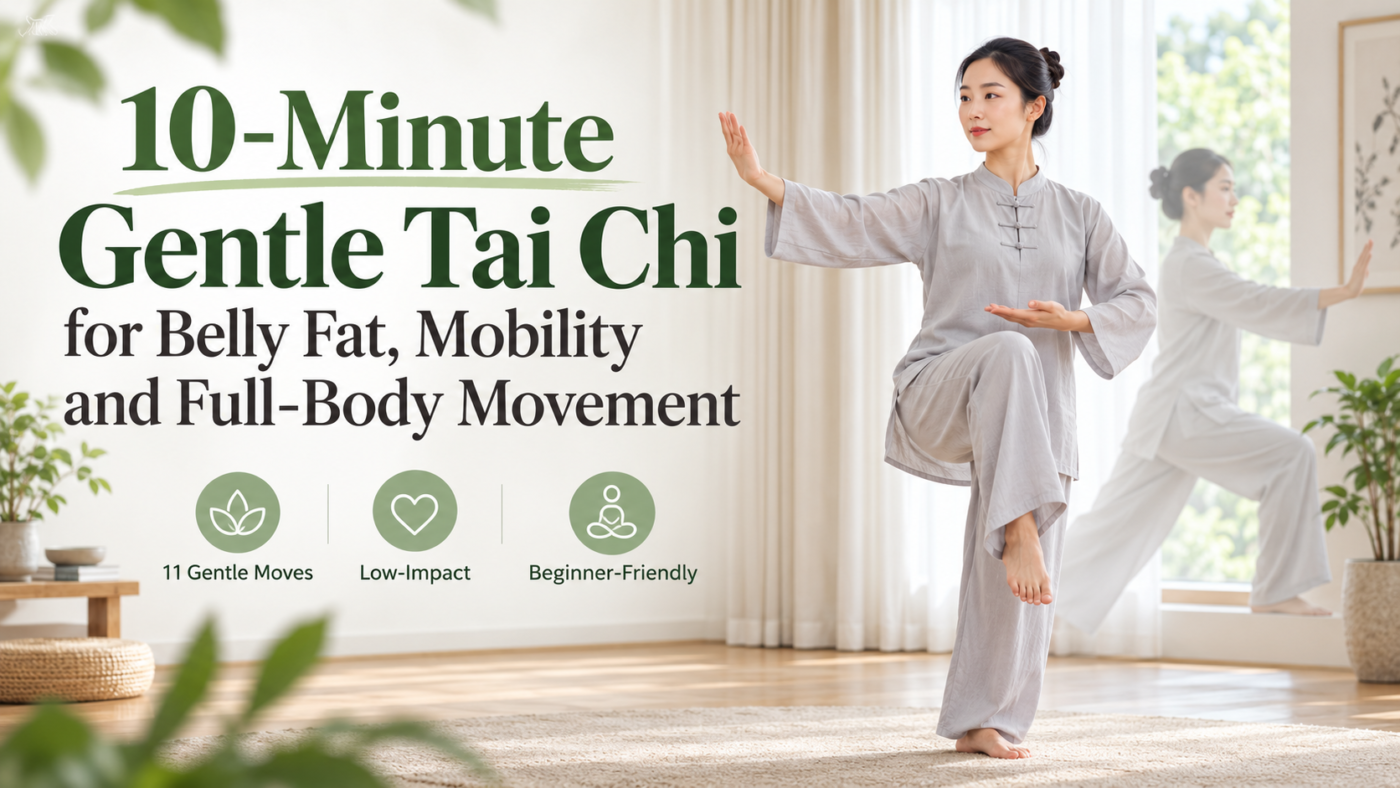
Ten minutes of gentle Tai Chi can be a practical way to add more movement to your day without jumping, running, or complicated choreography. This short routine combines knee lifts, cross-body movements, arm swings, balance work, hip mobility, and gentle stretching to keep the whole body active while remaining accessible for many beginners.
It is important to set realistic expectations. Tai Chi cannot selectively burn fat from the abdomen, and a two-week routine cannot guarantee a specific reduction in belly fat or visceral fat. Fat loss occurs throughout the body and depends on overall energy balance, physical activity, nutrition, sleep, age, genetics, and long-term consistency.
What this type of routine can do is help increase daily movement, contribute to energy expenditure, improve balance and mobility, and make regular exercise easier to maintain. Over time, those habits can support healthy body-weight and waist management as part of a broader lifestyle.
Why a 10-Minute Gentle Tai Chi Routine Can Be Useful
Short exercise sessions are often easier to repeat consistently than long, demanding workouts. A 10-minute routine may seem modest, but it can still provide meaningful movement when performed regularly.
This sequence uses large muscle groups in the legs, hips, trunk, shoulders, and arms. Repeated stepping and knee lifting increase muscular activity, while cross-body movements challenge coordination and trunk control.
The routine also includes slower stretching movements toward the end, helping the body transition from active movement into a more relaxed state.
For people who spend much of the day sitting, even a short period of structured activity can be a useful way to break up inactivity and improve overall movement habits.
Can Tai Chi Reduce Belly Fat?
Tai Chi does not specifically remove fat from the stomach.
Movements such as twisting, knee lifting, side stepping, and abdominal engagement may strengthen and coordinate the muscles around the trunk, but they do not force the body to burn fat only from that area.
Body fat is reduced through overall changes in energy balance.
A Tai Chi session can contribute by increasing physical activity and energy expenditure. When regular movement is combined with appropriate nutrition, sufficient sleep, and long-term consistency, it may support gradual reductions in overall body fat and waist circumference.
For this reason, it is more accurate to think of Tai Chi as one part of a sustainable weight-management strategy rather than a targeted belly-fat exercise.
What About Visceral Fat?
Visceral fat is stored deeper in the abdominal cavity around internal organs. Excess visceral fat is associated with a higher risk of metabolic and cardiovascular problems.
Regular physical activity is one of the most important lifestyle strategies for helping manage visceral fat, but no single 10-minute exercise session can specifically eliminate it.
A short Tai Chi routine may contribute to overall activity levels, particularly for people who are currently inactive or prefer low-impact exercise. For larger changes in body composition, it is usually helpful to combine gentle movement with additional aerobic activity, resistance training, and appropriate dietary habits.
The 11-Move 10-Minute Gentle Tai Chi Routine
Move slowly and maintain comfortable breathing throughout the routine. The goal is controlled, continuous movement rather than speed.
If balance is difficult, perform the exercises near a wall, sturdy chair, or countertop.
Exercise 1: Cross Knee Tap
Stand upright with your feet comfortably apart.
Lift one knee while bringing the opposite elbow downward toward it. Return to the starting position and repeat on the other side.
Continue alternating.
This movement engages the hips, legs, trunk, and shoulders while encouraging cross-body coordination.
The knee lift also increases lower-body activity and gently challenges balance.
Avoid forcing the elbow and knee to touch. The quality of the movement matters more than the range.
Exercise 2: Cross-Step Pull Down
Raise both arms overhead.
As you lower your arms, step one foot lightly behind the other in a small cross step.
Return to the center and alternate sides.
This movement combines upper-body motion with stepping, helping keep several major muscle groups active at the same time.
The cross-step component challenges coordination, hip control, and balance.
Keep the step small if you feel unstable.
Exercise 3: Side Arm Toe Kick
Open both arms outward.
Lift one leg forward and reach one hand toward the foot or lower leg.
Lower the leg slowly and repeat on the other side.
You do not need to touch your toes.
The movement can help challenge balance while gradually working the hamstrings, hips, trunk, and legs.
Keep the knee slightly bent if your hamstrings feel tight.
Exercise 4: Back-Step Knee Swing
Reach both arms forward while stepping one foot backward.
Bring the same leg forward into a comfortable knee lift while swinging the arms toward that side.
Repeat several times before changing sides.
This continuous movement increases lower-body involvement and introduces a mild cardiovascular component without high impact.
Keep the supporting knee soft rather than locked.
Exercise 5: Knee Lift Reach
Stand tall.
Lift one knee while reaching the same-side arm upward.
Lower the leg and arm smoothly.
Repeat several times and then change sides.
The movement challenges balance, hip flexor strength, trunk stability, and shoulder mobility.
Try to remain tall through the spine instead of leaning backward.
Exercise 6: Arm Circle Cross Step
Raise both hands overhead.
Circle your arms outward and downward while stepping one foot lightly behind the other.
Return to the starting position and repeat on the opposite side.
This flowing movement combines shoulder mobility, balance, hip control, and whole-body coordination.
Move slowly enough that you can maintain control throughout the cross step.
Exercise 7: Knee Lift With Arm Swing
Raise both arms overhead as you inhale comfortably.
As you exhale, lower the arms while lifting one knee.
Return to the starting position and alternate sides.
This movement combines rhythmic breathing with lower-body activity.
The steady pattern may also make the routine feel calmer and more meditative.
Avoid holding your breath.
Exercise 8: Side Knee Press
Step to one side and bend the knee slightly.
Place your hands gently on the thigh above the knee.
Shift your weight into the side movement without forcing the joint.
Return to the center and repeat on the other side.
This exercise can help improve lateral hip mobility, leg control, and comfort during side-to-side movement.
Do not push directly downward on the knee joint.
Exercise 9: Toe-Up Forward Fold
Step one foot slightly forward with the heel on the floor and the toes pointing upward.
Keep your spine long and hinge forward gently from the hips.
You may feel a stretch through the back of the thigh and calf.
Return to standing and change sides.
Do not force yourself into a deep fold.
A small forward hinge is enough if your hamstrings are tight.
Exercise 10: Standing Quadriceps Stretch
Stand tall and bend one knee behind you.
If comfortable, hold the ankle or foot with the same-side hand.
Keep the knees relatively close together and maintain an upright torso.
This stretch targets the front of the thigh and can help restore a sense of length after repeated knee lifting and stepping.
If balance is difficult, hold a chair or wall with the free hand.
Exercise 11: Cross-Arm Shoulder Stretch
Bring one arm across your chest.
Use the opposite arm to gently support it closer to the body.
Keep your shoulders relaxed and breathe slowly.
Repeat on the other side.
This final movement helps release tension through the shoulders and upper back after the more active portion of the routine.
How to Perform the Routine Safely
Gentle Tai Chi should feel smooth and controlled rather than painful.
Reduce your range of motion if you feel uncomfortable.
People with significant balance problems may want to practice next to a stable support.
If you experience sharp pain, dizziness, chest discomfort, unusual shortness of breath, or loss of balance, stop the exercise.
Anyone recovering from surgery, managing a recent injury, or living with a medical condition that affects movement should seek individualized guidance before beginning a new exercise program.
How Often Should You Practice?
A practical starting point is 10 minutes once a day or several times per week.
Consistency is more important than making every session intense.
As your comfort improves, you can gradually increase your total activity by adding walking, resistance training, longer Tai Chi sessions, or other low-impact exercises.
For weight management and metabolic health, total weekly physical activity matters much more than any one individual routine.
Will You See Results in Two Weeks?
Two weeks may be enough to notice improvements in familiarity with the movements, confidence, balance, flexibility, or general activity levels.
It is not realistic to guarantee visible abdominal fat loss in such a short period.
Changes in body composition usually take longer and depend on many factors beyond the exercise itself.
A better goal for the first two weeks is to establish the habit.
If the routine becomes something you can maintain, the long-term benefits are much more meaningful.
Why Gentle Movement Can Be Easier to Maintain
One of the biggest challenges in exercise is not finding the most intense workout. It is finding movement you can repeat consistently.
Tai Chi is appealing because it combines movement, balance, coordination, mobility, and controlled breathing without requiring equipment or a large space.
For people who dislike high-impact workouts, this can make physical activity feel more approachable.
That matters because sustainable routines tend to produce better long-term results than short periods of extreme effort.
The Role of Tai Chi in Healthy Weight Management
Tai Chi should not be viewed as a shortcut for weight loss.
Its value comes from helping people move more regularly.
A sustainable weight-management plan usually includes several components:
Regular physical activity.
Adequate protein and nutrient-dense foods.
Reasonable portion control.
Resistance training to preserve or build muscle.
Enough sleep.
Stress management.
Long-term consistency.
Tai Chi can fit comfortably into this broader approach, especially for people who prefer gentle or low-impact exercise.
Final Thoughts
This 10-minute gentle Tai Chi routine offers an accessible way to move the whole body, practice balance, improve coordination, mobilize the hips and shoulders, and add more physical activity to the day.
The most important expectation to keep realistic is fat loss.
No individual Tai Chi movement can specifically burn belly fat, and abdominal or visceral fat cannot be targeted through local exercise alone.
However, regular Tai Chi can contribute to daily activity and energy expenditure. When combined with a balanced diet, sufficient sleep, resistance training, aerobic activity, and long-term consistency, it can become a useful part of a healthy weight-management routine.
Ten minutes may not transform your body overnight, but it can be enough to build a habit that supports better movement for years.
FAQ
Can 10 minutes of Tai Chi a day help with weight loss?
It can contribute to daily activity and energy expenditure, but significant weight loss usually requires a broader combination of regular exercise, nutrition, sleep, and long-term energy balance.
Can Tai Chi reduce belly fat?
Tai Chi cannot selectively burn abdominal fat. It may support overall weight management when practiced regularly as part of an active lifestyle.
Can Tai Chi reduce visceral fat?
Regular physical activity can help manage visceral fat over time. Tai Chi may contribute to total activity, but it should not be considered a stand-alone or guaranteed visceral-fat treatment.
Is this routine suitable for beginners?
The movements are generally low impact and beginner-friendly, but they should be modified according to balance, joint comfort, and mobility.
Is Tai Chi good for balance?
Tai Chi frequently uses controlled weight shifting, slow stepping, and single-leg movements, which can help train balance and body awareness.
How many times per week should I practice?
Several short sessions per week can be a practical starting point. Daily practice is also reasonable if the movements remain comfortable.
Medical Disclaimer
This article is for educational purposes only and is not medical advice. Exercise should be adjusted to your individual ability, health status, and physical limitations. Stop if you experience pain, dizziness, chest discomfort, or unusual shortness of breath, and consult a qualified healthcare professional when appropriate.
This article is for general education and does not replace individualized care from a qualified health professional. Seek appropriate advice for persistent, severe, or concerning symptoms.
Read the full medical disclaimer