After 50, many people notice that the waist feels thicker, movement becomes less fluid, and maintaining flexibility takes more conscious effort. Changes in activity level, muscle mass, sleep, hormones, and overall energy expenditure can all influence body composition with age.
A gentle Tai Chi-inspired routine can be a useful way to stay active without relying on high-impact exercise. Slow squats, controlled twists, heel raises, arm swings, knee lifts, balance work, and coordinated breathing can help improve mobility, lower-body strength, posture, balance, and daily movement confidence.
One point deserves clarification: no specific movement can selectively “burn waist fat.” Fat loss occurs throughout the body when overall energy expenditure, nutrition, sleep, and lifestyle create the right conditions. What these exercises can do is strengthen the muscles around the hips, legs, trunk, shoulders, and back while adding regular low-impact activity that may support healthy weight management.
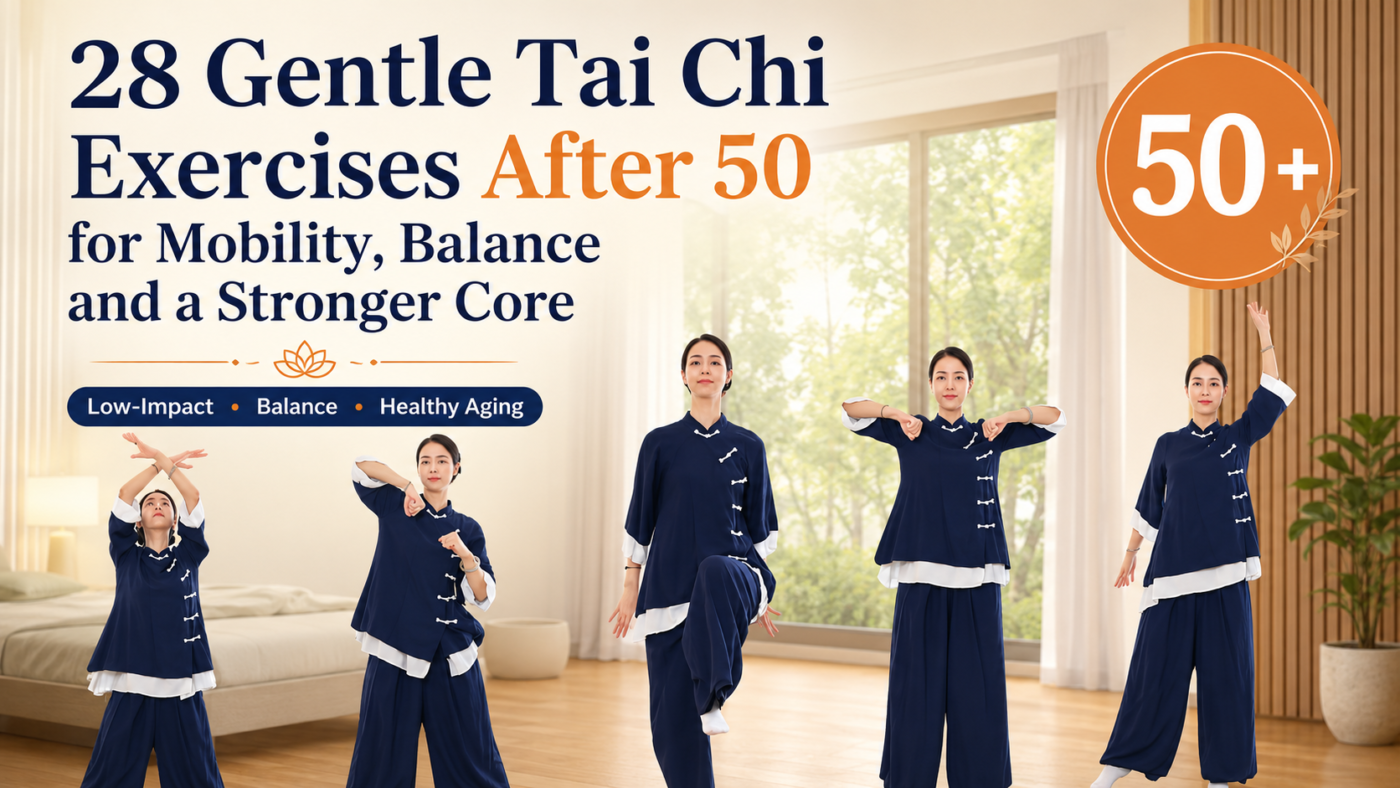
The following 28-movement routine is designed especially for adults over 50 who want a gentler way to keep moving.
Why Gentle Tai Chi-Style Movement Can Be Valuable After 50
Healthy aging is not only about staying thin. It is also about preserving the physical qualities that make everyday life easier.
These include:
Strength in the legs and hips
Balance while standing and walking
Ankle stability
Shoulder mobility
Spinal rotation
Core control
Coordination between the upper and lower body
Confidence when changing direction or shifting weight
Gentle Tai Chi-inspired exercise combines many of these elements in one flowing routine.
The movements do not need to be performed quickly. In fact, slower repetition often makes balance and muscular control more demanding.
1. Fist and Knee Bend
Clench both fists in front of the body.
Bend the knees into a shallow squat.
As you rise, swing both arms backward.
Continue moving the legs and upper body together.
This coordinated pattern engages the thighs, hips, back, shoulders, and arms.
The repeated knee bend adds lower-body strengthening while the arm swing increases total-body movement.
Keep the squat shallow if your knees are sensitive.
2. Heel Lift and Reach
Raise both arms overhead.
Then sweep the arms downward and backward while rising onto the balls of the feet.
Lower the heels slowly and return to the starting position.
Repeat in a smooth rhythm.
Heel raises strengthen the calf muscles and help train ankle control.
They also challenge balance, which becomes increasingly important with age.
Use a wall or chair for support if needed.
3. Torso Twist With Arm Swing
Stand comfortably with the knees soft.
Rotate the torso toward one side while allowing the arms to swing with the body.
One hand may pass near the abdomen while the other moves behind you.
Reverse direction.
Keep the movement gentle and continuous.
This exercise encourages thoracic and waist rotation.
It also trains the body to shift direction smoothly rather than moving rigidly.
Do not force the twist from the lower back.
4. Elbow Lift and Heel Raise
Keep both elbows bent close to the body.
Raise the elbows toward shoulder height as you lift the heels.
Lower the arms and heels together.
Repeat with control.
This movement coordinates the upper and lower body while challenging balance.
The heel raise strengthens the calves, while the arm movement activates the shoulders and upper back.
5. Forward Fold With Overhead Reach
Stand tall with the feet comfortable.
Raise the arms overhead.
Hinge forward from the hips while keeping the movement controlled.
Return gradually to standing.
Avoid collapsing through the lower back.
This movement stretches the posterior body and challenges trunk control.
People with dizziness, osteoporosis, significant back pain, or balance difficulties should use a smaller range or skip deep forward bending.
6. Hands-Together Chest Opener
Place the palms or hands together in front of the chest.
Open the elbows outward while gently rising onto the toes.
Return the elbows inward as the heels lower.
Continue slowly.
The chest-opening portion encourages shoulder mobility and upper-body posture.
The heel raise adds ankle and balance training.
Keep the ribs relaxed rather than excessively arching the lower back.
7. Cross-Arm Squat
Cross the arms in front of the body.
Lower into a comfortable squat.
As you rise, sweep the crossed arms upward.
Then return to the starting position.
Squats recruit some of the largest muscles in the body, including the quadriceps and glutes.
This makes them useful for maintaining lower-body strength and functional ability.
A chair can be placed behind you for additional confidence.
8. Knee Lift and Arm Swing
Extend both arms forward.
Swing the arms backward while lifting one knee.
Lower the foot and return to center.
Switch sides.
This is an excellent coordination drill.
The knee lift challenges single-leg balance, while the arm swing helps the body learn to coordinate multiple regions simultaneously.
Lift the knee only as high as you can without leaning backward.
9. Up-and-Down Hand Push
Clasp the hands in front of the body.
Raise them upward.
Then press or guide them downward.
Continue in a smooth vertical rhythm.
This simple exercise keeps the shoulders and arms moving while encouraging posture awareness.
Avoid shrugging the shoulders excessively.
Think of lengthening upward through the top of the head.
10. Clasped-Hand Overhead Reach
Clasp the hands in front of the chest.
Reach both arms overhead.
Pause briefly without forcing the shoulders.
Then lower the arms slowly.
Repeat.
Overhead reaching can help maintain shoulder flexion and upper-body mobility.
If overhead motion causes shoulder pain, stop below the painful range.
11. Wide Squat
Stand with the feet wider than hip-width.
Place the hands at the waist.
Bend the knees and lower the hips into a comfortable squat.
Rise slowly.
Repeat.
Wide squats strengthen the thighs, hips, and glutes.
They also challenge hip mobility.
Keep the knees traveling generally in the same direction as the toes.
12. Gentle Neck Lift and Lower
Place the hands behind the back or allow them to rest at your sides.
Gently look upward only within a comfortable range.
Then return the head to neutral and slightly lower the chin.
Move slowly.
Neck mobility should never be forced.
Avoid aggressive backward extension, particularly if you experience dizziness, neck pain, numbness, or known cervical spine problems.
The goal is gentle movement, not maximum range.
13. Cross-Arm Swing
Cross the arms in front of the body.
Then open the arms outward and diagonally upward.
Allow the head to turn gently with the movement.
Return and repeat.
This exercise combines chest opening, shoulder movement, and mild trunk rotation.
Keep the neck relaxed.
The shoulders should move freely rather than being pulled forcefully backward.
14. Cross Knee Touch
Open the elbows to the sides.
Lift one knee.
Bring the opposite hand toward the raised knee.
Return to center.
Switch sides.
Cross-body movements require coordination between the two sides of the body.
They also engage the abdominal and hip muscles and challenge balance.
Perform the motion slowly enough to remain stable.
15. Elbow Circles
Raise the elbows approximately to shoulder height.
Make comfortable circles forward.
Then reverse the circles.
The circles do not need to be large.
This movement can help maintain shoulder mobility and warm the muscles around the upper back.
Stop if you feel pinching or sharp pain.
16. Alternating Heel Kick
Extend the arms slightly behind the body.
Bend one knee and bring the heel upward toward the back of the thigh.
Lower it.
Alternate sides.
Keep the movement low impact.
Heel kicks mobilize the knees and engage the hamstrings.
They also provide a gentle cardiovascular element when performed continuously.
Avoid trying to force the heel close to the buttock.
17. Knee Lift With Same-Side Reach
Raise one arm overhead while lifting the knee on the same side.
Lower both.
Repeat on the opposite side.
This challenges balance and coordination in a slightly different pattern from cross-body movements.
The overhead reach also lengthens the side of the torso.
Stand near support if necessary.
18. Heel Raise With Alternating Arm Reach
Raise one arm overhead while placing the opposite hand near or behind the head.
At the same time, lift the heels.
Lower the heels.
Switch the arm positions.
Continue.
Combining arm movement with a heel raise increases the coordination challenge.
The calves and ankles work to control the vertical movement while the shoulders remain active.
19. Squat and Arm Swing
Raise both arms overhead.
Then swing the arms backward as you bend the knees and lower the body.
Rise and bring the arms upward again.
Repeat with a steady rhythm.
This movement uses several large muscle groups together.
It can increase overall activity while strengthening the hips and legs.
The squat depth should always match your ability.
20. Side-to-Side Twist
Keep the elbows bent in front of the chest.
Rotate the torso gently from one side to the other.
Allow the hips to participate naturally rather than fixing the lower body completely.
Keep the movement smooth.
Regular rotational movement helps preserve comfortable trunk mobility.
Avoid twisting aggressively at the end of your range.
21. Squat and Press
Lower into a comfortable squat.
Hold the hands together in front of the chest.
Raise the hands overhead.
Return them to the chest.
Then guide the hands downward as you hinge forward slightly.
Return to the starting position.
This flowing sequence combines lower-body endurance, shoulder mobility, balance, and trunk control.
Move deliberately rather than rushing through the transitions.
22. Cross-Toe Reach
Stand upright.
Hinge forward and reach one hand toward the opposite foot.
Return to standing.
Repeat on the other side.
You do not need to touch the toes.
Reaching toward the knee or shin is enough.
This exercise combines rotation with a hip hinge and stretches the back of the legs.
People with significant back problems should keep the range small.
23. Wide Squat Hold and Rise
Stand with the feet wide apart.
Hold the hands together in front of the chest.
Lower into a squat while keeping the arms steady.
Rise back to standing.
Repeat.
Keeping the arms relatively still makes the legs and trunk responsible for controlling the movement.
This can help strengthen the lower body and reinforce posture.
24. Leg Lift and Opposite Elbow Press
Bend the elbows near shoulder height.
Lift one leg inward and upward while pressing the opposite elbow downward.
Return.
Alternate sides.
Think of this as a controlled coordination drill rather than a forceful kick.
It challenges balance, hip mobility, and cross-body control.
Slow repetitions are preferable.
25. Squat and Twist
Place the hands gently behind the head without pulling on the neck.
Rotate the torso toward one side.
Return to center.
Lower into a squat.
Rise and repeat, alternating the twist.
This combines lower-body strengthening with controlled rotation.
Keep the chest open and the elbows relaxed.
If placing the hands behind the head is uncomfortable, cross the arms over the chest instead.
26. Clasp Behind the Back With Leg Reach
Clasp the hands behind the body if shoulder mobility allows.
Gently open the chest.
Extend one leg backward.
Return.
Release or adjust the hands as needed and switch legs.
The backward leg reach activates the glutes and challenges standing balance.
The arm position encourages chest opening.
Do not force the hands together if shoulder mobility is limited.
27. Squat and Heel Raise Flow
Bend the knees slightly and hinge forward.
Sweep both arms overhead.
Then bring the arms backward while rising onto the toes.
Lower the heels and repeat.
This exercise combines ankle strength, knee control, shoulder movement, and coordination.
Because the center of gravity changes repeatedly, it can also be useful for balance training.
Perform it near stable support if necessary.
28. Overhead Clap With Backward Leg Extension
Bring the hands together overhead.
Then lower the arms while extending one leg backward.
Return to center.
Switch legs.
Continue slowly.
The backward leg extension activates the glutes and challenges balance.
The overhead arm movement keeps the shoulders and upper body active.
Finish with controlled repetitions rather than trying to move quickly.
Can This Routine Reduce Waist Fat?
It can contribute to an active lifestyle, but the answer requires an important distinction.
You cannot choose where the body removes stored fat simply by exercising the muscles in that area.
Twisting, squatting, and abdominal movement may strengthen and condition the muscles around the waist, but they do not selectively remove abdominal fat.
A more realistic approach to reducing excess body fat after 50 includes:
Regular physical activity
Adequate protein intake
A balanced overall diet
Resistance or strength training
Good sleep
Stress management
Maintaining a sustainable calorie balance
Limiting excessive alcohol intake
Consistency over months rather than days
Gentle Tai Chi-style movement fits very well into this larger strategy because it can make regular exercise more accessible.
Why Balance Training Becomes More Important With Age
Several movements in this routine involve heel raises, knee lifts, backward leg reaches, and changes in weight distribution.
These are valuable because balance is a skill.
Like strength and flexibility, it benefits from practice.
Balance training can help improve body awareness, ankle control, and confidence during everyday activities such as stepping over obstacles, turning, climbing stairs, or walking on uneven ground.
People who are at increased risk of falling should perform balance exercises close to a wall, countertop, or sturdy chair.
Why Lower-Body Strength Matters After 50
The legs and hips are central to independence.
They help you:
Stand up from chairs
Climb stairs
Carry groceries
Walk longer distances
Recover balance after a misstep
Get down to and up from the floor
Squats, knee bends, heel raises, and leg extensions all train parts of this system.
You do not need extremely heavy exercise to benefit, although progressive resistance training can provide additional strength and muscle-preservation benefits.
How Long Should You Practice?
A full routine containing all 28 movements may take around 25 to 35 minutes depending on pace and rest periods.
Beginners do not need to perform the entire sequence immediately.
You might begin with 8 to 10 exercises and gradually add more.
A practical weekly schedule could include this routine three to five days per week, combined with regular walking and two or more sessions of age-appropriate strength training.
The exact amount should depend on your health, fitness level, and recovery.
How Hard Should It Feel?
Most of the routine should feel light to moderate.
You should still be able to speak in short sentences.
The muscles may feel warm and mildly challenged, but the exercises should not produce sharp pain.
Slow movement is especially useful because it requires more control.
Do not confuse gentle with ineffective.
Controlled movement can be surprisingly demanding when performed accurately.
Safety Tips for Adults Over 50
Start with a smaller range of motion than you think you need.
Use a stable chair or wall for balance when necessary.
Avoid locking the knees.
Move the neck conservatively.
Do not hold your breath during squats.
Stop if you experience chest pain, severe shortness of breath, faintness, unusual dizziness, sudden weakness, or sharp joint pain.
People with recent surgery, severe osteoporosis, uncontrolled cardiovascular disease, significant arthritis, neurological conditions, or persistent balance problems should discuss a new exercise program with a qualified healthcare professional.
Final Thoughts
Aging does not automatically mean becoming stiff, weak, or inactive.
But maintaining physical function after 50 usually requires greater consistency than it did earlier in life.
This 28-movement Tai Chi-inspired routine provides a gentle way to practice many important physical abilities at the same time: balance, mobility, coordination, leg strength, ankle stability, shoulder movement, trunk control, and endurance.
Do not judge the routine only by how many calories it burns.
Its greater value is helping the body continue to move confidently.
If fat loss is also a goal, use the routine as one part of a broader strategy that includes nutrition, walking, strength training, sleep, and consistent daily activity.
The goal is not simply a smaller waist.
The more meaningful goal is a body that remains strong, mobile, balanced, and capable as the years pass.
FAQ
Is Tai Chi good exercise after age 50?
Tai Chi and Tai Chi-inspired movement can be particularly useful after 50 because they emphasize controlled movement, balance, coordination, posture, and lower-body stability without requiring high impact.
Can Tai Chi eliminate belly fat?
No exercise can selectively remove fat from the waist. Regular Tai Chi-style activity can contribute to overall energy expenditure and physical activity, which may support weight management when combined with appropriate nutrition and lifestyle habits.
Can beginners perform this routine?
Yes. Beginners can use smaller movements, shallow squats, slower repetitions, and external support when needed.
How often should adults over 50 exercise?
Regular movement is generally more beneficial than occasional intense workouts. Many people can benefit from a mixture of aerobic activity, strength training, balance work, and mobility exercise throughout the week.
What if my knees hurt during squats?
Reduce the depth, slow down, adjust foot position, or use a chair-assisted squat. Persistent knee pain should be evaluated appropriately rather than repeatedly exercising through pain.
Is 30 minutes necessary?
No. Even 10 to 15 minutes can be useful. Consistency matters more than completing a specific duration every day.
Medical Disclaimer
This article is for general educational purposes only and does not provide medical diagnosis or treatment. Exercise needs vary according to age, health history, mobility, medications, cardiovascular status, balance, and joint health. Stop if an exercise produces pain, dizziness, unusual shortness of breath, weakness, or other concerning symptoms, and seek professional medical guidance when appropriate.
This article is for general education and does not replace individualized care from a qualified health professional. Seek appropriate advice for persistent, severe, or concerning symptoms.
Read the full medical disclaimer