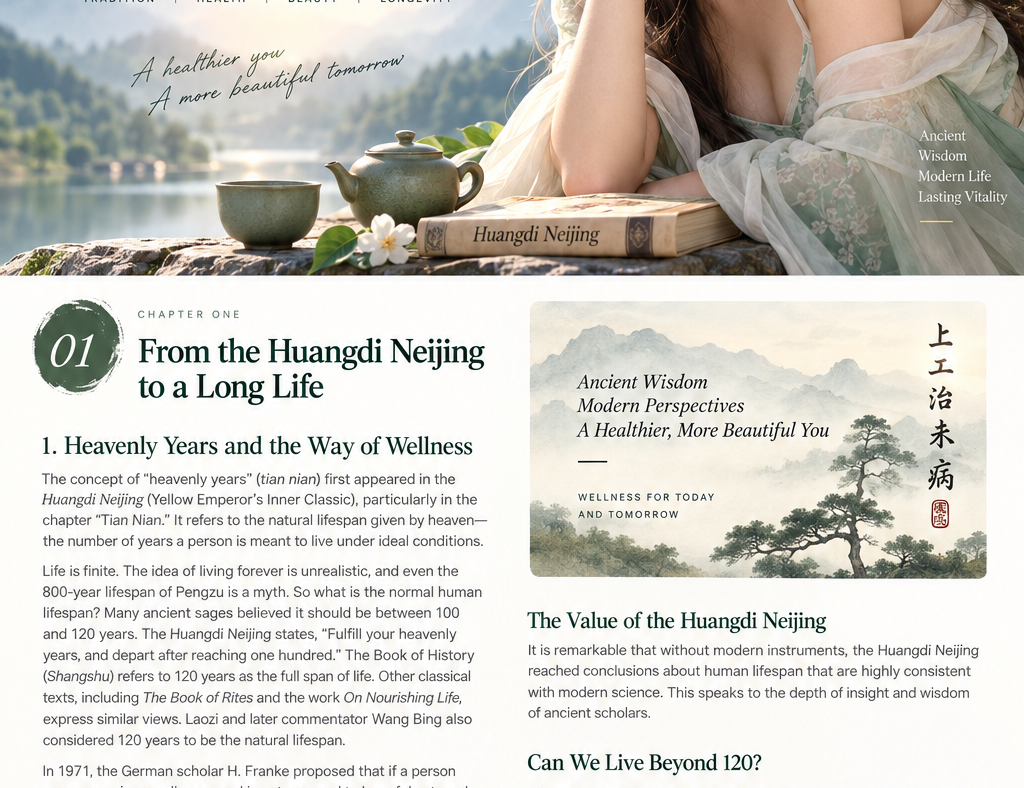
Healthy longevity is rooted in an ancient view of health that connects daily habits, nourishment, movement, emotional balance, and the natural rhythms of life. Rather than treating longevity as simply living more years, the Huangdi Neijing presents healthy aging as the result of maintaining balance throughout the course of life.For more than two thousand years, the Huangdi Neijing—the Yellow Emperor’s Inner Classic—has shaped Chinese thinking about health, aging, prevention, and the relationship between everyday life and longevity.
Its language belongs to a very different medical world from our own. Concepts such as qi, kidney essence, stomach qi, yin and yang, and the relationship between seasonal rhythms and health arose within classical Chinese medicine and should not be treated as direct equivalents of modern anatomy or physiology.
Yet beneath this traditional language lies an enduring question that remains highly relevant today:
How can we preserve strength, function, resilience, and quality of life for as many years as possible?
The answer offered by the classical tradition was not a single herb, medicine, pressure point, or secret technique. It was a way of living—one that emphasized prevention, moderation, regularity, nourishment, recovery, emotional balance, and respect for the changing needs of the body throughout life.
Modern science does not confirm every traditional explanation found in ancient medical texts. But many of the broader lifestyle principles can be interpreted in ways that fit remarkably well with what we now know about healthy aging.
1. “Heavenly Years” and the Traditional Ideal of Longevity
The classical Chinese term tian nian, often translated as “heavenly years” or “natural lifespan,” appears in the Huangdi Neijing in discussions of how long a person might live when life unfolds according to its natural course.
Ancient Chinese writings frequently associated exceptional longevity with reaching or surpassing one hundred years of age. Some historical texts spoke of 100, 120, or even greater ages as symbols of a life lived to its fullest natural potential.
These numbers should not be interpreted as precise biological predictions.
Modern human longevity research is far more complex. Genetics, childhood conditions, infectious disease, cardiovascular risk, cancer, nutrition, physical activity, smoking, healthcare access, socioeconomic conditions, accidents, and many other factors influence lifespan.
The longest rigorously documented human lifespan is far beyond the average lifespan, and living to 120 remains extraordinarily rare.
What remains valuable in the classical idea of tian nian is not a promise that every person can live to a specific age.
It is the belief that people should try to preserve health and function so that avoidable illness, frailty, and harmful habits do not unnecessarily shorten or diminish life.
In modern language, the goal is not simply lifespan.
It is healthspan—the number of years lived with meaningful physical and mental function.
That means maintaining the ability to walk, think, communicate, care for oneself, maintain relationships, and participate in everyday life for as long as possible.
Longevity Is Built Over Time
One of the most famous passages associated with the Huangdi Neijing contrasts people who remained vigorous into advanced age with people who became weakened much earlier.
The classical explanation emphasizes several behaviors:
eating and drinking with moderation,
maintaining regular daily routines,
avoiding excessive physical and sexual exhaustion,
living according to natural rhythms,
and maintaining harmony between body and mind.
The terminology is ancient, but the underlying principle is recognizable today.
Healthy aging rarely depends on one dramatic intervention.
It develops over decades.
Sleep matters.
Movement matters.
Nutrition matters.
Smoking matters.
Alcohol matters.
Stress matters.
Muscle strength matters.
Social connection matters.
Preventive healthcare matters.
Small habits repeated thousands of times can eventually become large differences in function and health.
2. Treating the “Not-Yet-Ill”: Prevention Before Disease
Perhaps the most influential health principle associated with the Huangdi Neijing is zhi wei bing—often translated as “treating disease before it arises” or “caring for the not-yet-ill.”
A classical analogy compares waiting until disease is established before acting to digging a well only after becoming desperately thirsty.
The broader lesson is simple:
Do not wait for a crisis before paying attention to health.
In modern healthcare, prevention has become a major field in its own right.
Vaccination helps prevent infectious disease.
Blood-pressure management reduces cardiovascular risk.
Cancer screening can detect some diseases earlier.
Exercise helps preserve cardiovascular fitness, muscle, bone, balance, and metabolic health.
Stopping smoking substantially reduces multiple health risks.
Adequate sleep supports physical and psychological well-being.
Healthy dietary patterns can influence cardiovascular and metabolic risk.
None of these measures makes illness impossible.
Prevention is not a guarantee.
It is risk reduction.
That distinction matters.
Prevention in Everyday Life
A modern interpretation of zhi wei bing might look like this:
Maintain muscle before frailty develops.
Train balance before falls become frequent.
Protect cardiovascular health before symptoms appear.
Improve sleep before chronic exhaustion becomes normal.
Build sustainable eating habits before metabolic problems become advanced.
Pay attention to persistent symptoms instead of ignoring them.
Receive appropriate screening and professional care when indicated.
The strongest version of preventive wellness is not “avoid doctors.”
It is the opposite:
use lifestyle intelligently and use healthcare appropriately.
3. “Healthy Qi Within”: A Traditional Language of Resilience
The Huangdi Neijing uses the concept of zheng qi, often translated as “upright qi,” “correct qi,” or “healthy qi,” to describe the body’s capacity to resist disruptive influences and maintain internal stability.
One classical phrase is commonly translated as:
“When healthy qi is strong within, harmful influences cannot easily invade.”
This should not be interpreted as a literal modern immunological statement.
Traditional qi theory and contemporary physiology are different systems of explanation.
But the broader idea—maintaining bodily resilience—has modern relevance.
The body possesses many systems that help maintain stability:
immune defenses,
cardiovascular regulation,
metabolic regulation,
hormonal signaling,
nervous-system responses,
tissue repair,
musculoskeletal adaptation,
and physiological homeostasis.
A body supported by adequate nutrition, physical activity, sleep, recovery, and appropriate medical care is generally better positioned to maintain function than one continually exposed to severe deprivation, inactivity, smoking, or other harmful conditions.
That does not mean a healthy lifestyle makes someone immune to disease.
Very healthy people can still develop cancer, infections, autoimmune disease, neurological disorders, genetic conditions, and many other illnesses.
Health is partly within our influence, but never completely within our control.
Kidney Qi and the Classical View of Aging
Classical Chinese medicine places special importance on the kidneys in discussions of growth, reproduction, maturation, and aging.
This does not mean the traditional concept of “kidney qi” is simply the same thing as the anatomical kidneys measured in modern nephrology.
The classical kidney system was a broader functional concept associated with reproduction, development, vitality, bones, aging, and inherited constitution.
From a modern perspective, aging involves many biological systems at once:
genetics,
hormones,
cellular repair,
muscle mass,
bone density,
vascular health,
brain health,
immune function,
metabolism,
and cumulative environmental exposures.
There is no single organ or “energy reserve” that determines the entire aging process.
Still, the classical warning against repeatedly exhausting the body remains useful.
Chronic sleep deprivation, excessive alcohol, severe overtraining, nutritional deficiency, unmanaged stress, and other forms of prolonged strain can undermine health.
The modern lesson is therefore not to “preserve kidney qi” literally.
It is to protect the body’s capacity to recover.
Moderation Rather Than Exhaustion
The classical texts repeatedly warn against excess.
This includes excessive work, excessive indulgence, disrupted sleep, and other behaviors believed to consume vitality.
Modern wellness can reinterpret this principle as a balance between stimulus and recovery.
Exercise is beneficial.
Too little causes deconditioning.
But excessive training without recovery can also cause injury and fatigue.
Energy restriction may be appropriate in some circumstances.
Extreme restriction can cause nutritional deficiency.
Work can provide meaning and structure.
Chronic overwork without sufficient rest can harm physical and mental well-being.
The useful principle is not deprivation.
It is moderation, recovery, and sustainability.
4. Aging, Reproductive Health, and the Limits of Traditional Explanations
The Huangdi Neijing also connects reproductive vitality with the traditional concept of kidney qi.
Classical passages describe some older individuals as retaining reproductive capability because their vitality remained abundant.
Historically, this reflected an attempt to explain why reproductive capacity varies among individuals and generally changes with age.
Modern reproductive science provides a much more detailed picture.
Fertility is influenced by age, ovarian reserve, egg and sperm quality, hormones, reproductive anatomy, genetics, infections, lifestyle factors, and many other medical conditions.
It would therefore be inaccurate—and potentially harmful—to claim that infertility is usually caused by “kidney qi deficiency” or that traditional wellness practices alone can reliably restore fertility.
People who have difficulty conceiving deserve appropriate medical evaluation.
That does not make lifestyle irrelevant.
Healthy body weight, adequate nutrition, avoiding smoking, limiting excessive alcohol, managing chronic conditions, obtaining sufficient sleep, and addressing significant stress can all form part of responsible reproductive wellness.
Traditional practices may also provide relaxation, cultural meaning, or supportive self-care for some individuals.
But supportive wellness should complement appropriate reproductive healthcare rather than replace it.
5. “Stomach Qi” and the Importance of Nourishment
Another major classical idea concerns wei qi in the sense of “stomach qi”—not to be confused with the separate traditional term sometimes translated as defensive qi.
In classical medical thought, the spleen and stomach were central to transforming food into the substances that sustain the body.
Traditional texts therefore placed enormous importance on appetite, digestion, nourishment, and the ability to take in and process food.
The language differs from modern physiology, but the underlying importance of nutrition is unquestionable.
The digestive system breaks food down into nutrients that support:
energy production,
muscle maintenance,
brain function,
immune activity,
blood formation,
tissue repair,
bone health,
and countless metabolic processes.
Severe inability to eat or absorb nutrients can indeed become life-threatening.
But modern medicine understands digestion through the gastrointestinal tract, liver, pancreas, microbiome, nervous system, hormones, enzymes, circulation, and numerous interacting physiological mechanisms rather than the traditional theory of spleen and stomach qi.
Nutrition as a Foundation of Healthy Aging
The classical emphasis on nourishment remains highly relevant.
As people age, adequate nutrition becomes especially important for preserving muscle, bone, energy, and recovery.
A sustainable dietary pattern generally benefits from:
adequate protein,
vegetables and fruits,
whole grains or other minimally processed carbohydrate sources,
healthy fats,
sufficient fiber,
appropriate hydration,
and enough total energy to support individual needs.
Healthy eating is not about one “longevity food.”
It is the overall dietary pattern.
No herb, tonic, supplement, tea, or traditional formula can compensate for chronically inadequate nutrition.
Appetite Can Be an Important Health Signal
Traditional physicians paid close attention to appetite because eating ability often reflected a person’s overall condition.
That observation still has practical value.
Persistent loss of appetite, unexplained weight loss, difficulty swallowing, repeated vomiting, abdominal pain, gastrointestinal bleeding, or major changes in bowel habits should not simply be explained as “weak stomach qi.”
They can have many causes and deserve appropriate medical assessment.
Traditional wellness language may help describe experience.
It should not delay diagnosis.
The Deeper Connection Between “Kidney” and “Stomach” in Classical Thought
Classical Chinese medicine often described two broad sources of vitality.
One was inherited constitution—the resources with which a person begins life.
The other was acquired nourishment—the resources continually obtained through food and daily living.
This distinction can be useful philosophically even though modern biology explains it differently.
We inherit genes and biological traits that influence health.
But our health trajectory is also shaped by nutrition, activity, environment, education, healthcare, sleep, relationships, and lifestyle.
We cannot choose every biological condition with which we begin life.
We can influence many conditions under which that biology operates.
That is one of the most useful bridges between ancient wellness philosophy and modern preventive health.
From Ancient Longevity to Modern Healthspan
The central message of this chapter is not that the Huangdi Neijing discovered a precise formula for living to 120.
Nor is it that traditional Chinese medical concepts should replace modern medical science.
Its enduring contribution is more fundamental.
It asks us to think about health before illness.
It reminds us that daily life matters.
It emphasizes moderation.
It values nourishment.
It recognizes recovery.
It connects emotional and physical well-being.
It encourages people to preserve function throughout the lifespan rather than waiting until serious decline has already occurred.
These principles belong naturally within the philosophy of Health, Beauty & Longevity.
The Modern Longevity Framework
For today’s reader, the classical pursuit of tian nian can be translated into a practical goal:
Build strong foundations early. Preserve function through midlife. Protect independence in later life.
That means paying attention to the fundamentals.
Move regularly.
Maintain muscle.
Challenge balance.
Protect bone health.
Eat well.
Sleep consistently.
Avoid tobacco.
Limit excessive alcohol.
Manage cardiovascular and metabolic risk.
Maintain meaningful relationships.
Protect emotional health.
Use preventive healthcare.
And when illness appears, seek appropriate diagnosis and treatment rather than assuming that lifestyle alone will resolve it.
Our Guiding Principle
The wisdom worth carrying forward from the Huangdi Neijing is not a promise of immortality.
It is a philosophy of stewardship.
Care for the body before problems become serious. Nourish it without excess. Strengthen it without exhausting it. Respect natural rhythms. Preserve function with age. Combine traditional wisdom with modern evidence.
The goal is not merely to live longer.
The goal is to live stronger, healthier, more independently, and more fully for as many of our years as possible.
Medical Disclaimer
This article is intended for general education and wellness information. Traditional Chinese medicine concepts are discussed in their historical and cultural context and should not be interpreted as substitutes for modern medical diagnosis or treatment. Seek qualified medical care for persistent symptoms, medical conditions, fertility concerns, medication decisions, or other health issues.
This article is for general education and does not replace individualized care from a qualified health professional. Seek appropriate advice for persistent, severe, or concerning symptoms.
Read the full medical disclaimer