A tight forehead can feel surprisingly uncomfortable.
Some people notice tenderness when pressing above the eyebrows or across the center of the forehead. Others feel tension after long hours of concentrating, staring at screens, squinting, or repeatedly raising the eyebrows.
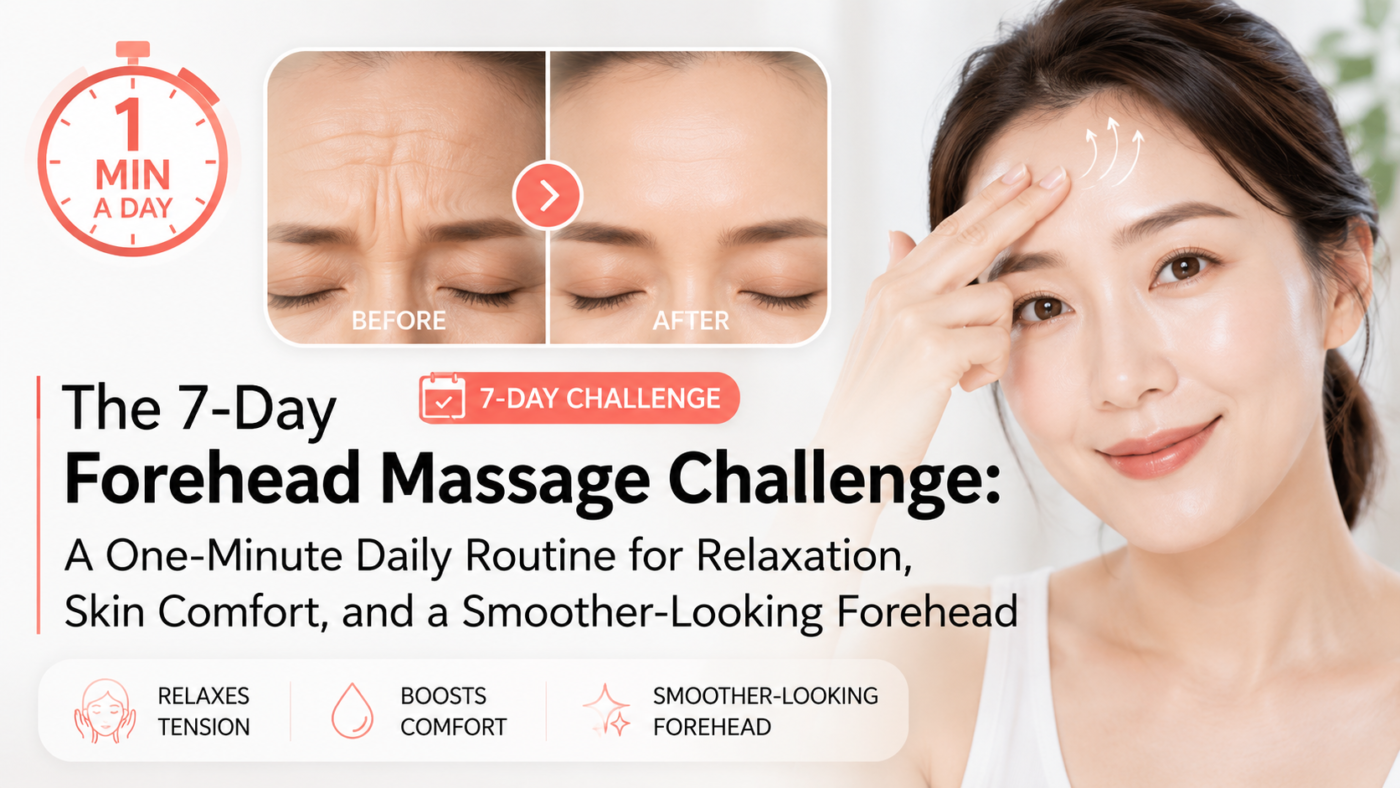
This one-minute daily routine uses the knuckles and fingertips to massage the forehead and the frontalis muscle, the large facial muscle that helps raise the eyebrows and create horizontal forehead lines.
The original routine makes several strong claims, including that the massage can work “better than Botox,” restore collagen production, lift the entire face, and visibly smooth wrinkles within seven days.
Those claims go beyond what can currently be established from this simple massage technique.
A more realistic goal is:
to gently relax forehead tension, temporarily increase local warmth and circulation, improve skin comfort, and become more aware of habitual facial tension.
Try the routine once a day for seven days and pay attention to how your forehead feels rather than expecting a medical or cosmetic transformation.
Why Does the Forehead Feel Tight?
The forehead is not just skin.
Underneath it lies the frontalis muscle, which plays an important role in facial expression.
You use this muscle when you:
Raise your eyebrows
Look surprised
Open your eyes more widely
React emotionally
Concentrate
Compensate for heavy or drooping upper eyelids
Repeated facial expressions can create temporary muscle tension, while normal aging and years of facial movement contribute to the development of forehead lines.
Stress may also make people unconsciously hold tension around the forehead, temples, jaw, and eyes.
That can make massage feel particularly noticeable.
Does Pain During Forehead Massage Mean Poor Blood Flow?
Not necessarily.
The original routine suggests that pain when pressing the forehead indicates restricted blood circulation and stiff muscles.
That interpretation is too specific.
Tenderness can have many explanations, including:
Pressure sensitivity
Muscle tension
Skin sensitivity
Headache disorders
Sinus discomfort
Excessive pressure during massage
Irritation of superficial tissues
A tender area does not automatically prove impaired blood circulation.
Massage may create a temporary feeling of warmth or increased local blood flow because rubbing the skin stimulates superficial tissues, but pain itself should not be treated as a diagnostic test.
Can Forehead Tension Stop Collagen Production?
There is no good basis for concluding that a painful or tight forehead means collagen production has become “blocked.”
Collagen is produced by cells in the skin and is influenced by many factors, including:
Age
Ultraviolet exposure
Smoking
Genetics
Hormonal changes
Nutrition
Skin injury
Normal biological aging
Repeated facial movement contributes to expression lines, but massage cannot simply restart collagen production because an area feels tender.
Massage may temporarily make skin look more relaxed or plump because of changes in hydration, superficial circulation, and muscle tension.
That is different from rebuilding collagen.
Can Forehead Massage Replace Botox?
No.
Massage and botulinum toxin work in fundamentally different ways.
Botulinum toxin temporarily reduces contraction of selected facial muscles by interfering with nerve signaling.
Forehead massage does not produce that effect.
Massage may help someone feel less tense and may temporarily alter the appearance of the skin, but it should not be described as a proven substitute for Botox.
That does not make massage useless.
It simply means the realistic benefits are different.
What Forehead Massage May Realistically Do
A brief massage may help with:
A temporary sense of relaxation
Awareness of habitual facial tension
A feeling of warmth in the skin
Temporary improvement in skin suppleness after using moisturizer or oil
Relaxation around the forehead and eyebrows
A short break from prolonged screen use or concentration
Some people may also find the routine calming.
The effect is likely to be subtle and temporary rather than dramatic.
Step 1: Make a Loose Fist
Begin with clean hands.
Make a relaxed fist.
Use the flat surface of your knuckles rather than a sharp point.
Place the knuckles gently against the center of the forehead.
Do not dig forcefully into the skin.
The pressure should feel noticeable but tolerable.
Step 2: Rub Gently Across the Forehead
Begin rubbing the forehead in small controlled movements.
You can use one hand or both hands.
Move gradually from the center toward the sides.
The original routine recommends strong rubbing, but there is no need to make the technique intensely painful.
A useful rule is:
mild pressure is enough.
More pain does not mean more benefit.
Step 3: Use Small Circular Motions
Place your knuckles against the forehead.
Make small circles while slowly moving across the forehead.
You may work from the center outward toward the temples.
Try to keep your facial expression relaxed.
Avoid raising the eyebrows during the massage.
Breathe normally.
Continue for several seconds.
Step 4: Massage Vertically
Next, change direction.
Move the knuckles gently upward and downward over the forehead.
Keep the movements short and controlled.
You do not need to pull aggressively on the skin.
The goal is to move over the tissue comfortably rather than scrub it harshly.
If Your Skin Is Dry, Use Cream or Oil
Dry skin creates more friction.
If your fingers or knuckles drag across the surface, apply a small amount of moisturizer, facial oil, or another skin product that you already tolerate well.
This can reduce friction.
Do not use a new irritating product simply for the massage.
People with acne-prone, highly sensitive, rosacea-prone, or dermatitis-prone skin may need to be especially cautious with both friction and oils.
Pain Is Not the Goal
The original challenge repeatedly encourages participants to push through strong discomfort.
That is not necessary.
Forehead massage should not “hurt like crazy.”
If the pressure causes significant pain, reduce it.
Stop if you experience:
Sharp pain
Persistent burning
Bruising
Skin irritation
Numbness
Worsening headache
Visual symptoms
Swelling
Pain that persists after the massage
A massage routine should leave the area feeling more comfortable, not injured.
Step 5: Switch to Your Fingertips
After the knuckle portion, relax your hands.
Place your fingertips lightly across the forehead.
Massage gently using small circles.
You can move across the forehead from the center outward.
This part should feel softer than the knuckle massage.
Spend several seconds moving slowly across the area.
Step 6: Finish With Gentle Pressure
To finish, place your fingertips or palms against the forehead.
Apply mild, comfortable pressure.
You can add a very small side-to-side movement if it feels relaxing.
Then release.
Notice whether your forehead feels warmer or less tense.
You may experience a mild tingling sensation after rubbing the skin.
That can simply reflect stimulation of superficial nerves and circulation.
It should not be painful or persistent.
The One-Minute Routine
A simple version can look like this:
15 seconds: gentle knuckle circles across the center of the forehead
15 seconds: move gradually toward each side
15 seconds: gentle vertical strokes
15 seconds: fingertip massage and relaxation
That is enough for one session.
There is no evidence that exactly one minute is a special therapeutic dose.
The value of the challenge is mainly that one minute is easy to remember and repeat.
Day 1: Learn How Much Pressure You Need
On the first day, use less pressure than you think you need.
Notice how sensitive your forehead is.
If one area feels uncomfortable, do not attack it more aggressively.
Use slower, gentler pressure.
Your goal is to learn what feels relaxing.
Day 2: Relax the Eyebrows
Many people unknowingly keep their eyebrows slightly raised.
During the second session, consciously let them relax.
Notice whether your forehead feels different when you stop holding an expression.
This awareness can sometimes be more useful than aggressive massage.
Day 3: Slow the Movement Down
On day three, make the circles smaller and slower.
Fast rubbing may simply increase friction.
Slow movements make it easier to control pressure.
Day 4: Pay Attention to Screen Tension
If you work at a computer or spend long periods on your phone, notice what your forehead does while concentrating.
Are you frowning?
Squinting?
Raising your eyebrows?
Tensing your jaw?
Use the massage as a reminder to relax those habits.
Day 5: Add Moisturizer if Needed
If the skin feels dry or irritated, reduce friction.
Apply a small amount of moisturizer before the massage.
Skin comfort matters more than following the routine exactly.
Day 6: Keep the Pressure Comfortable
By day six, you may discover that you do not need much force at all.
A massage can feel effective without pain.
Gentle repetition is usually preferable to aggressive pressure on delicate facial skin.
Day 7: Compare How It Feels
After seven days, ask yourself:
Does the forehead feel less tense?
Are you more aware of how often you raise your eyebrows?
Does your skin feel more comfortable after the massage?
Do you feel more relaxed afterward?
These are realistic things to evaluate.
Do not judge the challenge only by whether wrinkles have dramatically disappeared.
Will Forehead Wrinkles Become Smoother in Seven Days?
Possibly a little in appearance, but expectations should remain modest.
Massage may temporarily change how the skin looks because:
The area becomes warmer.
Moisturizer can improve hydration.
Facial muscles may feel less tense.
The skin surface may temporarily appear more supple.
But established forehead wrinkles are influenced by repeated muscle movement, skin aging, sun exposure, collagen loss, and genetics.
One week of massage is unlikely to fundamentally reverse those processes.
Why Forehead Lines Develop
Forehead wrinkles generally become more noticeable through a combination of:
Repeated facial expressions
Loss of collagen and elastin with age
Sun exposure
Skin dehydration
Smoking
Genetics
Changes in facial structure and soft tissue
Dynamic wrinkles first appear when you make expressions.
Over time, some may remain visible even when the face is relaxed.
Massage can address the feeling of tension, but not all of these biological factors.
Can Forehead Massage Lift the Entire Face?
The original routine claims that lifting the forehead can lift the whole face.
This is an exaggeration.
Facial muscles and tissues are interconnected, so relaxing one area can change the way your expression looks.
For example, if you stop unconsciously frowning or raising your eyebrows, your face may appear softer or more rested.
But manual massage does not structurally lift all facial tissues.
Any visible lifting effect is likely to be temporary and subtle.
What About Droopy Eyelids?
Forehead muscle activity and eyelid position can interact.
Some people with heavy upper eyelids unconsciously use the forehead muscles to raise the eyebrows and help open the eyes.
However, massage is not a treatment for true eyelid ptosis.
Persistent or new eyelid drooping can have several causes and should be medically evaluated when appropriate, especially if it appears suddenly or is accompanied by weakness, double vision, unequal pupils, or neurological symptoms.
What About Crow’s Feet?
Crow’s feet are primarily expression lines around the outer corners of the eyes.
They develop from repeated contraction of muscles around the eyes along with normal skin aging.
Forehead massage does not directly eliminate them.
Reducing excessive squinting, protecting the skin from ultraviolet exposure, maintaining skin hydration, and using evidence-based skin treatments may be more relevant.
Can This Help Headaches?
Some people with tension-related discomfort may find gentle massage around the forehead and temples relaxing.
But headaches have many possible causes.
Massage should not be presented as a universal headache treatment.
Recurrent, severe, unusual, or worsening headaches deserve proper assessment.
Seek urgent medical care for a sudden severe headache or a headache accompanied by neurological symptoms, fever, confusion, fainting, weakness, or vision changes.
Do Not Massage Too Close to the Eyes
The skin around the eyes is thinner and more delicate than the forehead.
Avoid pressing knuckles directly into the eye socket or eyeball.
Stay on the forehead and use particularly gentle pressure around the brow area.
Do Not Massage Irritated or Injured Skin
Skip the routine if you have:
Active sunburn
Open wounds
Severe acne inflammation
Skin infection
Active dermatitis
Recent facial surgery
Recent injections or cosmetic procedures
Significant bruising
If you have recently received Botox, fillers, laser treatment, microneedling, or another cosmetic procedure, follow the specific aftercare instructions from your treating professional before massaging the area.
A Better Goal Than “Erase Your Wrinkles”
A seven-day challenge can still be useful without promising dramatic anti-aging effects.
Use it as a short daily ritual to:
Relax facial tension
Interrupt screen time
Become aware of unconscious expressions
Care for dry skin
Slow down for one minute
Create a consistent self-care habit
Those are meaningful benefits even if your forehead does not suddenly look years younger.
The Bottom Line
The one-minute forehead massage challenge is a simple self-care routine using the knuckles and fingertips to gently massage the forehead and frontalis muscle.
It may temporarily improve comfort, warmth, relaxation, and the appearance of skin hydration.
However, strong claims that it works better than Botox, restores collagen production, permanently lifts the face, activates dramatic anti-aging mechanisms, or erases wrinkles within seven days are not established by this routine.
The best way to approach the challenge is simple:
Use gentle pressure.
Avoid pain.
Reduce friction.
Pay attention to habitual facial tension.
And judge the results by comfort and relaxation rather than dramatic cosmetic promises.
Try it once a day for seven days.
You may not fundamentally rejuvenate your forehead in one week.
But you may become much more aware of how much unnecessary tension you have been carrying there.
FAQ
Can forehead massage reduce wrinkles?
Forehead massage may temporarily make the skin feel more relaxed and supple, especially when combined with moisturizer. However, it has not been shown to permanently remove established wrinkles or rebuild lost collagen.
Can forehead massage replace Botox?
No. Botox and massage work through different mechanisms. Botox temporarily reduces selected muscle activity, while massage mainly provides mechanical stimulation, relaxation, and temporary changes in skin comfort or appearance.
How long should I massage my forehead?
A short session of around one minute is sufficient for this routine. There is no evidence that exactly one minute is medically necessary, but the short duration makes the habit easy to repeat consistently.
Should forehead massage hurt?
No. Strong pain is not required for benefit. The pressure should feel comfortable to mildly noticeable. Stop or reduce pressure if you experience sharp pain, burning, bruising, numbness, or worsening headache.
Does pain in the forehead mean poor blood circulation?
Not necessarily. Tenderness can result from pressure sensitivity, muscle tension, headache disorders, skin irritation, or other causes. Pain alone does not prove restricted circulation.
Can forehead massage increase collagen production?
There is not enough evidence to say that a simple one-minute forehead massage meaningfully restores collagen production. Collagen is affected by aging, ultraviolet exposure, genetics, smoking, hormones, and other biological factors.
Can forehead massage lift the face?
Massage may temporarily change facial tension and make the face appear more relaxed, but it does not structurally lift the entire face.
Can this massage help with headaches?
Some people may find gentle forehead or temple massage relaxing during tension-related discomfort. However, headaches have many possible causes, and persistent, severe, or unusual headaches should be medically evaluated.
Can I use oil or moisturizer during the massage?
Yes, if your skin tolerates it. A small amount of moisturizer or facial oil can reduce friction. People with sensitive, acne-prone, rosacea-prone, or irritated skin should choose products carefully.
Should I massage after Botox or fillers?
Not unless your treating clinician says it is appropriate. After cosmetic injections, laser treatment, microneedling, surgery, or similar procedures, follow the specific aftercare instructions you were given.
Medical & Skin-Care Disclaimer: This article is for educational purposes only and is not medical or dermatologic advice. Facial pain, persistent headaches, sudden eyelid drooping, neurological symptoms, significant skin irritation, or other unexplained symptoms should be assessed by an appropriate healthcare professional. People who have recently undergone Botox injections, dermal fillers, surgery, laser procedures, or other facial treatments should follow their clinician’s post-procedure instructions before performing facial massage.
This article is for general education and does not replace individualized care from a qualified health professional. Seek appropriate advice for persistent, severe, or concerning symptoms.
Read the full medical disclaimer