In traditional Chinese wellness culture, the Liver and Gallbladder are often discussed as an interconnected pair involved in the smooth movement of qi, emotional balance, digestion, and overall vitality.
Classical descriptions sometimes refer to the Liver as the “general” of the body and emphasize the importance of keeping Liver qi flowing freely. When this flow is described as constrained, traditional practitioners may associate it with irritability, tension, digestive discomfort, poor sleep, or a feeling of heaviness and stagnation.
Modern medicine approaches these experiences very differently. The biological liver is responsible for functions such as metabolism, nutrient processing, bile production, and the breakdown of many substances in the bloodstream. Stretching or pressing a meridian does not “flush toxins” out of the liver, cure gallbladder disease, or remove harmful substances from the body.
However, some of the gentle movements traditionally described as “Liver and Gallbladder meridian exercises” can still be useful from a modern movement perspective.
They may help relax tight hips, move the legs through comfortable ranges of motion, stretch the inner and outer thighs, reduce the sensation of stiffness after prolonged sitting, encourage slower breathing, and create a calming transition before bedtime.
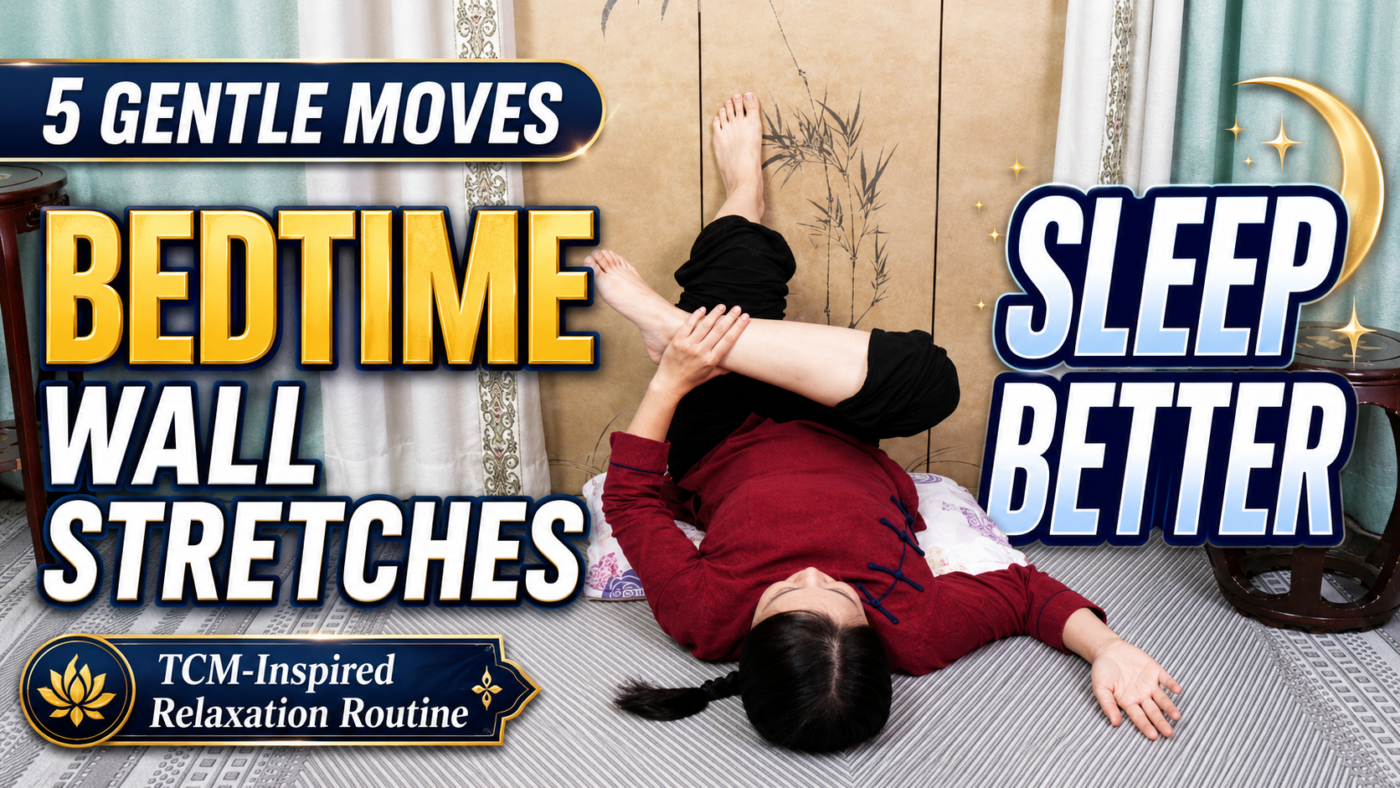
The following five movements are performed lying down near a wall. A pillow can be used for comfort, although people with lower-back problems should be cautious about placing the spine into an uncomfortable arch.
The goal is not to force the body.
The goal is to create a gentle evening routine that encourages relaxation and comfortable mobility.
Why Practice Gentle Stretching Before Bed?
Many people spend much of the day sitting.
The hips remain flexed for hours, the inner and outer thighs move through relatively little range, and the shoulders may remain rounded forward.
By nighttime, the body can feel stiff even when there is no actual injury.
A gentle stretching routine may provide a useful transition between daytime activity and sleep.
Slow breathing is equally important.
When the movements are performed without rushing, a few minutes of quiet breathing and low-intensity stretching can help shift attention away from the day’s stimulation and toward physical relaxation.
That does not mean stretching directly treats insomnia. Sleep problems can have many causes.
But a consistent wind-down routine can be one component of healthy sleep habits.
The Traditional Liver and Gallbladder Perspective
Within traditional Chinese medicine, the Liver meridian is commonly described as traveling along portions of the inner leg, while the Gallbladder meridian is traditionally associated with the outer side of the body and legs.
For this reason, many traditional mobility routines emphasize opening the inner thighs, outer hips, groin, and sides of the legs.
The movements below preserve that traditional logic.
Modern anatomy offers another way to understand them.
Instead of “opening blocked meridians,” these positions can be described as gently lengthening muscles around the hips and thighs, encouraging joint mobility, and increasing awareness of breathing and body position.
Both perspectives can be discussed, as long as traditional meridian concepts are not confused with anatomical blood vessels, nerves, or organs.
Movement 1: Legs Up the Wall With Relaxed Breathing
Begin by sitting beside a wall and carefully turning onto your back so that your legs can rest upward against the wall.
Allow your hips to come reasonably close to the wall without forcing the position.
If it feels comfortable, place a thin pillow or folded towel beneath the pelvis or lower back. If this creates pressure or excessive arching, remove it.
Keep the legs approximately hip-width apart.
Let the arms rest comfortably at your sides, or bend the elbows and allow the forearms to relax.
Close your eyes if that feels comfortable.
Bring your attention to your breathing.
Inhale slowly.
Then exhale gradually without forcing the breath.
Continue for about one to two minutes.
This is the simplest position in the routine.
From a traditional perspective, practitioners may describe it as supporting the smooth flow of the Liver and Pericardium meridians and helping settle excessive internal “heat.”
From a modern perspective, the more defensible benefits are relaxation, gentle positional change for the legs, awareness of breathing, and a quiet period of reduced muscular effort.
Some people also find the legs-up-the-wall position comfortable after spending a long day standing.
It should not, however, be described as a method for detoxifying the body or treating liver disease.
Movement 2: Wall-Assisted Inner-Thigh Opening
Remain on your back with both legs resting against the wall.
Slowly allow your legs to separate toward each side.
Do not try to force them as wide as possible.
Let gravity gradually create a stretch.
Your arms can remain relaxed beside your body.
Close your eyes and breathe naturally.
Stay in a comfortable position for approximately one to two minutes.
You may feel a stretch along the inner thighs and groin.
That sensation should be noticeable but manageable.
Sharp pain, burning, numbness, or an intense pulling sensation is a reason to reduce the range immediately.
Traditional Chinese exercise may describe this position as stretching the Liver meridian because of its emphasis on the inner legs.
From a modern movement perspective, it primarily creates a gentle stretch through the hip adductors and surrounding tissues.
People who sit for long periods may find this especially relaxing.
The original traditional explanation sometimes claims that this position removes toxins, corrects internal-organ prolapse, eliminates leg swelling, and reshapes the legs.
Those claims go beyond what this stretch can reasonably be expected to do.
It may temporarily make the legs feel lighter or less tense, but it should not be used as a treatment for unexplained swelling or internal-organ problems.
Persistent or one-sided leg swelling deserves medical evaluation.
Movement 3: Gentle Wall-Supported 90/90 Hip Rotation
Return the legs toward the center and bend both knees.
Now begin creating a gentle rotational position through the hips.
Allow one thigh to rotate inward while the opposite leg opens outward, creating a shape similar to a relaxed 90/90 or zigzag position.
The exact angles do not need to be perfect.
The wall is simply providing support.
Hold the position for about one minute, or less if the hips feel tight.
Then change sides.
This movement introduces rotation rather than simply opening the legs apart.
From a traditional perspective, it may be described as working through pathways associated with the Liver, Gallbladder, Stomach, and Pericardium meridians.
From a modern anatomical perspective, it challenges internal and external hip rotation.
Hip rotation is useful in many ordinary activities, including walking, changing direction, getting up from the floor, and stepping into or out of a vehicle.
People with stiff hips often benefit more from a small comfortable range practiced regularly than from forcing a dramatic stretch.
This movement should not be promoted as a treatment for reproductive disorders, pelvic disease, or other medical conditions.
Its most credible role is improving comfort and movement awareness around the hips.
Movement 4: Reclined Figure-Four Hip Stretch
Begin again with both knees bent.
Place your right ankle across the left thigh, just above the knee.
Keep the right foot gently flexed if that feels comfortable.
You can leave the left foot against the wall, or carefully bring the left thigh toward the body.
If reaching is comfortable, thread one hand between the legs and the other around the outside of the thigh, then hold behind the left thigh.
Gently draw the leg toward you until you feel a stretch through the right buttock and outer hip.
Do not pull aggressively.
Hold for approximately 30 seconds to one minute.
Then switch sides.
This is essentially a reclined figure-four stretch.
Many people feel it through the gluteal muscles, deep hip rotators, and posterior hip.
Traditional explanations may connect this area with the Gallbladder and Liver pathways.
The modern movement interpretation is simpler: it is a hip mobility stretch.
Some people with mild muscular stiffness around the hips or buttocks may feel temporarily more comfortable afterward.
But this distinction matters: the movement does not reliably treat sciatica, lumbar disc disease, pelvic disorders, or chronic back injury.
In fact, some people with true sciatic nerve irritation can find deep hip stretching uncomfortable.
If the stretch produces shooting pain, tingling, numbness, or symptoms traveling down the leg, stop rather than pushing through it.
Movement 5: Wall-Supported Butterfly With Overhead Reach
Finish with both knees bent.
Bring the soles of the feet together and allow the knees to move gently outward.
There is no need to press the knees toward the wall.
Let the hips relax as much as they comfortably can.
As you inhale, slowly reach your arms overhead.
As you exhale, allow your shoulders, chest, abdomen, and legs to soften.
Continue breathing in this rhythm for approximately one to two minutes.
This position combines a gentle inner-thigh opening with an upper-body reach.
Traditional practice may describe the movement as influencing the Liver, Large Intestine, and Pericardium meridians.
From a modern standpoint, it combines hip abduction, gentle adductor stretching, shoulder movement, and slow breathing.
That makes it an appropriate final position because it is relatively passive and can be performed at a calming pace.
What Should You Feel During the Routine?
You may notice stretching through the inner thighs, outer hips, buttocks, calves, or lower back depending on your individual mobility.
You may also notice that your breathing becomes slower as the routine progresses.
Those are reasonable responses.
Pain is not required.
The original exercise description encourages people to tolerate a strong, even painful inner-thigh stretch.
That is unnecessary.
A stretch does not become more effective simply because it hurts more.
Stay within a range in which you can breathe normally and maintain control.
Can These Exercises “Detox” the Liver?
Not in the literal medical sense.
Your liver, kidneys, gastrointestinal tract, lungs, and other organs continuously process and eliminate metabolic waste.
Stretching does not mechanically squeeze toxins from the liver or clean the bloodstream.
The word “detox” is frequently used differently in traditional wellness language.
In that context, people may use it to describe feeling lighter, less bloated, more relaxed, or more comfortable after movement.
Those subjective experiences can be real without meaning that toxins were physically removed by a stretch.
For a health publication, keeping this distinction clear is important.
Can These Movements Improve Sleep?
Possibly, but not because they directly “clear Liver fire.”
A gentle bedtime routine may help some people relax.
Slow breathing, lower stimulation, quiet movement, and consistency can all contribute to creating a predictable transition toward sleep.
However, chronic insomnia can be associated with stress, sleep apnea, medications, pain, depression, anxiety, hormonal changes, irregular schedules, and many other factors.
A stretching routine should therefore be considered supportive rather than curative.
Can They Make Your Legs Slimmer?
Stretching alone does not selectively burn fat from the thighs.
There is no exercise that reliably removes fat from one specific body area.
What stretching can do is improve flexibility, reduce a temporary feeling of tightness, and help people move more comfortably.
Changes in body composition depend primarily on overall energy balance, physical activity, nutrition, genetics, and other factors.
So it is better to describe these as leg-mobility exercises rather than “leg-slimming” exercises.
What About Skin and Beauty Benefits?
The original routine also connects these movements with clearer skin, reduced blemishes, and facial rejuvenation.
There is no good reason to promise those effects from these specific stretches.
Skin appearance is influenced by many factors, including genetics, sun exposure, sleep, hydration, nutrition, hormones, smoking, skincare, and medical conditions.
Relaxation and better overall lifestyle habits may indirectly support how a person looks and feels, but these exercises are not a dermatological treatment.
How to Use This as a Bedtime Routine
You do not need to perform each position for the maximum duration immediately.
A beginner may spend only 30 to 60 seconds in each position.
Move gently from one exercise to the next.
If a position feels particularly comfortable, remain there slightly longer.
If another feels awkward, reduce the range or skip it.
The entire routine can take approximately five to ten minutes.
That is enough to create a calming movement practice without turning bedtime into another demanding workout.
When You Should Be More Cautious
These exercises are gentle, but they are not appropriate for everyone.
People with recent hip or spine surgery, acute back pain, severe osteoporosis, significant hip or knee disease, uncontrolled cardiovascular conditions, severe dizziness, or neurological problems should seek individualized guidance before attempting unfamiliar stretching positions.
People with glaucoma or medical conditions for which prolonged leg elevation or inverted positioning has been restricted should also obtain professional advice.
Pregnant individuals may require position modifications, particularly later in pregnancy.
If a movement causes sharp pain, numbness, tingling, dizziness, or unusual shortness of breath, stop.
A Better Way to Think About “Liver and Gallbladder Wellness”
Traditional Chinese medicine often uses the language of flow, stagnation, heat, qi, and meridians.
Modern medicine uses anatomy, physiology, biochemistry, and measurable disease processes.
These frameworks are not interchangeable.
But they can sometimes meet at a practical point: movement.
A person who spends ten quiet minutes stretching the hips, breathing slowly, and reducing muscular tension before bed may genuinely feel calmer and more comfortable.
That experience does not require claiming that toxins have been physically expelled or that an organ has been medically treated.
The movement itself can still be worthwhile.
The Takeaway
The strongest part of this traditional five-movement routine is not the promise of detoxification.
It is the combination of gentle hip opening, leg elevation, rotational mobility, controlled breathing, and relaxation.
Practiced comfortably, these positions may help reduce the sensation of stiffness, encourage hip mobility, and create a calmer bedtime routine.
Traditional Chinese wellness practitioners may describe these benefits in terms of supporting the smooth flow of Liver and Gallbladder qi.
Modern exercise science would describe them primarily as mobility and relaxation exercises.
You do not have to force either explanation.
Move slowly.
Stay within a comfortable range.
Breathe naturally.
And allow the routine to serve its most realistic purpose: helping your body transition from a busy day into a quieter evening.
Frequently Asked Questions
Can I do all five exercises every night?
If the movements feel comfortable and do not create excessive soreness, many people can use them as a light evening routine. Daily practice is not required, however. Frequency should depend on your mobility, comfort, and recovery.
Do I need a pillow under my lower back?
No. A pillow is optional. If it causes your lower back to arch excessively or creates discomfort, remove it.
How long should I hold each stretch?
About 30 seconds to two minutes is sufficient for most gentle stretching. There is no need to remain in a painful position.
Are these exercises really for the Liver meridian?
That description comes from traditional Chinese medicine. Modern anatomy does not recognize meridians as anatomical structures. The exercises can still be practiced as mobility and relaxation movements.
Can this routine treat fatty liver or gallbladder disease?
No. Stretching does not treat fatty liver disease, gallstones, hepatitis, or other liver and gallbladder disorders. Those conditions require appropriate medical assessment and management.
Can these exercises cure sciatica?
No. Some of the hip stretches may feel comfortable for certain people, while others with nerve irritation may feel worse. Persistent or radiating nerve pain should be assessed appropriately.
Is pain necessary for the stretch to work?
No. Mild to moderate tension is enough. Sharp or severe pain is a reason to reduce the stretch or stop.
Medical Disclaimer
This article is for educational and general wellness purposes only and is not medical advice. Traditional Chinese medicine concepts discussed here represent a traditional wellness framework and should not be interpreted as established anatomical or physiological mechanisms. These exercises are not treatments for liver disease, gallbladder disease, insomnia, reproductive disorders, chronic pain, sciatica, edema, or other medical conditions. Anyone with significant medical problems, recent surgery, unexplained swelling, neurological symptoms, or concerns about exercise safety should seek individualized advice from a qualified healthcare professional.
This article is for general education and does not replace individualized care from a qualified health professional. Seek appropriate advice for persistent, severe, or concerning symptoms.
Read the full medical disclaimer