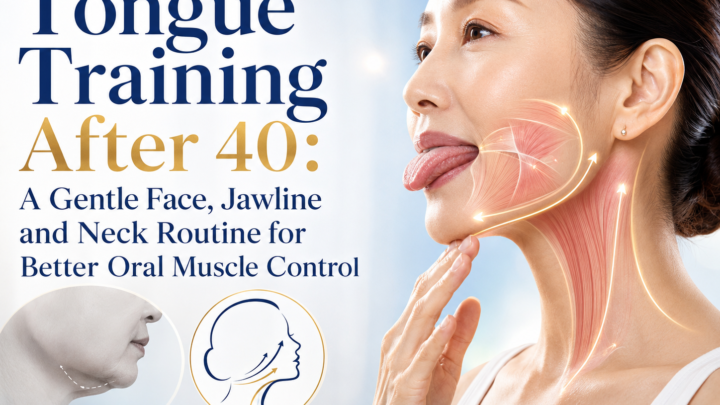
Tongue exercises for jawline support are often included in facial and oral-motor routines because the tongue interacts with muscles of the mouth, jaw, throat, and upper neck. While these exercises cannot reshape facial bones or guarantee a sharper jawline, they may help improve tongue control, oral-motor strength, swallowing awareness, and coordination around the chin and neck.A defined jawline is often associated with skin elasticity, body composition, facial structure, and muscle tone. But there is another structure that is frequently overlooked in facial exercise routines: the tongue.
The tongue is not just involved in speaking and eating. It also contributes to swallowing, oral posture, airway function, and coordinated movement across the mouth, jaw, and throat. Because of that, tongue exercises can be useful for improving oral-motor awareness and control.
They may also make the muscles under the chin and around the jaw feel more active, especially when combined with neck and facial movement.
However, it is important to separate realistic benefits from exaggerated claims. Tongue exercise cannot reliably “melt” a double chin, detox the face, reverse neurological aging, or permanently lift sagging skin. Those outcomes depend on many different factors.
What tongue exercise can do is improve movement awareness, coordination, and muscle activity in the tongue, mouth, jaw, and surrounding structures.
Why Tongue Movement Matters
The tongue is controlled by several cranial nerves and works together with muscles of the jaw, neck, and throat.
It helps with:
speech,
chewing,
swallowing,
oral posture,
and moving food safely through the mouth.
Because tongue movement is neurologically controlled, an obvious new inability to move the tongue normally, especially if it occurs suddenly, can be medically important.
For example, if someone suddenly cannot move the tongue properly to one side, or develops facial weakness, slurred speech, numbness, severe headache, confusion, or difficulty swallowing, they should seek medical attention promptly.
That is very different from simply having one side that feels slightly tighter during an exercise.
A Simple Tongue Mobility Check
Stand or sit in front of a mirror.
Relax your jaw.
Gently stick your tongue out.
Move it slowly toward the right.
Return to the center.
Then move it toward the left.
Do not force it.
Notice:
whether both sides move comfortably,
whether there is pain,
whether the tongue visibly deviates,
and whether the movement feels dramatically different from your usual ability.
Small side-to-side differences are not automatically abnormal.
But a sudden or significant change in tongue movement should not be ignored.
Can Tongue Exercises Detect Brain or Nerve Disease?
This claim needs careful wording.
Tongue movement is part of a neurological examination, and doctors may assess it when evaluating certain nerve or brain conditions.
But routine tongue exercise is not a validated screening test for neurological disease.
It would therefore be inaccurate to say that regular tongue exercise can reliably detect brain or nerve disorders early.
It is more accurate to say that paying attention to normal movement patterns may help someone notice an unusual new change that deserves medical evaluation.
That is a much safer and more evidence-based way to describe the idea.
Can Tongue Training Prevent Brain Aging?
There is not enough evidence to support the claim that tongue exercise directly prevents brain or nerve aging.
Oral-motor activity certainly involves the nervous system, but that does not mean tongue exercise has been proven to slow neurological aging.
Healthy aging is much more strongly supported by broader habits such as:
regular physical activity,
good cardiovascular health,
adequate sleep,
social engagement,
mental stimulation,
balanced nutrition,
and management of blood pressure and metabolic health.
Tongue training may be a useful oral-motor exercise, but it should not be presented as an anti-aging treatment for the brain.
Can Tongue Exercises Improve the Jawline?
This is where expectations need to stay realistic.
The muscles involved in tongue movement connect functionally with structures under the jaw and around the floor of the mouth.
When you actively move the tongue, you can feel increased muscular effort in the submental area beneath the chin.
This may improve muscle awareness and temporarily create a firmer sensation.
But a visible double chin can result from several different factors:
subcutaneous fat,
genetics,
skin laxity,
facial anatomy,
age-related tissue changes,
posture,
and jaw structure.
Tongue exercises cannot selectively remove fat from beneath the chin.
They also cannot permanently tighten loose skin.
They may, however, complement a broader routine that includes posture, neck strength, healthy body composition, and general physical activity.
Tongue and Neck Exercise Routine
The original routine combines neck stretching, massage, tongue movements, and facial expressions.
Below is a cleaner and more realistic version.
Move gently and stop if you experience pain, dizziness, jaw locking, cramping, or unusual neurological symptoms.
Tongue Exercises for Jawline: What Can They Actually Do?
Tongue exercises mainly train the muscles involved in tongue movement and oral function. They may improve muscle awareness and control around the mouth, floor of the mouth, and upper neck, but they should not be presented as a way to permanently change bone structure or remove facial fat.
Exercise 1: Neck Stretch
Sit or stand upright.
Place your right hand over your left shoulder or upper chest.
Gently tilt your head away from that side.
Keep your shoulders relaxed.
Breathe slowly.
Hold the stretch for several comfortable breaths.
Return to center.
Repeat on the other side.
This is intended to reduce unnecessary tension around the neck before beginning the tongue exercises.
Exercise 2: Gentle Neck Massage
Use your fingertips to massage the side of the neck.
Avoid pressing deeply over the front of the throat or directly over the carotid artery.
Move slowly.
Focus on superficial tension rather than trying to “break up” tissue.
Repeat on the opposite side.
The goal is comfort and relaxation.
Exercise 3: Tongue Right and Left
Relax the jaw.
Stick your tongue out comfortably.
Move it toward the right.
Return to center.
Move it toward the left.
Continue slowly.
Once the movement feels easy, you can increase the rhythm slightly.
Do not strain.
Quality of movement matters more than speed.
Exercise 4: Rhythmic Side-to-Side Tongue Movement
Repeat the same side-to-side movement with a steady rhythm.
Keep the jaw as relaxed as possible.
Avoid clenching the teeth.
Perform only as many repetitions as remain comfortable.
If the tongue begins to cramp, stop and rest.
Exercise 5: Gentle Massage at the Back of the Head
Place your fingertips near the base of the skull.
Massage gently.
This may help reduce perceived tension around the upper neck.
The original routine suggests a direct connection between the back of the head and tongue muscles, but this should not be overstated.
There are anatomical and neurological relationships between cranial structures, neck muscles, and oral function, but simple scalp or occipital massage has not been proven to directly strengthen the tongue.
Use this step mainly for relaxation.
Exercise 6: Look Up and Extend the Tongue
Lift the chin slightly.
Do not throw the head far backward.
Open the mouth gently.
Extend the tongue.
Relax.
Repeat.
You may feel muscular activity beneath the jaw.
Keep the movement mild.
If you have neck problems, reduce the head extension or keep the head neutral.
Exercise 7: Tongue Left and Right With the Chin Slightly Raised
Keep the head in a comfortable position.
Extend the tongue.
Move it left and right.
This increases the demand on the tongue and floor-of-mouth muscles.
Again, this does not directly remove chin fat.
Think of it as an oral-motor strengthening drill.
Exercise 8: Trace the Upper Gum
Close the lips lightly.
Place the tip of your tongue against the upper gumline behind the teeth.
Slowly trace from one side to the other.
Keep the jaw relaxed.
Then reverse direction.
This challenges tongue control without requiring large jaw movement.
Exercise 9: Tongue Circles
With the lips closed, trace a large circle around the inside of your mouth with the tongue.
Move slowly.
Complete several circles in one direction.
Then reverse.
This may fatigue the tongue quickly, so keep the volume moderate.
Exercise 10: Facial Relaxation and Lift
Relax your forehead.
Soften the area between your eyebrows.
Gently lift the corners of your mouth.
Avoid aggressively squinting the eyes.
Think of widening and lengthening the face rather than forcing a dramatic expression.
Breathe normally.
This step is best understood as a facial-awareness exercise rather than a proven anti-aging treatment.
Can Tongue Exercise Reduce Facial Puffiness?
The original routine claims tongue movement improves lymphatic flow and helps remove toxins and excess fluid.
That is too strong.
There is no good evidence that tongue exercises “detox” the face.
The body already removes metabolic waste through systems involving the liver, kidneys, lungs, gastrointestinal tract, and lymphatic system.
Facial puffiness can change for many reasons, including:
sleep,
salt intake,
allergies,
hydration,
hormonal changes,
inflammation,
and body position.
Gentle facial and neck movement may temporarily change how tissues feel, but it should not be described as toxin removal.
What About a Double Chin?
A double chin is usually caused by some combination of:
fat under the chin,
skin laxity,
genetics,
facial structure,
and aging.
Tongue exercises may activate the muscles under the chin.
That can be worthwhile.
But they do not selectively burn fat.
If body-fat reduction is a goal, the more reliable strategies remain:
regular exercise,
appropriate calorie intake,
adequate protein,
resistance training,
sleep,
and long-term consistency.
Some cosmetic procedures can also address submental fat or loose skin, but those require professional assessment.
Why the Tongue Still Deserves Attention
Even though some cosmetic claims are exaggerated, tongue function matters greatly.
Weakness or poor coordination can affect:
speech,
swallowing,
chewing,
and oral function.
Tongue-strengthening exercises are sometimes used in rehabilitation settings, particularly for selected swallowing disorders.
That does not mean everyone needs intensive tongue training.
But gentle movement work can be a useful way to maintain oral-motor awareness.
A Simple 5-Minute Daily Routine
If you want a shorter version, try this:
Minute 1: Gentle neck stretches.
Minute 2: Tongue right and left.
Minute 3: Trace the upper gum and perform tongue circles.
Minute 4: Gentle tongue extension with the head neutral or slightly raised.
Minute 5: Relax the face, soften the forehead, and practice slow breathing.
That is enough for most people.
More is not necessarily better.
When to Stop and Seek Medical Advice
Do not treat tongue asymmetry as a cosmetic issue if it appears suddenly.
Seek medical evaluation if you develop:
sudden tongue weakness,
new facial drooping,
slurred speech,
difficulty swallowing,
numbness,
severe dizziness,
confusion,
or weakness in an arm or leg.
Those symptoms may require urgent assessment.
Also consider professional evaluation if tongue movement is consistently painful, severely limited, or associated with repeated choking or swallowing difficulty.
The Bigger Picture: Jawline Appearance Is Multifactorial
A sharper-looking jawline is rarely created by one exercise.
Its appearance depends on several components:
bone structure,
skin elasticity,
body fat,
muscle tone,
neck posture,
hydration,
lighting,
and age.
Tongue exercise may contribute to muscular awareness under the jaw, but it is only one small part of the picture.
That is why the most realistic goal is not:
“Erase my double chin with one exercise.”
A more useful goal is:
Improve oral function, facial muscle awareness, posture, and movement while maintaining healthy overall habits.
Final Takeaway
Tongue exercises can be a gentle way to train oral-motor control, increase awareness of the muscles under the jaw, and add variety to a face-and-neck routine.
They may make the jaw and chin area feel more active, but they should not be promoted as a method to detox the face, prevent neurological aging, eliminate localized fat, or permanently reverse skin sagging.
Use them for what they can realistically provide:
better movement awareness, tongue coordination, oral function, neck relaxation, and facial muscle control.
Medical Disclaimer
This article is for educational purposes only and is not medical advice. Sudden tongue weakness, facial drooping, speech changes, swallowing difficulty, or other new neurological symptoms require prompt medical evaluation.
This article is for general education and does not replace individualized care from a qualified health professional. Seek appropriate advice for persistent, severe, or concerning symptoms.
Read the full medical disclaimer