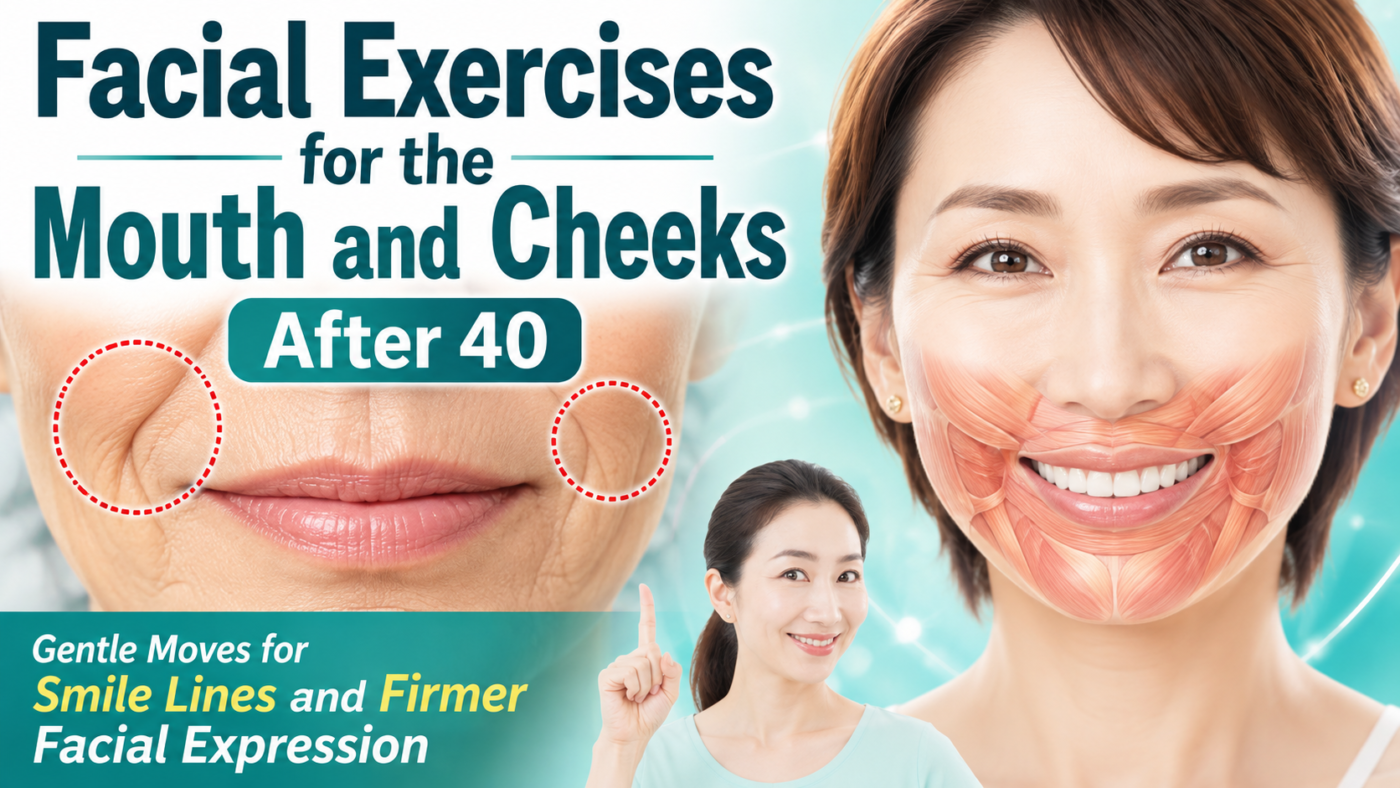
Facial exercises after 40 can be a simple way to train the muscles around the mouth and cheeks while improving facial awareness and expression.
We train the legs to stay strong.
We train the back to maintain posture.
We exercise the heart and lungs for cardiovascular health.
But what about the muscles of the face?
The face contains a complex network of small muscles that help us smile, speak, chew, close the lips, raise the cheeks and create nearly every expression we make.
With age, these muscles do not simply “switch off,” but facial appearance does change because of a combination of skin aging, fat redistribution, bone remodeling, connective-tissue changes and muscle activity.
That raises an interesting question:
Can facial exercises improve muscle control around the mouth and cheeks—and can that make the face look a little more refreshed?
The answer is more nuanced than many anti-aging claims suggest.
Facial exercise cannot erase deep wrinkles or permanently lift sagging skin.
But regular, gentle practice may improve awareness and coordination of facial muscles, temporarily increase local circulation and potentially influence facial fullness or expression in subtle ways.
Why the Area Around the Mouth Changes With Age
The mouth and lower face are especially expressive regions.
They are affected by:
Skin thinning.
Collagen loss.
Repeated facial expressions.
Changes in facial fat compartments.
Dental changes.
Bone remodeling.
Sun exposure.
Smoking.
Genetics.
Muscle activity.
That is why smile lines, lip lines and changes in cheek contour become more noticeable over time.
No single facial muscle is responsible.
The Main Muscles Around the Mouth and Cheeks
Several muscles in the original routine are real and important.
Orbicularis Oris
The orbicularis oris surrounds the mouth.
It helps:
Close the lips.
Pucker the lips.
Control speech.
Shape facial expressions.
It is heavily involved when you make a “kiss” or “pout” shape.
Levator Labii Superioris
This muscle helps elevate the upper lip.
It contributes to expressions around the nose and upper mouth.
Zygomaticus Major
The zygomaticus major is one of the major smiling muscles.
It helps pull the corners of the mouth upward and outward.
It plays a key role in a broad smile.
Does Facial Exercise Prevent the Face From Aging First?
No.
The claim that “bones and muscles deteriorate from the face first” is not a recognized rule of human aging.
Different tissues age at different rates.
The face changes visibly because its structures are exposed and highly expressive.
But there is no evidence that facial bones universally deteriorate before the rest of the skeleton.
Can Facial Exercise Stop Facial Aging?
No.
Facial aging cannot be prevented entirely.
But some habits may help maintain:
Muscle coordination.
Facial awareness.
Comfort.
Expression control.
Skin health.
The strongest anti-aging measures still include sun protection, avoiding smoking, adequate sleep, good nutrition and evidence-based skincare.
Can Facial Exercise Reduce Smile Lines?
Possibly to a limited degree, but expectations should remain realistic.
Nasolabial folds are influenced by:
Cheek volume.
Skin elasticity.
Facial fat distribution.
Bone structure.
Ligament changes.
Repeated movement.
Facial exercise cannot permanently erase them.
However, improving muscle control and reducing excessive tension may alter expression enough to make the area look temporarily softer.
Start With the Neck
Before training the face, relax the neck.
Place one hand gently on the side or top of the head.
Tilt the head slightly.
Do not pull aggressively.
Breathe slowly.
Hold for several breaths.
Switch sides.
This can help reduce upper-neck tension before facial movement.
Why Neck Relaxation Matters
The neck does not mechanically “pull the face down” in a simple way.
But tension in the neck and jaw often occurs together.
Relaxing the neck may make it easier to perform facial exercises without clenching.
Add an Overhead Stretch
Bring the hands together.
Reach upward.
Lengthen through the torso.
Breathe in.
Exhale and relax.
Repeat gently.
This step is mainly for posture and whole-body relaxation.
Shoulder and Side-Neck Stretch
Place one hand on the opposite shoulder.
Tilt the head away slightly.
Keep the shoulders relaxed.
Do not force the stretch.
Repeat on the other side.
Gentle Neck Massage
Use the fingertips on the sides of the neck.
Avoid strong pressure over the front of the throat.
Massage slowly.
The goal is relaxation, not “draining stagnant lymph.”
Does Neck Massage Improve Lymph Flow?
Gentle massage can influence superficial fluid movement.
But soreness does not prove lymphatic blockage.
And ordinary neck rubbing should not be described as medically “clearing” the lymphatic system.
Ear Massage
Gently rub the outer ears.
Move slowly around the rim.
This can be included as a relaxing sensory warm-up.
There is no need to assign dramatic anti-aging effects to it.
Exercise 1: High Pout
Purse the lips forward.
Imagine making a gentle kiss shape.
Lift the lips slightly upward.
Do not strain.
Hold briefly.
Relax.
What Does the High Pout Train?
This mainly engages the orbicularis oris and surrounding facial muscles.
It can increase awareness of the muscles around the lips.
Move the Pout to the Right
Keep the lips gently pursed.
Shift them slightly toward the right.
Do not force the jaw.
Return to center.
Move the Pout to the Left
Repeat on the other side.
Compare both directions.
It is common for one side to feel easier.
Is Facial Asymmetry Normal?
Yes.
Most human faces are naturally asymmetric.
Differences can come from:
Habitual chewing.
Sleeping position.
Dental structure.
Facial expression habits.
Muscle dominance.
Minor asymmetry is normal.
Exercise 2: Rolled-Lip Smile
Gently bring the lips inward over the teeth.
Then try to smile.
Lift the corners of the mouth.
Avoid wrinkling the forehead.
Hold briefly.
Relax.
Which Muscles Are Working?
This variation combines several facial muscles, including:
Orbicularis oris.
Zygomaticus major.
Other lip elevators and cheek muscles.
Because the lips are held differently, the smile may feel more difficult than usual.
Can This Make the Lips Look Fuller?
Possibly temporarily.
Muscle activity can increase local blood flow.
That may make the lips look slightly more flushed or full for a short period.
But facial exercise does not permanently add lip volume.
Repeat Slowly
Try several repetitions.
Quality matters more than speed.
Avoid pulling or distorting the skin aggressively.
Facial exercise should not hurt.
Massage After the Exercise
Use fingertips around the corners of the mouth.
Make very small circles.
Keep pressure light.
This may reduce the sensation of muscle fatigue.
Does Pain Mean the Exercise Is Working?
No.
Pain is not required.
Mild muscular fatigue is different from sharp or persistent pain.
If the jaw, lips or face hurt, reduce intensity.
Exercise 3: Gentle Lip Suction
Draw the lips inward gently.
Create a narrow line with the mouth.
Do not bite.
Hold briefly.
Relax.
What Does This Do?
This changes the way the orbicularis oris contracts.
It may improve awareness of lip control.
It should not be interpreted as literally “sucking sagging skin upward.”
Can This Erase Wrinkles Around the Mouth?
No.
Repeated muscle contraction cannot erase established wrinkles.
In fact, aggressive repetitive facial movement can potentially emphasize dynamic lines in some people.
The goal should be gentle control rather than exaggerated force.
Exercise 4: Cheek Inflation
Close the lips.
Fill the mouth gently with air.
Let the cheeks expand.
Keep the jaw relaxed.
Hold.
Release.
Move the Air Around
Shift the air toward one cheek.
Then the other.
You may feel a clear difference between sides.
This can be a useful coordination exercise.
Does Puffing the Cheeks “Peel” the Muscles From the Nose?
No.
The tissues around the nose and cheeks are not being peeled away from the bone.
The air simply creates internal pressure against the cheeks.
That stretches the soft tissue temporarily.
Is Cheek Puffing Safe?
For most healthy adults, gentle cheek inflation is harmless.
Avoid extreme pressure.
People with recent oral surgery or certain dental conditions should wait until appropriately healed.
Exercise 5: Targeted Cheek Inflation
Place fingertips lightly beside the nose.
Inflate the cheek underneath.
Feel the tissue expand.
Do not press hard.
Switch sides.
Why This Can Be Useful
The exercise helps you notice how each side of the cheek moves.
That may improve facial awareness and coordination.
It is not a structural facelift.
Exercise 6: Controlled Smile
Relax the forehead.
Gently lift the corners of the mouth.
Allow the cheeks to rise.
Keep the jaw relaxed.
Hold for several seconds.
Then release.
Why Smile Training Can Feel Different
Many people habitually smile using excessive tension in the jaw or forehead.
A controlled smile teaches you to use the cheeks while keeping other areas relaxed.
That may create a softer expression.
Can Expression Training Make You Look Younger?
Expression affects appearance.
A relaxed face can look different from a tense face.
Reducing habitual clenching and learning smoother facial movements may create a more refreshed appearance.
But that is different from reversing biological aging.
The Role of Blood Flow
Facial movements can temporarily increase local circulation.
The skin may appear warmer or more colorful after exercise.
That is a normal short-term response.
It does not mean wrinkles have been permanently removed.
Can Facial Exercise Build Muscle?
Facial muscles can respond to repeated use.
Some limited research suggests facial exercise programs may influence cheek fullness or perceived age.
However, the evidence remains much smaller and weaker than the evidence supporting conventional resistance training for the body.
Results should not be exaggerated.
Could Facial Exercise Make Wrinkles Worse?
Potentially, if done aggressively.
Repeated extreme expressions can contribute to dynamic wrinkles.
That is why facial exercise should emphasize:
Moderate range.
Controlled movement.
Relaxation.
Minimal skin pulling.
No excessive repetition.
A 10-Minute Mouth and Cheek Routine
Minute 1: Neck Relaxation
Gentle side stretch.
Minute 2: Shoulder and Neck Release
Breathe slowly.
Minute 3: High Pout
Lift gently.
Minute 4: Right and Left Pout
Move slowly.
Minute 5: Rolled-Lip Smile
Keep the forehead relaxed.
Minute 6: Mouth-Area Massage
Use gentle circles.
Minute 7: Lip Suction
Short controlled holds.
Minute 8: Cheek Inflation
Use both sides.
Minute 9: Side-to-Side Air Transfer
Compare coordination.
Minute 10: Relaxed Smile
Finish without strain.
How Often Should You Practice?
A few minutes several times per week is reasonable.
Daily practice may also be comfortable for some people.
But more is not automatically better.
If the jaw becomes tired or the skin feels irritated, reduce frequency.
What About Nasolabial Folds?
Nasolabial folds are normal anatomical structures.
They become deeper with age because of multiple structural changes.
Exercises may change expression around them.
They cannot reliably erase them.
What About Fine Lines Around the Lips?
Common causes include:
Sun exposure.
Smoking.
Skin aging.
Repeated lip movement.
Loss of collagen.
Genetics.
Facial exercise is unlikely to be enough on its own.
Better Evidence-Based Ways to Protect the Mouth Area
Use broad-spectrum sunscreen.
Avoid smoking.
Use moisturizer.
Consider retinoids when appropriate.
Protect lips from excessive sun exposure.
Maintain adequate nutrition.
Discuss professional treatments with a qualified clinician if desired.
Facial Exercise and Botox Are Not the Same
Botulinum toxin reduces muscular contraction.
Facial exercise increases or retrains muscular activity.
They operate in very different ways.
One should not be marketed as a direct replacement for the other.
Facial Exercise and Fillers Are Also Different
Fillers add volume.
Exercise does not.
No amount of smiling or puckering can replace volume that has been structurally lost.
What Facial Exercise May Realistically Improve
Potential benefits include:
Better facial muscle awareness.
Improved movement coordination.
Temporary circulation increase.
Relaxation.
Reduction in habitual tension.
A more controlled smile.
Possibly subtle changes in facial fullness with consistent practice.
What It Cannot Reliably Do
Facial exercise cannot:
Erase deep wrinkles.
Permanently remove nasolabial folds.
Lift facial bones.
Restore lost facial fat.
Guarantee younger-looking skin.
Stop aging.
Replace dermatologic treatment.
Be Gentle Around the Jaw
If you have temporomandibular joint problems, avoid extreme mouth movements.
Stop if you experience:
Jaw clicking with pain.
Locking.
Sharp facial pain.
Headaches triggered by exercise.
Dental pain.
Stop for Neurological Symptoms
Sudden facial weakness is not a cosmetic issue.
Seek urgent medical attention if facial drooping appears suddenly, especially with:
Arm weakness.
Speech problems.
Vision changes.
Severe headache.
Confusion.
A Better Goal Than “Never Sag Again”
No exercise can guarantee a permanently youthful face.
A healthier goal is:
Maintain movement.
Relax unnecessary tension.
Protect the skin.
Preserve healthy expression.
Age well.
That is both realistic and sustainable.
Facial exercises after 40 are not a replacement for dermatologic or cosmetic treatments, but they may help improve voluntary muscle control and facial awareness.
One advantage of facial exercises after 40 is that they require no equipment and can be practiced gently at home.
When practicing facial exercises after 40, avoid pulling or aggressively stretching delicate facial skin.
Consistency matters more than intensity when performing facial exercises after 40.
The realistic goal of facial exercises after 40 is better muscle control and expression—not permanently erasing wrinkles.
Final Takeaway
Facial exercises for the mouth and cheeks can be an interesting form of muscle-awareness training after 40.
Pouting, smiling, controlled lip movements and cheek inflation activate muscles such as the orbicularis oris, levator labii superioris and zygomaticus major.
These movements may improve coordination, increase temporary circulation and help some people develop a more relaxed, controlled facial expression.
But they should not be presented as a way to permanently erase wrinkles, eliminate nasolabial folds or reverse structural facial aging.
The best approach is simple:
Train gently. Avoid excessive force. Relax between repetitions. Protect your skin. And judge progress by comfort and control—not miracle before-and-after promises.
Frequently Asked Questions
Do facial exercises really work?
They can improve facial muscle awareness and coordination, but evidence for major anti-aging effects remains limited.
Can facial exercises remove nasolabial folds?
No. They may subtly change expression, but they cannot reliably erase structural smile lines.
Can facial exercises make lips fuller?
Temporary increased circulation may make lips appear slightly fuller, but exercise does not permanently add volume.
How often should I train facial muscles?
A few minutes several times per week is a practical starting point.
Can facial exercise cause wrinkles?
Aggressive and repetitive exaggerated expressions may contribute to dynamic lines, so movements should stay controlled.
What is the orbicularis oris?
It is the circular muscle around the mouth that helps close and purse the lips.
What is the zygomaticus major?
It is a major smiling muscle that pulls the corners of the mouth upward and outward.
Does cheek puffing tighten the face?
It trains coordination and stretches soft tissue temporarily, but it does not structurally lift the face.
Should facial exercise hurt?
No. Mild fatigue can occur, but pain is not necessary.
Is facial exercise suitable after 40?
For most healthy adults, gentle facial movement is reasonable, provided there is no significant jaw, dental or neurological problem.
Medical and Skincare Disclaimer
This article is for educational purposes only and is not medical diagnosis, dental treatment, dermatologic care or individualized cosmetic advice. People with significant TMJ disorders, recent facial or dental surgery, new facial weakness, severe facial pain or neurological symptoms should seek appropriate professional evaluation.
This article is for general education and does not replace individualized care from a qualified health professional. Seek appropriate advice for persistent, severe, or concerning symptoms.
Read the full medical disclaimer