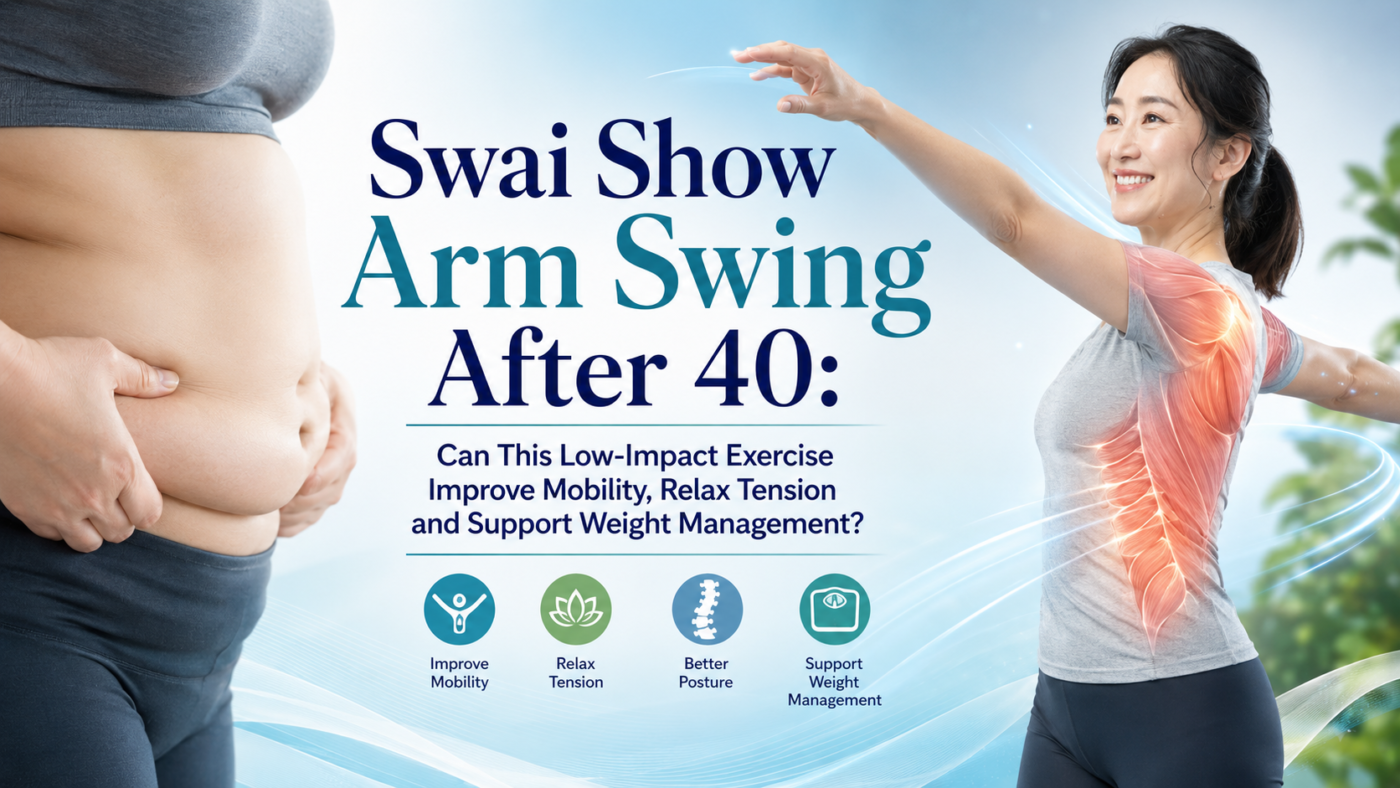
Swai Show arm swing is a simple low-impact exercise that can help adults over 40 move more, loosen tight shoulders and add gentle whole-body activity without jumping or complicated equipment.Many adults over 40 want to become more active without putting excessive stress on the knees or lower back.
Many adults over 40 want to become more active without putting excessive stress on the knees or lower back.That is one reason simple arm-swinging exercises can be appealing.
They require no equipment.
They can be performed at home.
They are easy to modify.
And they encourage movement through the shoulders, upper back, trunk and hips without the impact of running or jumping.
One traditional movement often called Swai Show, or arm swinging, is especially simple.
At first glance, it may look too easy to count as exercise.
But after several minutes, many people notice their shoulders loosening, their torso moving more freely and their body beginning to feel warmer.
Those effects are real.
What is less certain are claims that arm swinging activates “fat-eating cells,” removes toxins through the fingertips or burns fat dozens of times faster than ordinary exercise.
A more useful question is:
Can Swai Show provide enough movement to improve mobility, reduce sedentary time and support a healthier lifestyle after 40?
For many people, the answer is yes.
What Is Swai Show?
Swai Show is a simple repetitive arm-swinging practice found in several East Asian movement traditions.
The exact form varies.
A basic version involves:
Standing comfortably.
Relaxing the shoulders.
Swinging both arms forward and backward.
Allowing the torso to participate naturally.
Keeping the knees soft.
Breathing without strain.
The movement can remain very gentle or become more energetic depending on fitness and comfort.
Why Arm Swinging Can Feel Surprisingly Effective
The shoulders do not move in isolation.
When the arms swing, the shoulder blades move over the rib cage.
The upper spine rotates slightly.
The abdominal and back muscles help stabilize the trunk.
The hips and legs respond to shifting weight.
As the movement becomes larger, more of the body becomes involved.
That is why a simple arm swing can gradually feel like a whole-body exercise.
Is Swai Show Low Impact?
Generally, yes.
There is no jumping.
The feet can remain on the floor.
The range can be small.
The pace can be slow.
That makes it attractive for people who dislike high-impact workouts.
However, “low impact” does not automatically mean suitable for every knee or back problem.
Painful conditions may still require modification.
Can It Help Protect the Knees?
Arm swinging places much less impact through the knees than running or jumping.
If the knees remain softly bent without deep squatting, the load may be relatively modest.
That can make it easier for some adults to tolerate.
But knee pain has many causes.
Exercise should not be painful simply because it is labeled low impact.
What About the Lower Back?
A relaxed arm-swing routine may help people move the thoracic spine and hips instead of remaining rigid.
That can feel good after prolonged sitting.
However, excessive leaning, aggressive twisting or repeatedly arching the back can irritate some people.
Keep the spine comfortable rather than forcing it perfectly “straight.”
Do You Need to “Push the Sacrum In”?
Not literally.
The original routine uses cues such as pushing the sacrum inward, pulling the chin in and avoiding a protruding belly.
A simpler and safer cue is:
Stand tall, keep the pelvis neutral and avoid exaggerated arching of the lower back.
That is enough.
Start With Shoulder Relaxation
Place one hand over the opposite shoulder.
Let the other arm hang.
Breathe slowly.
Notice whether the arm feels heavy or tense.
Then switch sides.
The goal is to reduce unnecessary muscular effort before the main movement begins.
Let the Arms Feel Heavy
Drop the arms by your sides.
Relax the fingers.
Relax the wrists.
Let the shoulders soften.
This is important because Swai Show works best when the arms are not being forced through the movement.
Think of the arms as pendulums.
Begin With a Narrow Swing
Stand with the feet around shoulder width apart.
Keep the knees soft.
Swing the arms only a short distance forward and backward.
Do not try to generate maximum speed.
Let the shoulder joints become comfortable first.
Why Small Range First?
The shoulders may feel stiff after years of desk work.
Starting small allows:
The shoulder blades to move gradually.
The chest to relax.
The upper back to rotate.
The nervous system to become comfortable with the pattern.
Larger swings can come later.
Gradually Increase the Range
Once the shoulders feel loose, allow the arms to travel farther.
Keep the movement rhythmic.
Avoid jerking.
Do not pull aggressively at the end of the range.
The motion should remain smooth.
Why the Shoulders May Feel Lighter
After several minutes of repetitive swinging, muscle tension may decrease.
The movement also provides sensory input to the shoulders, arms and upper back.
That can create a noticeable contrast:
The arms may feel heavier and more relaxed.
The shoulders may feel lighter.
This is a reasonable nervous-system and muscular response.
Traditional “Releasing Energy” Imagery
Some Eastern movement traditions describe arm swinging as releasing unwanted or stagnant energy through the fingertips.
That language can be used as a mindfulness image.
For example:
Imagine tension leaving the hands as the arms swing.
That may help some people relax.
But it should not be interpreted as evidence that harmful energy, toxins or metabolic waste are physically leaving the body through the fingers.
Can Visualization Still Be Useful?
Yes.
Mental imagery can influence relaxation and movement quality.
You might imagine:
The shoulders becoming lighter.
The arms swinging like ropes.
Stress leaving with each exhalation.
The body becoming more fluid.
These images can be valuable without being literal physiological explanations.
Add Gentle Core Control
As the swing becomes larger, gently engage the abdominal wall.
Do not suck the belly in hard.
Do not hold the breath.
The goal is simply to keep the trunk stable enough to move comfortably.
Keep the Feet Grounded
At first, keep both feet firmly in contact with the floor.
This increases stability.
Once you feel comfortable, allow subtle weight shifts.
Do not deliberately twist the knees.
The rotation should come mainly from the hips and torso.
Add Elbow Swinging
Bring the hands toward each other.
Allow the elbows to swing.
This changes the movement pattern through the shoulders and upper back.
Keep the neck relaxed.
If the shoulders pinch or hurt, reduce the range.
Let the Spine Move Naturally
The spine does not need to remain frozen.
A small wave-like movement through the trunk can be comfortable.
The key is control.
Avoid forceful flexion and extension.
Movement should be fluid rather than exaggerated.
Add Gentle Rocking Through the Feet
Shift slightly toward the balls of the feet.
Then back toward the heels.
Keep both feet on the floor.
The movement should be subtle.
This adds ankle and calf activity and involves more of the lower body.
Does Rocking Activate More Muscles?
Yes.
Weight shifting requires participation from:
Calves.
Ankles.
Hips.
Core muscles.
Postural muscles.
That increases total movement compared with standing completely still.
Can Swai Show Raise the Heart Rate?
Yes, especially when:
The swings become larger.
The pace increases.
The knees and hips participate.
The session lasts several minutes.
It may not become vigorous cardio, but it can move you from complete rest toward light or moderate activity.
Can It Support Weight Loss?
Yes, indirectly.
Swai Show increases movement and energy expenditure.
If performed consistently, it can contribute to total daily activity.
That matters.
But weight loss still depends on long-term energy balance.
A 15-minute arm-swing session is helpful.
It cannot compensate for unlimited calorie intake.
What About Brown Fat?
Brown adipose tissue is biologically real.
Unlike white fat, brown fat specializes in producing heat.
Adults retain some brown fat, particularly around areas such as the neck and upper chest.
But the popular claim that brown fat “burns fat 70 times faster” is not a useful way to describe human weight loss.
There is no simple rule where moving the shoulder blades turns on nearby brown fat and causes rapid body-fat loss.
Does Shoulder-Blade Movement Activate Brown Fat?
There is no strong evidence that ordinary arm swinging specifically activates brown adipose tissue enough to create major weight loss.
Moving the shoulder blades is still beneficial.
It improves movement.
It engages muscles.
It increases energy expenditure.
Those explanations are sufficient.
Why the Body Feels Warm
Warmth during Swai Show can come from:
Increased muscle activity.
Increased blood flow.
Higher energy expenditure.
A modest rise in heart rate.
This is normal.
It does not prove that a special fat-burning mechanism has been activated.
Women Over 40 and Weight Gain
Weight gain after 40 is not caused simply by “loose muscles around the pelvis and shoulder blades.”
Several factors may contribute:
Lower activity levels.
Loss of muscle mass.
Hormonal changes.
Sleep disruption.
Changes in appetite.
Reduced daily movement.
Menopause-related changes in fat distribution.
Lifestyle.
That is why maintaining muscle and regular movement becomes increasingly valuable.
Muscle Can Still Improve After 40
One encouraging point from the original routine is correct:
Age does not eliminate the ability to improve muscular strength and function.
Adults can gain strength and maintain muscle well beyond 40.
Resistance training is especially effective.
Swai Show is useful for movement and mobility, but it should ideally complement strength training rather than replace it.
Add Torso Rotation
Toward the end of the routine, allow the torso to rotate gently.
Let the arms follow.
Do not force the hands around the body.
Keep the rotation comfortable.
This can increase mobility through the thoracic spine.
What Is Tanden?
Traditional Japanese and East Asian movement practices often refer to the tanden, a center in the lower abdomen associated with balance, breathing and bodily awareness.
In modern anatomical language, you can use this as a concentration cue.
Imagine movement beginning from the center of the body.
That can improve coordination.
Tanden as a Movement Cue
You do not need to treat the tanden as a measurable energy organ.
Instead, think:
Move from the center.
Stay balanced.
Let the arms follow the torso.
Breathe calmly.
That preserves the spirit of the traditional exercise while keeping the explanation grounded.
Does Centrifugal Force Remove Waste?
No.
Twisting the body does not squeeze toxins or metabolic waste out through the arms.
The liver, kidneys, lungs and gastrointestinal system manage metabolic waste.
But rotational movement does mobilize muscles and joints.
That is the real benefit.
A 15-Minute Swai Show Routine
Minutes 1–2: Shoulder Release
Relax the arms and shoulders.
Minutes 3–4: Small Arm Swings
Keep the range narrow.
Minutes 5–7: Larger Arm Swings
Increase the range gradually.
Minutes 8–9: Elbow Swing Variation
Bring more upper-back movement into the pattern.
Minutes 10–11: Weight Shifting
Rock gently from forefoot to heel.
Minutes 12–13: Torso-Led Swing
Allow controlled trunk rotation.
Minute 14: Slow Arm Swings
Reduce intensity.
Minute 15: Breathing and Relaxation
Stand quietly and notice how the shoulders and body feel.
How Hard Should It Feel?
A beginner version should feel light to moderate.
You may notice:
Warmth.
A slightly faster heart rate.
Relaxed shoulders.
Mild muscular fatigue.
Easier upper-body movement.
You should not experience sharp pain, dizziness or severe breathlessness.
Can You Do It Every Day?
For many healthy adults, yes.
Because the movement can be gentle, it is suitable for frequent practice.
Possible times include:
Morning.
During work breaks.
Before walking.
After sitting for a long period.
As part of an evening mobility routine.
Consistency is more important than intensity.
Is It Enough Exercise by Itself?
Not usually.
A complete healthy-aging program should ideally include:
Aerobic activity.
Resistance training.
Balance training.
Mobility work.
Swai Show can contribute mainly to mobility and light aerobic movement.
Pair It With Walking
A useful combination is:
10–15 minutes of Swai Show.
Then 20–30 minutes of walking.
This increases total movement without creating excessive impact.
Pair It With Strength Training
Two or more strength sessions per week can help preserve:
Muscle.
Bone.
Balance.
Metabolic health.
Useful exercises include:
Squats to a chair.
Rows.
Hip hinges.
Wall or incline push-ups.
Step-ups.
Calf raises.
Swai Show can serve as an excellent warm-up.
Can It Help Knee or Back Pain?
Some people may feel better because gentle movement reduces stiffness.
But pain relief is not guaranteed.
If movement consistently worsens pain, stop and adjust.
Persistent knee or back pain should be assessed appropriately.
Modify for Knee Problems
Keep the knees nearly straight but not locked.
Do not bounce.
Avoid deep bending.
Keep the feet planted.
Use a smaller range.
Modify for Back Problems
Reduce torso rotation.
Keep the swing primarily in the shoulders.
Avoid forceful forward and backward rocking.
Stop if symptoms radiate into the legs.
Modify for Balance Problems
Stand near a wall or sturdy chair.
Use a wider stance.
Keep the swing small.
Do not close the eyes.
Safety matters more than range.
Traditional Practice and Modern Exercise Science
Swai Show can be appreciated in both frameworks.
Traditional language emphasizes:
Energy.
Relaxation.
Mind-body connection.
Flow.
Modern exercise science emphasizes:
Joint movement.
Muscle activity.
Circulation.
Energy expenditure.
Balance.
Coordination.
These approaches do not need to cancel each other out.
The traditional imagery can remain part of the practice while physiological claims are kept accurate.
What Results Can You Expect Immediately?
After one session, you may notice:
Looser shoulders.
Warmer hands.
Reduced upper-body tension.
Easier torso rotation.
A mild increase in energy.
A calmer mental state.
These are reasonable short-term benefits.
What You Should Not Expect
One session will not:
Burn 20 pounds of fat.
Activate a 70-times-faster fat-burning system.
Remove toxins through the fingertips.
Permanently fix back pain.
Eliminate knee problems.
Reverse aging.
Those claims are unnecessary.
The exercise is useful without them.
Why Simple Exercise Can Be Powerful
People often assume exercise must be painful or complicated to matter.
It does not.
A movement that you can perform consistently for months may have more long-term value than a difficult workout you abandon after three days.
Swai Show has that advantage.
It is simple.
Accessible.
Low cost.
Adaptable.
And easy to repeat.
Final Takeaway
Swai Show arm swinging can be a practical low-impact movement practice after 40.
It may help loosen the shoulders, mobilize the upper back, increase whole-body movement and provide light aerobic activity without the impact of running or jumping.
It can also preserve an important element of traditional Eastern exercise: using relaxed movement, breathing and attention as a unified practice.
But the benefits do not require exaggerated explanations.
You do not need to believe that your fingertips are releasing toxins or that your shoulder blades are switching on a 70-times-faster fat-burning mechanism.
The simpler explanation is already powerful:
Move more. Relax unnecessary tension. Use your whole body. Breathe naturally. Build consistency.
That is what can make Swai Show valuable for healthy aging.
Frequently Asked Questions
What is Swai Show?
Swai Show is a traditional arm-swinging exercise that combines relaxed shoulder movement, trunk motion and breathing.
Is Swai Show good for people over 40?
For many healthy adults, yes. It can provide gentle mobility and light physical activity.
Can Swai Show help with weight loss?
It can increase daily movement and energy expenditure, but weight loss still depends on overall energy balance.
Does Swai Show activate brown fat?
There is no strong evidence that arm swinging specifically activates enough brown fat to produce major weight loss.
Is the “70 times faster fat burning” claim accurate?
No. That is an oversimplified and misleading description of brown adipose tissue.
Is Swai Show easy on the knees?
It is generally low impact, especially when performed without deep knee bending or bouncing.
Can people with back pain do it?
Some may tolerate it well, but torso rotation should be reduced if it causes discomfort.
How long should I practice?
About 5–15 minutes is a practical starting range.
Can I do it every day?
For many people, yes, provided it remains comfortable.
Does swinging the arms remove toxins or negative energy?
Traditional practices may use energy-release imagery for relaxation, but toxins are not physically expelled through the fingertips.
Medical and Fitness Disclaimer
This article is for educational purposes only and is not medical diagnosis, physical therapy or individualized exercise advice. People with severe joint pain, significant balance problems, recent surgery, neurological conditions or persistent back or knee symptoms should seek appropriate professional guidance before beginning a new exercise routine.
This article is for general education and does not replace individualized care from a qualified health professional. Seek appropriate advice for persistent, severe, or concerning symptoms.
Read the full medical disclaimer