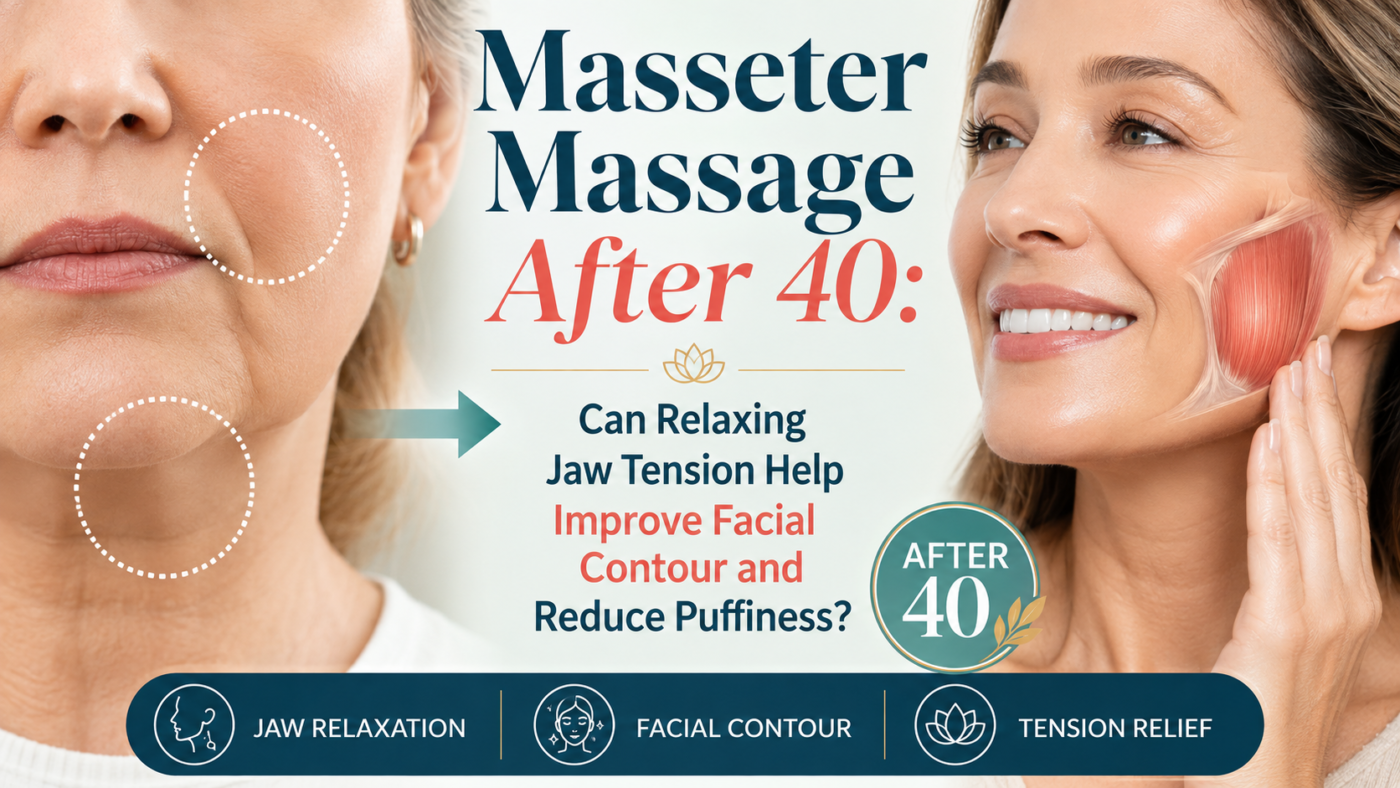
A blurred or heavier-looking facial contour is often blamed on loose skin or excess fat beneath the chin.
But there is another part of the lower face worth paying attention to:
The masseter muscles.
These powerful chewing muscles sit along the sides of the jaw. They become active every time you bite, chew or clench your teeth.
For some people, habitual jaw clenching or nighttime bruxism can leave the masseters feeling tight, sore or enlarged.
That can influence how the lower face feels—and sometimes how it looks.
A short massage cannot permanently “lift” the cheeks or remodel the jawbone, but gentle masseter massage may reduce the sensation of jaw tension, improve comfort and make the face feel less tight after periods of clenching.
That makes it worth understanding.
What Is the Masseter Muscle?
The masseter is one of the primary muscles used for chewing.
It runs from the cheekbone region down toward the lower jaw.
When you clench your back teeth, you can usually feel it contract immediately beneath your fingertips.
Place your fingers along the outer jaw.
Clench gently.
Feel that firm bulge?
That is largely the masseter.
Relax your teeth again.
The muscle softens.
The Masseter Has Superficial and Deep Portions
Anatomically, the masseter contains distinct superficial and deeper portions.
Both contribute to jaw closing.
This does not mean you need to aggressively dig through the cheek to reach a hidden layer.
Much of the muscle can be influenced indirectly through gentle external pressure, jaw movement and relaxation.
Deep, painful pressure is rarely necessary for a home routine.
Why Masseter Tension Is Common
Modern habits can encourage jaw tension.
Stress.
Concentration.
Teeth clenching.
Bruxism during sleep.
Chewing gum frequently.
Jaw posture.
Certain bite patterns.
Some people are barely aware that they clench until they begin paying attention.
Others wake with jaw fatigue or headaches.
What Is Bruxism?
Bruxism refers to repetitive jaw-muscle activity involving clenching or grinding.
It can occur during sleep or while awake.
Sleep bruxism is not simply a bad habit.
It is considered a sleep-related movement behavior with multiple contributing factors.
Awake bruxism is often linked with concentration or stress.
Both can increase loading of the masseter muscles.
Does Masseter Tension Cause Headaches?
It can contribute to some types of facial pain and headache.
People who clench heavily may experience:
Jaw soreness.
Temple discomfort.
Morning headaches.
Tooth sensitivity.
Facial fatigue.
Neck tension.
But headache has many causes.
Persistent or severe headaches should not automatically be attributed to the masseter.
Can Jaw Clenching Affect Sleep?
Bruxism may occur during sleep, but it does not necessarily cause poor sleep by itself.
Some people with sleep bruxism also have other sleep conditions.
Snoring, sleep apnea and repeated awakenings may coexist.
If you wake frequently, grind heavily or feel excessively sleepy during the day, broader sleep evaluation may be appropriate.
Does Masseter Tension Block Blood Flow?
Not in the dramatic sense often described online.
A tense muscle can alter local tissue pressure and blood flow temporarily.
But masseter tension does not shut down circulation throughout the entire face.
The face has a rich blood supply.
Likewise, jaw tightness does not automatically create a whole-face lymphatic blockage.
Those explanations oversimplify the anatomy.
Can a Tight Masseter Make the Face Look Wider?
Yes, sometimes.
If the masseter becomes hypertrophied—meaning enlarged from repeated heavy activity—the lower face can appear broader.
This is one reason chronic clenching can influence facial contour in some people.
However, not every wide lower face is caused by masseter enlargement.
Bone structure, fat distribution and genetics also matter.
Can Massage Make the Jawline Look Sharper?
Possibly temporarily.
If massage reduces muscle tension or mild puffiness, the lower face may look slightly softer or less bulky immediately afterward.
But massage does not shrink the muscle permanently after one session.
Nor does it remove fat.
Long-term changes in true masseter size require changes in muscle activity over time.
Start With the Neck
Before working on the jaw, relax the surrounding area.
Sit or stand comfortably.
Place one hand gently over the opposite shoulder or side of the head.
Tilt the head slightly.
You should feel a mild stretch.
Breathe slowly.
Do not yank the neck.
Repeat on the other side.
Shoulder Shrugs
Raise the shoulders toward the ears.
Hold briefly.
Then let them drop.
Repeat several times.
This can reduce awareness of chronic shoulder tension.
It does not specifically “release the rhomboids,” but it may help the upper body feel less stiff.
Gentle Neck Massage
Use the fingertips along the sides and back of the neck.
Avoid deep pressure over the front of the throat.
Slow circular movements are enough.
The goal is comfort.
Not pain.
Ear Massage as a Relaxation Cue
Gently rubbing the ears can be included as a sensory relaxation technique.
It does not detoxify the face.
But it can help you slow down and shift attention toward the body.
That can be valuable during a stress-related jaw routine.
How to Find the Masseter
Place two or three fingertips on the side of the jaw.
Clench your back teeth gently.
Feel the muscle become firm.
Now relax.
Keep your teeth slightly apart.
That is the area you will massage.
Step 1: Open and Relax
Place fingertips on the masseter.
Inhale.
Slowly open the mouth within a comfortable range.
Exhale.
Relax the jaw.
Allow the fingers to glide slightly downward over the muscle.
Repeat.
The jaw should not click painfully or feel forced.
Step 2: Slow Downward Strokes
With the teeth relaxed, use slow strokes from the upper portion of the masseter toward the lower jaw.
Pressure should be mild to moderate.
Do not press hard enough to bruise.
Repeat several times.
Step 3: Small Circular Massage
Use fingertip pads.
Make small circular movements.
Move across the outer cheek and jaw muscle.
If you find a tender point, decrease pressure rather than digging harder.
Tenderness is not proof of a blockage.
Step 4: Combine Massage With Breathing
Inhale.
Relax the jaw.
Exhale slowly.
Let the tongue rest comfortably.
Keep the teeth apart.
This matters because many people unconsciously clench more when focusing.
Step 5: Avoid “Full Body Weight” Pressure
Some routines recommend leaning strongly into one finger.
That is unnecessary.
The face contains superficial nerves, blood vessels and sensitive tissues.
More force does not mean more benefit.
Comfortable pressure is enough.
Can You Lift the Cheekbone With Massage?
No.
Your cheekbone—the zygomatic bone—is part of the skull.
Massage cannot move it upward.
What can change is the position of soft tissue during manual pressure.
That may create a temporary lifted appearance.
But the bone itself has not moved.
Cheek Massage After Masseter Work
Place your palm or fingers over the cheek.
Use gentle upward or outward strokes.
The goal is relaxation.
Do not attempt to physically “push the cheekbone into a higher position.”
That is not anatomically realistic.
What About the Deep Masseter?
You may feel deeper tension near the back portion of the jaw.
A safer way to work there is:
Use moderate fingertip pressure.
Keep the mouth slightly open.
Apply small slow movements.
Stop if the area becomes sharply painful.
Deep pressure should never be forceful.
Intraoral Massage Is Different
Some clinicians use intraoral techniques for jaw-muscle disorders.
That involves working inside the mouth.
Those techniques require hygiene, anatomical knowledge and caution.
A generic beauty routine should not assume that deep external pressure is equivalent.
If jaw pain is significant, a dentist, TMJ specialist or physical therapist is a better resource.
Can Massage “Drain Waste” From the Masseter?
No.
Metabolic waste is continuously transported through normal circulation and lymphatic physiology.
Massage may change local fluid movement temporarily.
But it does not extract toxins from the jaw.
You do not need that explanation to justify massage.
Why the Face May Look Less Puffy Afterward
A combination of factors may produce a temporary difference:
Muscle relaxation.
Changes in superficial fluid distribution.
Warmer skin.
Reduced jaw clenching.
A more relaxed facial expression.
All of those can subtly alter appearance.
Facial Symmetry and the Masseter
One side of the masseter may feel stronger or larger than the other.
This can happen because of chewing habits, clenching patterns, dental occlusion or normal asymmetry.
Human faces are naturally asymmetric.
Trying to manually force both sides into identical shape is unrealistic.
If asymmetry changes suddenly or is accompanied by weakness, seek medical evaluation.
Does Masseter Massage Treat TMJ Disorders?
Not by itself.
Temporomandibular disorders can involve:
Jaw muscles.
The TMJ itself.
Disc mechanics.
Pain sensitization.
Dental factors.
Stress.
Sleep behaviors.
Massage may help muscular discomfort in some people, but TMD often requires a broader approach.
Signs You May Need Professional Assessment
Seek help if you have:
Persistent jaw pain.
Jaw locking.
Limited mouth opening.
Painful clicking.
New bite changes.
Frequent headaches.
Broken or worn teeth.
Severe nighttime grinding.
Facial swelling.
These deserve more than cosmetic self-massage.
Can a Night Guard Help?
For some people with bruxism, a dentist may recommend an oral appliance.
Its main purpose is often to protect teeth and reduce mechanical damage.
It does not necessarily cure the underlying bruxism.
Individual dental evaluation matters.
What About Botox for the Masseter?
Botulinum toxin is sometimes used medically or cosmetically to reduce masseter activity.
It can reduce muscle size over time in selected patients.
However, it is a medical procedure with potential risks and should only be performed by an appropriately trained clinician.
Massage does not reproduce the same mechanism.
A Simple 10-Minute Masseter Routine
Minute 1: Neck Stretch
Gentle side stretch.
Minute 2: Shoulder Relaxation
Raise and release.
Minute 3: Neck Massage
Light pressure.
Minute 4: Locate the Masseter
Clench gently, then relax.
Minutes 5–6: Open-and-Relax Massage
Slow downward strokes.
Minutes 7–8: Circular Masseter Massage
Both sides.
Minute 9: Cheek Relaxation
Warm palms over the cheeks.
Minute 10: Jaw Rest Position
Lips together or comfortably relaxed.
Teeth apart.
Tongue resting gently.
Breathe slowly.
What Is a Good Jaw Resting Position?
For many people:
The teeth are not touching.
The jaw is relaxed.
The lips may rest together.
The tongue rests comfortably.
This is different from clenching.
Becoming aware of resting position during the day may be more useful than performing intense massage once and then clenching for the next eight hours.
Try the “Teeth Apart” Reminder
During work, periodically ask:
Are my teeth touching?
If you are not eating or swallowing, they generally do not need to be clenched together.
Let the jaw soften.
That tiny habit may reduce unnecessary muscle activity.
Stress Matters
Jaw clenching often increases during periods of stress or concentration.
That does not mean stress is the only cause.
But relaxation strategies may help.
Slow breathing.
Exercise.
Regular breaks.
Sleep routines.
Mindfulness.
All can complement jaw-focused care.
Does Masseter Relaxation Make You Look Younger?
It cannot reverse age.
But a relaxed jaw may change facial expression.
Less clenching can make the lower face look softer.
Reduced muscular tension may also make the face feel more comfortable.
That is a reasonable cosmetic benefit.
Do Not Chase Pain
Painful massage is not more effective.
You do not need to cry through a facial routine.
If pressure is intense enough to make you recoil, it is too much.
A successful massage should leave the jaw feeling calmer.
Not injured.
What Results Can You Expect After One Session?
You may notice:
Less jaw tension.
A warmer cheek.
Improved awareness of clenching.
A softer facial expression.
A small temporary change in facial fullness.
What you should not expect is permanent cheek lifting or a dramatically redesigned facial contour.
What About Long-Term Practice?
If your masseter tension is driven by habitual daytime clenching, increasing awareness may help over time.
If nighttime grinding is the main problem, massage alone may have limited impact.
The underlying cause matters.
Final Takeaway
The masseter is one of the most powerful muscles of the face.
Chronic clenching or bruxism can make it feel tight, sore or fatigued and may contribute to a broader-looking lower face in some people.
Gentle massage combined with jaw relaxation, breathing and neck mobility can improve comfort and body awareness.
But massage does not lift the cheekbones.
It does not flush toxins from the face.
And it does not permanently reshape the jaw after one session.
The most useful approach is:
Find the masseter. Relax the teeth. Use gentle pressure. Breathe. Reduce clenching habits. And seek professional help when jaw symptoms persist.
Frequently Asked Questions
Can masseter massage sharpen the jawline?
It may temporarily reduce the sensation of tightness or puffiness, but it does not permanently reshape the jawline.
How do I find the masseter?
Clench your back teeth gently and feel for the firm muscle along the outer jaw.
Can masseter tension make the face look wider?
Yes. Enlarged masseters from chronic heavy use can contribute to a broader lower face in some people.
Does masseter tension block lymphatic flow?
There is no strong evidence that ordinary jaw tension blocks lymphatic drainage throughout the face.
Can massage move the cheekbones upward?
No. Facial bones cannot be repositioned with massage.
Can masseter massage help bruxism?
It may relieve muscular discomfort, but it does not necessarily stop sleep bruxism.
Should massage hurt?
No. Mild tenderness may occur, but strong pain is unnecessary.
Can bruxism cause headaches?
It can contribute to some jaw- and temple-related headaches.
Is jaw clenching common?
Yes, but exact prevalence estimates vary considerably depending on how bruxism is defined and measured.
When should I see a dentist or doctor?
Persistent pain, jaw locking, damaged teeth, severe grinding, major asymmetry or neurological symptoms warrant professional assessment.
Medical and Skincare Disclaimer
This article is for educational purposes only and is not medical diagnosis, dental treatment, physical therapy or individualized cosmetic advice. Persistent jaw pain, locking, severe headaches, facial swelling, dental damage or new facial weakness should be evaluated by an appropriate healthcare professional. Avoid aggressive pressure over painful or inflamed areas.
This article is for general education and does not replace individualized care from a qualified health professional. Seek appropriate advice for persistent, severe, or concerning symptoms.
Read the full medical disclaimer