Smiling looks effortless.
But beneath that expression, multiple facial muscles are working together to elevate the upper lip, move the cheeks and shape the corners of the mouth.
One of those muscles is the levator labii superioris, which sits alongside the nose and helps lift the upper lip.
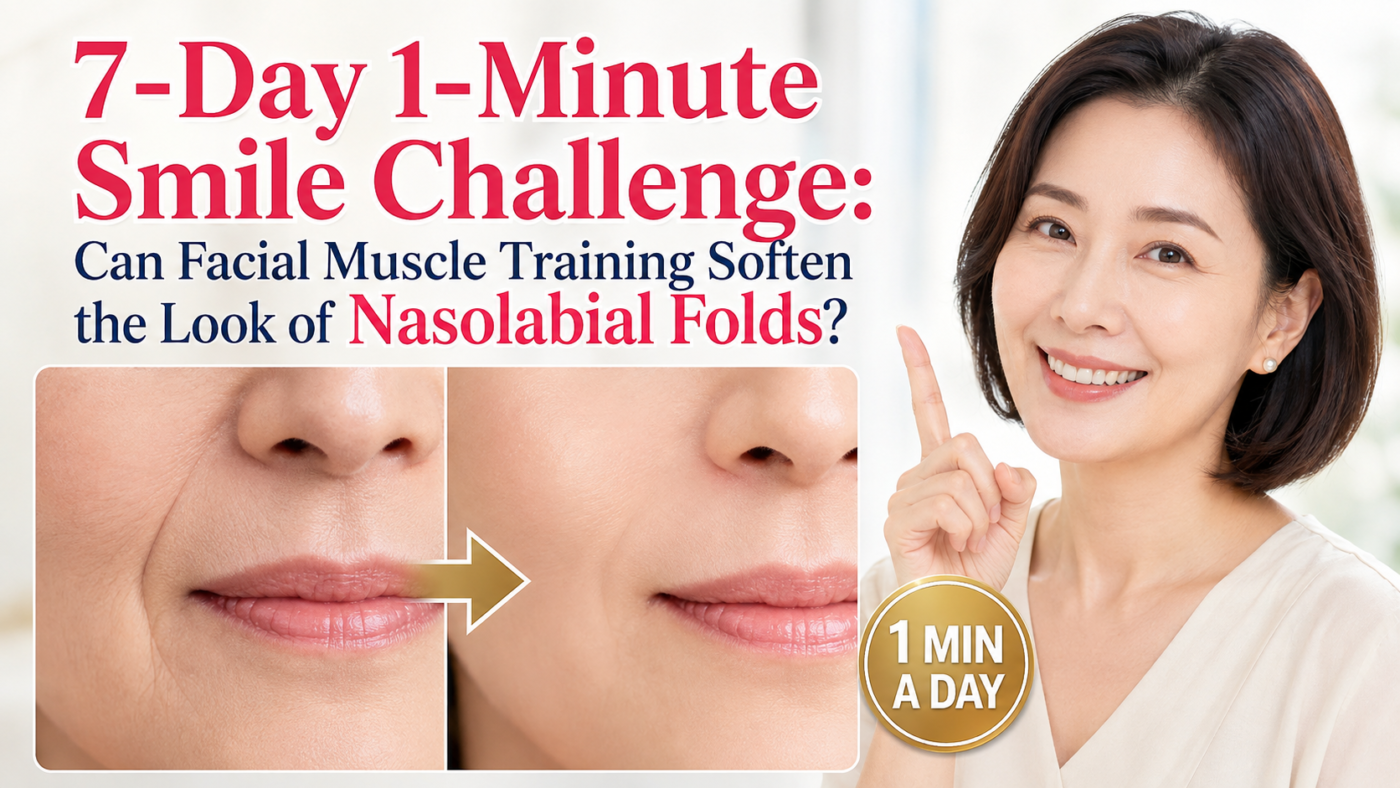
Because this muscle contributes to smiling and upper-lip movement, some facial-exercise routines claim that training it for just one minute a day can lift the entire face and make nasolabial folds disappear within seven days.
That promise is too strong.
Facial-muscle exercises can create muscular fatigue, increase awareness of facial movement and potentially improve control of certain expressions. A short smile exercise may also make the face feel more active and relaxed afterward.
But there is not enough evidence to say that one minute of resisted smiling for seven days can permanently erase established nasolabial folds or structurally lift the face.
The more realistic goal is simple:
Train the facial muscles gently, improve expression awareness and use the exercise as part of a healthy skincare and facial-mobility routine.
What Is the Levator Labii Superioris?
The levator labii superioris is a facial-expression muscle located beside the nose.
Its main role is to elevate the upper lip.
It works together with nearby muscles involved in smiling and facial expression, including the zygomaticus muscles and other muscles around the mouth and nose.
When you smile broadly, these muscles contract in a coordinated pattern.
That is why placing light resistance over the cheek or beside the nose can make a smile feel surprisingly difficult after several repetitions.
The muscle is genuinely working.
But muscle activation and wrinkle removal are not the same thing.
Why Nasolabial Folds Form
Nasolabial folds are the lines that extend from the sides of the nose toward the corners of the mouth.
They are not caused by one weak muscle.
Their appearance is influenced by several factors, including:
Facial anatomy.
Cheek volume.
Skin elasticity.
Collagen and elastin changes.
Bone structure.
Fat distribution.
Ligament support.
Repeated facial expression.
Age.
Genetics.
Sun exposure.
This is important because it explains why strengthening one small facial muscle cannot simply “delete” the fold.
Can Facial Muscle Training Change Appearance?
Possibly, but the evidence is still limited.
A small amount of research has explored structured facial exercise programs and suggested that repeated facial training may influence the appearance of some facial regions.
However, these studies have generally involved much longer programs than seven days and often used multiple exercises.
That is very different from claiming that a single one-minute exercise reliably produces dramatic facial lifting.
If changes do occur, they may result from muscle tone, expression habits, tissue hydration or other factors.
More research is needed.
Why a One-Minute Challenge Can Still Be Useful
The biggest advantage of a one-minute challenge is not that it produces a miracle.
It is that people are likely to do it.
A short routine can improve consistency.
It can help you notice how you use your facial muscles.
It may also reveal that you habitually tense your forehead, jaw or cheeks.
That awareness is useful.
How to Perform the Smile Exercise
Stand or sit comfortably in front of a mirror.
Relax your forehead.
Unclench the jaw.
Allow the lips to rest naturally.
Place one or two fingertips lightly beside the nose and over the upper-cheek area.
Do not press hard.
Now smile.
Allow the upper lip and cheek to lift naturally against the light resistance of your fingers.
Hold briefly.
Relax.
Repeat.
Use Your Fingers as Light Resistance, Not Heavy Weights
The idea of using the fingers like “dumbbells” is a useful analogy—as long as the resistance remains gentle.
You are not trying to stop the smile completely.
The fingers should simply make the movement slightly more challenging.
Too much pressure may distort the skin or create unnecessary tension.
Facial muscles are small.
They do not require aggressive loading.
Your 60-Second Challenge
For approximately one minute:
Smile gently against light fingertip resistance.
Hold for a few seconds.
Relax.
Repeat.
Maintain smooth breathing.
Do not clench the jaw.
Do not raise the eyebrows unnecessarily.
If the muscle begins to feel tired, that is normal.
If you experience sharp pain, stop.
What Does Facial Muscle Fatigue Mean?
When the area beside the nose or upper lip starts to feel tired, the muscles are being challenged.
That sensation can be compared with fatigue during other forms of exercise.
However, muscle fatigue does not mean wrinkles are being burned away.
It only means the muscles have been working.
That distinction matters.
Should the Exercise Feel Intense?
A mild muscular challenge is fine.
Severe discomfort is unnecessary.
You should not need to force yourself through pain to achieve a cosmetic effect.
With facial exercise, excessive effort can encourage compensatory movements—such as squinting, wrinkling the forehead or clenching the jaw.
Controlled movement is more useful.
Finish With Gentle Massage
After the exercise, place your fingertips lightly around the upper cheek and beside the nose.
Use small circular movements.
The massage should feel comfortable.
You can also gently shake or tap the area.
This may help the muscles feel relaxed after the exercise.
Does Massage “Flush Out Waste”?
Not in the way that phrase is often used online.
Your body already manages metabolic waste through circulation, the lymphatic system, liver, kidneys and other physiological systems.
A brief facial massage does not manually remove toxins from facial muscles.
Massage may temporarily change local blood flow and tissue sensation.
That can make the area feel warmer or more relaxed.
Those are reasonable effects.
Can Massage Improve Blood Flow?
Yes, mechanical stimulation of the skin can temporarily increase superficial circulation.
This may produce warmth or mild redness.
The skin may look more vibrant for a short period.
But increased circulation should not be interpreted as proof that the skin is regenerating faster or that wrinkles are disappearing.
Will Your Smile Look Different Immediately?
Possibly.
After repeatedly smiling and relaxing, you may become more conscious of the expression.
The cheeks may feel more active.
You may naturally smile more fully when you look in the mirror.
That can create an immediate visual difference.
But expression changes are not the same as permanent structural lifting.
The 7-Day Challenge
Day 1: Learn the Movement
Use minimal resistance.
Focus on finding the upper-lip and cheek muscles.
Day 2: Relax the Forehead
Try to smile without raising the eyebrows.
Keep the upper face calm.
Day 3: Relax the Jaw
Make sure the teeth are not clenched.
The smile should come from the facial muscles, not jaw tension.
Day 4: Improve Symmetry
Watch yourself in the mirror.
Notice whether one side lifts more easily.
Do not force the weaker side aggressively.
Simply practice controlled movement.
Day 5: Slow the Exercise Down
Hold each smile for a little longer.
Then fully relax.
This makes it easier to feel the contrast between contraction and release.
Day 6: Add Gentle Massage
Finish with 20–30 seconds of comfortable cheek massage.
Avoid painful pressure.
Day 7: Compare Expression, Not Wrinkle Depth
Instead of asking only whether the folds disappeared, notice:
Does your smile feel more natural?
Can you control the upper lip more easily?
Are you less likely to tense the forehead?
Does your face feel less stiff?
These are more realistic short-term observations.
Will Nasolabial Folds Fade After Seven Days?
A dramatic permanent reduction is unlikely.
Seven days is a very short period for meaningful structural skin remodeling.
The folds may look different depending on hydration, lighting, expression and temporary tissue changes.
But established folds will usually remain.
That is normal.
Does Smiling More Create More Wrinkles?
Facial expression contributes to dynamic lines over time, but that does not mean smiling should be avoided.
Human faces are designed to move.
Avoiding natural expression in an attempt to prevent aging is neither realistic nor necessary.
The more important contributors to premature skin aging include cumulative ultraviolet exposure and smoking.
Can Facial Exercise Lift the Entire Face?
Not reliably.
Facial-muscle contractions can change the position of skin temporarily while the muscle is active.
That is why the face looks different when smiling.
But exercise does not permanently reposition all facial tissues upward.
Aging involves skin, ligaments, fat compartments, muscle and bone.
One exercise cannot reverse all of those changes.
What Actually Helps With Nasolabial Folds?
Sun Protection
Daily broad-spectrum sunscreen helps protect collagen and reduce photoaging.
Moisturizer
Hydrated skin often makes fine surface lines appear softer.
Retinoids
Topical retinoids have stronger evidence for improving aspects of photoaging and fine wrinkles.
Healthy Lifestyle
Avoiding smoking, maintaining general fitness, getting adequate sleep and eating well support overall skin health.
Professional Treatments
People seeking more substantial correction of nasolabial folds may discuss options with a qualified dermatologist or cosmetic physician.
Depending on anatomy and goals, approaches may include fillers, energy-based treatments or other procedures.
These treatments have their own risks and should be individualized.
Facial Exercise Is Best Viewed as Training, Not Surgery
This distinction makes the entire practice more realistic.
Facial exercise can train movement.
It can build awareness.
It may improve coordination.
It can help you notice chronic tension.
It may make the face feel more active.
Those are worthwhile outcomes.
It does not replace procedures that physically alter facial structure.
Should You Use a Mirror?
Yes.
A mirror is particularly useful at the beginning.
Watch for compensations.
If the forehead starts wrinkling dramatically while you try to lift the cheeks, reduce the effort.
If the jaw clenches, relax it.
If one side feels weaker, practice calmly rather than forcing perfect symmetry.
Who Should Be Careful?
People with significant TMJ pain, facial nerve disorders, recent facial surgery or recent cosmetic procedures should be cautious with intensive facial exercises.
If you have had Botox, fillers, thread lifting or other facial treatments, follow the instructions of your treating clinician.
New facial weakness or sudden asymmetry should be medically evaluated rather than treated with facial exercise.
A Better Way to Define Success
Success after seven days does not need to mean “my wrinkles vanished.”
A successful challenge might mean:
You completed one minute every day.
You learned where the upper-lip lifting muscles are.
You can smile without unnecessary jaw tension.
You became aware of facial asymmetry.
You developed a relaxing self-care habit.
These are more achievable and more honest goals.
Final Takeaway
The 7-Day 1-Minute Smile Challenge is a simple facial-muscle exercise focusing on the muscles that lift the upper lip and cheeks.
Light fingertip resistance can make smiling more challenging and may improve facial-muscle awareness and control.
A gentle massage afterward may help the area feel relaxed and temporarily increase superficial circulation.
But seven days of smiling exercises cannot be guaranteed to erase nasolabial folds or permanently lift the entire face.
The better message is:
Train gently. Smile naturally. Relax completely between repetitions. Protect your skin. And use facial exercise as a small part of healthy aging—not as a promise to reverse it.
Frequently Asked Questions
Can smiling exercises reduce nasolabial folds?
There is limited evidence that facial exercises may influence facial appearance, but one short exercise cannot be relied upon to erase established nasolabial folds.
What muscle does this exercise target?
It primarily emphasizes muscles involved in lifting the upper lip and cheek, including the levator labii superioris.
Can I use my fingers as resistance?
Yes, but only light resistance is necessary.
Should the exercise hurt?
No. Mild fatigue is normal. Pain is not required.
Does facial massage remove toxins?
No. Massage may temporarily influence circulation and tissue sensation, but it does not detoxify facial muscles.
Can facial massage improve blood flow?
It can temporarily increase superficial circulation.
Will my face look lifted immediately?
Your expression may look more elevated during or immediately after exercise, but that does not mean the tissues have been permanently lifted.
How long should I continue?
A one-minute daily routine can be used as a simple facial-awareness practice if it remains comfortable. Long-term cosmetic effects are uncertain.
Can facial exercise replace Botox or fillers?
No. These approaches work through completely different mechanisms.
Medical and Skincare Disclaimer
This article is for educational purposes only and is not medical diagnosis, dermatologic treatment or individualized cosmetic advice. Stop facial exercises if you experience significant pain, persistent muscle spasm, jaw problems or new neurological symptoms. People with recent facial surgery or cosmetic procedures should follow the advice of their own clinician.
This article is for general education and does not replace individualized care from a qualified health professional. Seek appropriate advice for persistent, severe, or concerning symptoms.
Read the full medical disclaimer