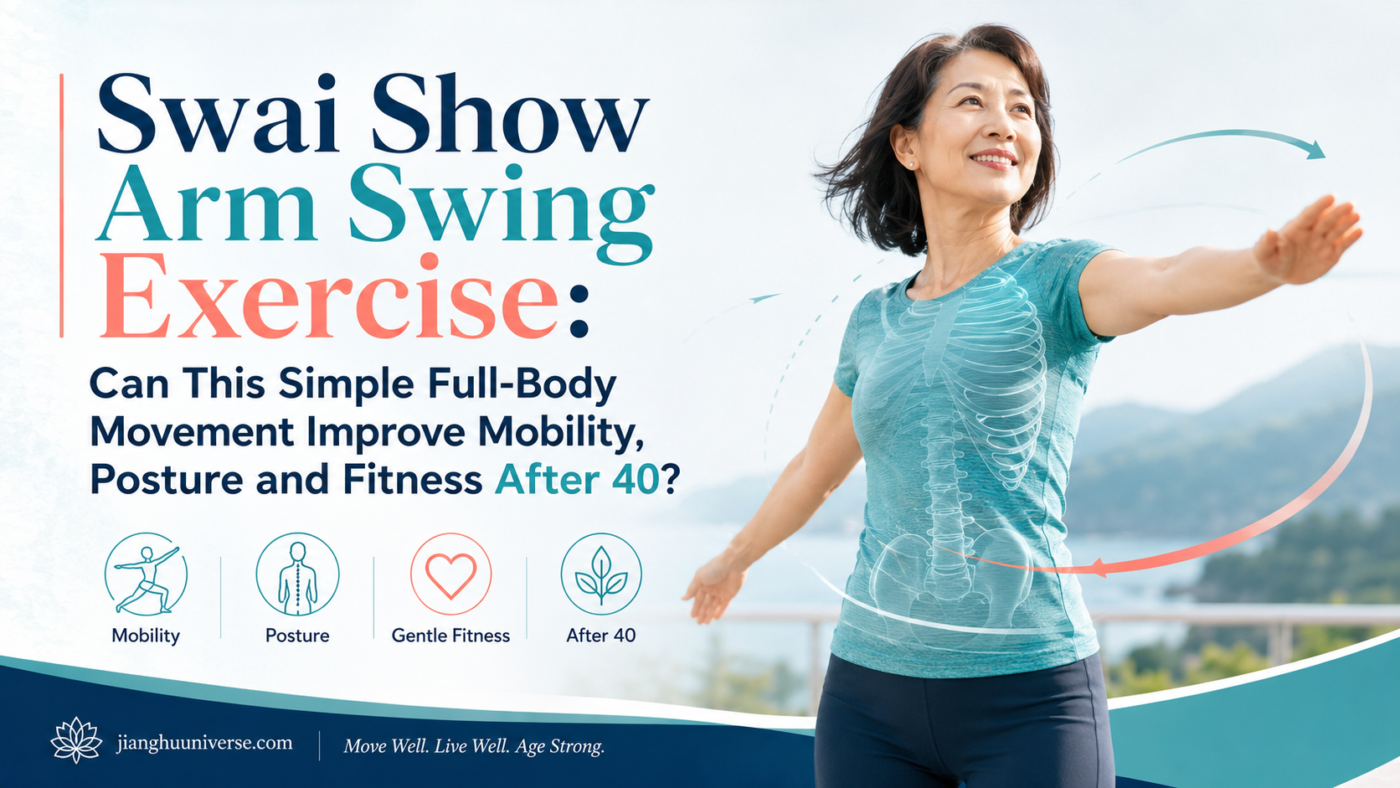
A simple arm-swing exercise may not look like much of a workout.
There are no heavy dumbbells. No sprint intervals. No complicated choreography. The feet may barely leave the floor.
Yet after several minutes of relaxed torso rotation and rhythmic arm swinging, many people notice something unmistakable: the shoulders feel warmer, the trunk feels more mobile, breathing becomes easier, and the entire body feels more awake.
This type of movement is often called Swai Show, Shuai Shou, or simply an arm-swing exercise. Similar relaxed swinging movements also appear in several traditional Chinese movement systems, qigong practices and modern mobility routines.
Some popular versions make dramatic promises. They claim that arm swinging can activate brown fat around the shoulder blades, make the body burn fat “70 times faster,” push negative energy out through the fingertips, reposition the rib cage, flatten the abdomen and dramatically reverse aging.
Those claims go well beyond current evidence.
But the exercise does not need extraordinary promises to be worthwhile.
Performed with comfortable trunk rotation, relaxed shoulders and steady breathing, arm swinging can provide a surprisingly useful combination of low-intensity movement, shoulder mobility, thoracic rotation, balance practice, coordination and light cardiovascular activity.
For adults who spend much of the day sitting—and especially for people over 40 who want a gentle way to move more—it can be an accessible place to start.
What Is Swai Show?
Swai Show is a transliteration used for a family of traditional arm-swinging exercises.
The basic movement is simple.
Stand comfortably with the feet grounded. Allow the knees to remain soft. Rotate the torso from side to side and allow the arms to swing naturally with the movement rather than forcing them independently.
The shoulders stay relatively relaxed.
The arms follow the torso.
As the body rotates, one arm may swing forward while the other travels backward.
More elaborate variations may include alternating arms, elbow movements, wider diagonal openings, gentle waist rotation or awareness of the Tanden—a traditional Japanese term referring to a center of attention in the lower abdomen.
From a modern exercise perspective, the most useful way to understand the movement is as a form of rhythmic, low-load rotational exercise.
Let the Rib Cage Move Before the Arms
One of the strongest ideas in the original routine is this instruction:
Let the rib cage and torso initiate the movement, then allow the arms to follow.
That is a good movement cue.
Many people spend hours sitting with very little rotation through the thoracic spine. When asked to swing the arms, they compensate almost entirely at the shoulder joints.
Instead, imagine the breastbone gently turning from left to right.
As your torso rotates, the shoulder blades naturally glide around the rib cage.
The arms then follow the motion.
This does not mean the ribs are physically “misaligned” and need to be pushed back into place.
It means you are practicing movement through areas that may not receive much rotational activity during a sedentary day.
Does Rib-Cage Position Cause a Protruding Belly?
Not in the simple way often described online.
The appearance of the abdomen is influenced by many factors, including body-fat distribution, abdominal muscle tone, posture, pelvic position, rib-cage orientation, breathing mechanics, abdominal contents and individual anatomy.
Posture can certainly change how the abdomen looks.
For example, excessive extension through the lower back combined with the ribs projecting forward can make the abdomen appear more prominent in some people even without a change in body fat.
But this is not because a “misaligned rib cage compresses the organs and pushes the stomach out.”
That explanation is too simplistic.
A more useful goal is learning to coordinate the ribs, pelvis and trunk muscles during standing and movement.
Try This Posture Cue
Instead of attempting to “raise” the rib cage, stand tall without forcing the chest upward.
Allow the ribs to sit comfortably over the pelvis.
Keep the knees soft.
Gently engage the abdominal wall without sucking the stomach in as hard as possible.
Then breathe.
You should still be able to expand the ribs and abdomen naturally.
Good posture is not a rigid military position.
It is the ability to organize the body efficiently while still being able to move and breathe.
Why the Shoulder Blades Move During Arm Swinging
The shoulder blades, or scapulae, are designed to glide over the back of the rib cage.
When the arms move and the torso rotates, the scapulae naturally protract, retract and rotate.
This means an arm-swing routine can encourage movement around the shoulders and upper back without requiring heavy resistance.
People who spend long periods typing or looking at screens may especially enjoy this sensation.
The exercise may help the shoulders feel less stiff.
However, feeling looser after movement does not mean adhesions were broken apart or that structural problems were corrected.
Often, movement simply changes muscular activity, increases tissue temperature and reduces the sensation of stiffness.
Does Arm Swinging Activate Brown Fat?
Brown adipose tissue is real.
Unlike white adipose tissue, which primarily stores energy, brown adipose tissue can generate heat through a process called thermogenesis.
Adults retain varying amounts of metabolically active brown fat, particularly around regions such as the neck and upper torso.
What is not established is the popular claim that swinging the arms or moving the shoulder blades specifically “switches on” brown fat and causes body fat to burn 70 times faster.
The often-repeated “70 times” figure should not be presented as an expected human weight-loss effect.
Human research on exercise and brown adipose tissue is still complex and inconsistent.
Even if brown fat activity changes under certain conditions, that does not mean a shoulder movement multiplies whole-body fat loss seventyfold.
Feeling Warm Does Not Mean Fat Is Suddenly Melting
After several minutes of arm swinging, you may feel warm.
That is completely normal.
Working muscles produce heat.
Blood flow increases.
Heart rate may rise slightly.
The skin may feel warmer.
None of those sensations prove that stored body fat has suddenly begun burning at an extraordinary rate.
Your body continuously uses mixtures of carbohydrate and fat for energy.
Long-term fat loss depends primarily on sustained energy balance over time—not on whether a particular body region feels hot during one exercise session.
Can Swai Show Help With Weight Loss?
Potentially, but indirectly.
Any physical movement requires energy.
If arm swinging encourages a sedentary person to move for 10 or 20 additional minutes every day, it contributes to total physical activity.
That is useful.
If the practice becomes a gateway to walking, resistance training and a generally more active lifestyle, its contribution becomes even more meaningful.
What it cannot realistically do is produce dramatic weight loss while everything else remains unchanged.
A testimonial describing a large amount of weight lost within several weeks does not prove that one exercise produced the result.
Individual weight change is influenced by overall diet, total activity, starting body weight, fluid balance, medication, health conditions and many other variables.
“No Dieting” Does Not Mean Nutrition Is Irrelevant
People sometimes say they lost weight “without dieting” when what they really mean is that they did not follow an extreme or highly restrictive diet.
That can be a positive distinction.
Weight management does not require starvation or eliminating entire food groups.
But food intake still matters.
A sustainable approach generally emphasizes adequate protein, vegetables and fruit, minimally processed foods, appropriate portions and an eating pattern that can be maintained long term.
Exercise and nutrition work together.
There is no movement technique that makes energy intake irrelevant.
What Changes After 40?
The idea that women over 40 gain weight mainly because the muscles around the pelvis and shoulder blades become loose is not biologically accurate.
Midlife body-composition changes are more complicated.
Physical activity may decline.
Muscle mass can gradually decrease with age, particularly when resistance training is absent.
Hormonal changes around menopause can influence fat distribution.
Sleep, stress, diet and daily energy expenditure may also change.
The good news is that aging does not mean muscle growth becomes impossible.
Adults can continue gaining strength and muscle well into later life when training provides sufficient resistance and progression.
That is one of the most encouraging findings in exercise science.
Movement Is Good, but Resistance Still Matters
Swai Show is gentle movement.
That is part of its appeal.
But if the goal is preserving muscle after 40, it should ideally complement rather than replace resistance exercise.
Useful strength movements may include squats, sit-to-stands, rows, presses, hip hinges, step-ups and loaded carries appropriate to the individual’s ability.
Even relatively simple resistance training performed consistently can improve strength and function.
Arm swinging can then serve as a warm-up, movement break or recovery activity.
What About “Negative Energy”?
Traditional movement systems often use concepts such as energy, qi, internal flow or Tanden awareness.
These ideas can have value as attention cues.
For example, imagining movement beginning from the body’s center may help someone coordinate torso rotation rather than waving the arms randomly.
Imagining tension leaving the fingertips may also create a powerful sense of relaxation.
There is nothing wrong with using such imagery.
The distinction is that modern medicine has not demonstrated a measurable substance called “negative energy” physically leaving the body through the fingers or skull.
Traditional imagery and biological mechanism do not need to be treated as the same thing.
Tanden as a Useful Body-Awareness Cue
In Japanese movement traditions, the Tanden refers to a region in the lower abdomen often treated as a center of balance, breathing and attention.
You do not need to interpret this literally as an invisible anatomical organ.
Instead, use it as a cue.
Bring attention toward the lower abdomen.
Keep your weight centered.
Let the torso rotate around a stable base.
Avoid throwing the shoulders wildly from side to side.
That interpretation fits comfortably within both traditional movement practice and modern movement education.
Does Twisting “Squeeze Waste” From the Body?
No.
The body does not rely on torso rotation to wring toxins out of the tissues.
The liver, kidneys, lungs, gastrointestinal system and other physiological systems continuously process and eliminate metabolic waste.
Centrifugal force generated during relaxed arm swinging does not squeeze toxins out from the center of the spine.
That said, rhythmic movement can still feel refreshing.
Movement increases circulation, changes sensory input, warms muscles and can interrupt long periods of sitting.
Those real benefits are enough.
Can It Help Lower-Back or Joint Pain?
Possibly for some people, but this should not be promised universally.
Gentle movement is often useful for people who feel stiff after prolonged sitting.
Torso rotation may improve movement confidence and reduce perceived stiffness.
But lower-back pain and joint pain have many different causes.
A movement that feels wonderful for one person may aggravate another.
Pain relief following an exercise session also does not necessarily mean the underlying structure has been “fixed.”
If symptoms are persistent, severe, worsening or accompanied by weakness, numbness or other neurological symptoms, medical assessment is appropriate.
A Gentle Swai Show Routine
You can adapt the original sequence into a simple movement session.
1. Rib-Cage Rotation
Stand with your feet approximately hip-width apart.
Place your hands lightly around the lower ribs.
Keep your shoulders relaxed.
Rotate the torso gently from side to side.
Allow your feet and knees to move naturally if needed.
Do not force the spine to remain completely rigid.
Breathe normally.
Continue for approximately one minute.
2. Relaxed Arm Swings
Let your arms hang loosely.
Begin rotating your torso.
Allow one arm to travel forward as the other moves backward.
Do not deliberately yank the arms.
Think:
Torso first. Arms second.
Continue comfortably.
3. Keep the Core Active Without Holding Your Breath
You may gently engage the abdominal wall to keep the trunk controlled.
But avoid aggressively pulling the stomach inward throughout the entire exercise.
You should still be able to breathe.
A functional core is not one that stays maximally contracted all day.
It is one that adjusts tension according to the task.
4. Keep the Knees Soft
Avoid locking the knees.
A slight bend can make rotation feel smoother and reduce unnecessary tension.
Keep your feet grounded.
If you naturally pivot slightly through the feet during a larger rotation, that can also reduce excessive twisting at the knees.
5. Elbow-Swing Variation
Bring the hands loosely together in front of the body.
Allow the elbows to move as the torso rotates.
Feel the movement around the upper back and shoulder blades.
Keep the neck relaxed.
6. Single-Arm Swing
Allow one arm to swing while the other remains comparatively quiet.
Continue the torso rotation.
After a comfortable interval, switch sides.
This asymmetrical variation can challenge coordination differently.
7. Finger-Extension Variation
Extend the fingers comfortably.
Rotate slowly.
Notice your hands and fingertips.
This is a good place to incorporate the traditional body-awareness element of the practice.
Instead of trying to physically expel negative energy, simply notice sensation.
Temperature.
Movement.
Breathing.
Muscular tension.
That is mindfulness through movement.
8. Lower-Torso Rotation
Place the hands around the pelvis or waist.
Perform a smaller, gentler rotation.
The lumbar spine has less rotational capacity than the thoracic spine, so do not aggressively wrench the lower back.
Allow rotation to be distributed through the hips, feet and upper trunk.
Comfort matters more than range.
9. Diagonal Chest Opening
Bring the arms forward.
Rotate the thumbs outward and open the arms diagonally.
Return gently.
The movement can provide a pleasant contrast to prolonged rounded sitting positions.
Do not force the shoulders backward.
10. Finish With Slow Rotation and Breathing
Reduce the size of the movement.
Let the arms become loose.
Slow the torso rotation.
Breathe comfortably.
Notice whether the body feels warmer or less stiff than before.
That comparison is more meaningful than trying to determine whether fat is “burning.”
How Long Should You Practice?
There is no scientifically established magical duration for Swai Show.
A beginner might start with 3 to 5 minutes.
If comfortable, that could gradually increase to 10 or 15 minutes.
People using it mainly as a movement break may perform only a minute or two at a time several times throughout the day.
The best duration is one you can perform comfortably and consistently.
Stop When You Need To
This advice from the original routine is worth keeping.
Never feel obligated to continue simply because an instructor is still moving.
Stop if you become dizzy, unusually breathless, painful or unsteady.
Modify the range if the shoulders or back feel uncomfortable.
Exercise should challenge you appropriately—not force you through warning signs.
Could This Make You “20 Years Younger”?
No exercise literally reverses chronological age.
But physical activity can improve many characteristics people associate with feeling younger.
Regular movement can support mobility, balance, cardiovascular fitness, muscle strength, mood, sleep and confidence.
Those benefits can be profound.
The strongest anti-aging message is therefore not that one movement turns back time.
It is that the human body remains remarkably responsive to training throughout adulthood.
Muscle Can Still Improve at Older Ages
One statement from the original routine deserves emphasis:
Your age does not mean your muscles can no longer improve.
Adults in their 40s, 50s, 60s, 70s and beyond can improve strength with appropriate resistance training.
The magnitude and speed of adaptation vary from person to person, but aging does not switch off the ability to respond to exercise.
This is far more empowering than promising a secret fat-burning trick.
Use Swai Show as a Gateway
The best role for an arm-swing routine may be helping people enjoy movement again.
Start with five minutes.
Then walk.
Add some strength training.
Move more often during the workday.
Sleep adequately.
Eat in a way that supports your health goals.
Over months, those apparently small choices can become substantial.
That is how simple exercise produces powerful results—not through an invisible 70-fold metabolic shortcut, but through consistency.
Final Takeaway
Swai Show is a simple, accessible movement practice built around relaxed torso rotation and rhythmic arm swinging.
It may help warm the body, mobilize the shoulders and thoracic region, improve coordination and break up long periods of sitting.
It can also provide a pleasant form of moving meditation when attention is placed on breathing, body awareness and the Tanden.
What it should not be marketed as is a proven method for burning fat 70 times faster, repositioning internal organs, activating shoulder-blade brown fat on command or squeezing toxins out of the spine.
You do not need those claims.
The real message is stronger:
Move your body. Relax unnecessary tension. Practice regularly. Build strength. And let a simple movement become the first step toward a more active life.
Frequently Asked Questions
Does Swai Show really burn fat 70 times faster?
No reliable human evidence supports that claim. Arm swinging uses energy like other forms of physical activity, but it does not multiply whole-body fat loss seventyfold.
Does moving the shoulder blades activate brown fat?
Exercise may interact with brown adipose tissue in complex ways, but there is no good evidence that shoulder-blade movement specifically activates brown fat enough to cause dramatic weight loss.
Can Swai Show flatten a protruding belly?
It may improve posture awareness and trunk movement, which can subtly change appearance, but it cannot selectively remove abdominal fat or mechanically reposition internal organs.
Can arm swinging improve shoulder mobility?
It can encourage shoulder-blade movement and thoracic rotation and may reduce the sensation of stiffness in some people.
Is Swai Show good for adults over 40?
It can be a useful low-intensity movement option, particularly for sedentary adults. For maintaining muscle and bone health, it is best combined with regular resistance training and aerobic exercise.
Does twisting remove toxins from the body?
No. Detoxification is primarily handled by organs such as the liver and kidneys. Twisting can still feel refreshing because it involves movement, circulation and sensory stimulation.
What is the Tanden?
Tanden is a traditional Japanese concept referring to a center of awareness in the lower abdomen. In modern exercise practice, it can be used as a useful cue for balance, breathing and movement originating from the body’s center.
How long should beginners practice?
Three to five minutes is a reasonable starting point for many healthy adults. Increase gradually if the exercise remains comfortable.
Medical and Fitness Disclaimer
This article is for educational purposes only and is not medical diagnosis, treatment or individualized exercise advice. Exercise tolerance varies according to age, health status, medications and injury history. Stop exercising if you experience chest pain, dizziness, severe shortness of breath, sharp pain, neurological symptoms or other concerning symptoms, and seek appropriate medical care when necessary.
This article is for general education and does not replace individualized care from a qualified health professional. Seek appropriate advice for persistent, severe, or concerning symptoms.
Read the full medical disclaimer