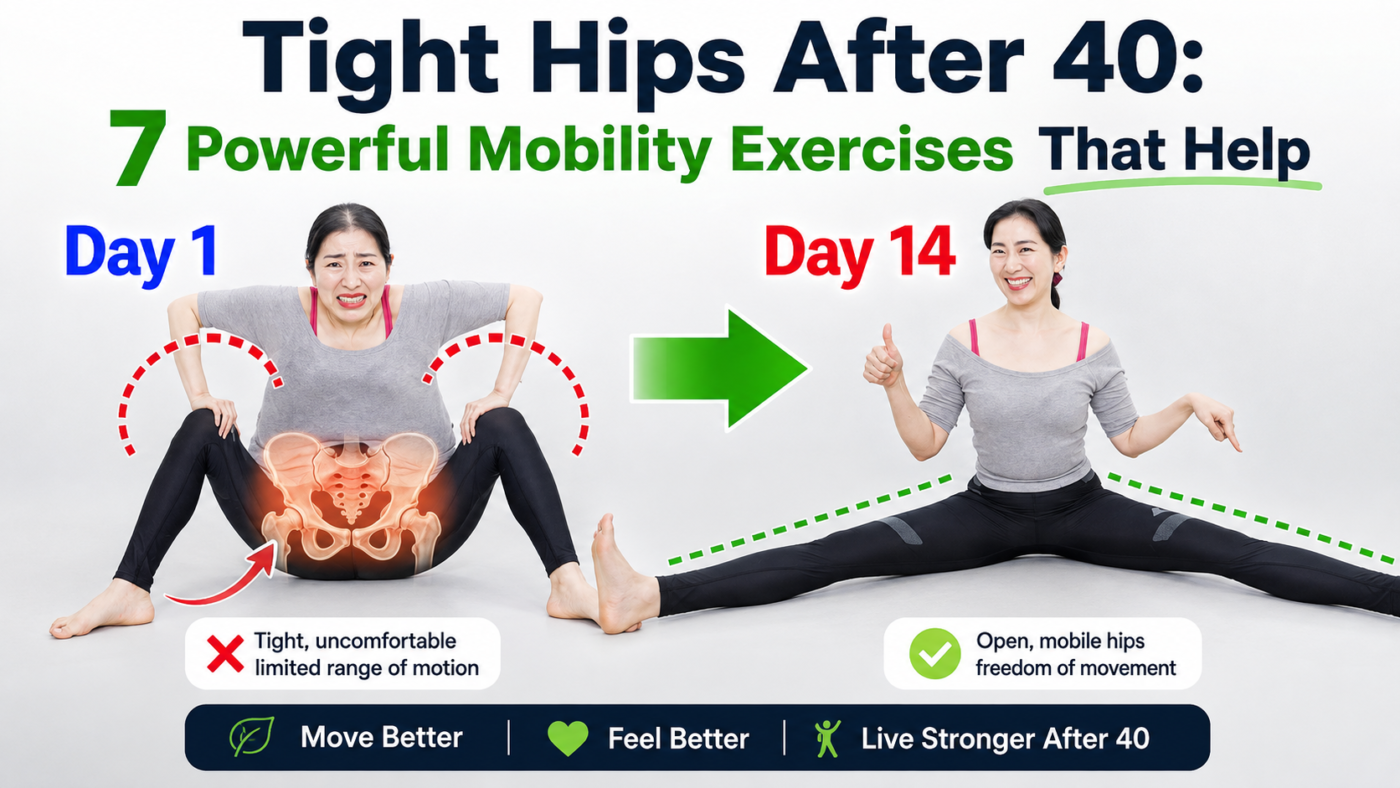
Many people notice that their hips become stiffer with age.
Sitting on the floor feels harder.
Opening the legs widely becomes uncomfortable.
Getting into a deep squat may feel restricted.
Even tying shoes, climbing stairs, or getting up from the floor can become less effortless than it once was.
This has led to a popular claim online:
Loosen your hips and the weight will start melting off.
That sounds exciting.
But the real benefit of hip mobility is different—and still extremely valuable.
Improving hip flexibility does not directly increase fat burning by several times.
It does not automatically reduce lower-body fat.
And doing the splits is not a shortcut to weight loss.
What better hip mobility can do is help you move more comfortably, exercise with better range of motion, reduce feelings of stiffness, and maintain confidence in everyday movement.
For adults over 40, those benefits can support an active lifestyle for years to come.
Why Hips Often Feel Tighter With Age
The hip is a ball-and-socket joint designed to move in many directions.
It allows:
- Flexion
- Extension
- Abduction
- Adduction
- Internal rotation
- External rotation
But many adults spend large portions of the day sitting.
When movement variety decreases, certain positions can begin to feel unfamiliar or restricted.
Other factors can also contribute to stiffness, including:
- Reduced activity
- Previous injury
- Arthritis
- Muscle weakness
- Limited ankle mobility
- Low-back stiffness
- Individual anatomy
- Fear of movement
A feeling of tightness does not always mean that a muscle is permanently shortened.
Sometimes it reflects reduced stretch tolerance or a nervous system that is less comfortable at the end of a movement range.
Are Tight Hips Making It Harder to Lose Weight?
Not directly.
Tight hip muscles do not stop your body from burning fat.
Body fat decreases when, over time, energy expenditure exceeds energy intake.
Hip stretching alone uses relatively little energy.
However, there is an indirect connection.
If stiff hips make walking, strength training, dancing, cycling, or other activity uncomfortable, you may naturally move less.
Improving mobility can make exercise feel easier.
That may help you stay more active.
And increased activity can support weight management.
So the realistic relationship is:
Better mobility → easier movement → greater activity → better support for weight management
Not:
Hip stretch → automatic fat loss
Do the Hips Control Your Metabolism?
No single joint controls metabolism.
The hip is extremely important for movement, but it is not a metabolic switch.
Your metabolic rate is influenced by factors such as:
- Body size
- Muscle mass
- Age
- Genetics
- Hormones
- Activity level
- Food intake
Opening the hips or doing the splits does not increase resting metabolism several times over.
But strengthening large muscles around the hips and legs can contribute to overall physical fitness and muscle maintenance.
That is much more meaningful.
Why Hip Mobility Matters
Healthy hip movement can make many everyday activities easier.
These include:
- Walking
- Climbing stairs
- Getting into a car
- Sitting on the floor
- Standing from a chair
- Squatting
- Reaching down
- Exercising
Good mobility is not about achieving an extreme split.
It is about having enough range of motion for the activities you want to perform.
Do You Need to Do the Splits?
Absolutely not.
The splits are a high-level flexibility skill.
Some people can learn them.
Others may never comfortably achieve a full split because of differences in anatomy.
Hip joint structure varies from person to person.
Bone shape can influence how far your hips can open.
Trying to force a full split despite anatomical restrictions can cause injury.
For healthy aging, you do not need extreme flexibility.
You need functional mobility.
Can Hip Flexibility Correct Pelvic Misalignment?
The term “pelvic misalignment” is often overused online.
The pelvis naturally moves and changes position throughout the day.
Small asymmetries are extremely common and are not automatically a problem.
Stretching may change how the hips and pelvis feel during movement.
Strength and mobility training may also improve control.
But there is no evidence that everyone needs to “realign” the pelvis through stretching.
Can Hip Stretching Prevent Pelvic Organ Prolapse?
No.
Pelvic organ prolapse involves weakening or dysfunction of the pelvic floor support system.
Risk factors may include:
- Pregnancy
- Childbirth
- Age
- Menopause
- Chronic coughing
- Constipation
- Heavy straining
- Genetic connective-tissue factors
Hip flexibility alone does not prevent prolapse.
Pelvic floor muscle training can be useful for some people, particularly when supervised appropriately.
Anyone experiencing pelvic pressure, bulging, urinary symptoms, or suspected prolapse should seek medical evaluation rather than relying on hip stretching.
Can Hip Mobility Prevent Frequent Urination?
Not directly.
Frequent urination can have many causes.
These may include:
- Urinary tract infection
- Overactive bladder
- Diabetes
- Fluid intake
- Medications
- Pelvic floor dysfunction
- Prostate conditions
- Other medical issues
Hip flexibility exercises are not a treatment for unexplained urinary frequency.
Can Stretching Prevent Hip Replacement?
No.
Hip replacement is usually performed because of severe joint damage, often from osteoarthritis or other structural disease.
Mobility and strength training are important for general joint health and function.
Maintaining a healthy body weight and staying active may also support overall musculoskeletal health.
But doing the splits cannot guarantee that someone will avoid hip replacement surgery.
Can Hip Mobility Help You Walk Better?
Yes, in some people.
Walking requires coordinated movement through:
- Hips
- Knees
- Ankles
- Spine
If hip mobility is severely restricted, gait may become less comfortable.
Improving appropriate range of motion can therefore make movement easier.
But strength is equally important.
Flexible hips without sufficient strength are not necessarily better-functioning hips.
Mobility and Strength Should Work Together
One of the biggest mistakes in flexibility training is focusing exclusively on stretching.
The hip needs:
Mobility + strength + control
The muscles around the hip include:
- Gluteus maximus
- Gluteus medius
- Gluteus minimus
- Hip flexors
- Adductors
- Hamstrings
- Deep rotators
Training these muscles helps support walking, balance, and lower-body function.
A Beginner-Friendly Hip Mobility Routine
The original video includes several useful gentle movements.
Below is a safer, evidence-based version.
The goal is comfort and gradual improvement.
Step 1: Check Your Starting Position
Sit on the floor with your legs open to a comfortable width.
Keep your knees relaxed.
Point the toes upward if comfortable.
Notice:
- How wide your legs can open
- Whether your back rounds
- Whether the knees feel tense
- Whether one side feels tighter
Do not force anything.
This is simply your starting point.
Step 2: Use Cushions
If sitting upright is difficult, place a folded blanket or cushion under your hips.
This tilts the pelvis forward slightly and can make the position much easier.
Using support is not cheating.
It is a smart modification.
Step 3: Gentle Hip Rocking
Sit comfortably.
Move your pelvis gently from side to side.
Keep the range small.
Breathe naturally.
Continue for 30–60 seconds.
This helps introduce movement without forcing a stretch.
Step 4: Pelvic Tilts
Bend your knees.
Place your feet comfortably.
Slowly tilt the pelvis forward.
Then tilt it backward.
Allow the lower back to move gently.
Repeat 8–12 times.
This can improve awareness of pelvic movement.
Step 5: Relax the Legs
Extend the legs comfortably.
Gently shake them.
Relax the knees and ankles.
This is simply a way to reduce unnecessary muscle tension before deeper mobility work.
Step 6: Hip Rotation
Sit with one knee bent.
Support the leg with your hands.
Gently rotate the thigh inward and outward.
Keep the movement comfortable.
Repeat 8–10 times.
Switch sides.
Do not force the joint.
Step 7: Ankle Mobility
Hold one ankle gently.
Move the foot through slow circles.
Then point and flex the foot.
Repeat on both sides.
Ankle mobility also contributes to lower-body movement quality.
Step 8: Butterfly Stretch
Bring the soles of the feet together.
Let the knees move outward.
Do not push the knees toward the floor.
Sit tall.
If comfortable, lean forward slightly from the hips.
You may feel a stretch in the inner thighs.
Hold for 20–30 seconds.
Step 9: Diamond Stretch
Move the feet slightly farther away from the body so the legs form a diamond shape.
Hinge forward gently.
This may feel more comfortable than a traditional butterfly.
Again, do not force the stretch.
Step 10: Seated Hip Opener
Place one leg in front of you and one leg to the side.
Use cushions if needed.
Lean slightly forward.
You should feel a gentle stretch around the hip or gluteal area.
Hold for 20–30 seconds.
Repeat on the other side.
Step 11: Knee-to-Chest Stretch
Lie on your back.
Bring one knee toward your chest.
Hold behind the thigh or over the shin.
Breathe slowly.
Do not force the knee toward the chest.
Hold for 20–30 seconds.
Repeat on the other side.
Step 12: Gentle Rocking
While lying down, hold one leg comfortably.
Move it gently side to side or toward and away from the body.
This introduces controlled movement through the hip.
Keep the range small.
Step 13: Hip Windshield Wipers
Lie on your back with knees bent.
Place the feet on the floor.
Allow both knees to move slowly toward one side.
Return to center.
Move toward the other side.
Repeat 8–10 times.
This can gently rotate the hips and lower spine.
Step 14: Recheck Your Mobility
Return to your original seated position.
Notice whether:
- The hips feel warmer
- The knees relax more easily
- The back stays more upright
- The legs open slightly farther
- Movement feels more comfortable
Temporary improvements after one session are common.
But permanent flexibility changes require consistency.
How Long Should You Stretch?
There is no need for extremely long holds.
A practical starting point is:
20–30 seconds per stretch
Repeat one or two times.
Gentle movement can also be repeated for 30–60 seconds.
Consistency matters more than intensity.
How Often Should You Train Hip Mobility?
Three to five short sessions per week can work well for many adults.
Gentle mobility can even be performed daily if it feels good.
You do not need to chase maximum flexibility every day.
What Should a Stretch Feel Like?
A stretch should feel like:
- Mild tension
- Gradual lengthening
- Controlled resistance
It should not feel like:
- Sharp pain
- Pinching
- Numbness
- Tingling
- Electric sensations
- Deep joint pain
If the front of the hip pinches strongly, reduce the range.
Why Forcing the Splits Can Be Risky
Aggressive split training can strain:
- Adductors
- Hamstrings
- Hip flexors
- Tendons
- Ligaments
Progress slowly.
Flexibility responds better to consistent, tolerable loading than sudden force.
Add Strength for Better Results
Mobility alone is not enough.
Consider adding:
Glute Bridges
Lie on your back.
Bend the knees.
Lift the hips.
Lower slowly.
Repeat 10–15 times.
Sit-to-Stand
Sit on a chair.
Stand up.
Sit down slowly.
Repeat 8–12 times.
Side-Lying Leg Raises
Lie on your side.
Raise the top leg.
Lower slowly.
Repeat 10–15 times.
Clamshells
Lie on your side with knees bent.
Keep the feet together.
Open the top knee.
Return slowly.
Repeat 10–15 times.
These exercises strengthen the muscles that control the hips.
Hip Mobility and Healthy Aging
Maintaining lower-body function becomes increasingly important with age.
The ability to:
- Walk independently
- Climb stairs
- Rise from a chair
- Maintain balance
- Recover from a stumble
has major implications for independence.
For this reason, adults over 40 should not think only about flexibility.
The bigger goal is:
strength + balance + aerobic fitness + mobility
Can Hip Mobility Reduce Back Pain?
Sometimes.
The hips and lower back work together during movement.
If the hips have limited motion, some people may compensate through the lumbar spine.
Improving hip mobility can make certain movements feel more comfortable.
But back pain has many causes.
Hip stretching is not a universal cure.
Does Blood Flow Make You More Flexible?
Warming up can temporarily increase tissue temperature and make movement feel easier.
Gentle activity before stretching is often useful.
But blood flow alone is not the reason flexibility improves long-term.
Long-term changes involve adaptation of muscles, connective tissue, stretch tolerance, and nervous-system responses.
Does Lymphatic Flow Reduce Lower-Body Fat?
No.
The lymphatic system transports fluid and immune cells.
It does not selectively remove stored thigh or hip fat.
Movement helps normal lymph circulation.
But fat loss still depends on overall energy balance.
Can One Session Change Your Split?
It may temporarily increase range of motion.
That is normal.
A warm-up and stretching session can improve short-term flexibility.
But that does not mean the hip joint has permanently changed.
Long-term flexibility requires repeated training over weeks or months.
Don’t Compare Your Split to Someone Else’s
Hip anatomy varies.
Some people naturally have:
- Deeper hip sockets
- Different femoral angles
- Different pelvic shapes
These differences can affect split ability.
A person who cannot perform a full split may still have excellent hip health.
The split is a skill.
It is not a medical test.
The Best Goal After 40
Instead of asking:
“Can I do a full split?”
Ask:
“Can I move my hips comfortably in the directions I need for daily life?”
That is a much more meaningful goal.
Useful milestones include:
- Sit comfortably on the floor
- Get up without pain
- Walk longer distances
- Squat to a chair
- Climb stairs confidently
- Reach shoes comfortably
These abilities matter far more than achieving a dramatic flexibility pose.
The Bottom Line
Tight hips after 40 are common.
Gentle mobility training can improve range of motion and make everyday movement feel more comfortable.
It may also make exercise easier.
But loosening your hips does not make fat melt away.
Doing the splits does not multiply your metabolism.
Hip stretching does not prevent pelvic organ prolapse or guarantee that you will never need hip surgery.
The strongest approach is much simpler:
Move regularly.
Build strength.
Improve mobility gradually.
Stay active.
Maintain a healthy body weight when appropriate.
You do not need extreme flexibility.
You need hips that are strong, comfortable, and capable of supporting the life you want to live.
Frequently Asked Questions
Can tight hips make weight loss harder?
Not directly. Tight hips do not block fat burning, but discomfort may reduce physical activity, which can indirectly make weight management harder.
Does stretching the hips burn fat?
No. Stretching uses relatively little energy and cannot selectively burn fat around the hips or thighs.
Can doing the splits increase metabolism?
No. A full split does not dramatically increase metabolic rate.
Can hip stretching reduce lower-body fat?
No. Fat loss cannot be targeted to one area through stretching.
Can hip mobility improve posture?
It may make certain movements and positions feel easier, but posture is influenced by many factors.
Can hip stretching prevent pelvic organ prolapse?
No. Pelvic floor function and other risk factors are much more relevant.
Can hip stretching reduce frequent urination?
Not reliably. Frequent urination has many possible causes and may require medical evaluation.
Can hip mobility prevent hip replacement?
No. Mobility is good for function, but it cannot guarantee prevention of arthritis or future surgery.
How often should I stretch my hips?
Three to five short sessions per week is a practical starting point, although gentle mobility can often be done daily.
Do I need to do the splits for healthy hips?
No. Functional mobility is more important than extreme flexibility.
Medical Disclaimer:
This article is for educational and informational purposes only and is not medical advice. Stop any stretch that causes sharp pain, numbness, tingling, pinching or severe joint discomfort. People with persistent hip pain, previous hip surgery, arthritis, neurological symptoms, pelvic floor symptoms or major mobility limitations should consult a qualified healthcare professional before beginning a new mobility program.
References
- American College of Sports Medicine. Guidance on flexibility, mobility and physical activity.
- World Health Organization. Physical activity guidelines for adults.
- National Institute on Aging. Exercise and physical activity guidance for healthy aging.
- Research literature on hip range of motion, stretching and flexibility adaptation.
- Research on resistance training and lower-body function in middle-aged and older adults.
- Clinical guidance concerning pelvic floor disorders and urinary symptoms.
This article is for general education and does not replace individualized care from a qualified health professional. Seek appropriate advice for persistent, severe, or concerning symptoms.
Read the full medical disclaimer