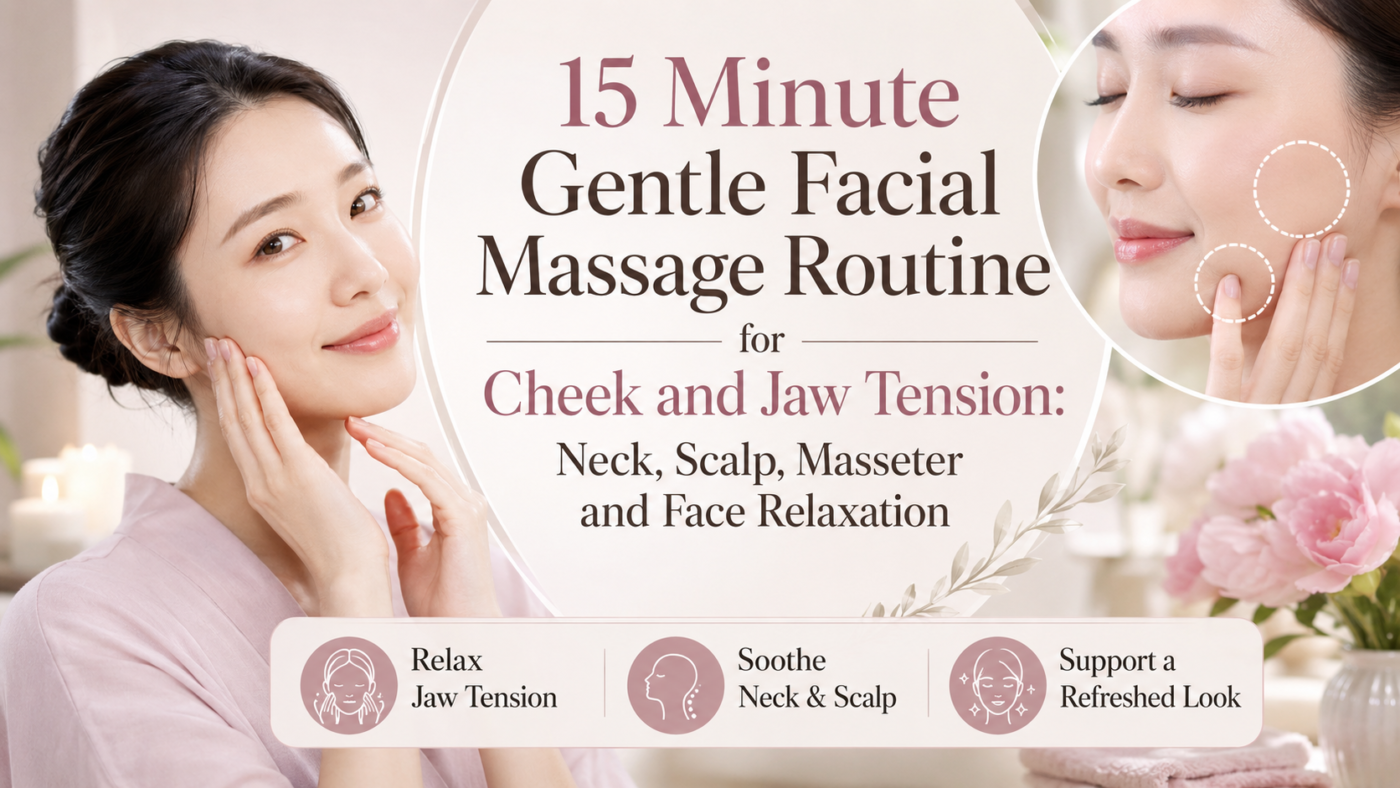
Facial massage for jaw tension can be a simple way to relax the cheeks, masseter, neck and scalp while becoming more aware of habitual facial tension.Why Your Face Can Feel Tight or Tired
Your face is constantly moving.
You talk.
You smile.
You chew.
You concentrate.
You squint at screens.
You may also clench your jaw during stressful moments without realizing it.
By the end of the day, areas around the jaw, temples, cheeks, neck and scalp may feel tense.
A gentle facial massage routine can provide a simple opportunity to slow down and become aware of this tension.
That does not mean massage can turn your face back to the way it looked 20 years ago.
It also does not mean that tight muscles are physically pulling your entire face downward.
A more realistic goal is much simpler.
Relax the muscles.
Move the skin gently.
Reduce unnecessary clenching.
Take a break from repetitive facial tension.
Notice how your face feels afterward.
For many people, that alone can make a self care routine worthwhile.
What Facial Massage Can and Cannot Do
Facial massage is often promoted with dramatic claims.
Some videos suggest that massaging the cheeks can permanently lift sagging tissue, erase wrinkles or produce results faster than Botox.
Those promises go far beyond what a simple massage can reliably accomplish.
Massage can temporarily increase warmth in the skin.
It can help some people relax tight muscles.
It may temporarily change the appearance of mild puffiness.
It can also simply feel pleasant.
But massage cannot reproduce the pharmacological effect of botulinum toxin injections.
It cannot provide the structural changes produced by facial surgery.
And it cannot permanently reposition facial bones or lift loose skin.
That distinction matters.
You can enjoy facial massage without turning it into an anti aging miracle treatment.
Start With the Neck
The routine begins away from the face.
Place one hand near the opposite shoulder and gently tilt your head to create a comfortable stretch along the side of the neck.
Do not pull aggressively.
Allow the weight of your head to create most of the stretch.
Keep your shoulders relaxed.
Breathe slowly.
Hold only within a comfortable range.
Then repeat on the opposite side.
The neck contains many muscles that contribute to head position and movement.
If you spend long periods looking downward at a phone or computer, a few minutes of comfortable movement may feel particularly welcome.
Avoid pressing deeply into the front of the neck.
Important blood vessels, nerves and other structures pass through this region.
Gentle movement is enough.
Massage Around the Side of the Neck
After stretching, use your fingertips or palm to gently massage muscular areas along the side and back of the neck.
Use light pressure.
This should feel soothing rather than painful.
Move slowly.
If you discover a tender area, do not assume that harder pressure will fix it faster.
Muscle tenderness is not a challenge that needs to be defeated.
Reduce the pressure instead.
Persistent or significant neck pain should be evaluated appropriately rather than repeatedly massaged.
Move Up Toward the Scalp
The routine next moves into scalp massage.
Place your fingertips against the scalp rather than simply rubbing the hair.
Use small circular movements.
You can gently move the scalp skin beneath your fingers.
Work across the sides, top and back of the head.
Some people enjoy gently lifting small sections of scalp skin between the fingers, but this should not become painful pinching.
Scalp massage may feel relaxing and can temporarily increase local warmth.
It should not be interpreted as a diagnostic test of facial age.
A stiff feeling scalp does not tell you how biologically old your face is.
And a more mobile scalp does not mean that your face has physically become younger.
Avoid the Idea That Pain Means Progress
One of the most important corrections to the original routine concerns pain.
The video sometimes treats painful massage as evidence that the correct area has been found.
That is not a reliable rule.
Massage does not need to hurt to be useful.
Pain can simply mean that you are applying too much pressure or irritating a sensitive structure.
Use enough pressure to feel the tissue without creating sharp pain.
Avoid using fingernails.
Do not leave bruises.
Do not repeatedly press into an area that becomes increasingly painful.
Gentle work is usually the better approach for the face.
Cheek Massage
Next, place clean hands against the cheeks.
Use broad, controlled circular movements.
The cheeks contain skin, subcutaneous tissue and several muscles involved in facial expression and chewing.
Massage may make the area feel warmer and temporarily more relaxed.
You can use the pads of your fingers, the broad surface of your fingers or your palms depending on what feels comfortable.
Do not aggressively drag the skin.
If your skin is dry, a small amount of moisturizer may reduce unnecessary friction.
People with active inflammatory skin conditions, painful acne, open wounds, recent procedures or infections should be cautious about vigorous massage.
Can Cheek Massage Lift Sagging Cheeks?
Not permanently.
You may notice that the face looks slightly different immediately after massage.
This can result from temporary changes in muscle tension, skin redness, fluid distribution, facial expression or simply the way you hold your face afterward.
That is different from moving facial tissue into a permanently higher anatomical position.
Enjoy the refreshed appearance if you notice one.
Just do not mistake a temporary effect for structural rejuvenation.
Finding the Masseter
One of the most useful sections of this routine focuses on the masseter.
The masseter is a major chewing muscle located along the side of the jaw.
Try gently clenching your teeth for a moment.
You may feel the muscle become more prominent near the angle of your jaw.
Then relax your teeth again.
Do not continue clenching.
Some people carry considerable tension in this area, especially if they habitually clench or grind their teeth.
Gentle Masseter Massage
Place your fingertips over the masseter.
Keep your teeth slightly separated and your jaw relaxed.
Make small circular movements.
Use mild to moderate pressure.
Move around the muscular area gradually rather than pressing as deeply as possible into a single point.
Continue breathing.
Then repeat on the other side.
If you notice that one side feels more tense than the other, that does not necessarily mean something is wrong.
Chewing patterns and muscle use can differ between sides.
What About Jaw Clenching?
Jaw clenching can happen during the day or during sleep.
Stress may contribute for some people, but clenching can have multiple causes.
Persistent clenching or grinding can sometimes be associated with jaw discomfort, headaches, tooth wear or other symptoms.
Massage may temporarily help a tense muscle feel more comfortable.
It does not necessarily address the underlying reason you are clenching.
If jaw pain, tooth damage, locking, limited opening or persistent headaches are occurring, dental or medical evaluation may be appropriate.
Massage Around the Jaw Carefully
The routine also explores the area near the jaw joint.
This region requires more caution.
The temporomandibular joint is located just in front of the ear.
You can gently open and close your mouth while placing a fingertip near the area to feel the joint move.
Do not aggressively dig into the joint.
Instead, massage surrounding muscular tissues gently.
Your goal should be relaxation, not forcing the jaw into a new position.
Stop if massage produces significant pain, clicking accompanied by pain, locking or worsening symptoms.
Facial massage should never become a test of how much discomfort you can tolerate.
Can Masseter Massage Create a Sculpted Jawline?
It is possible for an overactive or enlarged masseter to influence facial shape.
However, manually massaging the muscle should not be promoted as a guaranteed way to permanently reshape the jawline.
Temporary relaxation may change how the area feels or appears.
That is not equivalent to permanently reducing muscle size.
Be particularly cautious with before and after photographs taken immediately after facial massage.
Lighting, facial expression, camera angle and temporary redness can dramatically change appearance.
Cheekbone Massage
The routine next places the thumbs or fingers beneath the cheek area.
Use gentle upward or circular movements if comfortable.
Do not try to physically push your cheekbones into a different position.
Your cheekbones are part of your facial skeleton.
Massage does not relocate them.
Think of this step as soft tissue massage around the cheeks rather than bone repositioning.
Keep the pressure comfortable.
Avoid the delicate eye area unless you are using exceptionally light touch.
The skin around the eyes is thin and does not need aggressive manipulation.
Relaxing the Face After Massage
After working on the cheeks and jaw, gently shake or move the facial muscles.
Relax your mouth.
Allow your jaw to hang comfortably for a moment.
Let your teeth remain slightly separated.
Drop your shoulders.
Take a slow breath.
Many people unconsciously return to clenching immediately after releasing the jaw.
Use this moment to notice that habit.
You may discover that simply recognizing unnecessary tension is one of the most useful parts of the routine.
Facial Expression Exercise
The routine finishes with facial expression movements.
Relax the forehead.
Keep the area between the eyebrows soft.
Gently engage the cheeks and corners of the mouth.
Smile naturally rather than forcing the expression.
Then relax again.
Facial muscles can certainly move and be exercised.
However, stronger facial contraction does not automatically equal a younger face.
Repeated facial expressions are also involved in the development of some dynamic lines.
So there is no need to perform extreme facial contractions.
Gentle movement is enough.
Does Face Yoga Really Tighten the Face?
This is an area where claims frequently exceed the evidence.
Small studies have explored facial exercise programs, and some participants have shown changes in perceived facial appearance.
However, the evidence remains limited compared with established dermatological treatments.
Results should not be presented as guaranteed.
Face yoga is better understood as a low cost facial movement and relaxation practice rather than a proven replacement for medical or cosmetic treatment.
Can Facial Massage Improve Blood Flow?
Massage can temporarily increase local skin blood flow and warmth.
That is a normal response to physical stimulation.
It does not mean that previously starved facial tissues have suddenly received oxygen for the first time.
Healthy facial tissues already receive continuous blood supply.
You do not need to massage them to keep them alive.
Temporary circulation changes are real enough without exaggerating them.
Does Facial Massage Remove Toxins?
There is no good reason to describe facial massage as removing stored toxins from the cheek or jaw muscles.
Your body’s waste processing involves the liver, kidneys, lungs, gastrointestinal tract and other physiological systems.
Massage may influence local fluid movement and may feel refreshing.
That is not the same as detoxification.
For an evidence conscious beauty website, it is better to use words such as relaxation, massage, comfort and temporary reduction in puffiness rather than toxin release.
Are Emotions Stored Inside the Jaw?
People often describe stress as being held in the jaw.
There is a practical reason for that expression.
Some people clench more when stressed or concentrating.
That does not mean individual memories or emotions are physically stored inside the masseter muscle waiting to be massaged out.
You may still experience an emotional sense of relief during a relaxing routine.
That experience can be meaningful without requiring an unsupported anatomical explanation.
Can Facial Massage Replace Botox?
No.
Botulinum toxin works by temporarily reducing signaling between nerves and targeted muscles.
Massage does not produce the same biological effect.
Facial massage and Botox should therefore not be described as interchangeable treatments.
Someone may prefer massage because it is noninvasive, inexpensive and easy to perform at home.
That is a perfectly reasonable preference.
It simply has different effects.
Can Facial Massage Replace a Facelift?
No.
A surgical facelift alters deeper facial tissues and removes or repositions tissue through surgery.
Massage cannot reproduce those structural changes.
Statements claiming that manual massage works faster than a scalpel are marketing language, not a realistic comparison.
Beauty routines do not need impossible promises to be valuable.
A relaxing 15 minute ritual that helps you feel less tense may already be worthwhile.
How Much Pressure Should You Use?
Use considerably less pressure than many dramatic social media videos suggest.
The face contains numerous superficial structures.
Harder is not better.
As a simple rule, pressure should feel comfortable enough that you can continue breathing normally without pulling away.
Reduce pressure around the temples, eyes and jaw joint.
Do not intentionally create significant pain.
If your skin remains sore or bruised afterward, you probably used too much force.
How Often Can You Practice?
A gentle facial relaxation routine can be practiced regularly if your skin and jaw tolerate it well.
You might begin two or three times per week.
Shorter sessions are perfectly acceptable.
You do not need 15 minutes every day to benefit from relaxation.
Some days, one minute of consciously relaxing your jaw and shoulders may be more useful than an aggressive massage session.
Use your body’s response as your guide.
Who Should Avoid Aggressive Facial Massage?
Use additional caution if you have recently undergone facial surgery, injectable treatments, dental surgery or other facial procedures.
People with active skin infections, significant inflammatory acne, open wounds, severe facial pain or unexplained swelling should avoid aggressive massage.
Anyone with persistent jaw locking, severe temporomandibular joint pain, facial numbness, facial weakness or sudden facial asymmetry should seek appropriate professional evaluation.
Do not try to massage away new neurological symptoms.
A Better Approach to Anti Aging
The idea that your face needs to return to the way it looked in your twenties can create unrealistic expectations.
Faces change.
Skin changes.
Fat distribution changes.
Bone structure changes gradually with age.
Muscle tone and facial expression also change.
None of this means you must stop caring for your appearance.
It simply means that healthy aging does not require pretending aging never happens.
A useful beauty routine might include sun protection, appropriate skin care, adequate sleep, regular physical activity, good nutrition, avoiding smoking and managing health conditions.
Facial massage can sit alongside those habits as a relaxing optional practice.
It does not need to carry the impossible job of reversing every sign of aging.
The Goal Is a More Relaxed Face, Not a Perfect Face
At the end of the routine, look in the mirror again.
Instead of searching immediately for wrinkles, compare how your face feels.
Does your jaw feel less clenched?
Do your shoulders feel lower?
Does your neck feel easier?
Does smiling feel more natural?
Does your face feel warmer or more relaxed?
These changes may be subtle.
That is fine.
A wellness practice does not need dramatic before and after photographs to have value.
Sometimes the most meaningful change is simply noticing that you have been holding tension all day and finally allowing yourself to release some of it.
Frequently Asked Questions
Can facial massage make my face look younger?
Facial massage may temporarily change muscle tension, skin redness or puffiness, which can make the face appear refreshed. There is not strong evidence that ordinary massage permanently reverses facial aging.
Does masseter massage help jaw tension?
Gentle massage may temporarily help some people with muscular tension around the jaw. Persistent pain, grinding, locking or other symptoms should be evaluated appropriately because massage may not address the underlying cause.
Can facial massage lift sagging cheeks?
Massage cannot permanently reposition sagging facial tissue. Temporary visual changes may occur because of muscle relaxation, fluid movement, facial expression and increased skin warmth.
Can facial massage remove wrinkles?
Massage is not an established method for permanently removing wrinkles. Some temporary changes in appearance may occur immediately after a session.
Can scalp massage lift the face?
There is no established evidence that scalp massage mechanically lifts facial tissues. Scalp massage may feel relaxing and can temporarily increase local warmth.
Does facial massage detox the skin?
Facial massage should not be described as a detox treatment. The body’s waste processing systems operate continuously through organs such as the liver and kidneys.
Does painful massage work better?
No. Significant pain is not evidence that massage is more effective. Facial massage should generally remain comfortable.
Can facial massage replace Botox?
No. Botox and facial massage work through entirely different mechanisms and should not be considered equivalent treatments.
Can facial massage replace a facelift?
No. Massage cannot reproduce the structural tissue changes created by facial surgery.
How long should I massage my face?
There is no required duration. A gentle five to fifteen minute routine can be enough for relaxation. Shorter sessions are also completely reasonable.
Medical Disclaimer
This article is for general educational and informational purposes only and is not medical advice, diagnosis or treatment. Stop massage if it causes significant pain, worsening swelling, numbness, weakness, skin injury or other concerning symptoms. Seek appropriate medical or dental care for persistent jaw pain, jaw locking, unexplained facial swelling, facial weakness, severe headaches or other significant symptoms.
This article is for general education and does not replace individualized care from a qualified health professional. Seek appropriate advice for persistent, severe, or concerning symptoms.
Read the full medical disclaimer