The area around the eyes is often one of the first places where people notice changes in facial appearance. Fine lines may become more visible, the upper eyelids may appear heavier, under-eye puffiness can fluctuate, and long hours in front of screens can leave the eyes looking tired even when you feel energetic.
It is understandable that facial exercises and eye-area massage have become popular. They are inexpensive, easy to perform at home, and may feel relaxing.
But can they actually lift sagging eyelids, rebuild collagen, reverse eye aging, or make the eyes look years younger?
The answer is more nuanced.
Gentle massage, blinking, movement breaks, posture changes, and facial relaxation may help reduce muscular tension and eye-strain symptoms. Some people may also notice temporary changes in puffiness or facial expression.
What these techniques cannot reliably do is reverse structural eyelid aging, permanently tighten loose skin, restore age-related loss of collagen, or reverse presbyopia.
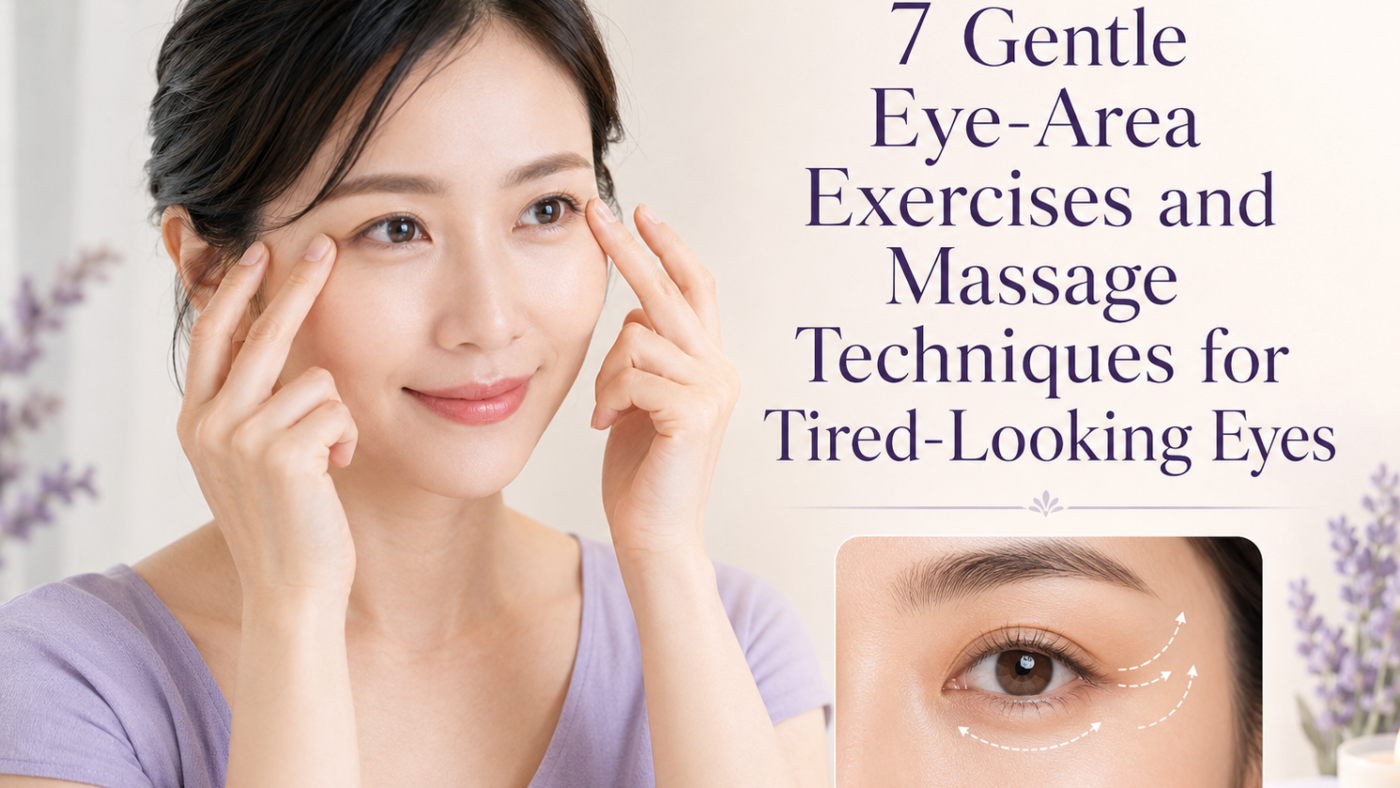
Here are seven gentle techniques you can try, along with what they realistically can—and cannot—do.
Why the Eye Area Changes With Age
The skin around the eyes is thin and delicate.
As we age, several things happen at the same time. Skin gradually loses collagen and elasticity. Facial fat compartments change in volume and position. Bone structure changes slowly. Ligaments and connective tissues may become less supportive, and the muscles and tendons that control the eyelids can also change.
Sun exposure is another major contributor to visible skin aging.
This means that “tired-looking eyes” are rarely caused by one weak muscle that simply needs to be exercised.
Upper-eyelid heaviness, crow’s feet, under-eye hollows, puffiness, dark circles, and true eyelid ptosis can all have different causes.
That is why a technique that feels relaxing is not necessarily a treatment for every age-related change around the eyes.
Facial Tension Is Real—but Emotions Are Not Trapped in Your Eyelids
Stress can affect facial expression.
When concentrating, worrying, or staring at a screen, you may unconsciously tighten your forehead, squint, clench your jaw, or raise your eyebrows.
Over time, repeated facial expressions can contribute to dynamic expression lines.
Relaxing those muscles may make your face look softer temporarily.
However, emotional stress does not become physically trapped inside the eyelids, forehead, or facial muscles as a toxin that must be massaged out.
Likewise, crying during relaxation or massage may feel emotionally meaningful, but tears are not evidence that stored trauma or toxins are leaving the tissues.
Relaxation can still be valuable without attaching unsupported biological explanations to it.
What About Botox?
Botulinum toxin injections, including Botox and similar products, temporarily relax selected facial muscles.
Dermatologists commonly use them to soften expression lines such as crow’s feet and frown lines.
The effect is temporary, generally lasting around three to four months for many people.
There is no evidence that appropriately administered cosmetic Botox blocks emotions inside the face and forces tension to move elsewhere in the body.
Botulinum toxin does have potential side effects and should be administered by an appropriately trained medical professional, particularly around the eyes.
Facial exercises and Botox are therefore not simply two versions of the same treatment.
They work in very different ways.
1. Start With Shoulder and Neck Relaxation
Before touching the eye area, begin farther away from the face.
Sit comfortably with your shoulders relaxed.
Use the opposite hand to gently massage the upper trapezius—the broad muscle running between the shoulder and neck.
Use light squeezing or circular motions rather than aggressive pressure.
Then slowly turn your head from side to side within a comfortable range.
Repeat on the other shoulder.
What This May Help
Long periods of computer work can contribute to neck and shoulder discomfort alongside eye strain.
Relaxing these muscles may help you feel less tense overall.
It does not, however, “open a blocked blood-flow pathway to the eyes.”
Your eyes already receive blood through a highly regulated vascular system.
Think of this step as muscle relaxation, not circulation therapy.
2. Try a Gentle Side-of-the-Neck Stretch
Place one hand lightly on your shoulder.
Tilt your head gently toward the opposite side until you feel a mild stretch along the side of your neck.
Do not pull aggressively on your head.
Breathe slowly for about 15 to 20 seconds.
Return to the center and repeat on the other side.
You should feel a comfortable stretch rather than pain, tingling, dizziness, or pressure.
A relaxed neck may make screen-heavy days feel better, particularly when eye strain and upper-body tension occur together.
3. Use Gentle Brow and Temple Massage—Not Eyeball Pressure
The skin around the eyes is delicate, so more pressure is not better.
Place your fingertips around the temples or along the bony eyebrow region.
Use very small, gentle circular motions.
Avoid pressing directly on the eyeball.
Avoid aggressively pinching, pulling, stretching, or shaking the eyelid itself.
If you are wearing contact lenses, remove them before manipulating the eyelids.
Can This Lift Sagging Eyelids?
There is no strong evidence that massage can permanently lift age-related eyelid sagging.
Massage may temporarily change skin appearance, muscle tension, or puffiness.
But true upper-eyelid ptosis often results from changes involving the muscle or tendon responsible for lifting the eyelid.
Persistent or significant ptosis needs an eye examination rather than increasingly aggressive massage.
4. Practice Conscious Blinking
This may sound too simple to matter, but blinking is important.
People often blink less frequently while looking at computers, smartphones, or other digital screens.
Reduced blinking can contribute to dryness, burning, irritation, and tired-feeling eyes.
Try this:
Close your eyes gently.
Do not squeeze them shut.
Pause for one or two seconds.
Open them again.
Repeat several comfortable times.
Then return to normal blinking.
You can repeat this throughout a screen-heavy day.
The 20-20-20 Habit
Another practical strategy is the 20-20-20 rule.
Approximately every 20 minutes, look at something around 20 feet away for about 20 seconds.
This gives your eyes a break from continuous close focusing.
Unlike many online “anti-aging eye workouts,” screen breaks and frequent blinking are established approaches for managing digital eye strain.
5. Gentle Side-to-Side and Up-and-Down Gaze Movements
Keep your head still and comfortable.
Without forcing your eyes to the extreme edge of their range, look gently toward the left.
Return to the center.
Look toward the right.
Repeat several times.
Then look gently upward and downward.
Move slowly.
Stop if you experience dizziness, double vision, eye pain, or unusual visual symptoms.
What Does This Exercise Train?
Eye movements are controlled by the extraocular muscles.
These muscles are already highly active throughout the day.
Moving the eyes in different directions can provide a short break from staring at one location, but it is not a proven method for lifting eyelids or rejuvenating the skin around the eyes.
It should be viewed as a movement break rather than an anti-aging treatment.
6. Try Near-and-Far Focusing for Eye-Strain Relief
Hold a finger at a comfortable distance in front of your face.
Look at the finger for several seconds.
Then shift your gaze to something farther away.
Return your gaze to the finger.
Repeat several times without straining.
This changes the focusing demand placed on the eyes and can be a useful break from prolonged close work.
But there is an important distinction.
Near-Far Focusing Does Not Reverse Presbyopia
Presbyopia is the age-related loss of the eye’s ability to focus clearly on nearby objects.
It becomes increasingly common after approximately age 40 because the natural lens of the eye becomes less flexible with age.
Focusing exercises do not restore the lens to its youthful flexibility.
If reading small text is becoming difficult, holding material farther away helps, or you increasingly need brighter light, an eye examination is more useful than attempting to “train away” presbyopia.
Reading glasses, prescription lenses, contact lenses, certain medications, and other options can help depending on the individual.
7. Gentle Facial Muscle Awareness
Some people enjoy deliberately activating the muscles around the cheeks, mouth, eyebrows, and eyes.
You can experiment with a gentle version.
Relax your forehead first.
Allow your eyebrows to rest rather than holding them raised.
Make a natural smile without squeezing the eyes tightly.
Relax.
Repeat several times.
You can also gently raise the eyebrows and lower them again while observing the movement in a mirror.
Can Facial Exercises Make You Look Younger?
Evidence is limited.
One small exploratory study of middle-aged women found that a prolonged facial exercise program was associated with improvements in upper- and lower-cheek fullness.
However, the study was small, had no control group, included participants who completed an intensive exercise program for 20 weeks, and did not establish that facial exercise can reverse eyelid sagging.
The results therefore should not be interpreted as proof that a few minutes of eye exercises can produce a nonsurgical eye lift.
More research is needed.
What About Squinting Exercises for the Under-Eye Area?
Some facial-exercise programs recommend placing fingers beneath the eyes and repeatedly squinting.
The orbicularis oculi muscle does surround the eye and participates in blinking and eyelid closure.
However, deliberately exercising it has not been shown to permanently tighten loose under-eye skin or eliminate eye bags.
Repeated forceful squinting also increases folding of the skin around the eyes.
That is why the goal should never be to perform the hardest possible contraction.
If you choose to experiment with facial movements, keep them gentle.
Don’t Use Pain as Proof That an Exercise Is Working
One of the most concerning ideas in some facial massage routines is that severe pain means you have discovered an important area that needs more pressure.
That is not a safe principle around the eyes.
The eye socket contains delicate structures, nerves, blood vessels, muscles, glands, and the eyeball itself.
You should not continue an eye-area massage because the pain “feels deep” or makes you cry.
Pain is a reason to reduce pressure or stop.
A wellness routine should not require you to tolerate skull-buzzing discomfort.
Does Eye Massage Increase Collagen?
Collagen production in skin is influenced by aging, ultraviolet exposure, genetics, hormones, smoking, and other biological factors.
There is currently insufficient evidence to say that shaking or pressing the eyelids substantially increases collagen production.
Some cosmetic treatments can stimulate remodeling of the skin under controlled conditions, but that cannot simply be extrapolated to home massage.
Massage and clinically validated collagen-remodeling treatments are not equivalent.
Can Face Exercises Remove Crow’s Feet?
Crow’s feet are expression lines around the outer corners of the eyes.
They are influenced by repeated muscle movement as well as age-related skin changes and sun exposure.
Facial exercises cannot reliably erase them.
If reducing their appearance is your goal, some of the most evidence-based strategies include:
- daily broad-spectrum sunscreen
- sunglasses that reduce squinting in bright light
- appropriate moisturizers
- retinoids or other dermatologist-recommended skin care
- professional cosmetic treatments when appropriate
Prevention of additional sun damage is particularly important.
What About Under-Eye Puffiness?
Under-eye puffiness can fluctuate.
Sleep, allergies, crying, dietary sodium, fluid shifts, genetics, and aging can all influence the appearance of the area.
Gentle cooling or very light massage may temporarily reduce mild puffiness for some people.
But persistent bags beneath the eyes may reflect structural fat and tissue changes that massage cannot remove.
If swelling is sudden, painful, red, or affects only one side, medical assessment may be appropriate.
Dark Circles Are Not Simply Poor Circulation
Dark circles can result from several factors.
These include pigmentation, genetics, thin skin that makes blood vessels more visible, shadowing from under-eye hollows, allergies, rubbing, and age-related structural changes.
Increasing massage intensity is unlikely to correct all of these causes.
Treatment should be based on what is actually producing the dark appearance.
What Actually Helps Tired-Looking Eyes?
If you spend significant time on digital devices, start with the fundamentals.
Blink frequently.
Take visual breaks.
Correct your screen position.
Reduce glare.
Use appropriate lighting.
Get enough sleep.
Treat allergies and dry eye when necessary.
Use sunglasses and sunscreen.
Have your vision checked regularly.
For many people, these simple measures are more valuable than complicated “eye rejuvenation” routines.
A Simple 7-Minute Eye-Area Relaxation Routine
You can combine the gentler elements into a short daily routine.
Minute 1: Relax your shoulders and gently massage the upper trapezius.
Minute 2: Perform comfortable side-of-the-neck stretches.
Minute 3: Lightly massage the temples and brow bone without pressing on the eyeballs.
Minute 4: Practice several slow, complete blinks.
Minute 5: Look left and right, then gently up and down.
Minute 6: Alternate between a nearby target and a distant target.
Minute 7: Relax your forehead, smile naturally, close your eyes, and breathe slowly.
The goal is to finish feeling calmer—not exhausted.
When Drooping Eyelids Need an Eye Examination
Not every drooping eyelid is cosmetic aging.
True ptosis can occur when the structures that raise the upper eyelid become stretched, weak, or neurologically impaired.
A gradually developing mild droop may be related to aging.
But sudden eyelid drooping requires more attention.
Seek prompt medical evaluation if a new drooping eyelid occurs with symptoms such as:
- double vision
- unequal pupils
- severe headache
- facial weakness
- difficulty speaking
- weakness elsewhere in the body
- sudden vision changes
Persistent ptosis that interferes with vision should also be assessed by an ophthalmologist.
Treatment depends on the cause and may include prescription medication for selected cases or surgery.
Exercises are not an established treatment for structural ptosis.
What About Botox Around the Eyes?
Botulinum toxin can temporarily soften crow’s feet and other dynamic facial wrinkles when administered appropriately.
For many patients, effects last approximately three to four months.
Possible complications include temporary eyebrow or eyelid drooping, asymmetry, bruising, and other adverse effects.
That is why injections around the eyes should be performed by appropriately qualified medical professionals.
Choosing Botox is a personal cosmetic decision.
Using it does not mean someone is emotionally suppressing themselves, and avoiding it does not automatically make facial muscles healthier.
The Most Important Anti-Aging Habit for the Eye Area
If your goal is to protect the appearance of the skin around the eyes over time, sun protection deserves more attention than most facial exercises.
Use broad-spectrum sunscreen on exposed skin.
Wear sunglasses when appropriate.
Avoid intentional tanning.
Do not smoke.
Manage dry-eye or allergy-related rubbing.
And use skin-care products suitable for your skin type.
These habits address important contributors to visible aging rather than promising to mechanically “lift” the face in minutes.
The Bottom Line
Gentle eye-area exercises and massage can be enjoyable.
They may help you relax your forehead, neck, and shoulders, remind you to blink, interrupt long periods of screen staring, and temporarily change how tense or puffy your face feels.
Those are worthwhile benefits.
But eye exercises do not reliably reverse age-related eyelid sagging.
Near-and-far focusing does not restore a youthful lens.
Massage does not force the eyelids to produce new collagen.
Botox does not trap emotions inside the face.
And painful pressure around the eyes is not a sign of deeper healing.
The healthiest approach is also the simplest:
Treat your eyes gently.
Rest them when they are tired.
Protect the surrounding skin from the sun.
Keep realistic expectations about cosmetic exercises.
And seek professional eye care when changes involve your vision or true eyelid drooping.
Your eyes do not need to look 20 years younger to look healthy and expressive.
They need appropriate care.
Frequently Asked Questions
Can eye exercises lift droopy eyelids?
There is no strong evidence that eye exercises can correct structural eyelid ptosis or permanently lift age-related excess eyelid skin. Persistent drooping should be evaluated by an eye-care professional.
Can eye exercises make the eyes look younger?
Gentle relaxation or facial exercise may temporarily change expression and muscle tension, but evidence for meaningful anti-aging effects around the eyes is limited.
Can eye exercises reverse presbyopia?
No. Presbyopia mainly results from age-related loss of flexibility in the natural lens of the eye. Eye exercises have not been shown to reverse this structural aging process.
Is it safe to massage the eyelids?
Very gentle touch may be tolerated by many people, but avoid direct pressure on the eyeball and aggressive pulling, pinching, or rubbing. People with recent eye surgery or an eye condition should ask their eye-care professional first.
Why do my eyes feel tired after using screens?
People often blink less while looking at screens. Prolonged focusing, dry eyes, glare, lighting, uncorrected vision problems, and neck or shoulder tension can also contribute to digital eye strain.
Does blinking more help?
Yes. Blinking spreads the tear film across the surface of the eye and may help reduce dryness associated with prolonged screen use.
Does Botox permanently remove eye wrinkles?
No. Botulinum toxin temporarily relaxes selected facial muscles. Cosmetic effects commonly last approximately three to four months, although duration varies.
Can facial exercises increase collagen?
There is not enough evidence to conclude that home facial exercises or massage meaningfully stimulate collagen production around the eyes.
Medical and Eye-Care Disclaimer
This article is for educational purposes only and is not medical advice, diagnosis, or treatment. Do not apply painful or excessive pressure to the eyes or eyelids. Stop any exercise that causes eye pain, dizziness, double vision, visual changes, severe headache, or other unusual symptoms. Sudden eyelid drooping, sudden vision loss, new double vision, unequal pupils, or neurological symptoms require prompt medical evaluation. Consult an ophthalmologist, optometrist, dermatologist, or other qualified healthcare professional for individualized care.
References
American Academy of Dermatology. Botulinum Toxin Therapy: Overview and FAQs.
Mayo Clinic. Eyestrain: Diagnosis, Treatment and Self-Care.
Mayo Clinic. Presbyopia: Diagnosis and Treatment.
Cleveland Clinic. Ptosis (Droopy Eyelid): Causes and Treatment.
Cleveland Clinic. Options for Droopy Eyelids, Circles and Sags.
Alam M, Walter AJ, Geisler A, et al. Association of Facial Exercise With the Appearance of Aging. JAMA Dermatology. 2018;154(3):365–367.
This article is for general education and does not replace individualized care from a qualified health professional. Seek appropriate advice for persistent, severe, or concerning symptoms.
Read the full medical disclaimer