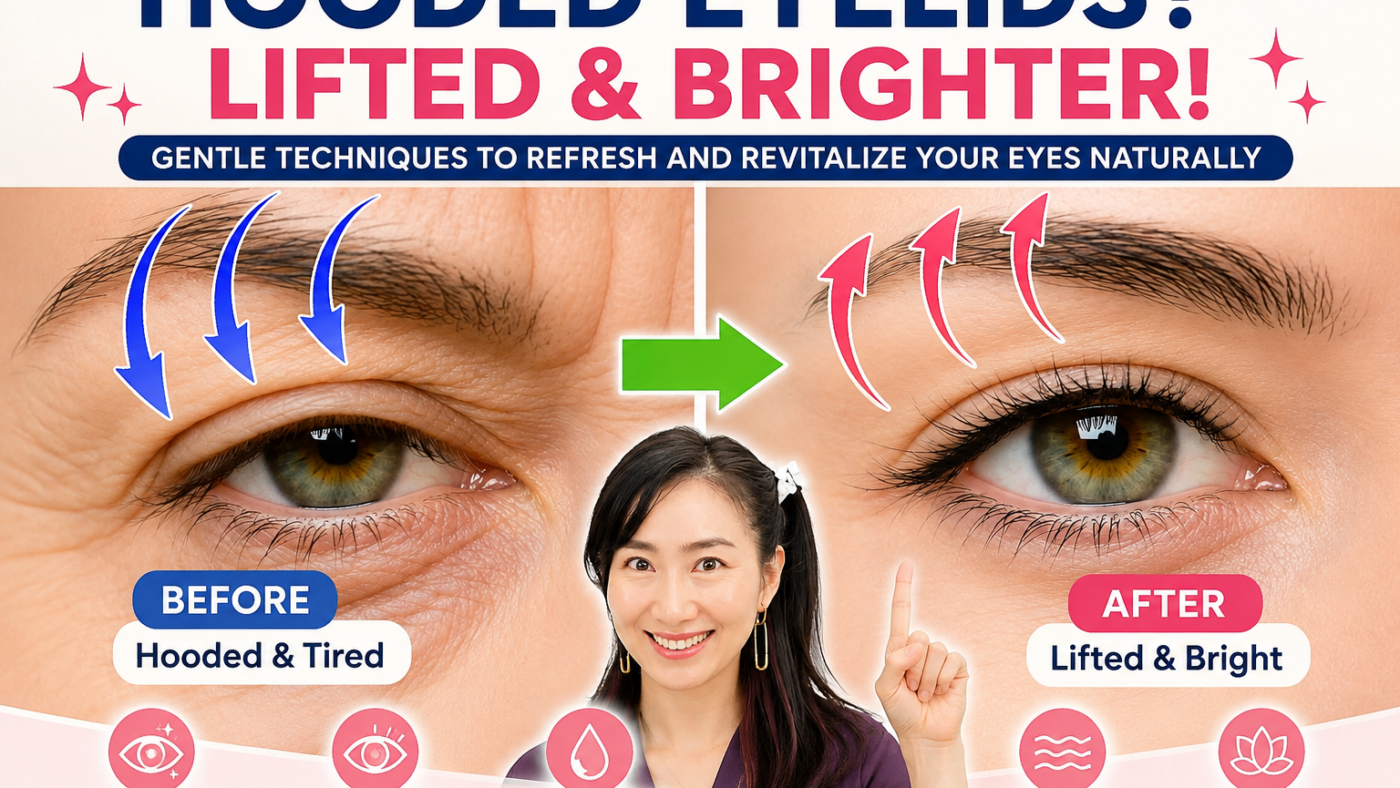
Eye massage for droopy eyelids and tired eyes has become increasingly popular among people looking for a natural way to make the eye area appear brighter, less tense, and more refreshed. After hours of looking at phones and computer screens, the eyes can feel dry, heavy, strained, or fatigued, while squinting and facial tension can make forehead lines and the area around the eyes appear more noticeable.
Gentle massage, warmth, blinking, relaxation, and regular screen breaks may improve comfort for some people. However, these techniques cannot reverse every cause of drooping eyelids, eliminate wrinkles, unblock a medically obstructed tear duct, or restore age-related vision changes. Understanding what these exercises can—and cannot—do is essential before beginning.
Why Do Your Eyes Look Tired or Heavy?
The appearance of the eye area changes for many reasons.
Normal aging affects skin elasticity, connective tissue, muscles, fat distribution, and the structures supporting the eyelids. Genetics, sun exposure, sleep, allergies, fluid retention, smoking, facial expressions, and individual anatomy can also influence how open or tired the eyes appear.
Long periods of concentrated screen use create another problem: people tend to blink less frequently when staring at digital displays. Reduced blinking can contribute to tear-film instability, dryness, burning, irritation, and eye fatigue.
This can make the eyes feel considerably older or heavier even though the underlying problem may have little to do with eyelid aging itself.
Droopy Eyelids Are Not Simply “Frozen” Muscles
A popular beauty claim is that aging eyes become droopy because the muscles or tissues around them have become “frozen.”
That is an appealing metaphor, but it is not a medical explanation.
True eyelid drooping, known as ptosis, can occur when structures responsible for elevating the upper eyelid are weakened, stretched, damaged, or affected by neurological or other medical conditions.
Age-related changes are one possible cause, but sudden or unusual eyelid drooping requires particular attention.
Facial exercises cannot reliably correct structural ptosis.
Gentle relaxation may nevertheless change how tense the forehead and brow area looks, which can subtly influence overall facial expression.
Dry Eyes Do Not Usually Mean Your Tear Ducts Are Blocked
Another common misconception is that dry eyes are primarily caused by blocked tear ducts.
Dry-eye disease is more complicated.
The tear film contains several interacting components, and symptoms may develop when tear production is inadequate or when tears evaporate too quickly.
Ironically, an obstructed tear-drainage system may cause excessive tearing rather than simply dry eyes.
Therefore, trying to manually “open” the tear ducts with aggressive massage is not an appropriate general treatment for dry eye.
If dryness is persistent, painful, or accompanied by vision changes, professional eye care is preferable to increasingly forceful massage.
What Gentle Eye Massage May Actually Do
The realistic benefits are more modest than many anti-aging claims—but still useful.
A gentle routine may encourage you to close your eyes, step away from screens, blink normally, relax facial muscles, and apply comfortable warmth around the eyelids.
These behaviors may temporarily make tired eyes feel better.
Relaxing the forehead, temples, shoulders, and brow can also soften a tense facial expression.
The result may be eyes that appear somewhat more rested and refreshed.
That is different from physically reversing the aging process.
Step 1: Start With Your Shoulders and Neck
Before touching the delicate eye area, relax the upper body.
Sit comfortably and allow your shoulders to drop.
Gently massage one upper shoulder with the opposite hand. Slowly turn or tilt your head only within a comfortable range.
Breathe normally.
Repeat on the other side.
The purpose is relaxation, not correcting the anatomy of the eyes through the neck.
Avoid aggressive neck stretching or any movement that produces dizziness, numbness, sharp pain, or neurological symptoms.
Step 2: Relax the Jaw
People often tense several areas of the face simultaneously when concentrating.
Allow your teeth to separate slightly.
Relax your jaw rather than clenching it.
Take several slow breaths.
Notice whether your eyebrows, forehead, and area around the eyes relax at the same time.
This simple awareness exercise can be especially useful after prolonged computer or phone use.
Step 3: Use Gentle Warmth Around the Eyes
Close your eyes.
Warm your clean hands by rubbing your palms together and then lightly cup them over the closed eyes without pressing on the eyeballs.
The warmth should feel comfortable, never hot.
Warm compresses are commonly used as part of care for some forms of dry eye and meibomian gland dysfunction because warmth can help soften oils produced by glands along the eyelids.
However, simply placing warm hands over the eyes should not be presented as a cure for dry-eye disease.
Step 4: Massage Around the Orbital Bone—Not the Eyeball
Use clean fingertips and extremely light pressure around the bony rim surrounding the eye.
You can make small, slow movements around the brow and upper cheek.
Do not press directly into the eyeball.
The eye itself is delicate, and strong pressure is unnecessary.
This is especially important because some social-media routines demonstrate pressing or vibrating through closed eyelids. There is no need to do this to obtain the relaxation benefits of the routine.
Stay on the surrounding bony structures instead.
Step 5: Relax the Space Between the Eyebrows
Place your fingertips lightly above or between the eyebrows.
Take a slow breath.
As you exhale, consciously release the habitual frown or squint.
Do not forcefully stretch the skin.
People who concentrate intensely often contract the muscles between the brows without realizing it. Becoming aware of this pattern can make the forehead look and feel less tense.
It will not permanently erase established wrinkles, but it can change your resting facial expression.
Step 6: Practice Comfortable Blinking
Blink naturally several times.
Then gently close your eyes for a moment before reopening them.
Blinking helps redistribute the tear film across the surface of the eye.
During prolonged screen use, consciously remembering to blink can be more useful than complicated eye exercises.
Avoid squeezing the eyelids forcefully.
The movement should remain easy and natural.
Step 7: Look Left, Right, Up, and Down
Keep your head still and move your gaze slowly to the left and then to the right.
Return to center.
Then look comfortably upward and downward.
Do not strain to reach the maximum possible range.
A few gentle repetitions can provide a break from staring continuously at one fixed location.
However, moving the eyes around does not strengthen vision in the same way resistance exercise strengthens skeletal muscle.
It should be considered a movement and screen-break exercise rather than a treatment for refractive errors or eye disease.
Step 8: Try Near-and-Far Focus Changes
Hold one finger at a comfortable reading distance.
Look at it briefly.
Then shift your attention to an object farther away.
Alternate between near and far several times without straining.
Changing viewing distance can be a useful break from prolonged near work.
The well-known 20-20-20 rule follows a similar principle: approximately every 20 minutes, look at something around 20 feet away for at least 20 seconds.
This can help reduce symptoms associated with prolonged digital-device use.
But near-and-far focusing exercises do not reverse presbyopia, cataracts, glaucoma, macular degeneration, or other structural eye diseases.
Step 9: Relax the Forehead
Place your fingertips gently across the forehead.
Instead of trying to “train the forehead higher,” consciously release unnecessary tension.
Some people repeatedly raise their eyebrows to compensate for heavy upper eyelids. This can contribute to prominent horizontal forehead lines.
Trying to strengthen the forehead aggressively may therefore be counterproductive if your goal is a relaxed appearance.
Allow the forehead to soften.
Step 10: Finish With a Screen Break
Close your eyes comfortably for several moments.
Then look into the distance.
Take several natural blinks.
Relax your jaw and shoulders.
This may be the most valuable part of the entire routine because it gives your visual system a genuine break from continuous near focus.
Can Eye Exercises Lift Droopy Eyelids?
There is insufficient evidence that ordinary facial exercises can reliably correct true eyelid ptosis.
The position of the upper eyelid depends on specific muscles, tendons, nerves, and other anatomical structures.
Age-related changes can alter these structures.
Someone may temporarily look more alert after relaxation, improved sleep, reduced puffiness, or a change in facial expression, but this should not be confused with repairing structural eyelid drooping.
Persistent ptosis should be assessed professionally.
Can Eye Exercises Improve Blurry Vision?
This requires an equally important distinction.
Blurry vision can result from refractive errors such as nearsightedness, farsightedness, astigmatism, or presbyopia, but it can also result from dry eye, cataracts, retinal disease, diabetes-related eye disease, glaucoma, medication effects, and many other conditions.
Eye exercises cannot be assumed to correct these problems.
If your vision has become persistently blurry, obtaining an eye examination is far more important than attempting to “train” your eyes harder.
What About Forehead Wrinkles?
Forehead lines develop partly from repeated movement of the frontalis muscle, together with age-related changes in the skin and cumulative sun exposure.
Relaxation exercises may reduce habitual brow raising or frowning.
They cannot erase established wrinkles permanently.
Daily broad-spectrum sun protection remains one of the most important strategies for reducing premature photoaging.
Can Massage Make the Eyes Look Brighter?
Possibly, in a temporary and subtle way.
A few minutes away from screens, comfortable warmth, blinking, relaxation, and reduced facial tension can change how your eyes feel and how your expression looks.
If mild puffiness or fatigue is making the eyes look heavy, rest may also improve their appearance.
That is a perfectly reasonable benefit.
It does not require claiming that massage biologically reverses eye aging.
What You Should Never Do Around the Eyes
Never deliberately apply strong pressure directly to the eyeballs.
Do not perform a technique simply because intense pain is described as evidence that it is “working.”
Pain around the eye is not a desirable goal.
Do not attempt to forcefully unblock tear ducts yourself.
Do not use unclean hands around the eyes, and avoid applying irritating oils, essential oils, or cosmetic products inside the eyes.
Stop immediately if a technique produces pain, persistent blurred vision, dizziness, flashes of light, unusual visual symptoms, or significant irritation.
When Droopy Eyelids Need Medical Attention
A gradually changing eyelid position can have several explanations, but sudden eyelid drooping deserves particular caution.
Seek urgent medical evaluation if new eyelid drooping occurs with symptoms such as double vision, facial weakness, severe headache, unequal pupils, difficulty speaking, weakness in an arm or leg, or other sudden neurological changes.
Similarly, sudden vision loss, flashes and a new shower of floaters, severe eye pain, significant trauma, or a curtain-like shadow across the vision should not be treated with facial exercises.
These situations require prompt professional assessment.
A Better Daily Strategy for Tired Eyes
If your eyes frequently feel tired after screens, focus on fundamentals before complicated routines.
Take regular viewing breaks.
Blink normally.
Adjust screen distance and lighting.
Avoid excessive glare.
Get appropriate vision correction if you need it.
Maintain adequate sleep.
Use recommended dry-eye treatments when appropriate.
And give your eyes genuine periods away from near work.
A short relaxation routine can complement these habits rather than replace them.
The Bottom Line
Your eyes do not become old simply because they have “stopped flowing,” and droopy eyelids are not usually caused by blocked tear ducts.
But modern visual habits can absolutely make the eye area feel tired.
Long periods of screen use, reduced blinking, dry-eye symptoms, squinting, poor sleep, and facial tension can contribute to eyes that feel heavy and look fatigued.
Gentle warmth, natural blinking, screen breaks, comfortable gaze changes, and relaxation around the forehead and shoulders may help some people feel refreshed.
The key word is gentle.
Do not press the eyeballs. Do not use pain as a measure of effectiveness. Do not expect massage to correct structural ptosis or eye disease.
The goal is not to make your eyes biologically younger.
The goal is to take better care of the eyes you depend on every day.
Frequently Asked Questions
Can eye massage lift droopy eyelids?
Eye massage may temporarily make the eye area look more relaxed or refreshed, but it has not been shown to reliably correct structural eyelid ptosis.
Can massage unblock tear ducts?
You should not assume that dry eyes are caused by blocked tear ducts or attempt aggressive self-massage to unblock them. Persistent tearing, swelling, discharge, pain, or suspected tear-duct obstruction should be professionally evaluated.
Can eye exercises improve blurry vision?
They do not reliably correct refractive errors or structural eye diseases. Persistent or new blurry vision warrants an eye examination.
Does screen time cause tired eyes?
Prolonged digital-device use can contribute to eye strain and dry-eye symptoms. Reduced blinking during concentrated screen use may contribute to discomfort.
Can warm hands help tired eyes?
Comfortable warmth and closing the eyes may feel relaxing. Proper warm compresses are also used in some dry-eye management strategies, although treatment depends on the underlying cause.
Should I massage my eyeballs through my eyelids?
No. Avoid deliberate pressure on the eyeballs. Keep massage extremely gentle and primarily around the surrounding orbital bone.
Can eye exercises prevent age-related vision changes?
There is no good evidence that routine eye exercises prevent major age-related eye diseases or reverse presbyopia. Regular eye examinations become increasingly important with age.
How often can I do this routine?
A short, gentle relaxation routine can be performed when your eyes feel tired, provided it causes no discomfort. Regular screen breaks throughout the day are generally more important than performing a long massage session.
Medical Disclaimer
This article is for general educational purposes only and is not medical or ophthalmological advice. Eye pain, persistent blurred vision, sudden eyelid drooping, double vision, sudden vision loss, flashes or new floaters, neurological symptoms, trauma, or other significant eye changes require appropriate professional assessment. Do not press directly on the eyeballs or use painful massage techniques around the eyes.
This article is for general education and does not replace individualized care from a qualified health professional. Seek appropriate advice for persistent, severe, or concerning symptoms.
Read the full medical disclaimer