Many people notice that after years of looking down at phones, working at a desk, studying, or sitting for long periods, their shoulders begin to roll forward, the chest appears more closed, and the upper back looks increasingly rounded.
This appearance is often loosely described as poor posture or a hunched back.
For some people, it is mainly a cosmetic concern. For others, it may also be accompanied by neck tension, shoulder discomfort, upper-back stiffness, or fatigue after prolonged sitting or standing.
However, there is an important distinction to understand.
Rounded shoulders and true spinal kyphosis are not always the same thing.
Rounded Shoulders Do Not Always Mean Spinal Disease
The thoracic spine naturally curves slightly backward.
When this curvature becomes more pronounced than normal, it may be described medically as kyphosis.
Kyphosis can make the upper back appear more rounded and may be associated with forward shoulders, stiffness, discomfort, or reduced mobility.
In some people, the posture is flexible and changes significantly when they consciously stand taller. This may be more closely related to habitual posture, muscle balance, mobility, and movement patterns.
In other cases, however, the curvature may involve structural changes in the spine.
One example is Scheuermann’s kyphosis, which often develops during adolescence.
For this reason, a visibly rounded upper back should not automatically be assumed to result from poor sitting posture alone.
When the curvature is pronounced, persistent, progressive, painful, or difficult to correct voluntarily, professional assessment may be appropriate.
Can One Exercise Correct a Hunched Back?
Many online posture routines promise that a single exercise can correct rounded shoulders or a hunched posture.
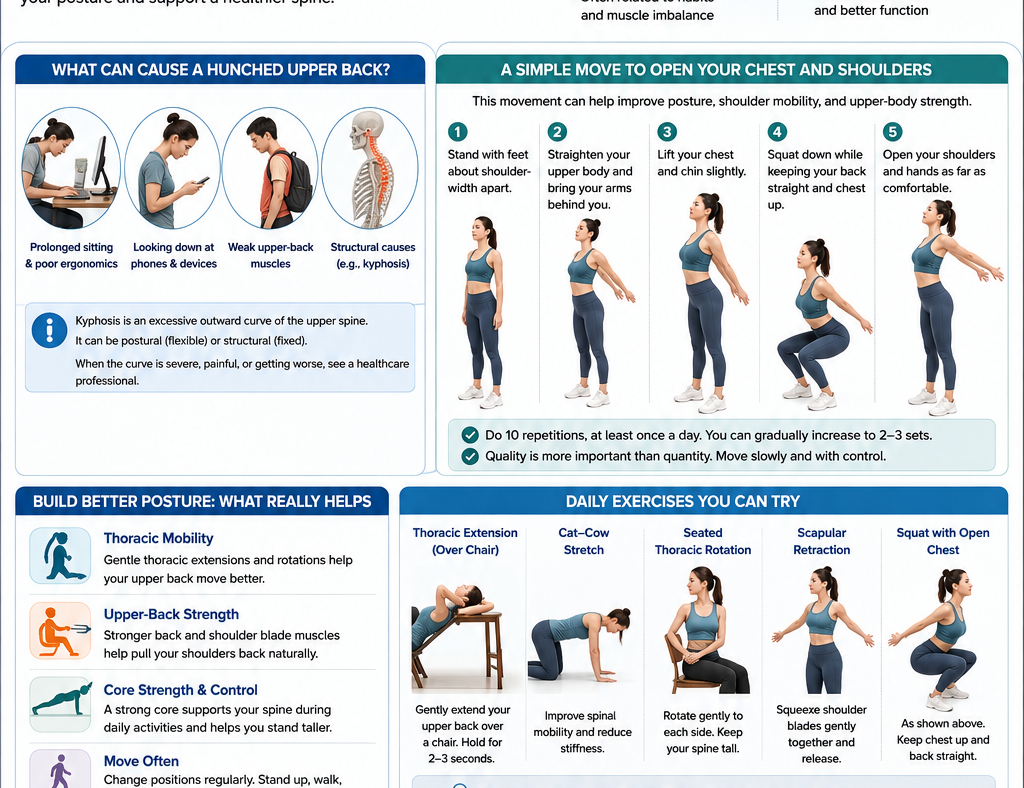
A common example involves standing with the feet about shoulder-width apart, reaching the arms behind the body, lifting the chest, and performing squats while keeping the torso upright.
For someone who is healthy, pain-free, and able to perform the movement comfortably, this may be a useful general mobility and strengthening exercise.
However, it is not accurate to claim that performing ten repetitions a day will automatically correct kyphosis.
Postural improvement usually involves several factors, including thoracic mobility, upper-back strength, shoulder control, core stability, lower-body strength, and daily movement habits.
Structural kyphosis is especially unlikely to be corrected by one simple exercise.
Exercise may still help improve strength, mobility, confidence, and comfort, but the goal should not be to force the spine into a perfectly straight position.
Do Not Overcorrect by Forcing the Chest Up
Another common mistake is trying too hard to stand straight.
Some people respond to rounded shoulders by aggressively pushing the chest forward, squeezing the shoulder blades together, arching the lower back, and lifting the chin.
This can simply replace one uncomfortable posture with another.
A healthier posture should feel balanced and natural rather than stiff.
When standing or exercising, allow the head to remain in a comfortable neutral position.
Keep the gaze generally forward rather than repeatedly tilting the head upward.
The shoulders do not need to be pulled backward as far as possible.
Instead, aim for relaxed control and allow the shoulder blades, shoulders, and thoracic spine to move naturally.
What Should You Actually Train?
Improving a rounded upper-body posture usually requires a more complete approach.
Thoracic Mobility
Long periods of sitting can leave the upper back feeling stiff.
Gentle thoracic extension and rotation exercises may help maintain or improve movement through the upper spine.
For example, sitting upright in a chair and gently extending the upper back over the backrest can provide comfortable thoracic movement.
The motion should remain controlled and pain-free.
Upper-Back Strength
The muscles around the shoulder blades and upper back help support comfortable posture and shoulder movement.
Appropriate rowing movements, resistance-band exercises, and shoulder-blade control exercises can help develop this area.
Core Strength and Trunk Control
Good posture does not mean holding the abdominal muscles as tightly as possible all day.
The core should instead provide enough control to support the trunk during standing, walking, lifting, squatting, and other everyday activities.
Gradual core strengthening can therefore be useful as part of a balanced exercise program.
Regular Movement
Even a posture that looks technically perfect may become uncomfortable if maintained for several hours without movement.
The human body is designed to move.
Rather than trying to maintain one ideal position all day, change positions regularly.
Stand up, walk around, stretch gently, and give the shoulders, spine, and hips opportunities to move.
A Simple Daily Posture Routine
If you do not have significant pain or a diagnosed spinal condition, you may begin with gentle and comfortable movements.
Stand naturally with your feet comfortably apart.
Allow your knees to remain relaxed rather than locked.
Think about gently lengthening upward through the body instead of aggressively pushing the chest forward.
Move the shoulders slightly backward and downward, then relax them completely.
This can help you become more aware of how the shoulder blades move without constantly squeezing them together.
You may also practice gentle thoracic extension.
Sit in a stable chair with both feet on the floor.
Keeping the movement comfortable, gently extend the upper back and then return to a neutral position.
Other useful exercises may include light rowing movements, shoulder-blade control exercises, core strengthening, lower-body strengthening, and controlled squats.
If you enjoy the squat variation described earlier, it can be included as part of a broader exercise routine.
However, there is no need to force the arms as far behind the body as possible.
The movement should not cause shoulder pain, excessive lower-back arching, neck strain, or other discomfort.
Quality of movement is more important than the number of repetitions.
Children and Teenagers Need Special Consideration
Posture concerns in children and teenagers deserve particular attention because the spine is still developing.
A child who sometimes slouches while studying but can comfortably stand upright when reminded may simply have a habitual posture pattern.
However, a visibly rounded back that remains pronounced when standing tall may require further assessment.
Seek professional advice if the spinal curvature appears to be getting worse, cannot be corrected voluntarily, looks uneven, or is accompanied by persistent pain.
Kyphosis in children and adolescents can have different causes.
Some cases are primarily postural.
Others may involve conditions such as Scheuermann’s kyphosis or, more rarely, congenital spinal abnormalities.
Treatment depends on the cause, severity, symptoms, age, and remaining growth.
Some young people may benefit from observation and physical therapy, while others may require additional orthopedic evaluation.
For this reason, simply asking a child to perform one posture exercise every day is not an appropriate substitute for assessment when the curvature is significant.
When Should You Seek Professional Evaluation?
Mild rounded shoulders without pain may often be approached with regular movement, better exercise habits, gradual strengthening, and improved mobility.
However, medical or physical therapy assessment is worth considering when the upper back appears markedly rounded or continues to worsen.
Professional evaluation is also recommended if there is persistent back pain, significant stiffness, reduced mobility, or difficulty voluntarily changing the posture.
More urgent assessment may be necessary if spinal changes are accompanied by weakness, numbness, unusual sensations, severe pain, balance problems, or breathing difficulties.
These symptoms should not simply be treated with home posture exercises.
The Most Important Principle
Healthy posture is not about holding your body in a rigid military position all day.
It does not mean squeezing your shoulders backward as far as possible or forcing your chest upward.
A healthy body should have enough strength, mobility, and control to move comfortably through many different positions.
Regular movement, thoracic mobility, upper-back and core strengthening, and avoiding prolonged periods of complete inactivity are generally more useful than searching for one miracle exercise that promises to fix a hunched back.
For children, teenagers, or anyone with a pronounced spinal curve, the first step is to determine whether the issue is primarily postural or structural.
Once the cause is better understood, a more appropriate and individualized approach can be chosen.
Medical Disclaimer
This article is intended for general health education and informational purposes only. It is not intended to diagnose, treat, cure, or prevent any medical condition and should not replace individualized advice from a physician, physical therapist, or other qualified healthcare professional.
If you or your child has a pronounced or worsening spinal curvature, persistent back pain, numbness, weakness, reduced mobility, breathing difficulties, or other concerning symptoms, seek appropriate professional medical evaluation.
This article is for general education and does not replace individualized care from a qualified health professional. Seek appropriate advice for persistent, severe, or concerning symptoms.
Read the full medical disclaimer