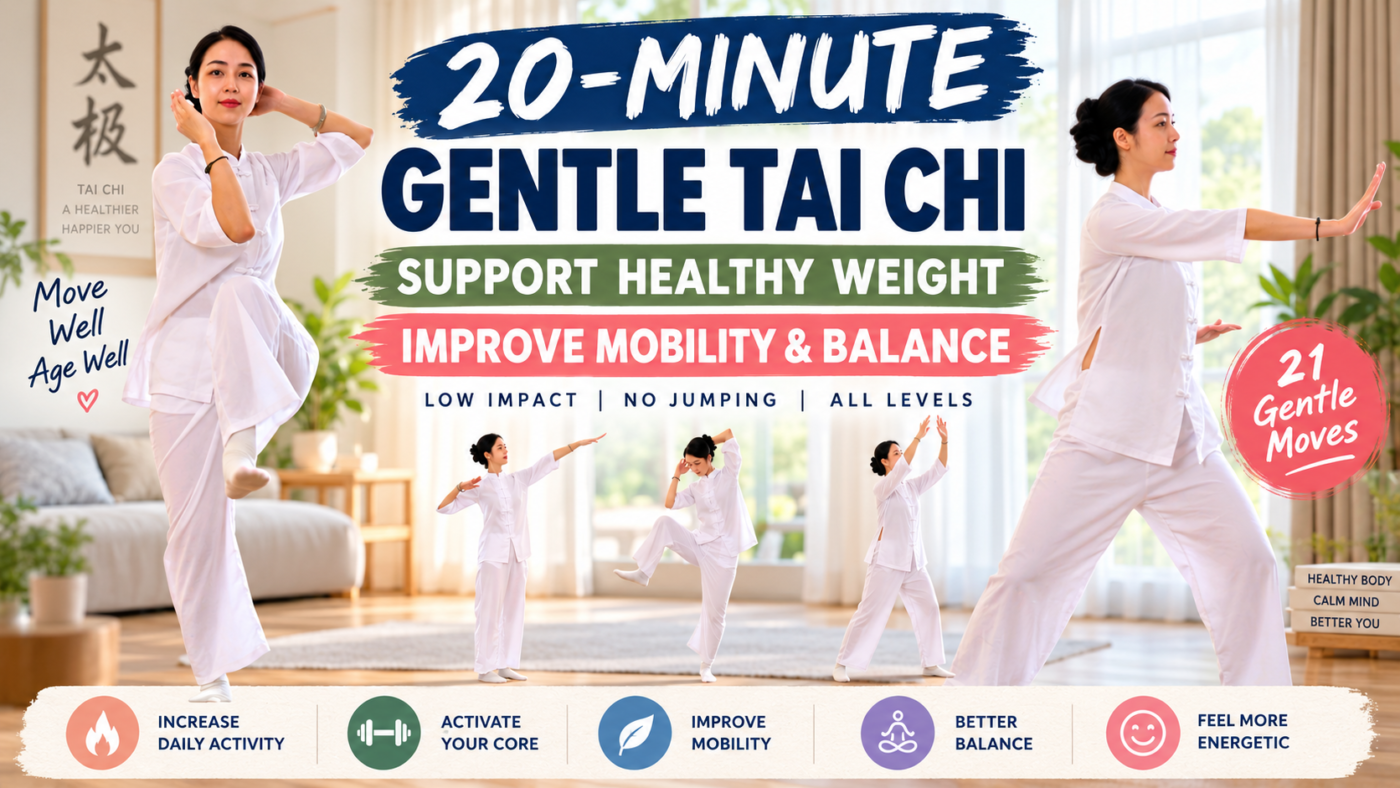
This 20-minute gentle Tai Chi workout combines 21 low-impact movements designed to support mobility, balance, coordination and healthy daily activity without jumping.
A good workout does not always need running, jumping or exhausting high-intensity intervals. Gentle, continuous movement can still keep the whole body active, challenge coordination and help you build a sustainable exercise routine.
A good workout does not always need jumping, running, or exhausting high-intensity intervals. Gentle, continuous movement can still keep the whole body active, challenge coordination, improve mobility, and contribute to daily energy expenditure.
This 20-minute Tai Chi-inspired routine combines flowing arm movements, controlled knee bends, gentle rotations, balance work, and rhythmic stepping. The sequence is designed to keep multiple muscle groups moving while remaining accessible to people who prefer a lower-impact form of exercise.
It is important to keep expectations realistic. No single exercise can selectively burn abdominal or visceral fat. Changes in body fat depend on overall energy balance, regular physical activity, nutrition, sleep, and other lifestyle factors. However, consistent low- to moderate-intensity movement can contribute to total physical activity and support long-term weight management.
The goal of this routine is simple: move steadily, breathe naturally, stay within a comfortable range of motion, and finish feeling active rather than exhausted.
30-Second Summary
This 20-minute routine includes 21 gentle Tai Chi-inspired movements that combine stepping, reaching, rotation, knee lifts, balance, and controlled bodyweight work.
The workout may help support:
Improved mobility
Better balance and coordination
Gentle lower-body and core engagement
Greater daily physical activity
Shoulder, hip, and trunk movement
A low-impact approach to healthy weight management
No jumping is required. Move slowly enough to maintain control, and reduce the range of motion whenever necessary.
Before You Begin
Stand in a clear space where you can move your arms freely. Wear comfortable clothing and supportive footwear if needed.
Keep the knees soft rather than locked. Allow your breathing to remain natural instead of holding your breath during more demanding movements.
If balance is a concern, practice near a sturdy chair, countertop, or wall.
Stop if you experience chest pain, severe shortness of breath, dizziness, faintness, or sharp joint pain.
The routine moves progressively from gentle full-body activation into stepping, rotation, knee lifts, balance work and controlled cool-down movements. The goal is steady, comfortable activity rather than maximum intensity.
1. Heel Raise With Arm Lift
Begin with your feet comfortably apart and your knees slightly bent.
Sweep both arms upward as you gradually straighten your body. As your hands rise overhead, lift your heels and come gently onto the balls of your feet.
Lower the heels with control while opening your arms out to the sides.
Continue in a slow, flowing rhythm.
This movement brings the calves, thighs, shoulders, trunk, and postural muscles into the routine at the same time. The heel raise also introduces a mild balance challenge while preparing the body for the movements ahead.
2. Step and Push
Step one foot forward while extending one hand in front of you. Draw the opposite hand back toward the waist.
Continue alternating the arms smoothly before changing legs.
Keep the step comfortable rather than excessively long.
The combination of stepping and coordinated arm movement keeps the lower and upper body working together while gently introducing trunk rotation.
3. Twist and Reach
Bring your hands together in front of the chest.
Rotate your torso toward one side while reaching one arm backward and slightly upward and extending the opposite arm forward.
Return to the center before repeating toward the other side.
Move through a comfortable range rather than forcing the rotation.
Alternating rotations encourage mobility through the thoracic spine, shoulders, and waist while challenging coordination.
4. Step and Open
Step one foot forward and open both arms widely to the sides.
Return to your starting position and repeat with the opposite leg.
Allow the chest to open naturally without forcing the shoulders backward.
This movement combines lower-body activity with broad upper-body motion, helping maintain a steady full-body rhythm.
5. Gentle Squat With Cross-Body Push
Stand with your feet comfortably apart and bend the knees slightly.
Keep both hands near your waist.
From the lowered position, push one hand diagonally across the body. Return the hand and repeat on the opposite side.
The knee bend adds work for the thighs and hips, while the cross-body action introduces trunk rotation and coordination.
There is no need to squat deeply. A shallow bend is enough to make the exercise useful.
6. Rolling Arm Pull
Circle both arms downward in a smooth motion.
Extend one arm forward while allowing the opposite arm to roll backward as though gently pulling something toward the body.
Continue alternating sides.
Keep the shoulders relaxed and avoid turning the movement into a forceful punch or pull.
This flowing pattern keeps the shoulders, upper back, arms, and torso moving continuously.
7. Alternating Knee Lift With Abdominal Taps
Lift one knee comfortably while lightly tapping both sides of the abdominal area.
Lower the leg and repeat with the opposite knee.
Maintain an upright posture and avoid leaning excessively backward.
Alternating knee lifts increase lower-body activity and require the trunk to stabilize the body during each repetition.
The abdominal tapping should remain light and comfortable. It is not intended to reduce abdominal fat.
8. Palm Press With Gentle Twist
Extend one arm forward with the palm facing outward.
Place the opposite hand gently against it.
Maintain the position while slowly rotating your torso from side to side.
You should feel controlled movement through the wrist, forearm, shoulder, and trunk rather than strain.
This exercise combines upper-body mobility with gentle rotation and postural control.
9. Knee Bend With Alternating Punch
Bend the knees slightly and hold both hands near the chest.
Extend one arm forward in a controlled punch, return it, and then alternate sides.
Keep the punches smooth rather than forceful.
Combining a partial squat position with rhythmic arm movement involves more of the body than punching alone and can modestly increase the intensity of the routine.
10. Knee Bend With Alternating Uppercut
Remain in a comfortable partial knee bend.
Bring one arm upward in a controlled uppercut motion, return it, and switch sides.
Keep the shoulders relaxed and avoid throwing the arm aggressively.
The movement engages the arms, shoulders, upper back, and lower body simultaneously while maintaining the flowing character of the session.
11. Knee Lift With Opposite Elbow
Place both hands lightly behind the head.
Lift one knee while lowering the opposite elbow toward it.
Return to the starting position before changing sides.
Do not pull on the neck.
The cross-body pattern challenges coordination while engaging the abdominal and trunk muscles.
If balance is difficult, perform the movement more slowly or keep one hand near a stable support.
12. Side Lean Flow
Keep the hands lightly behind the head or place them at the sides if that feels more comfortable.
Lean gently toward one side, return to the center, and repeat toward the other side.
Avoid collapsing forward.
Controlled lateral movement can help maintain mobility through the sides of the trunk and waist.
13. Knee Lift Hold
Lift one knee toward the body and place both hands lightly over it.
Pause briefly while maintaining an upright posture.
Lower the leg with control and repeat on the opposite side.
This exercise shifts the focus from continuous movement toward balance and stabilization.
A smaller knee lift is perfectly acceptable.
14. Step Back and Twist
Clasp your hands comfortably in front of your body.
Step one leg backward and rotate your torso gently toward the opposite side.
Return to the center and bring the foot forward before changing sides.
The backward step challenges lower-body control while the rotation maintains trunk mobility.
Shorten the step if necessary to preserve balance.
15. Overhead Reach With Rotation
Raise both arms overhead while standing tall.
Keeping the arms comfortably elevated, rotate the torso gently from one side to the other.
Avoid arching the lower back excessively.
The overhead position encourages shoulder movement and lengthening through the sides of the torso, while rotation adds trunk mobility.
16. Hip Circles
Place both hands on the hips and stand with the feet comfortably apart.
Move the hips slowly in a circular pattern.
Complete several circles in one direction before reversing.
The circles should remain smooth and controlled.
This movement can help reduce a sense of stiffness around the hips and lower trunk while preparing the body for the final active movements.
17. Side Knee Crunch
Place your hands lightly behind the head.
Lift one knee outward toward the side while bringing the elbow on the same side gently toward it.
Lower with control and alternate sides.
The exercise challenges lateral trunk control, hip movement, coordination, and balance.
Avoid aggressively pulling the elbow toward the knee.
18. Gentle Body Shake
Allow the knees to remain soft.
Create a small, relaxed bouncing movement through the body while letting the arms hang loosely.
Allow the hands and shoulders to move naturally.
This is a transition from the more active portion of the routine into the cool-down.
The movement should feel loose and comfortable rather than forceful.
19. Gentle Abdominal Circle Rub
Place both hands over the abdomen.
Move the hands slowly in comfortable circles while allowing the breathing to settle.
The purpose here is relaxation and body awareness rather than fat loss or treatment of digestive disease.
Slow breathing and gentle movement can help mark the transition toward the end of the session.
20. Slow Overhead Reach
Let both arms relax in front of the body.
Slowly raise them overhead while lengthening upward through the torso.
Lower the arms gently and repeat.
This simple movement helps restore a slower rhythm while moving the shoulders and sides of the upper body through a comfortable range.
21. Full-Body Gentle Tapping
Cross your arms and gently tap around the upper chest and shoulder area.
Continue lightly along the arms, across the torso, and down the legs.
Keep the contact gentle.
Tapping can be used as a sensory and body-awareness exercise at the end of the session. It should feel comfortable and refreshing, not painful.
How This Routine Supports Healthy Weight Management
The phrase “fat-burning workout” is often misunderstood.
Your body uses energy throughout physical activity, but no specific Tai Chi movement can target visceral fat or abdominal fat directly.
Instead, this routine contributes to a broader process.
Twenty minutes of continuous movement increases physical activity and energy expenditure compared with remaining sedentary. Repeating sessions consistently can become one component of an active lifestyle.
For meaningful changes in body fat, exercise usually works best alongside appropriate nutrition, adequate sleep, regular daily movement, and long-term consistency.
Tai Chi-style exercise may be particularly useful for people who find conventional high-impact workouts uncomfortable or difficult to sustain.
The best exercise program is not necessarily the one that burns the most calories in a single session. It is often the one you can perform safely and consistently for months and years.
Why Gentle Exercise Can Still Be Valuable
Low-impact does not mean ineffective.
This routine repeatedly asks the body to:
Shift weight
Control the knees and hips
Rotate the trunk
Coordinate the arms and legs
Balance briefly on one leg
Move the shoulders through a larger range
Maintain upright posture
These demands can make gentle movement surprisingly comprehensive.
For beginners, older adults, or people returning to activity after a sedentary period, this type of exercise may offer a manageable way to build confidence before progressing to more demanding training.
How Often Should You Practice?
For general activity and mobility, this routine can be performed several times per week if it feels comfortable.
You might begin with:
2 to 3 sessions per week
Then gradually progress toward:
4 to 5 sessions per week
You can also combine Tai Chi-inspired exercise with walking and appropriately chosen strength training.
For long-term health, variety is usually more useful than relying on one type of exercise alone.
Make the Routine Easier
Use shallower knee bends.
Lift the knees less high.
Reduce the range of twisting.
Keep the heels on the floor during balance movements.
Practice near a chair or wall.
Slow down the transitions.
Take additional rest whenever needed.
Make the Routine More Challenging
Once the movements feel comfortable, you can gradually:
Increase the range of motion.
Use slightly deeper but comfortable knee bends.
Perform transitions more continuously.
Hold balance positions slightly longer.
Move the arms through a fuller range.
Extend the session by repeating selected movements.
Progress should remain gradual. Control is more important than speed.
Who Should Be Careful?
Modify or stop movements if you have significant balance difficulty, recent surgery, acute joint injury, uncontrolled cardiovascular symptoms, or another condition that limits exercise.
People with knee or hip pain should avoid forcing deep knee bends.
People with shoulder limitations should reduce overhead reaching.
If you have a medical condition that makes exercise safety uncertain, seek individualized professional advice before beginning a new routine.
Frequently Asked Questions
Can 20 minutes of Tai Chi help with weight loss?
It can contribute to daily physical activity and energy expenditure, but weight loss depends on overall energy balance and long-term lifestyle habits. Tai Chi should not be viewed as a method for selectively burning abdominal or visceral fat.
Is this workout suitable for beginners?
Yes. The routine is designed around controlled, low-impact movements and can be modified by reducing the range of motion, slowing the pace, or using support for balance.
Does Tai Chi strengthen the core?
Many Tai Chi-inspired movements require the trunk to stabilize the body during stepping, rotation, knee lifts, and balance work. This can engage core musculature, although dedicated progressive resistance training may be needed for substantial strength development.
Can older adults do this routine?
Many movements can be adapted for older adults. Balance support, smaller steps, shallower knee bends, and reduced twisting may make the routine more accessible.
Can these exercises reduce visceral fat?
No exercise can selectively target visceral fat. Regular physical activity, combined with appropriate nutrition and other lifestyle factors, may help reduce overall and visceral fat over time.
Final Thoughts
A 20-minute workout does not need to be exhausting to be worthwhile.
These 21 Tai Chi-inspired movements combine gentle strengthening, balance, mobility, coordination, and continuous full-body activity in a format that requires no jumping and little equipment.
The most important goal is not to perform every movement perfectly or to chase exaggerated fat-burning claims.
Move comfortably. Maintain control. Breathe naturally. Practice consistently.
Over time, a sustainable movement habit can contribute far more to health than an intense routine that you cannot maintain.
Medical Disclaimer
This content is for general educational and wellness purposes only and is not a substitute for medical diagnosis, treatment, or individualized professional advice. Stop exercising if you experience significant pain, dizziness, chest discomfort, or unusual shortness of breath.
This article is for general education and does not replace individualized care from a qualified health professional. Seek appropriate advice for persistent, severe, or concerning symptoms.
Read the full medical disclaimer