Yoga for mental overload offers a simple way to step away from constant stimulation and reconnect with your body. Modern life can leave the mind feeling crowded long before the body feels physically tired. Notifications, unfinished tasks, work demands, conversations, decisions, and constant streams of information can make it difficult to slow down even when the day itself has stopped.Modern life can leave the mind feeling crowded long before the body feels physically tired. Notifications, unfinished tasks, work demands, conversations, decisions, and constant streams of information can make it difficult to slow down even when the day itself has stopped.
At times like these, a gentle yoga practice does not need to be complicated or physically demanding.
This approximately 19-minute floor-based sequence is designed around a simple idea: reduce external stimulation, bring attention back to the body, slow the breath, move the spine gently, and create space for a quieter transition into the rest of your day.
Rather than trying to force the mind to become blank, the practice encourages you to notice what is already present. Sensations, breathing patterns, muscular tension, sounds, and emotional states can all become useful anchors for attention.
The goal is not perfect relaxation. It is simply to check in.
Why Gentle Yoga Can Feel Helpful When Your Mind Is Overloaded
Mental overload often comes with a physical component.
The shoulders may rise toward the ears. The jaw may tighten. Breathing can become shallow or irregular. The upper back may feel rigid, and the body can remain subtly braced even when you are sitting still.
Gentle yoga offers a way to interrupt that pattern without adding another demanding task to your schedule.
A slower practice can give you an opportunity to:
- shift attention away from constant external input
- notice areas of physical tension
- reconnect movement with breathing
- gently mobilize the spine, shoulders, hips, and ankles
- practice slowing down without needing to achieve a difficult posture
- finish with several minutes of quiet body awareness
Think of the session less as a workout and more as a structured transition from mental activity toward embodied awareness.
1. Begin With a Comfortable Seated Position
Sit on the floor in any position that feels sustainable.
A folded blanket, yoga block, cushion, or towel can be placed underneath the hips if that makes sitting more comfortable.
Allow the sitting bones to settle downward while gently lengthening through the spine.
Imagine the crown of the head being drawn upward by a light thread. This should create a feeling of spaciousness rather than stiffness.
Relax the shoulders.
Let the hands rest comfortably on the thighs or in the lap.
You may keep the eyes open with a soft downward gaze or close them if that feels comfortable.
Take several natural breaths.
There is no need to immediately control the breath. Begin by noticing it.
Ask yourself quietly:
How does my body feel right now?
Where am I holding tension?
Is my breathing fast, shallow, smooth, or uneven?
This simple check-in can become your starting point.
2. Try an “Internal Weather Report”
Before beginning more deliberate breathing, spend a moment observing your internal state.
You do not need to label anything as good or bad.
Perhaps you feel restless.
Perhaps tired.
Perhaps mentally busy but physically calm.
Perhaps your shoulders are tight while the rest of the body feels relaxed.
Treat these sensations like changing weather rather than permanent conditions.
Notice them without trying to fix them immediately.
Then begin to expand your awareness outward.
Listen for a sound that seems far away.
Pause.
Let it go.
Now identify a sound that feels closer.
It may be a voice, an appliance, traffic, wind, your breathing, or simply the subtle tone of the room.
This practice of shifting attention between distant and nearby sensations can help bring awareness into the present environment.
3. Use Slow 4–6 Breathing
Place one hand gently over the center of the chest and the other over the lower abdomen if that position feels comfortable.
Relax the shoulders.
Begin gradually deepening the breath.
Inhale slowly for a count of four.
1… 2… 3… 4.
Then exhale for a count of six.
1… 2… 3… 4… 5… 6.
Continue for several cycles.
Do not force yourself to take an unusually large breath.
The breathing should remain smooth and comfortable.
If counting makes you feel tense, dizzy, or short of breath, return to normal breathing.
The purpose is not to hold as much air as possible. Instead, the slightly longer exhalation creates a slower rhythm and gives you something simple to focus on.
Complete several comfortable cycles before allowing the breath to return to normal.
4. Reach Up and Return the Hands to the Heart
Open the eyes gently if they have been closed.
Reach the fingertips outward and upward.
Stretch through the arms without forcing the shoulders.
Take an easy inhale as the arms rise.
Then bring the palms together in front of the chest as you exhale.
Pause for a moment.
Notice the transition from outward movement back toward the center of the body.
You can slightly bow the head toward the hands if that feels natural.
Then release the arms and prepare to move onto all fours.
5. Slow Cat–Cow Movements
Come to a tabletop position with the hands beneath or slightly ahead of the shoulders and the knees underneath the hips.
Spread the fingers comfortably.
Move slowly.
On an inhale, allow the abdomen to move downward while the chest gently opens.
Let the spine extend naturally.
Avoid collapsing into the lower back.
As you exhale, press the floor away and gradually round the spine.
Allow the head and neck to follow the movement rather than forcing the chin tightly toward the chest.
Repeat several times.
With each cycle, notice how different areas of the spine respond.
You may become aware of movement through:
the lower back
the middle back
the upper back
the shoulders
the neck
There is no need to maximize the range of motion.
A smaller, comfortable movement performed with awareness is often more appropriate for a calming practice than pushing deeply into the posture.
6. Ease Into Downward-Facing Dog
Return to a neutral tabletop position.
Walk the hands slightly forward if needed and tuck the toes.
Press through the hands as you begin lifting the hips upward and backward into Downward-Facing Dog.
The knees do not need to straighten.
In fact, keeping a soft bend in the knees may make it easier to lengthen the spine.
Allow yourself several breaths to explore the position.
You might alternate bending one knee and then the other.
You may shift the hips gently.
You may remain still.
Focus more on creating space through the back and sides of the body than on trying to place the heels on the floor.
Keep the neck as a natural continuation of the spine rather than allowing the head to hang without control.
Take a slow inhale through the nose.
Exhale comfortably through the mouth.
Then lower the knees back to the floor.
7. Extended Child’s Pose
Bring the knees comfortably wide and allow the big toes to move toward one another if that position suits your hips and knees.
Send the hips backward.
Reach the arms forward along the floor.
You can keep the arms active, gently reaching forward while the hips move backward, or relax the arms completely if that feels better.
There should be no sharp pain in the knees, hips, shoulders, or lower back.
Allow the breathing to settle.
Instead of thinking about your next task, direct your attention toward sensation.
Notice the contact between the hands and the floor.
Notice the movement of the ribs as you breathe.
Notice the stretch across the back, shoulders, and sides of the body.
This is an opportunity to give the thinking mind less work to do.
8. Transition to the Back and Take a Full-Body Stretch
Slowly rise from Child’s Pose and transition onto your back.
If desired, place a folded blanket underneath the head.
Extend the arms overhead and lengthen the legs.
Reach gently through the fingertips.
Point and flex the feet.
Take one full inhale.
Then release with a slow exhale.
Allow the body to become heavy against the floor.
Bend the knees and place the feet down.
Relax the shoulders.
Now notice where your body meets the ground.
Feel the feet.
The pelvis.
The back of the ribs.
The shoulders.
The arms.
The back of the head.
Rather than actively trying to relax every muscle, notice how the floor is supporting you.
9. Gentle Leg and Ankle Mobility
Keep the left foot grounded and lift the right leg toward the ceiling.
The knee may remain bent.
Point and flex the right foot several times.
Then slowly circle the ankle in one direction.
Reverse the circles.
Lower or bend the right leg as needed.
Repeat similar movements with the opposite leg.
These small movements encourage you to keep attention on physical sensation rather than rushing ahead mentally.
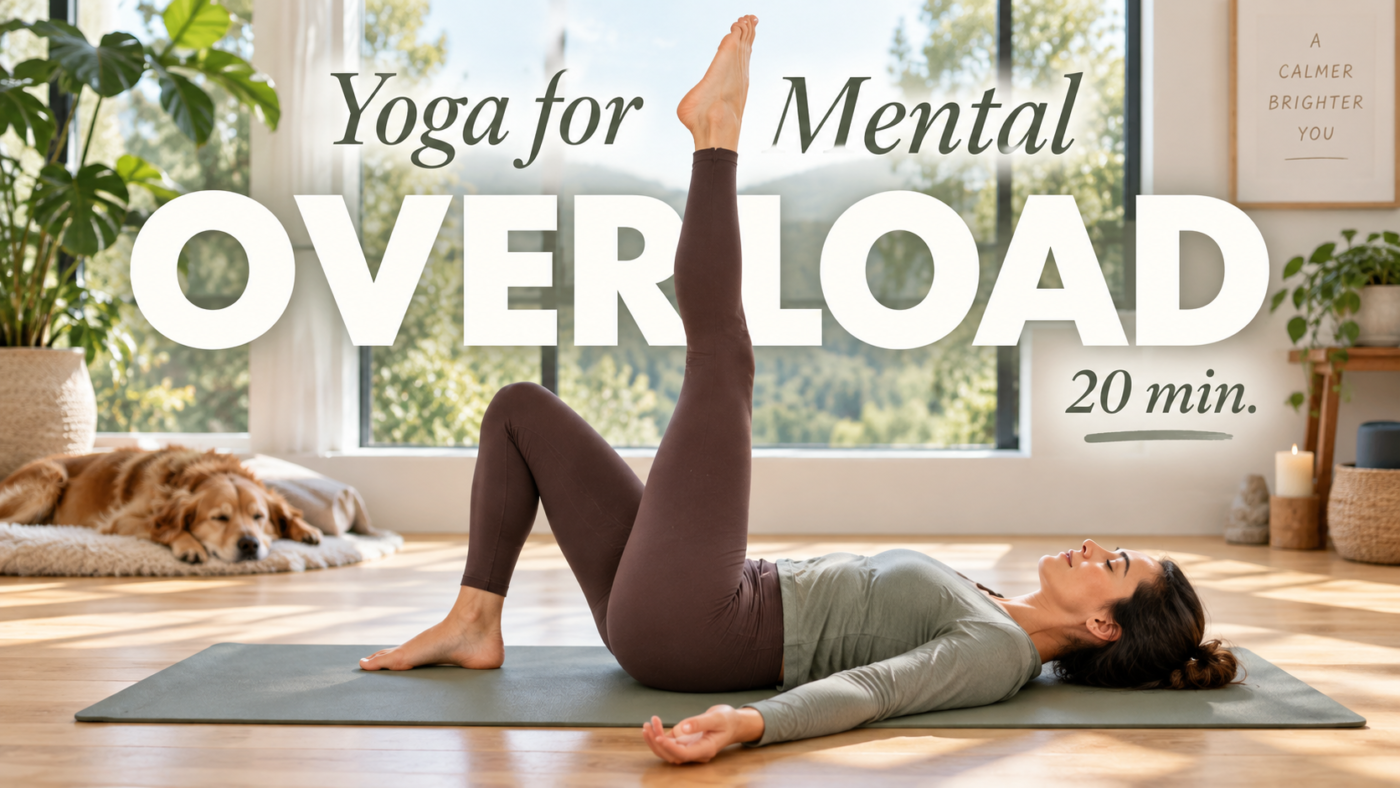
10. Legs-Up “Waterfall” Position
When comfortable, lift both legs toward the ceiling.
They do not need to be perfectly straight.
This creates a simple unsupported variation sometimes described as a waterfall position.
Point and flex the feet.
Circle the ankles gently.
Keep the shoulders and jaw relaxed.
Breathe normally.
If holding both legs in the air feels too demanding, bend the knees or place the feet back on the floor.
A supported legs-up-the-wall position may also be more comfortable for some people.
The goal of this practice is ease, not endurance.
11. Knees-to-Chest Hug
Bend both knees toward the torso.
Wrap the arms around the shins or hold behind the thighs.
Gently hug the legs inward.
Rock slowly from side to side if that feels pleasant.
This movement may provide a mild massage-like sensation through the lower back.
Keep the shoulders away from the ears.
An optional variation is to lift the head toward the knees for a brief moment, but this is not necessary.
If the neck feels strained, keep the head on the floor.
Then release.
12. Final Rest
Extend both legs comfortably.
Allow the arms to rest wherever they feel natural.
Close the eyes or soften the gaze.
Let the weight of the body settle into the ground.
There is nothing else to accomplish.
Take three slow breaths.
With each inhale, notice the expansion of the body.
With each exhale, allow unnecessary muscular effort to soften.
Remain here for several moments.
Then bring the palms together if you wish and slowly return your attention to the room.
A Different Way to Think About Mental Overload
When the mind feels overwhelmed, the instinct is often to solve the problem with more thinking.
Make another list.
Organize another task.
Read another article.
Check another notification.
Sometimes the more useful response is the opposite.
Reduce the amount of information entering the system.
Feel the ground.
Notice your breath.
Move slowly.
Pay attention to one sensation at a time.
A gentle yoga practice cannot remove the responsibilities, uncertainty, or stressors in your life. But it can provide a temporary environment in which you practice responding to them with a little more space and awareness.
And on particularly busy days, that may be enough.
Yoga for mental overload works best when the practice remains comfortable, unhurried, and focused on body awareness rather than performance.
Practice Tips
Choose a quiet space when possible.
Use blankets, cushions, or yoga blocks for comfort.
Keep every movement within a pain-free range.
Breathe naturally rather than forcing deep breathing.
Pause whenever you need to.
Skip any posture that does not feel appropriate for your body.
Consistency matters more than intensity. Even a short period of deliberate, gentle movement can become a useful transition between demanding parts of the day.
FAQ
Is this yoga practice suitable for beginners?
Yes. The sequence uses mostly gentle, floor-based movements and encourages participants to move slowly and modify positions as needed. Beginners can reduce the range of motion, bend the knees, use blankets or cushions, or skip any posture that feels uncomfortable.
How long does this yoga practice take?
The complete practice takes approximately 20 minutes, making it suitable for a morning reset, an afternoon break, or a calming transition at the end of a busy day.
Can yoga stop overthinking?
Yoga should not be considered a treatment for persistent overthinking or a mental health condition. However, a gentle practice can provide a structured period in which you shift attention away from external stimulation and toward breathing, movement, and physical sensation.
What is 4–6 breathing?
In this practice, 4–6 breathing means inhaling comfortably for about four counts and exhaling for about six counts. The breathing should remain smooth and easy. If the counting feels uncomfortable or causes dizziness, return to normal breathing. The original practice specifically uses this four-count inhale and six-count exhale pattern.
Do I need yoga equipment?
No special equipment is required. A yoga mat is useful, while a folded blanket, towel, cushion, or yoga block can make seated and floor-based positions more comfortable.
Can I practice this before bed?
Yes, the slow and mostly floor-based format can work well as an evening wind-down practice. If any posture feels stimulating rather than relaxing, reduce the effort or move directly into a comfortable resting position.
What should I do if Downward-Facing Dog feels difficult?
Keep the knees bent, shorten the time in the posture, or remain on hands and knees instead. The purpose of this session is not to achieve perfect yoga shapes but to move comfortably and maintain awareness.
Is this practice intended to treat anxiety or depression?
No. This is a general wellness and movement practice. It is not a substitute for diagnosis, psychotherapy, medication, or other professional mental health care.
How often can I practice yoga for mental overload?
Yoga for mental overload can be used whenever you want a gentle movement break or a quieter transition after a mentally demanding day. Frequency can depend on your comfort, schedule, and individual needs.
A short yoga for mental overload routine cannot remove life’s demands, but it can create a deliberate pause between constant stimulation and the rest of your day.
Medical Disclaimer
This article is for educational and general wellness purposes only and is not medical advice. Yoga and breathing exercises may not be appropriate for everyone. Stop if you experience pain, dizziness, unusual shortness of breath, numbness, or other concerning symptoms. People who are pregnant, recovering from surgery or injury, or living with significant cardiovascular, respiratory, neurological, musculoskeletal, or other medical conditions should seek individualized guidance from a qualified healthcare professional before beginning a new exercise practice.
This article is for general education and does not replace individualized care from a qualified health professional. Seek appropriate advice for persistent, severe, or concerning symptoms.
Read the full medical disclaimer