A Science Based Guide to Shoulder, Back, and Posture Training
A strong, upright back can make the body look more balanced, energetic, and youthful.
Although phrases such as “a thinner back makes you look younger” are not medical concepts, there is some truth behind the appearance they describe. The way the upper back looks is influenced not only by body fat, but also by posture, muscle strength, shoulder blade position, spinal mobility, and everyday movement habits.
People who spend long hours sitting at a desk, looking down at a phone, or working at a computer may gradually develop rounded shoulders, a forward head posture, upper back stiffness, and shoulder tension.
Even without significant weight gain, these postural changes can make the upper body appear heavier or less defined.
For this reason, rather than focusing only on making the back “thinner,” it is more useful to improve shoulder mobility, upper back strength, and overall posture.
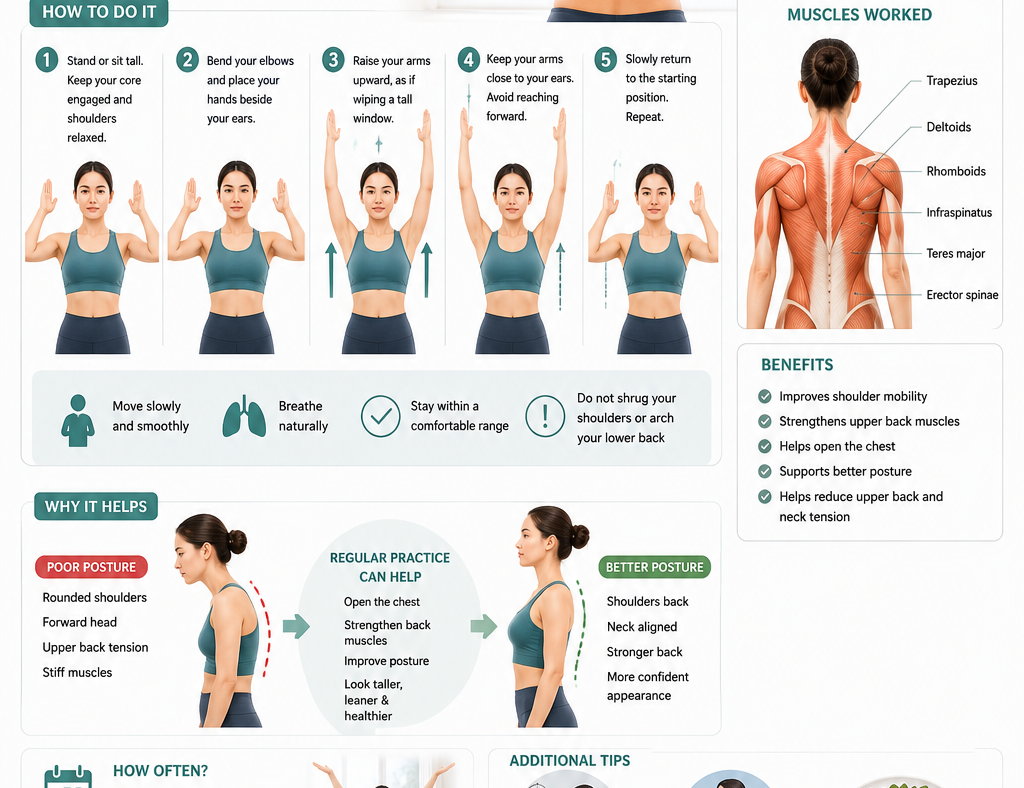
One simple exercise that can help is an overhead arm movement that resembles wiping a tall window.
What Is the Window Wiping Exercise?
You can perform this exercise while standing or sitting upright.
Keep your feet stable and your torso tall.
Gently engage your abdominal muscles without holding your breath.
Avoid excessively arching your lower back.
Bend your elbows and position your hands approximately beside your ears.
Your arms should remain close to the sides of your body rather than drifting far forward.
From this position, slowly raise your arms upward as though you were wiping a tall window above your head.
Move only as far as feels comfortable.
Then slowly return your arms to the starting position.
Keep your breathing natural throughout the movement.
Do not force your shoulders upward toward your ears, and do not push your arms behind your head simply to increase the range of motion.
Why This Movement Can Be Useful
Raising the arms overhead requires coordinated movement between the shoulder joints, shoulder blades, and upper back.
As the arms move upward, the shoulder blades naturally rotate and move across the rib cage while several muscles of the shoulders and upper back help control the motion.
For people who spend much of the day sitting or performing repetitive desk work, gentle shoulder and upper back movement can help counter prolonged inactivity.
Regular practice may help improve shoulder mobility, body awareness, muscular control, and overall comfort around the upper back and shoulders.
Some people may also notice that they feel less stiff after moving these areas regularly.
However, this exercise should be viewed as a simple mobility and strengthening activity rather than a treatment for cervical spine disease or other medical conditions.
Can This Exercise Really Make Your Back Thinner?
It is important to separate two different goals.
The first is improving posture and muscle tone.
The second is reducing body fat.
If rounded shoulders and poor posture make the upper body appear compressed or heavy, improving shoulder position and upper back control may create a more open and streamlined appearance.
Better posture can make the back look longer, more balanced, and more defined.
However, if the thickness of the back is mainly caused by body fat, repeatedly performing one shoulder exercise cannot selectively remove fat from that area.
The body does not reliably burn fat from a specific location simply because the muscles in that area are being exercised.
For meaningful fat loss, a broader approach is more effective.
This usually includes regular physical activity, resistance training, adequate daily movement, balanced nutrition, and sustainable calorie management when appropriate.
The goal should be overall health and body composition rather than trying to force fat loss from one isolated area.
What About the Idea That a Blocked Bladder Meridian Causes a Thick Back?
Traditional wellness practices sometimes describe a heavy or thick back as the result of blocked energy pathways or problems involving the bladder meridian.
These concepts belong to traditional medical systems.
From the perspective of modern anatomy and physiology, there is no reliable evidence that blockage of a bladder meridian directly causes fat to accumulate on the back.
The appearance of the back is more commonly influenced by factors such as body fat distribution, genetics, muscle mass, posture, age, physical activity, and lifestyle.
For modern health education, it is therefore more accurate to describe this movement as a shoulder and upper back exercise rather than claiming that it works by clearing a blocked meridian.
How to Practice Safely
Beginners do not need to perform the exercise continuously for ten minutes.
Start with about 8 to 12 slow repetitions.
Rest briefly.
Then perform another set if you feel comfortable.
As your mobility and endurance improve, you can gradually increase the amount of exercise.
During every repetition, focus on technique rather than speed.
Keep your hands close to the sides of your head.
Avoid allowing your arms to drift excessively forward.
Do not compensate by strongly arching your lower back.
Keep your neck relaxed.
Avoid shrugging your shoulders toward your ears.
Move slowly and under control.
Stay within a comfortable range of motion.
If your shoulders are stiff and you cannot fully straighten your arms overhead, do not force the movement.
Mobility usually improves more safely through gradual practice than through aggressive stretching.
Shoulder and Neck Relief Is Not the Same as Treating a Cervical Spine Condition
Many people feel more relaxed through the shoulders and upper back after gentle mobility exercises.
That feeling can be genuine and beneficial.
However, temporary relief from stiffness should not be interpreted as proof that a cervical spine disorder has been treated.
Neck and shoulder discomfort can have many causes.
These may include prolonged sitting, muscular tension, poor movement habits, joint problems, nerve irritation, shoulder injuries, or other medical conditions.
Exercise can be an important part of maintaining mobility and physical function, but it cannot replace proper medical evaluation when significant symptoms are present.
Who Should Be More Cautious?
Most healthy adults with mild stiffness from prolonged sitting can perform gentle shoulder movements within a comfortable range.
However, caution is appropriate if you have significant shoulder pain, a recent neck or shoulder injury, persistent numbness, arm weakness, radiating pain, or severe pain when raising your arms.
Stop the exercise if it causes sharp pain or noticeably worsens your symptoms.
Seek professional medical advice if you experience progressive weakness, persistent numbness, significant loss of function, severe pain, or symptoms that do not improve.
What Actually Helps Create a Healthier Looking Back?
There is no single exercise that can transform the back overnight.
A stronger and more balanced upper body usually comes from consistent lifestyle habits.
Break up long periods of sitting.
Stand up and move regularly during the workday.
Include resistance training for the back, shoulders, and other major muscle groups.
Stay physically active through walking, cycling, swimming, or other forms of aerobic exercise.
Maintain a healthy body composition appropriate for you.
Eat enough protein and maintain a balanced diet.
Reduce prolonged periods of looking downward at phones and other devices.
Practice exercises that improve shoulder, shoulder blade, and upper back mobility.
Maintain adequate sleep and recovery.
Consistency matters far more than performing hundreds of repetitions of one particular movement.
The Bottom Line
The idea that a thinner back automatically makes someone younger is an oversimplification.
What often makes the upper body look healthier and more youthful is a combination of good posture, appropriate body fat levels, adequate muscle strength, and comfortable shoulder movement.
The window wiping exercise can be a convenient way to move the shoulders, shoulder blades, and upper back.
For people who sit for long periods, it may be a useful addition to a daily movement routine.
However, it should not be promoted as a method for selectively burning back fat, and there is no reliable modern medical evidence that a thick back is caused by a blocked bladder meridian.
A more effective long term approach combines regular movement, resistance training, balanced nutrition, healthy body composition, and good postural habits.
A few minutes of thoughtful movement every day can be valuable, but lasting results come from consistent whole body health habits rather than a single miracle exercise.
Medical Disclaimer
This article is intended for general health education and wellness information only. It is not a substitute for professional medical advice, diagnosis, treatment, or individualized rehabilitation. If you experience persistent neck or shoulder pain, numbness, weakness, radiating pain, significant loss of movement, or worsening symptoms during exercise, consult a qualified healthcare professional.
This article is for general education and does not replace individualized care from a qualified health professional. Seek appropriate advice for persistent, severe, or concerning symptoms.
Read the full medical disclaimer