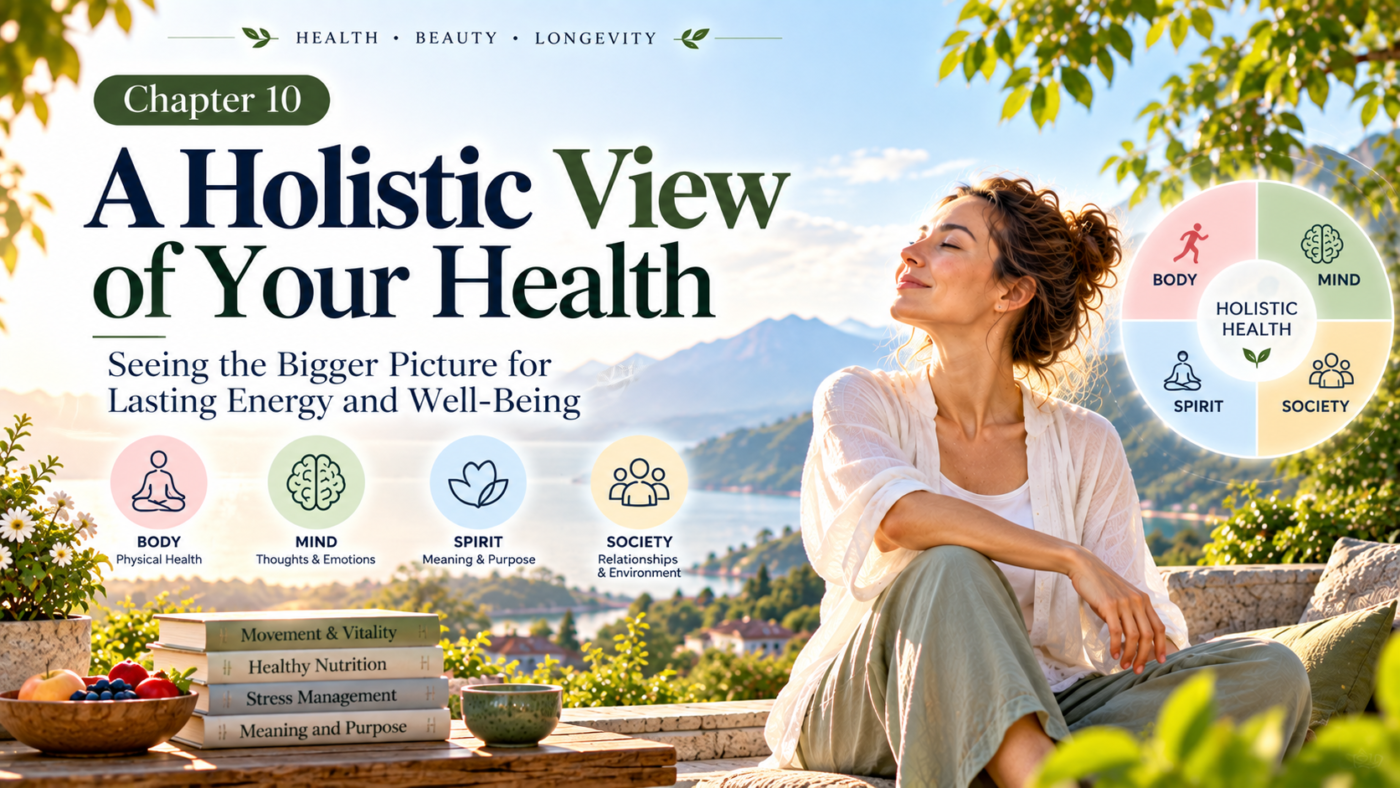
What Is Whole Person Health?
Whole person health is an approach that looks at health across interconnected biological, behavioral, social, and environmental dimensions rather than treating each symptom or body system as completely separate. It asks how these influences interact across everyday life and how appropriate healthcare, healthy behavior, supportive relationships, and healthier environments can work together to support resilience and well-being.
Whole person health begins with a simple idea: human health cannot always be understood by looking at one symptom, one organ, or one behavior in isolation. Sleep influences mood, stress can change behavior, pain can alter movement, relationships can affect coping, and the environments in which we live and work can shape the choices available to us.Health is rarely shaped by one factor.
Sleep influences mood. Stress affects behavior. Pain can change the way we move. Relationships can either support us or drain us. Work can provide meaning, but it can also become overwhelming. Beliefs about responsibility can influence whether we rest, ask for help, or continue pushing beyond our limits.
This is why a whole-person approach to health can be so useful.
Instead of asking only, “What symptom do I have?” it asks a broader question:
What is happening across my body, mind, behavior, relationships, environment, and daily life—and how are these pieces interacting?
That does not mean every health problem can be solved through lifestyle changes.
It means health is complex enough that looking at only one part of the picture may sometimes miss what matters.
What Does Whole-Person Health Mean?
Whole-person health is an approach that looks beyond a single symptom or organ system.
It considers physical health, psychological well-being, behavior, relationships, environment, values, and everyday routines as parts of one interconnected life.
This perspective overlaps with the biopsychosocial model used in modern health psychology.
A biological factor may involve sleep, pain, illness, hormones, medication, or physical fitness.
A psychological factor may involve stress, beliefs, worry, expectations, or coping style.
A social factor may involve family responsibilities, work demands, financial pressure, loneliness, caregiving, or access to support.
These factors often interact.
A person may sleep poorly because of stress.
Poor sleep may reduce patience and concentration.
Reduced concentration may make work more difficult.
Work difficulty may increase anxiety.
Anxiety may make it harder to fall asleep.
The problem is not located in only one place.
It is a pattern.
Holistic Does Not Mean “Alternative”
The word “holistic” is sometimes misunderstood.
It does not have to mean rejecting conventional medicine.
It does not mean every illness has an emotional cause.
It does not mean herbs, supplements, spiritual practices, or complementary therapies should replace medical evaluation.
A responsible holistic approach can include conventional healthcare while also recognizing the importance of sleep, movement, nutrition, mental health, stress, relationships, work, and meaning.
The key idea is integration.
A person with persistent fatigue may need blood tests, medication review, sleep assessment, mental health support, better workload boundaries, improved nutrition, or several of these at the same time.
Whole-person health asks how these pieces fit together.
Health Behaviors Have Context
Telling someone to “make healthier choices” sounds simple.
Living those choices is more complicated.
Consider sleep.
A person may know that regular sleep matters, but they may be caring for a family member at night.
Another person may work rotating shifts.
Someone else may stay awake because of anxiety.
Another may be experiencing pain.
The same is true for exercise, nutrition, stress management, and social connection.
Behavior does not occur in a vacuum.
It is influenced by time, money, culture, family roles, work schedules, health conditions, neighborhood environments, and personal history.
This is why good health guidance should not only ask what a person should do.
It should also ask:
What makes that behavior easy or difficult in this person’s actual life?
Boundaries Are Part of Health
One of the most important whole-person health skills is the ability to set limits.
Some people find this extremely difficult.
They agree to requests they do not have time for.
They take responsibility for everyone else’s problems.
They feel guilty when they rest.
They worry that saying no will make them selfish, disappointing, or unkind.
Over time, this pattern can create overload.
The person may lose sleep.
Meals become rushed.
Exercise disappears.
Quiet time becomes rare.
Family relationships become strained.
Resentment builds.
Fatigue increases.
The issue is not simply poor time management.
It may be a belief about worth:
“I am a good person only if I am always available.”
That belief can shape behavior for years.
Where Do These Beliefs Come From?
People learn beliefs about work, responsibility, emotion, and self-worth from many places.
Family.
School.
Religion.
Culture.
Workplaces.
Friends.
Media.
Community expectations.
Some messages are helpful.
Work hard.
Be generous.
Keep your promises.
Care about other people.
Other messages can become rigid when taken too far.
Never disappoint anyone.
Never show weakness.
Rest is laziness.
Your needs should always come last.
You must prove your value through sacrifice.
A whole-person approach invites us to examine these messages rather than obey them automatically.
The question is not whether a belief came from a family, culture, or religious tradition.
The question is:
Does this belief support a healthy, meaningful life—or is it causing avoidable harm?
Values Can Help or Hurt Depending on How They Are Lived
Values such as service, generosity, discipline, responsibility, and faith can give life deep meaning.
They can strengthen relationships.
They can provide purpose.
They can help people endure difficult periods.
But even positive values can become unhealthy when interpreted rigidly.
Service can become self-neglect.
Responsibility can become overcontrol.
Discipline can become perfectionism.
Generosity can become chronic overgiving.
Faith can become guilt if a person believes rest or limitation represents moral failure.
Healthy values need flexibility.
A value should guide life.
It should not imprison it.
A Whole-Person Example
Imagine someone named Daniel.
Daniel sees himself as dependable, generous, and hardworking.
He grew up believing that good people help whenever they are asked.
He also learned that complaining is a sign of weakness.
As an adult, these beliefs shape nearly every part of his life.
He works full time.
He volunteers regularly.
He helps extended family members.
He rarely turns down requests.
At first, this feels meaningful.
People appreciate him.
He feels useful.
But gradually, the demands increase.
He begins sleeping less.
His evenings fill with commitments.
He has less time with his own family.
Exercise becomes rare.
He starts relying on caffeine to stay alert.
When tired, he reaches for sugary snacks because they are quick and convenient.
At night, his mind remains active.
He worries about what he has not finished.
He becomes irritable.
Then he feels guilty about being irritable.
So he tries even harder to be helpful.
The cycle continues.
Daniel’s situation cannot be explained by only one factor.
There is no single “cause.”
There are several interacting layers.
His beliefs encourage overcommitment.
His schedule reduces sleep.
Reduced sleep increases fatigue.
Fatigue affects food choices and patience.
Relationship tension increases stress.
Stress makes sleep more difficult.
The system reinforces itself.
This is exactly why whole-person health matters.
The Goal Is Not to Blame the Individual
There is an important caution here.
Whole-person health should never become a sophisticated way of blaming people for illness.
Not every health problem can be prevented.
Not every stressful environment can be escaped.
Not every responsibility can be reduced.
People can develop disease despite excellent habits.
They can experience depression despite strong relationships.
They can feel exhausted even when they are trying very hard to take care of themselves.
The purpose of looking at behavior and psychology is not to say:
“You caused this.”
It is to ask:
“Which parts of this situation can realistically be changed, supported, or treated?”
That is a very different question.
Slow and Steady Change Works Better Than Reinvention
Many people try to improve their health by changing everything at once.
A new diet.
A new workout program.
A new sleep schedule.
No caffeine.
No sugar.
Daily meditation.
Perfect productivity.
The plan is ambitious.
The result is often short-lived.
Whole-person health works better when change is gradual.
One meaningful adjustment can influence several areas.
Going to bed thirty minutes earlier may improve energy and patience.
A short daily walk may support mood, mobility, and sleep.
Reducing one unnecessary commitment may create time for dinner with family.
Turning off work notifications at night may improve recovery.
A healthier routine does not need to be dramatic.
It needs to be repeatable.
Look for Feedback Loops
Many health patterns are self-reinforcing.
Poor sleep can increase caffeine use.
More caffeine late in the day can worsen sleep.
Stress can reduce exercise.
Less movement can affect mood and physical comfort.
Low mood can reduce motivation.
Reduced motivation can make healthy routines harder.
But positive loops also exist.
Better sleep can improve decision-making.
More energy can make movement easier.
Movement can support sleep.
Better sleep can improve stress tolerance.
The goal is to find one point in the loop where change is realistic.
You do not have to fix the entire system at once.
Five Questions for Whole-Person Health
A useful whole-person check-in can focus on five areas:
Body: What is happening physically? Are there symptoms, pain, sleep problems, medication effects, or medical issues that deserve attention?
Mind: What thoughts, emotions, or expectations are shaping the way I respond?
Behavior: Which habits are supporting me, and which are making recovery harder?
Relationships and environment: Who or what is affecting my stress, support, time, and choices?
Meaning and values: What matters enough to deserve my energy?
These questions do not diagnose disease.
They help organize the picture.
When the Body Needs Medical Evaluation
A holistic mindset should never delay appropriate medical care.
Persistent fatigue, pain, sleep problems, dizziness, shortness of breath, palpitations, unexplained weight change, neurological symptoms, or other significant changes may require professional evaluation.
Lifestyle is part of health.
It is not the explanation for every symptom.
Sometimes the most holistic decision is to seek medical care.
When the Mind Needs Support
Psychological support can also be part of whole-person health.
If anxiety, depression, trauma, chronic stress, insomnia, perfectionism, health anxiety, or difficulty setting boundaries is significantly affecting daily life, professional mental health support may help.
This does not mean physical symptoms are imaginary.
It means psychological health is one part of the whole person.
When Relationships Are the Missing Piece
Some people focus intensely on food and exercise while ignoring the role of relationships.
But social environments can have powerful effects on daily health.
A supportive partner may make recovery easier.
A hostile workplace may make stress harder to manage.
A caregiving role may leave little time for self-care.
Loneliness may reduce motivation.
Conflict may disrupt sleep.
Healthy living is not only an individual project.
It is also social.
When Meaning Is Missing
A person may be physically healthy and still feel depleted.
This can happen when life becomes dominated by obligation.
Work.
Bills.
Tasks.
Errands.
Deadlines.
Maintenance.
There may be little space left for creativity, connection, contribution, curiosity, spirituality, nature, or joy.
Whole-person health asks not only:
“How can I function better?”
It also asks:
“What is worth functioning for?”
Meaning does not need to be grand.
It may be raising a family.
Helping someone.
Learning.
Building something.
Practicing faith.
Creating art.
Being outdoors.
Serving a community.
Caring for animals.
Sharing time with people you love.
Health supports life.
Life also needs something worth supporting.
A Practical Whole-Person Reset
If life feels overloaded, do not begin by redesigning everything.
Choose one adjustment in each area that feels realistic.
For the body, it might be improving bedtime consistency.
For the mind, it might be challenging one rigid belief.
For behavior, it might be walking after lunch.
For relationships, it might be asking for help.
For meaning, it might be protecting one hour each week for something personally important.
Small changes can have wide effects because the system is interconnected.
Whole-Person Health Is Dynamic
There is no permanent state of perfect balance.
Life changes.
Health changes.
Work changes.
Families change.
Aging changes capacity.
The habits that worked at 25 may not fit at 55.
The routine that worked before parenthood may not work afterward.
The recovery strategy that helped during a quiet year may not be enough during a period of caregiving or illness.
Whole-person health is therefore not a fixed formula.
It is an ongoing process of adjustment.
The Deeper Meaning of Holistic Health
The strongest version of holistic health is not mystical.
It is practical.
It means recognizing that a human being is more than a symptom.
A person has a body.
A nervous system.
A history.
Relationships.
Responsibilities.
Habits.
Beliefs.
Values.
Stressors.
Strengths.
Limits.
And a life outside the clinic.
When these dimensions are considered together, health decisions can become more realistic and more humane.
The goal is not to control every variable.
The goal is to understand the pattern well enough to make wiser choices.
Sometimes that means changing a habit.
Sometimes setting a boundary.
Sometimes repairing a relationship.
Sometimes seeking therapy.
Sometimes asking for medical testing.
Sometimes resting.
Sometimes moving more.
Sometimes doing less.
Whole-person health is not about becoming perfect.
It is about becoming better aligned with what your body, mind, relationships, and values actually need.
And the most sustainable way forward is often exactly what the old proverb suggests:
slow and steady.
Whole person health is not the same as rejecting conventional medicine.
A whole person health perspective considers both individual behavior and the conditions that shape behavior.
The goal of whole person health is not perfection but a more complete understanding of what supports or undermines well-being.
Whole person health can be especially useful when several lifestyle, psychological, social, and medical factors interact.
The 4 Dimensions of Whole Person Health
1. Biological Health: What Is Happening in the Body?
This includes physical symptoms, sleep, pain, medical conditions, medications, genetics, fitness, metabolic health, and other biological factors.
A whole-person approach does not ignore medical diagnosis. In fact, appropriate medical evaluation is one of its foundations.
Lifestyle should never be used to explain away persistent or concerning physical symptoms.
2. Behavioral Health: What Do You Do Every Day?
Behavior includes sleep routines, physical activity, eating patterns, alcohol or tobacco use, stress-management habits, medication adherence, screen use, and many other repeated choices.
Behavior matters, but behavior also has context.
Knowing what is healthy does not automatically make a behavior easy to perform.
3. Social Health: Who and What Surrounds You?
Relationships, family responsibilities, caregiving, work, financial security, social support, education, culture, and access to healthcare can all influence health.
A person cannot always “self-care” their way out of a difficult social environment.
Support and circumstances matter.
WHO emphasizes that conditions such as where people are born, grow, live, work, and age can have major effects on health and health inequities.
4. Environmental Health: What Conditions Shape Daily Life?
Housing, noise, air quality, neighborhood safety, green space, transportation, working conditions, food access, and other environmental factors can make healthy behavior easier or harder.
Whole person health therefore extends beyond motivation or willpower.
Health is partly personal, but it is also shaped by the world in which a person lives.
Meaning, Purpose, and Spiritual Well-Being
Meaning and purpose can still be important parts of an individual’s experience of health. For some people, this includes religious faith or spiritual practice. For others, it may involve family, service, creativity, nature, community, or personal values. These experiences should not be presented as medical treatments, but they may be meaningful components of how a person understands well-being and quality of life.
FAQ
What is whole person health?
Whole person health is an approach that considers interconnected biological, behavioral, social, and environmental influences rather than focusing only on a single organ, symptom, or disease.
Is whole person health the same as holistic health?
The terms overlap, but “whole person health” is increasingly used in research and healthcare to describe an evidence-informed framework that examines multiple interconnected influences on health. “Holistic health” is a broader term and may be used in many different ways.
Does whole person health replace conventional medicine?
No. Whole-person approaches should complement appropriate medical evaluation and treatment, not replace them. Persistent or concerning symptoms still require appropriate professional assessment.
What are the four dimensions of whole person health?
A useful evidence-informed framework includes biological, behavioral, social, and environmental dimensions. These areas often interact rather than operating independently. NCCIH
Why do relationships matter for health?
Social support, caregiving demands, loneliness, family relationships, work conditions, and community resources can influence stress, behavior, access to care, and quality of life.
Does mindset affect physical health?
Thoughts and emotions can influence behavior, sleep, stress responses, coping, and healthcare decisions. This does not mean illness is caused simply by negative thinking.
Is spirituality part of whole person health?
Meaning, purpose, faith, and spirituality may be important to many individuals. However, NCCIH’s current formal whole-person framework centers on biological, behavioral, social, and environmental domains, while the role of spirituality continues to be examined. NCCIH
Can whole person health help with fatigue?
A whole-person perspective can help organize potential contributors such as medical conditions, sleep, medication effects, stress, activity, nutrition, relationships, and environment. Persistent fatigue still requires appropriate medical evaluation when unexplained or severe.
How can I begin improving whole person health?
Start by identifying one realistic area that needs attention—such as sleep, movement, stress management, social support, healthcare follow-up, or the environment around a daily habit—and make a sustainable change rather than attempting to transform everything at once.
Medical Disclaimer: This article is for general educational and informational purposes only and is not intended as medical advice, diagnosis, or treatment. Whole-person and holistic health approaches should complement, not replace, appropriate medical or mental health care. Persistent, severe, unexplained, or worsening symptoms should be evaluated by a qualified healthcare professional.
A Simple Whole-Person Health Check
Ask yourself:
- How would I rate my overall health?
- Am I sleeping well enough to feel restored?
- Am I physically active at a level appropriate for me?
- Is my usual eating pattern supporting my health?
- How well am I managing stress?
- Do I have supportive social or family connections?
- Does my daily life contain meaning or purpose?
- Is my environment helping or hindering healthy habits?
- Is there a symptom or health problem I have been postponing dealing with?
This is a reflection exercise, not a diagnostic test.
This article is for general education and does not replace individualized care from a qualified health professional. Seek appropriate advice for persistent, severe, or concerning symptoms.
Read the full medical disclaimer

